You might have already found a location, talked to suppliers, or started choosing products for your stationery shop. But how do you get customers to buy from you when they can find similar notebooks, pens, and greeting cards online or at big stores?
And even if customers come in, how many sales will you need each day to cover rent and wages? How much inventory should you buy, and what if some products sit unsold for months?
To help you work through these questions, I’ve created a sample plan for Penhallow Paper Co., a fictional stationery shop in downtown Delaware, Ohio. It shows how to choose products, manage inventory, and project finances.
Use it as a guide when writing your own stationery business plan.
Executive Summary
Penhallow Paper Co. is a new stationery shop opening on Saturday, April 3, 2027, in downtown Delaware, Ohio. It will sell greeting cards, notebooks, pens, planners, gift wrap, and a small range of gifts from a 1,100 sq ft storefront at the Kilbourne Block, 24 East Winter Street, Delaware, OH 43015.
The owner, Owen Pritchard, has worked in retail for 11 years. For the last six years, he was the visual merchandiser and assistant buyer for a 14-store bookstore-and-gift chain, where he bought cards, journals, and pens for every store.
Downtown Delaware gives the shop access to local shoppers, visitors, and students from nearby Ohio Wesleyan University. Seasonal Saturday farmers markets and monthly First Friday events also bring people downtown.
Owen sees an opportunity for a shop that focuses on stationery, even though customers can already buy cards and gifts from other local stores and larger retailers.
Cards are still a big part of gift-giving. In 2026, 74% of Mother’s Day shoppers planned to buy one, and Penhallow opens five weeks before Mother’s Day 2027.
The shop will serve stationery fans, gift shoppers, students, and people who work downtown. Its mission is to help customers find stationery they enjoy using and gifts they’re happy to give.
What sets Penhallow apart is the chance to try before buying. Shoppers can test pens and paper at the pen bar, pick a card and a gift in one stop, and have the gift wrapped for free.
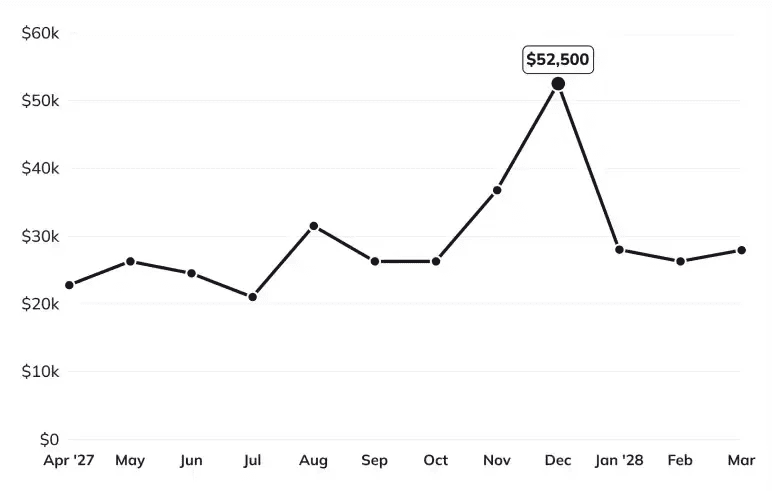
For its first 12 months, from April 2027 through March 2028, Penhallow expects 12,500 transactions, or about 41 per trading day, at an average of $28 each. This gives the shop a Year 1 sales forecast of $350,000.
Sales follow the gift-giving calendar, with a back-to-school lift in August and the biggest month in December.
Funding Request & Finances
We are asking for an $85,000, 10-year SBA 7(a) loan from Kilbourne Community Bank at 10.25% interest. Owen will invest $40,000 of his own savings, bringing the total startup capital to $125,000.
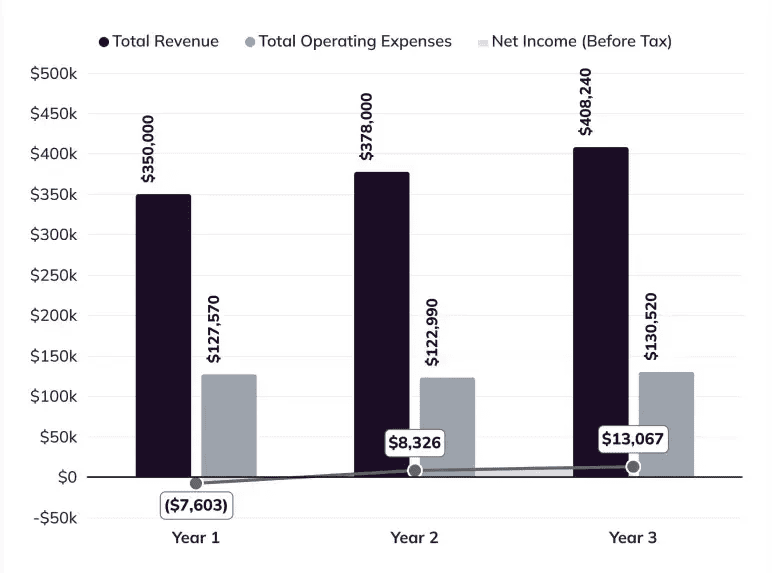
With prices held flat, sales grow each year as more regulars return. The shop expects a loss in Year 1 because of $10,900 in one-time opening costs, and it turns a profit from Year 2 after paying Owen a full salary.
The three-year financial outlook is:
| Category | Year 1 | Year 2 | Year 3 |
|---|---|---|---|
| Total Revenue | $350,000 | $378,000 | $408,240 |
| Net Income (Before Tax) | ($7,603) | $8,326 | $13,067 |
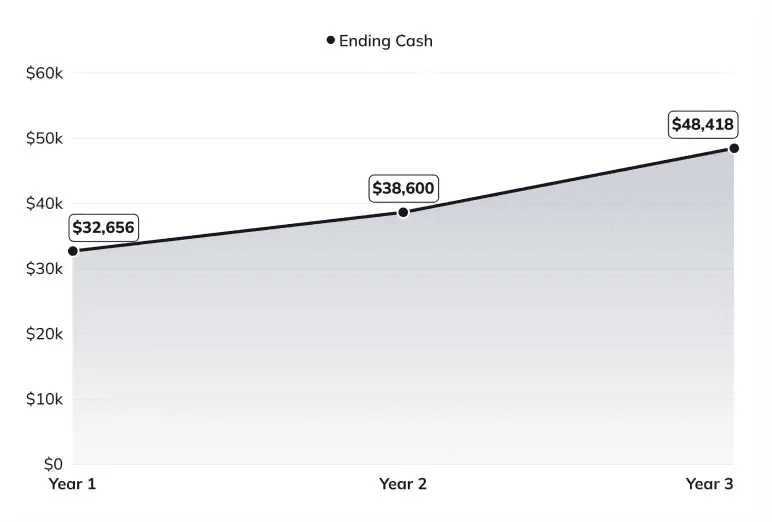
| Ending Cash | $32,656 | $38,600 | $48,418 |
The one-time opening costs come out of the startup funding, so the shop’s own earnings cover its loan payments from the first year. The $125,000 will pay for:
- About 1,900 products of opening stock
- Store fixtures, the sign, the register, and the website
- Build-out of the storefront
- A cash reserve for the first year
- Opening costs such as the launch, permits, and training

Business Overview
Penhallow Paper Co. is a single-member Ohio limited liability company (LLC) that Owen formed in October 2026. He owns all of it, and the LLC is taxed on his personal return. For this reason, the financial statements show results before income tax.
Penhallow’s vision is to become the go-to place Delaware County residents think of for greeting cards, journals, pens, and thoughtful gifts.
Owen also wants to bring local stationery lovers together through letter-writing and journaling meetups.
Storefront & Lease
Penhallow plans to lease the ground-floor storefront of the Kilbourne Block, half a block from North Sandusky Street in downtown Delaware.
The location puts the shop close to downtown offices, local businesses, and Ohio Wesleyan University. It also benefits from people visiting downtown for events such as the Saturday farmers market, which operates along Sandusky Street during the warmer months.
Inside, the 1,100 sq ft room is simple to shop. The greeting card wall will run along the left side near the entrance, with notebooks displayed on tables toward the front.
The pen bar will sit in the middle of the shop, where customers can test different pens and paper before buying. Planners and small gifts will be displayed toward the back.
The register and gift-wrap station share one counter, which keeps wrapping close to the checkout.
Owen has planned a 10-year lease starting February 1, 2027. Rent is $2,400 per month, including shared building costs and property taxes, with a 3% increase each year. The lease terms include February and March rent-free, giving Owen two months to prepare the store before its April 3 opening.
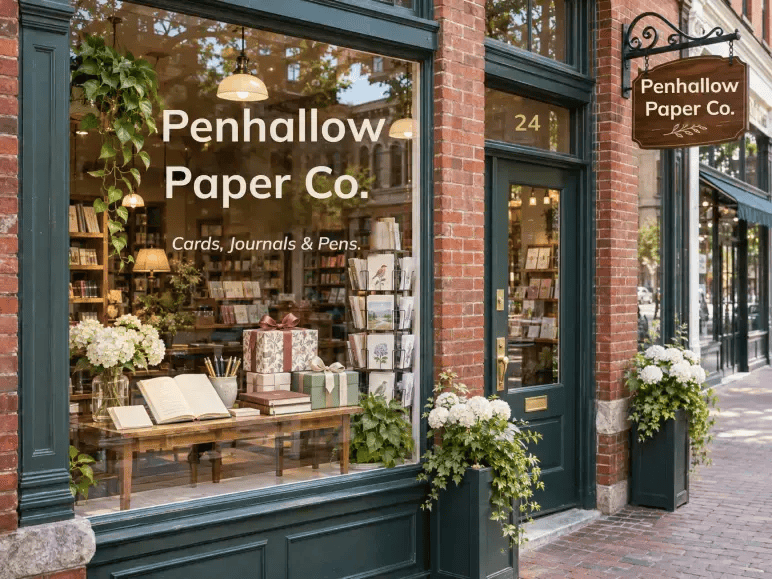
Here’s how the storefront will look from Winter Street:
Owner Background
Owen has 11 years of retail experience, including several years buying and selling stationery and gift products. His experience includes:
- Three years as a bookseller at an independent bookstore in Columbus
- Six years as a visual merchandiser and assistant buyer for a 14-store bookstore-and-gift chain
- Raising stock turns in his categories from 2.9 to 3.6 a year
- Cutting markdowns from 14% of sales to 9%
That experience will be particularly useful at Penhallow. Owen needs to choose products customers want without spending too much on notebooks, cards, and other items that may sit on the shelves for months.
Owen lives in Delaware and has run a monthly pen meetup at a downtown coffee shop for three years. The group has about 60 regular members, and its email list has grown to 410 people. Many of them have already asked when the shop will open.
Three-Year Goals
Owen has set these goals for the first three years:
| Goal | Target | By When |
|---|---|---|
| Open the shop | Keep approximately t 1,900 products and the pen bar ready | April 3, 2027 |
| Keep inventory moving | Reach about 3.5 stock turns a year | March 2028 |
| Train a lead associate | Have one associate trained to run the shop on Owen’s buying days | March 2028 |
| Grow the Paper Club | Reach 600 enrolled members | March 2029 |
| Pay down the loan | Bring the loan balance of $67,844 and $48,418 in cash | March 2030 |
Market Research
More Americans are now enjoying writing by hand, and younger adults are leading the change. In a May 2026 survey, Gen Z and millennial office workers were twice as likely as boomers to prefer handwriting meeting notes over typing them, 50% compared with 25%.
This gives Penhallow a steady market for good notebooks and pens among people in their 20s and 30s.
The broader office supplies market is changing, too. U.S. office supply sales are forecast at $11.1 billion in 2026, almost flat from 2025. While overall unit sales are expected to decline, writing instruments, specialty tapes, and creative supplies are among the categories expected to perform better.
Owen will focus on these products instead of competing with larger retailers on bulk copy paper, folders, and basic office supplies.
Gift shopping is another opportunity. Gift shoppers want something they won’t find everywhere. When buying for Mother’s Day in 2026, 46% of shoppers said finding something unique or different mattered most. Penhallow plans to serve these customers with cards from Ohio artists, small gifts, and free gift wrapping.
The local area population can also afford these purchases. Delaware County had 242,032 residents in 2025, 13.0% more than in 2020, and a median household income of $133,540.
These households have room in their budgets for a good card, a gift, or a fountain pen. New families moving into the county also buy cards for birthdays, weddings, and new homes.
Stationery Trends
The paper business has changed over the last few years, and Owen has watched it happen from the buying side. These trends shape what Penhallow will stock and do:
- Journaling as a screen break: More adults keep a paper journal or planner to step away from their phones. Penhallow stocks dot-grid notebooks and refills, and hosts journaling nights.
- Decorated pages: Stickers, washi tape, and journal charms now sell alongside notebooks. The shop gives them a full table next to the journals.
- Annotated books: Readers mark favorite novels with sticky tabs and highlighters. Penhallow sells annotation kits near the register.
- Letter-writing clubs: Small groups meet to write cards and letters by hand. First Friday letter-writing nights give them a place to meet.
- Refillable pens: More people want one good fountain pen instead of a drawer of cheap ones. Penhallow carries the ink and refills that keep those pens in use.
Target Customers
Penhallow serves four groups of customers, and each one comes in for a different reason.
- Stationary Fans
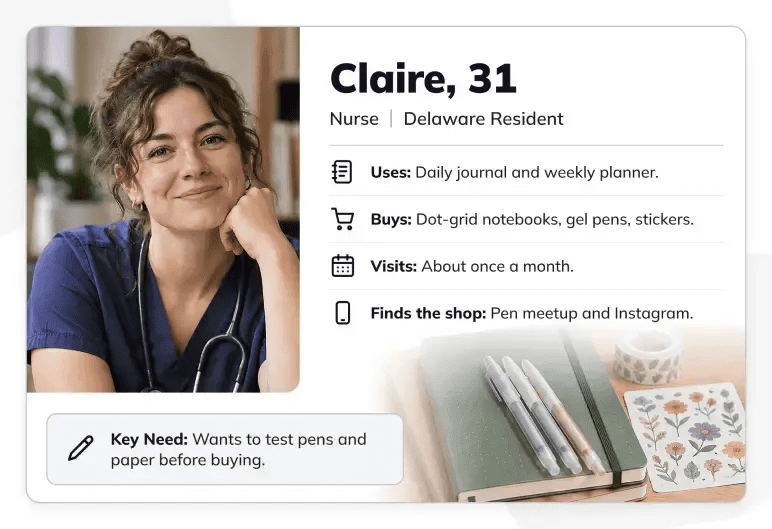
These are the shop’s core customer group. They are adults, mostly aged 22 to 55, who enjoy journaling, use a paper planner, or collect pens. They want to test a pen or feel the paper before they buy, and they want new things to see each month.
Owen expects about 310 regular fans in Year 1, each visiting about once a month. Here’s a profile of a typical one:
- Gift shoppers
They are expected to bring in the largest number of transactions. They would be local adults, mostly aged 30 to 65, and people visiting downtown shops and the farmers market.
They want a birthday card, a thank-you gift, or something for a holiday. Many want to find a card and gift in one visit, without going to several stores.
- Students
Ohio Wesleyan and local high school students shop most during the back-to-school period in August, September, and January. They need notebooks, pens, and planners that fit a student budget.
- Downtown workers
People working in downtown offices may stop in at lunch for notebooks, pens, thank-you cards, and small client gifts. They are likely to make occasional purchases rather than visit every month.
Competitive Analysis
Penhallow will compete with existing downtown gift shops, bookstores, specialty paper retailers, large chains, and online sellers. Owen knows customers already have plenty of places to buy a notebook or greeting card.
His goal isn’t to offer the largest selection or lowest prices. It’s to give customers a reason to visit a dedicated stationery shop.
Direct Competitors
Penhallow’s direct competitors are the shops near Delaware that sell cards, journals, or pens.
| Competitor | What They Offer | How Penhallow Will Compete |
|---|---|---|
| Bowerbird — Downtown Delaware | Gifts, greeting cards, and stationery | A wider selection of pens, notebooks, and writing supplies |
| Beanbag Books — West Winter Street, Delaware | Books, toys, gifts, and some stationery | A dedicated stationery selection, pen testing, and journaling products |
| Creative Paper Arts — Powell | Scrapbooking, card-making, and paper craft supplies | Everyday writing supplies, journals, greeting cards, and gift stationery |
These shops already give local customers places to buy paper goods and gifts. Penhallow will need to earn their business through its product selection, personal service, and the chance to try products before buying.
Indirect Competitors
Its indirect competitors are the big stores, websites, and apps that people use instead.
Target, Walmart, and Michaels sell basic notebooks, pens, and cards at low prices. Amazon, JetPens, and Etsy offer a huge range online, often with fast shipping.
Some people skip paper altogether. They plan on iPad apps such as Goodnotes, and they send a text or an e-card instead of a birthday card.
Penhallow won’t beat these options on price for basics or on the size of its range. It offers what online and big-box stores can’t: a pen to try, a notebook to flip through, a card and gift wrapped in one stop, and a place to meet other people who write by hand.
Paper Goods & Services
Penhallow will keep approximately 1,900 stationery and gift products, from everyday greeting cards and notebooks to specialty pens and small gifts.
Cards and gift wrap bring customers in every few weeks. Journals, pens, and planners raise what they spend on each visit. Owen will focus on products that sell regularly.
Here’s a look at the main product categories found in the shop:

Beyond the products themselves, Owen plans to make shopping easy and personal, with pen testing, gift wrapping, and personalization services.
Here’s how the different product lines and services will work:
Cards, Wrap & Gifts
This will take up the largest display space near the entrance. The shop holds about 900 designs, including cards by six Ohio artists.
- Single cards $5.50 to $8.00
- Boxed sets for holidays and thank-yous cost $14 to $22.
Gift wrap sits right next to the cards. So shoppers can find everything they need to wrap a present in the same area. The selection includes sheets and rolls, ribbon by the yard, tags, and gift bags priced from $4 to $12.
A small gift table holds desk accessories, candles, puzzles, and small books for $10 to $60. Owen will pick each gift that pairs with the cards. This makes it easy for customers to complete a present without visiting another store.
Notebooks & Journaling Supplies
Notebooks are Penhallow’s second-largest line. The shelves hold dot-grid, lined, and blank notebooks, plus refillable leather covers, for $12 to $45. Open sample copies sit on the table so shoppers can feel the paper first.
A separate student shelf will offer lower-priced notebooks under $12.
Journaling supplies sit beside the notebooks, and most cost $3 to $10, which makes them easy to add to a purchase. They include:
- Stickers and sticker sheets
- Washi tape
- Journal charms
- Sticky tabs and highlighters for marking books
Pens & Ink
Gel pens and fineliners start at $3. Fountain pens cost $30 to $120 and sit in a locked case near the register, next to bottled ink and refills.
Pen fans come back for ink and refills every few months. These small purchases keep them visiting between bigger ones.
Planners & Calendars
Planners are Penhallow’s most seasonal line. Academic planners arrive in July for students and teachers, and calendar-year planners arrive in September. They cost $18 to $55.
Unlike an undated notebook, a dated planner becomes harder to sell once part of the year has passed. Owen will order planners in smaller quantities and reorder popular styles while demand is strong.
In-Store Services
Along with its products, Penhallow will offer three services that give customers a reason to shop in person.
Pen-testing
The pen bar sits at the center of the shop. Shoppers can try more than 40 pens on different papers and see how each one writes before they pay.
Gift wrapping
This is free on purchases of $25 or more. Most gift shoppers qualify, and the service gives them one more reason to buy here instead of online.
Personalization
Customers can add names or initials to a notebook, planner, or pen for $8 to $15 per item. Penhallow takes the order and sends the item to Brightline Engraving & Foil in Columbus. The finished item is ready in three to five business days.
These services will help Penhallow offer something more than a regular stationery shelf.
Online Orders & Pickup
Customers who already know what they want won’t always need to visit the shop to browse. Penhallow’s website will carry about 400 of its best sellers, with stock counts linked to the shop’s register.
Local customers can order online and pick up the same day, and the shop ships anywhere in the U.S.
Customers will be able to request personalization and holiday gift wrapping online. This will be especially useful for busy shoppers in December who don’t have time to browse.
Marketing & Sales Strategy
Penhallow’s marketing focuses on bringing people back. A small shop does well when its regulars visit every month, and gift shoppers remember it in December.
Besides a $5,000 launch budget, Penhallow will spend $7,200 on marketing in Year 1. Here’s how Owen plans to divide the ongoing budget:
| Channel | Year 1 Budget | Share |
|---|---|---|
| Social media posts and paid ads | $2,400 | 33% |
| First Friday workshops | $1,800 | 25% |
| Paper Club and email software | $1,200 | 17% |
| Downtown association dues and local print | $1,800 | 25% |
| Total | $7,200 | 100% |
Grand Opening
The launch budget covers window graphics, postcards, ink samples, and a farmers market booth.
Two weeks before opening, window graphics will announce the date. Owen will send postcards and emails to the 410 people on his list and invite the pen meetup to a preview night on First Friday, April 2.
Opening day on Saturday, April 3, features a pen-testing event with ink samples. When the farmers market season starts in late May, Penhallow will set up a booth on its first four Saturdays to hand out cards and show new notebooks.
Online Marketing
Many first-time shoppers will find Penhallow by searching for a card shop or “stationery near me.”
Owen will set up the shop’s Google Business Profile before opening, with hours, photos of the card wall and pen bar, and the First Friday events. After each workshop, he’ll ask guests to leave a review.
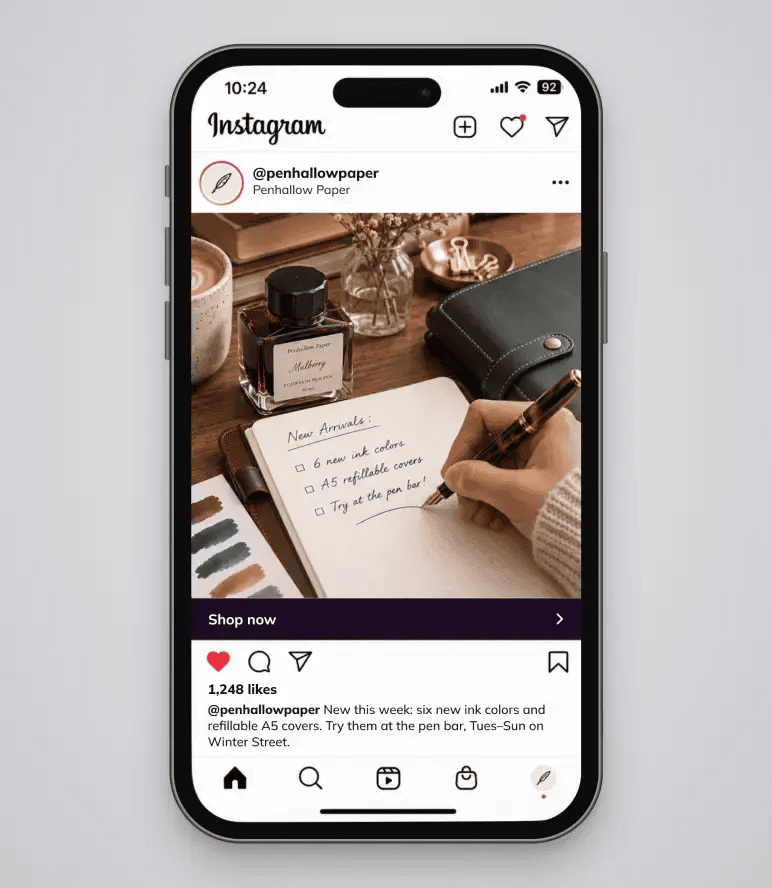
Instagram and TikTok will carry short videos of new arrivals, pen tests, and journal pages. Owen will post three times a week and run small paid ads to people within 15 miles before Mother’s Day and the holidays.
Here’s an example of a new-arrivals post:
A monthly email lists new arrivals, the next workshop, and seasonal cards. It goes to Paper Club members and everyone who signs up at the register or on the website.
Workshops & Paper Club
Each First Friday, Penhallow will host a journaling or letter-writing night for 12 people, booked online. The nights are free, and guests get 10% off what they buy that evening.
The Paper Club is the shop’s loyalty program, tracked by phone number at the register. Members get:
- $10 off after spending $150
- A free birthday card
- Early access to holiday cards and planners
These perks help turn one-time gift shoppers into regular customers.
Local Outreach
Penhallow will also reach customers who already spend time downtown, including students, office workers, and shoppers visiting nearby businesses.
Students get 10% off in August, September, and January, the months they buy supplies. Penhallow will also set up a table at Ohio Wesleyan’s welcome week each fall.
For downtown offices, Owen will offer a thank-you card service. A firm orders cards by email, and Penhallow has them ready for weekly pickup.
Owen will also reach out to complementary downtown businesses, such as coffee shops and other retailers, about displaying workshop flyers or promoting each other’s events. The coffee shop that hosts Owen’s pen meetup will keep a stack of workshop flyers on its counter.
Holiday Season
October through December brings in a third of Penhallow’s yearly sales, and December alone brings 15%. The shop plans for these months well before holiday shopping starts.
The holiday marketing plan includes:
- A holiday card preview night for Paper Club members in early November
- A gift guide in the November email, with ideas by price
- Longer evening hours on Thursdays, Fridays, and Saturdays from Thanksgiving week
- Online orders for gift wrapping and personalization, with a December 10 cutoff for engraving
Owen will order holiday cards, wrapping supplies, and popular gifts ahead of the season. He’ll also arrange extra checkout and wrapping help for the busiest shopping days.
Operations Plan
Penhallow is a small shop with one owner and a few part-time associates. Its daily work focuses on two things: helping customers on the floor and keeping the right stock on the shelves.
Hours of Operation
Penhallow is open 46 hours a week:
- Tuesday – Saturday: 10:00 AM – 6:00 PM
- Sunday: 11:00 AM – 5:00 PM
- Monday: Closed for buying, receiving, and bookkeeping
The shop stays open until 9:00 PM on First Fridays. From Thanksgiving week to December 23, it also stays open until 8:00 PM on Thursdays, Fridays, and Saturdays.
It closes on July 4, Thanksgiving, Christmas, New Year’s Day, and one January day for the stock count. This leaves 307 trading days a year.
Staffing Plan
Owen works the floor Tuesday through Saturday and spends Mondays buying and doing the books. He draws a salary from opening day.
Two part-time associates each work about 20 hours a week at $15.50 per hour. One covers Thursday to Saturday afternoons. The other covers Sundays, Tuesday and Wednesday afternoons, and Saturdays.
This puts two people on the floor during the busiest hours. One handles the register and gift wrap, while the other helps shoppers at the pen bar.
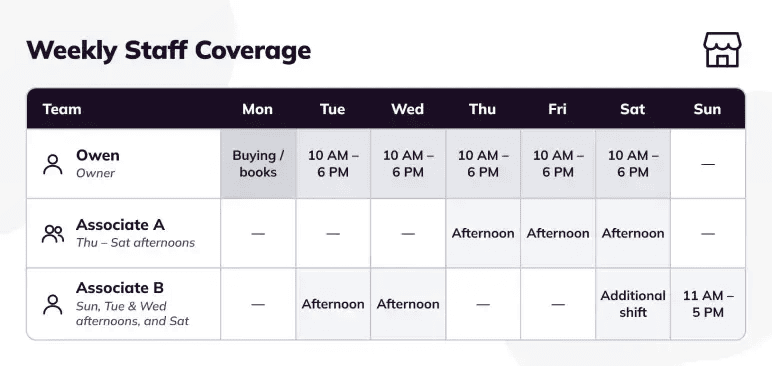
A holiday associate joins from November 1 to December 31 for about 290 hours. In all, associates work about 2,370 hours in Year 1. Their pay grows with sales after that, which leaves room for raises and more holiday hours.
Owen will hire both associates in March 2027 and train them for two weeks before opening. Training covers the register and stock system, gift wrapping, and how to help a shopper choose a pen. This makes sure every customer gets the same friendly help, whoever is on the floor.
By the end of Year 1, Owen will train one associate as a lead who can open, close, and place card reorders when he’s away.
Buying & Vendors
Owen will place Penhallow’s opening orders with 38 vendors, six of them Ohio artists.
He plans to meet stationery suppliers and place some opening orders at the NY NOW Winter Market in New York, January 31–February 2, 2027. The event will also feature NOTED, a trade show for greeting card publishers and paper brands.
After opening, Owen will reorder through vendors’ own websites and through Faire, a wholesale marketplace for independent shops. He’ll buy planners and holiday lines at the August show.
Payment terms depend on the vendor:
- Established vendors: Net 30, meaning Penhallow pays 30 days after the order ships
- First orders and small makers: Paid upfront
- Second holiday wave: Shipped in late October, with payment due in December
Brightline Engraving & Foil handles personalization for a flat price per item. Owen drops off orders each Monday and picks them up the following week.
Pricing & Markup
Penhallow will set prices high enough to cover what it pays suppliers and help pay for rent, wages, and other expenses. But not every product will have the same markup.
Notebooks and gifts sell at double their cost. Greeting cards sell at the publisher’s suggested price, about 2.27 times cost.
Pens and planners will sell for about 1.82 times their cost because customers can easily compare prices online. Personalization will cost customers about 1.67 times what the engraver charges Penhallow.
Overall, Penhallow expects to spend about 50% of its sales revenue on products. This includes shipping costs and a 1.5% allowance for stolen, damaged, or lost items.
If a supplier raises prices, Owen won’t automatically charge customers more. He’ll check whether the product is still profitable and decide whether to raise its price, find another supplier, or stop selling it.
Inventory & Holiday Buying
Stock is Penhallow’s biggest cash decision. The shop opens with $44,000 of products at cost. Owen aims to sell through his stock about 3.5 times a year. At that pace, the shop ends each year with about 104 days of stock on hand.
Stock grows to about $56,000 by the end of September, because back-to-school sales overlap with the first holiday deliveries.
To keep cash steady, Owen splits the holiday order into two waves. The first arrives in September, and the second arrives in late October on December payment terms.
Here’s how the buying year runs:
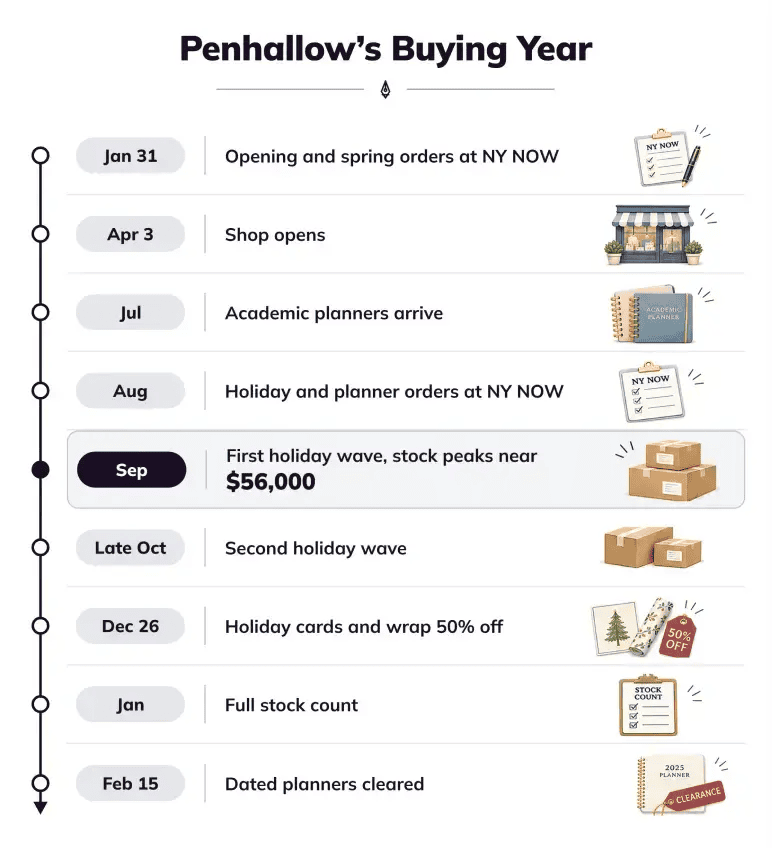
Markdowns follow fixed rules. Holiday cards and wrap go 50% off on December 26, and dated planners are cleared by February 15. Any product that hasn’t sold in 120 days is marked down.
The shop’s register tracks stock by product. Owen reviews sales each week, reorders cards every two weeks, and keeps about four weeks of stock on best sellers.
Licenses & Insurance
Penhallow registered its LLC with the Ohio Secretary of State and has a federal EIN. It also needs these approvals:
| Approval | Issued By | Why It Matters |
|---|---|---|
| Regular vendor’s license | Delaware County Auditor, through the Ohio Business Gateway | Lets the shop collect Ohio sales tax |
| Certificate of Use Compliance | City of Delaware | Confirms proposed retail use meets applicable local requirements before occupancy |
| Certificate of appropriateness for the sign and window graphics | City of Delaware Historic Preservation Commission | Required for exterior changes in the downtown historic district |
| Workers’ compensation coverage | Ohio Bureau of Workers’ Compensation | Required once the first associate is hired |
A business owner’s policy covers general liability and the stock on the shelves.
Risks & Backup Plans
Penhallow’s main risks come from seasonal demand, money tied up in inventory, and the shop’s dependence on Owen.
He has planned the following steps to reduce their impact.
Seasonal stock can go unsold
Dated planners and holiday cards lose value after their season. Owen orders planners in small batches, buys holiday stock in two waves, and follows the markdown rules.
Cash tied up in inventory
The holiday buildup can squeeze cash in the fall. Penhallow holds an $18,400 cash reserve, and Owen will arrange a $15,000 seasonal line of credit that the forecast doesn’t count on using.
Owner dependence
Owen is both the buyer and the manager. The trained lead associate, written reorder rules, and disability insurance help keep the shop running if he can’t work for a while.
Financial Plan
Penhallow’s plan runs from April to March, starting with the April 2027 opening. The $125,000 startup budget comes from the $85,000 Kilbourne Community Bank loan and Owen’s $40,000. After a small first-year loss from opening costs, the shop earns $13,067 before tax by Year 3.
Startup Costs
| Category | Amount |
|---|---|
| Leasehold improvements | $12,000 |
| Store fixtures and pen case | $17,500 |
| Exterior sign and window graphics | $3,500 |
| Register, laptop, printers, and cameras | $4,000 |
| Website and product photos | $4,500 |
| Opening inventory | $44,000 |
| Prepaid rent and insurance | $5,400 |
| Security deposit | $4,800 |
| Grand-opening marketing | $5,000 |
| Licenses and permits | $900 |
| Legal, accounting, and loan setup | $3,500 |
| Pre-opening payroll and training | $1,500 |
| Working capital reserve | $18,400 |
| Total Startup Costs | $125,000 |
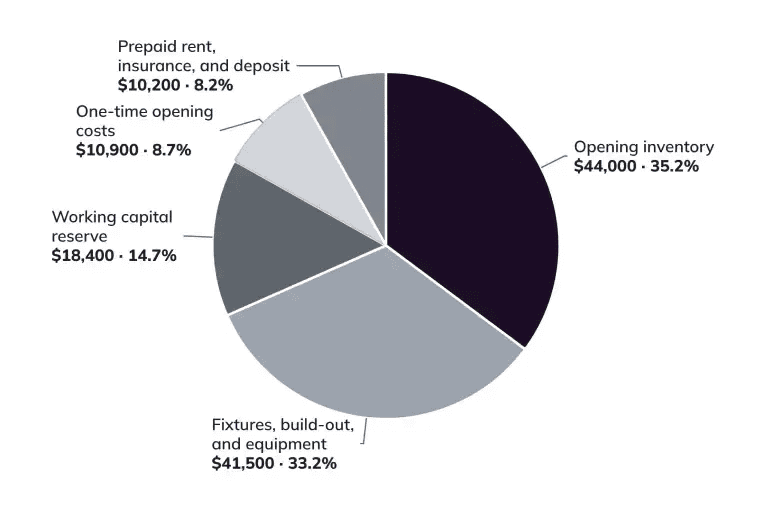
Financial Assumptions
| Assumption | Year 1 | Year 2 | Year 3 |
|---|---|---|---|
| Customer transactions | 12,500 | 13,500 | 14,580 |
| Sales per trading day | 40.7 | 44.0 | 47.5 |
| Trading days | 307 | 307 | 307 |
| Average purchase | $28.00 | $28.00 | $28.00 |
| Online share of sales | 8% | 8% | 8% |
| Merchandise cost (% of sales) | 50% | 50% | 50% |
| Associate wages (% of sales) | 10.5% | 10.5% | 10.5% |
| Payroll taxes (% of wages) | 9% | 9% | 9% |
| Owner salary | $45,000 | $48,000 | $52,000 |
| Card processing (% of sales) | 2.7% | 2.7% | 2.7% |
| Year-end stock (days of merchandise cost) | 104 | 104 | 104 |
| Vendor payment terms (average days) | 21 | 21 | 21 |
| Income tax | Pass-through | Pass-through | Pass-through |
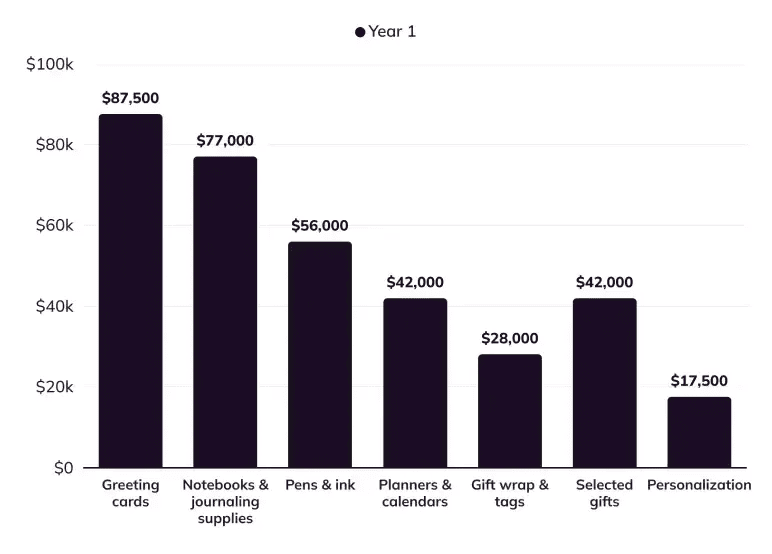
Revenue Forecast
| Category | Year 1 | Year 2 | Year 3 |
|---|---|---|---|
| Greeting cards | $87,500 | $94,500 | $102,060 |
| Notebooks & journaling supplies | $77,000 | $83,160 | $89,813 |
| Pens & ink | $56,000 | $60,480 | $65,318 |
| Planners & calendars | $42,000 | $45,360 | $48,989 |
| Gift wrap & tags | $28,000 | $30,240 | $32,659 |
| Selected gifts | $42,000 | $45,360 | $48,989 |
| Personalization | $17,500 | $18,900 | $20,412 |
| Total Revenue | $350,000 | $378,000 | $408,240 |
Profit & Loss Statement
| Category | Year 1 | Year 2 | Year 3 |
|---|---|---|---|
| Revenue | |||
| Total Revenue | $350,000 | $378,000 | $408,240 |
| Cost of Goods Sold | |||
| Merchandise, freight, and shrink | $175,000 | $189,000 | $204,120 |
| Associate wages | $36,750 | $39,690 | $42,865 |
| Payroll taxes on associate wages | $3,308 | $3,572 | $3,858 |
| Total Cost of Goods Sold | $215,058 | $232,262 | $250,843 |
| Gross Profit | $134,942 | $145,738 | $157,397 |
| Operating Expenses | |||
| Owner salary | $45,000 | $48,000 | $52,000 |
| Payroll taxes on owner salary | $4,050 | $4,320 | $4,680 |
| Rent | $28,800 | $29,664 | $30,554 |
| Utilities | $4,800 | $4,950 | $5,100 |
| Insurance | $3,000 | $3,150 | $3,300 |
| Accounting, payroll service, and legal | $3,600 | $3,750 | $3,900 |
| Phone and internet | $1,320 | $1,380 | $1,440 |
| Marketing | $7,200 | $7,500 | $7,800 |
| Card processing | $9,450 | $10,206 | $11,022 |
| Gift wrap, bags, shipping, and supplies | $5,250 | $5,670 | $6,124 |
| Repairs and maintenance | $1,200 | $1,300 | $1,400 |
| Software and website | $3,000 | $3,100 | $3,200 |
| One-time opening costs | $10,900 | $0 | $0 |
| Total Operating Expenses | $127,570 | $122,990 | $130,520 |
| EBITDA | $7,372 | $22,748 | $26,877 |
| Depreciation | $6,500 | $6,500 | $6,500 |
| Interest Expense | $8,475 | $7,922 | $7,310 |
| Net Income (Before Tax) | ($7,603) | $8,326 | $13,067 |
Balance Sheet
| Category | Year 1 | Year 2 | Year 3 |
|---|---|---|---|
| Assets | |||
| Cash | $32,656 | $38,600 | $48,418 |
| Inventory | $49,863 | $53,852 | $58,160 |
| Security deposit | $4,800 | $4,800 | $4,800 |
| Fixtures and equipment, net | $35,000 | $28,500 | $22,000 |
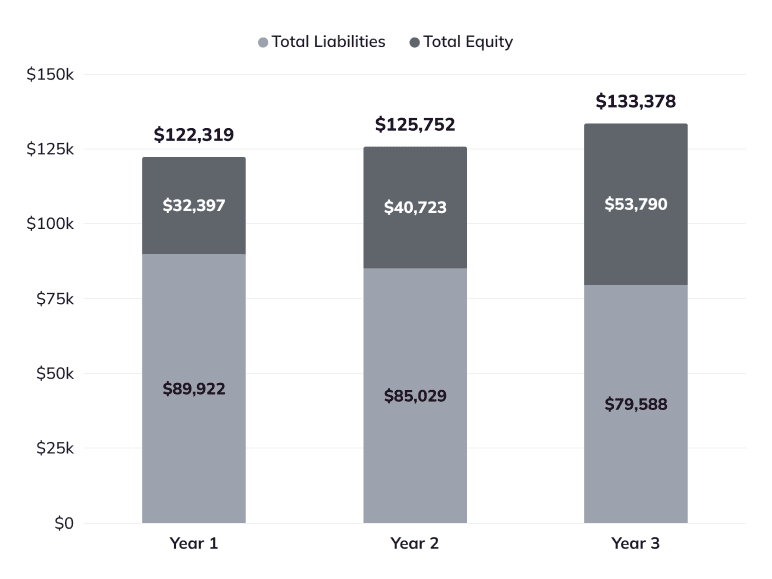
| Total Assets | $122,319 | $125,752 | $133,378 |
| Liabilities | |||
| Accounts payable | $10,068 | $10,874 | $11,744 |
| SBA 7(a) loan balance | $79,854 | $74,155 | $67,844 |
| Total Liabilities | $89,922 | $85,029 | $79,588 |
| Equity | |||
| Owner’s investment | $40,000 | $40,000 | $40,000 |
| Retained earnings | ($7,603) | $723 | $13,790 |
| Total Equity | $32,397 | $40,723 | $53,790 |
| Total Liabilities & Equity | $122,319 | $125,752 | $133,378 |
Cash Flow Statement
| Category | Year 1 | Year 2 | Year 3 |
|---|---|---|---|
| Beginning Cash | $29,300 | $32,656 | $38,600 |
| Operating Activities | |||
| Net income | ($7,603) | $8,326 | $13,067 |
| Depreciation | $6,500 | $6,500 | $6,500 |
| Change in inventory | ($5,863) | ($3,989) | ($4,308) |
| Change in accounts payable | $10,068 | $806 | $870 |
| Change in prepaid expenses | $5,400 | $0 | $0 |
| Net Cash from Operations | $8,502 | $11,643 | $16,129 |
| Investing Activities | |||
| Capital expenditures | $0 | $0 | $0 |
| Net Cash from Investing | $0 | $0 | $0 |
| Financing Activities | |||
| Loan principal repaid | ($5,146) | ($5,699) | ($6,311) |
| Net Cash from Financing | ($5,146) | ($5,699) | ($6,311) |
| Net Change in Cash | $3,356 | $5,944 | $9,818 |
| Ending Cash | $32,656 | $38,600 | $48,418 |
Break-Even Analysis
| Metric | Value |
|---|---|
| Average purchase | $28.00 |
| Variable cost per sale (merchandise, associate wages and taxes, card fees, supplies) | $18.38 |
| Contribution per sale | $9.62 |
| Annual fixed costs (Year 2, including depreciation and interest) | $121,536 |
| Break-even sales per year | 12,634 |
| Break-even sales per trading day | 41.2 |
| Break-even revenue | $353,765 |
| Year 2 planned sales | 13,500 |
Loan Repayment & Debt Coverage
| Category | Year 1 | Year 2 | Year 3 |
|---|---|---|---|
| Beginning loan balance | $85,000 | $79,854 | $74,155 |
| Annual payments | $13,621 | $13,621 | $13,621 |
| Interest | $8,475 | $7,922 | $7,310 |
| Principal | $5,146 | $5,699 | $6,311 |
| Ending loan balance | $79,854 | $74,155 | $67,844 |
| Debt service coverage | 0.54x | 1.67x | 1.97x |
| Debt service coverage before one-time opening costs | 1.34x | 1.67x | 1.97x |
The Quickest Way to turn a Business Idea into a Business Plan
Fill-in-the-blanks and automatic financials make it easy.


Upmetrics
Upmetrics is the #1 business planning software that helps entrepreneurs and business owners create investment-ready business plans using AI. We regularly share business planning insights on our blog. Check out the Upmetrics blog for such interesting reads. Read more