


In 2018, Brex founders Henrique Dubugras and Pedro Franceschi were pitching a corporate card built for startups.
Instead of starting with a market-size chart or a long explanation of the problem, they showed investors something much more direct: actual credit card rejection notices from Capital One, American Express, and Chase.
The rest of the deck was surprisingly simple too. It left out several slides you would normally expect in a pitch deck, yet Brex still raised a $50 million Series B that year.
So what made the pitch work?
In this breakdown, I’ll go through the Brex pitch deck slide by slide to see how the founders explained the problem, presented their solution, and built their case. I’ll also point out what worked well, where I think the pitch could have been stronger, and what founders can learn from it.
About Brex (then vs. now)
Before Brex was pitching investors on corporate cards, Henrique Dubugras and Pedro Franceschi had already built and sold Pagar.me, a Brazilian payments company.
They founded Brex in 2017 and joined Y Combinator’s Winter 2017 batch. Interestingly, corporate cards weren’t their original idea. They entered YC working on a virtual reality startup before quickly pivoting back to fintech.
Y Combinator’s own profile confirms that the founders eventually focused on corporate cards after experiencing how difficult it was for early-stage startups to access them.
Brex raised a $6.5 million Series A in April 2017, at a reported $25 million valuation. A year later, in April 2018, it raised the $50 million Series B associated with this pitch-deck period. (Source)
At that point, Brex was still in the early phase. Its card remained in private beta and hadn’t yet been opened nationally.
By the public launch on June 19, 2018, however, Brex had already reached more than 1,000 customers. The company also announced that its Series B had brought total funding to $57 million. (Source)
The Brex of 2026 looks very different.
Today, more than 35,000 companies use Brex. The product has expanded beyond corporate cards into expense management, travel, business accounts, bill pay, payments, and AI-powered financial workflows.
Then came the biggest change. On January 22, 2026, Capital One agreed to acquire Brex in a stock-and-cash transaction valued at $5.15 billion. The acquisition officially closed on April 7, 2026.
Brex pitch deck analysis (slide by slide)
The deck has 19 slides, but I don’t think every slide deserves equal attention. The important question is how the argument develops.
Slide 1: Cover

Brex opens with its logo on a dark background.
No tagline. No explanation. No round information.
It works in a live presentation where investors already know why they’re in the room. I wouldn’t copy it for a deck that may be forwarded without context.
Takeaway: If your deck needs to work without you, use the cover to explain what the company does in one line.
Slide 2: Team and investors
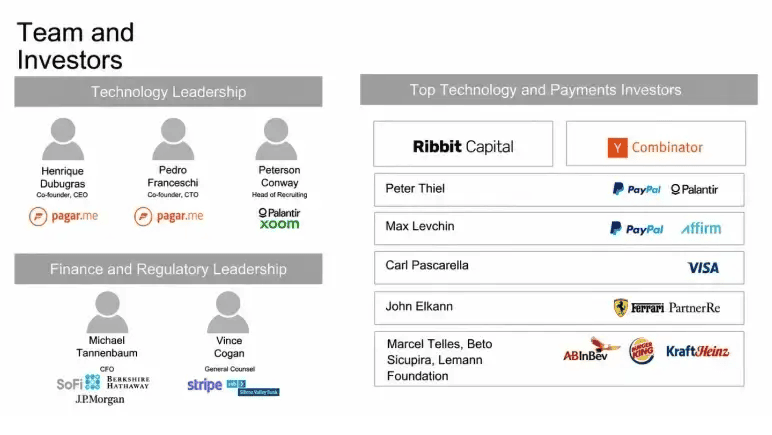
Brex puts its team before the problem.
That’s unusual, but I think the placement is deliberate.
The founders had payments experience through Pagar.me, while the slide also highlights finance and regulatory leadership and well-known backers such as Ribbit Capital, Y Combinator, Peter Thiel, Max Levchin, and former Visa CEO Carl Pascarella.
For a company entering credit and payments, credibility is part of the investment case.
Takeaway: Put the team early when investors need confidence that you can execute in a technically difficult or regulated market.
Slides 3-5: Establishing the problem and explaining why it persists
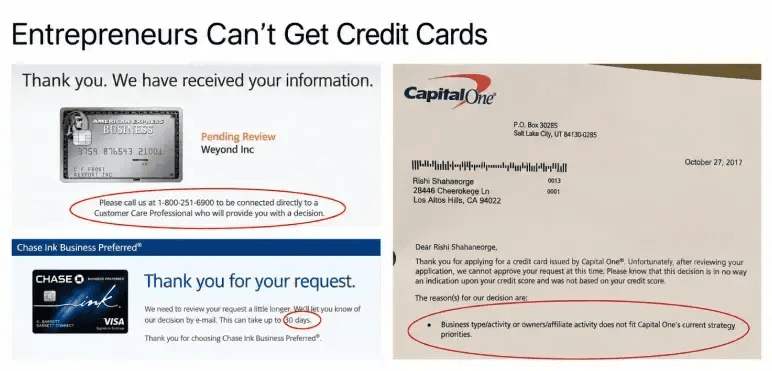
Slide 3 provides evidence of companies struggling to obtain corporate cards from traditional issuers.
That context is important. Brex wasn’t claiming businesses couldn’t make payments at all. The specific problem was that startup economics did not fit conventional corporate-card underwriting.
At launch, Brex explained the difference clearly: traditional models looked at profits and credit history, while Brex could use a startup’s available cash and funding to help determine its spending limit.
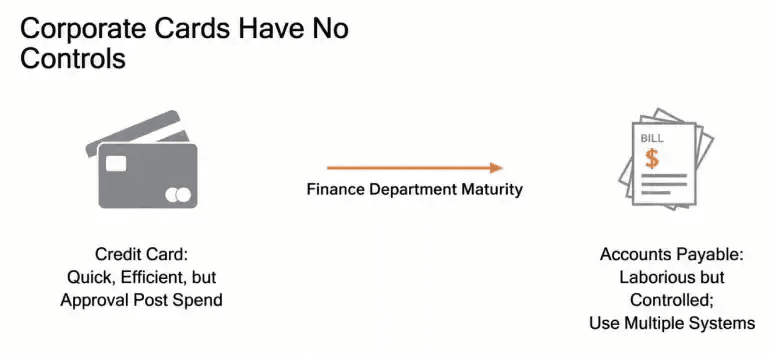
Slide 4 adds another problem. Corporate cards give employees flexibility, but companies have limited control before money is spent. Accounts payable provides more control, but usually creates more administrative work.
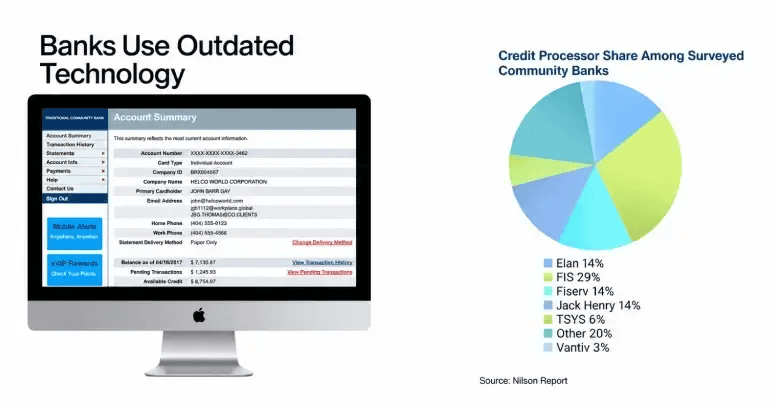
Then slide 5 tackles the investor objection hiding behind both slides: If these problems are real, why haven’t banks fixed them?
Brex points to legacy banking technology and dependence on existing card-processing infrastructure.
I wouldn’t treat that as proof that incumbents couldn’t respond. But it gives investors Brex’s explanation for why change had been slow.
Takeaway: Showing a customer problem isn’t enough. Explain why the market has allowed that problem to persist.
Ditch your old-school pitch deck creation methods
Make compelling pitch decks in minutes with AI
Plans starting from $14/month

Slide 6: The bigger market behind the card
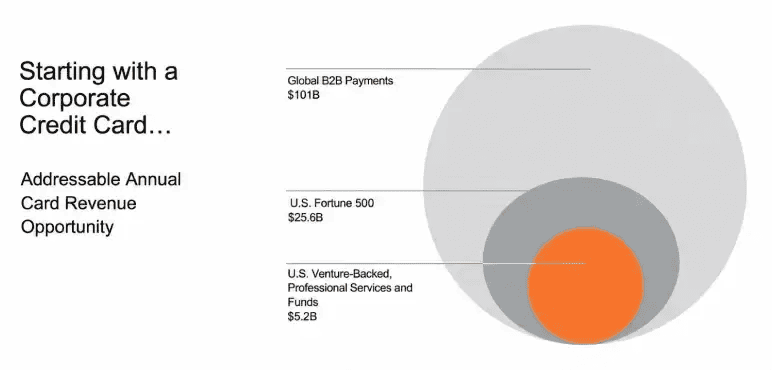
This slide is often described simply as Brex’s market-size slide, but there’s more going on.
Its headline is “Starting with a Corporate Credit Card.” Underneath, Brex maps progressively larger pools of annual card-revenue opportunity.
That’s an important framing choice.
Brex isn’t presenting the corporate card as the destination. It is positioning cards as the starting point within a much larger B2B payments opportunity.
I also like that the slide talks about card revenue opportunity, not simply trillions of dollars of payments volume. That brings the market sizing closer to what Brex could actually monetize.
Takeaway: If your first product is a wedge, show both the market it serves today and the larger opportunity it can unlock.
Slide 7: Why technology companies first?
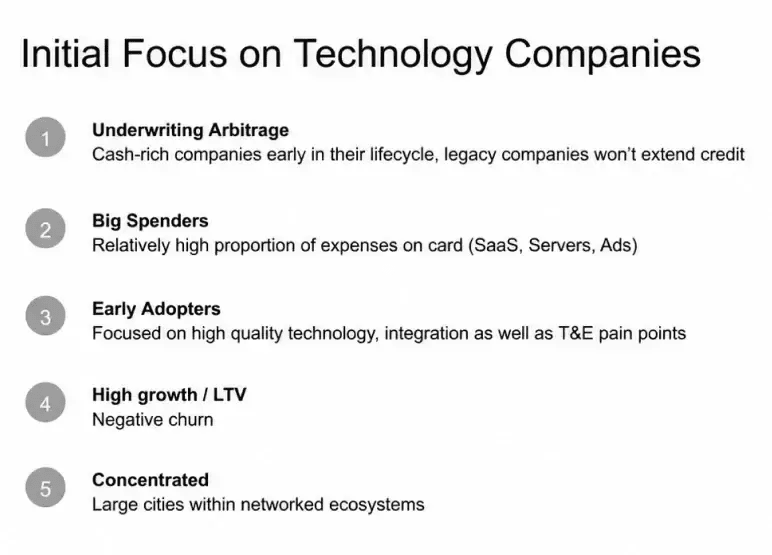
This may be the deck’s most important strategy slide.
Brex gives several reasons for starting with technology companies: founders had difficulty getting corporate credit, startups spent heavily on software and advertising, they adopted new technology quickly, and many were geographically concentrated.
But the underwriting insight does the most work.
A venture-backed startup might have substantial cash but little revenue history. That could make it unattractive under traditional underwriting while still making it attractive to Brex.
That isn’t just an ICP description. It’s an explanation of why this customer may be undervalued by incumbents.
Takeaway: Your beachhead becomes more convincing when you can explain why that customer is unusually attractive to you.
Slides 8-13: Get customers in, then make Brex useful enough to keep
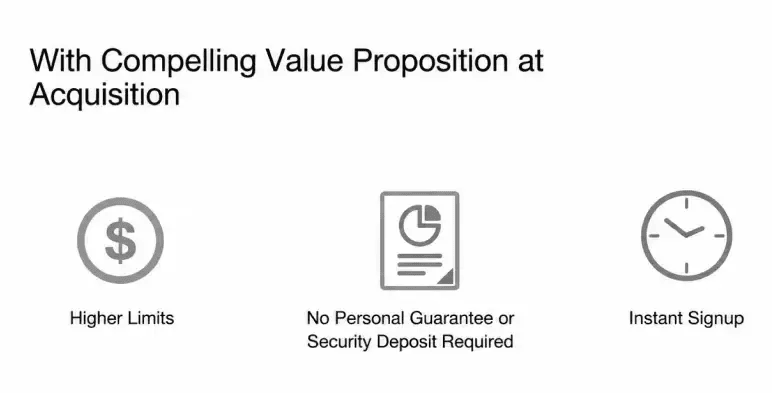
Slide 8 explains the immediate reasons a startup might choose Brex: higher limits, no personal guarantee or security deposit, and fast signup.
Then the argument changes.
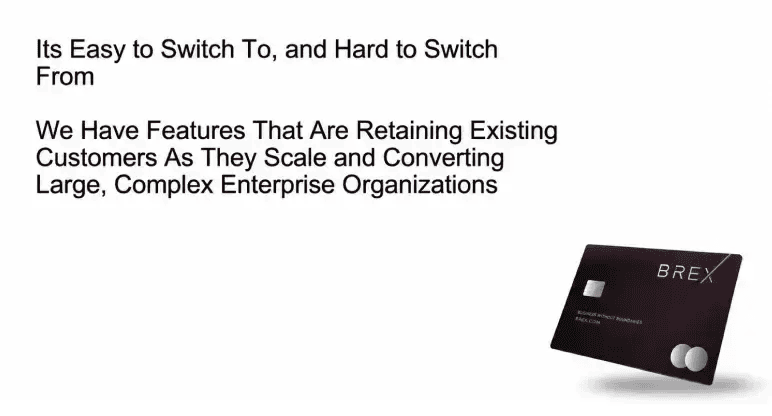
Slide 9 says Brex should be easy to switch to and hard to switch from.
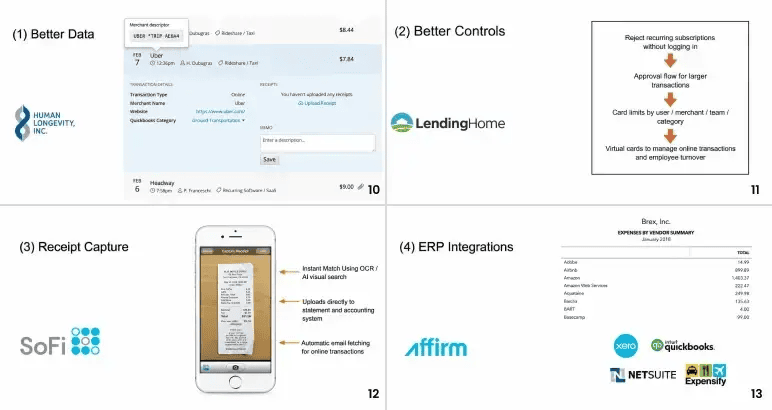
Slides 10-13 show the product capabilities intended to support that claim: cleaner transaction data, spending controls, receipt management, and accounting or ERP integrations.
I think this section matters more than the individual features.
A corporate card by itself is relatively easy to compare with another corporate card. A card embedded in expense controls, accounting workflows, employee spending, and transaction data is harder to replace.
The deck also puts recognizable customer names alongside particular product examples instead of reserving every logo for a generic traction slide.
Takeaway: Don’t only prove why customers will buy. Show how your product becomes more embedded after they do.
Slide 14: Rewards reinforce the customer strategy
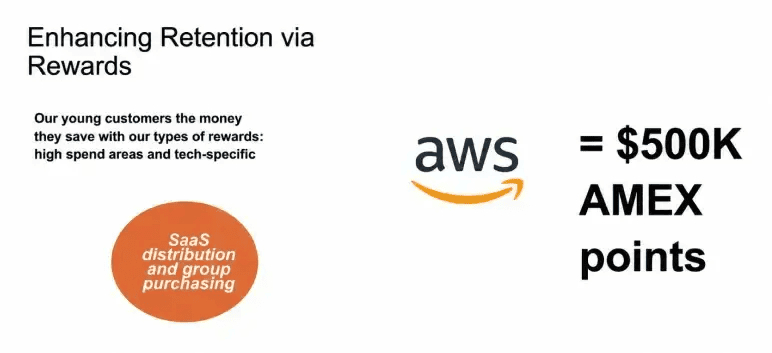
Brex positions rewards as another retention mechanism.
More importantly, the rewards are tailored around how technology companies spend. That makes the slide consistent with the customer strategy established earlier rather than feeling like a disconnected feature.
There is also a small but noticeable typo in the slide copy. One sentence reads:
“Our young customers the money they save with our types of rewards.”
It appears to be missing a verb, likely something like “love,” between “customers” and “the money.”
It doesn’t affect the argument Brex is making, but it is a useful reminder that this wasn’t a perfectly polished presentation.
I wouldn’t recommend leaving errors in an investor deck. But founders can also spend too much time polishing wording, icons, and transitions while avoiding the harder job of strengthening the investment case.
Takeaway: Spend more effort strengthening the argument than decorating it. Then proofread both.
Slide 15: Traction, with an important qualifier
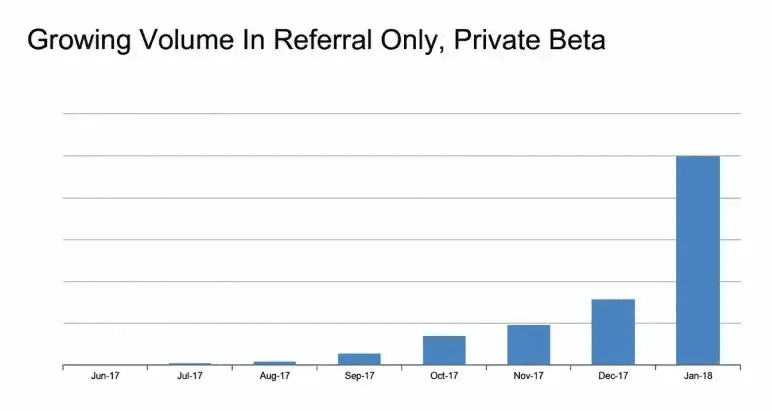
Brex shows card volume increasing from June 2017 through January 2018.
The chart doesn’t disclose the actual volume on the vertical axis, so we can see the direction and acceleration of growth, but not the absolute scale.
That’s important.
What strengthens the slide is the context: “Referral Only, Private Beta.”
The company is telling investors that the growth occurred before a full public launch.
I wouldn’t call that proof of low customer-acquisition cost because the slide doesn’t provide CAC or referral-rate data. But it is useful evidence of early usage and demand under constrained distribution.
Takeaway: A traction chart is stronger when investors understand both what grew and under what conditions.
Slide 16: The “negative churn” thesis
This slide needs careful interpretation.
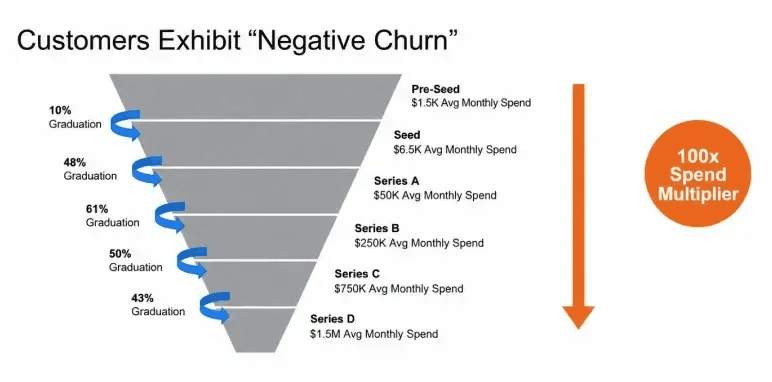
Brex uses external CB Insights data to show how startup card spending could increase as companies progress from pre-seed through later funding rounds. The slide pairs spending levels with the percentage of companies that graduate between stages.
So this is not evidence that Brex had already achieved negative revenue churn across its own customer base.
It is a model for why Brex believed its startup customers could become significantly more valuable as the successful ones raised capital and grew.
That’s still a powerful investment argument. But it’s a thesis, not a Brex cohort analysis.
I’d also question the highlighted “100x Spend Multiplier.” The slide doesn’t make the calculation transparent enough to reproduce from the visible figures alone.
Takeaway: Expansion potential can strengthen your retention story, but clearly separate market-based assumptions from your own customer data.
Slides 17-19: Turning the thesis into economics
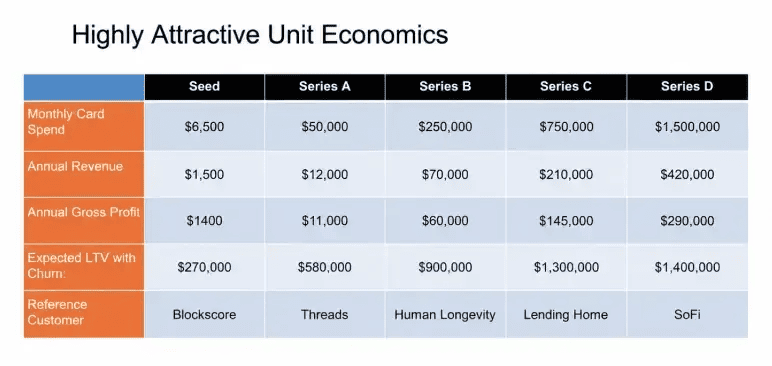
Slide 17 takes the previous argument and models what customer economics might look like at different startup stages.
It includes monthly card spend, revenue or gross-profit economics, and example companies associated with different stages.
Again, I would be careful with the interpretation. These are not necessarily observed Brex cohort results. The slide is modeling the attractiveness of customers as their businesses mature.
That’s useful, but an investor should still ask which inputs come from actual Brex customers and which are assumptions.
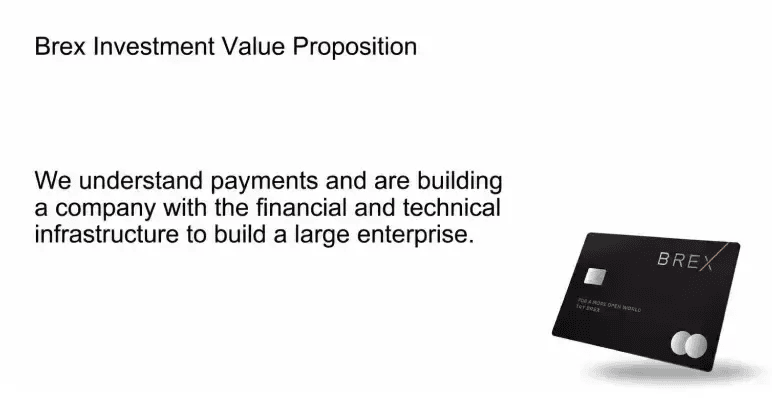
Slide 18 then pulls back to the larger investment proposition. Brex says it understands payments and is building the financial and technical infrastructure required to create a large enterprise.
Slide 19 simply closes with the Brex logo.
Takeaway: Good unit economics slides make assumptions visible. Great ones make it obvious which numbers are observed and which are projected.
That’s where all 19 slides come to an end, with Brex closing on its logo instead of a traditional funding ask.
The deck also leaves out a few things you would normally expect, such as a competition slide, detailed financial projections, use of funds, and a clear ask. But Brex was already backed by Ribbit Capital and had gone through Y Combinator, so its fundraising situation was very different from a founder sending a cold deck today.
So I’d treat those missing slides as part of Brex’s specific context, not as a structure to copy.
What I like about the Brex pitch deck
Four things stand out to me.
1. It shows the problem instead of overexplaining it. The corporate-card rejection evidence gives investors something concrete before Brex starts pitching its solution.
2. One strategic insight carries most of the deck. Traditional underwriting was poorly suited to venture-backed startups. That idea informs the customer segment, value proposition, underwriting model, and expansion thesis.
3. The deck anticipates investor objections. Why aren’t banks solving this? Why start with startups? Why would customers stay? What happens when startups fail? The story keeps moving toward the next obvious question.
4. Brex separates the initial product from the larger opportunity. This is the part that looks particularly interesting in hindsight. The corporate card gets Brex into the company. Expense management, controls, integrations, and broader financial infrastructure create room to expand.
The deck isn’t polished, and some of its economics deserve more scrutiny than many retrospective write-ups give them.
But the underlying investment logic is unusually coherent.
Conclusion
The Brex pitch deck shows how an early-stage company can turn a narrow product into a much bigger opportunity.
Brex didn’t have years of operating history or detailed projections. Instead, the founders used customer evidence, a clear market gap, early traction, and a strong expansion story to make the case.
That’s the part worth learning from.
If you want to build an investor-ready pitch deck, Upmetrics’ AI pitch deck generator can help you structure the key slides, organize your business and financial information, and present your opportunity clearly.
Turn Your Story Into a Powerful Pitch
Create an investor-ready pitch deck that brings your business vision to life.

Frequently Asked Questions
Should founders use the Brex pitch deck as a template?
Why does the deck open with the team instead of the problem?
What can early-stage founders learn from the Brex pitch deck?
How can an early-stage founder make a pitch deck convincing with limited data?
More pitch decks, broken down
See all 26




Vinay Kevadia
Vinay Kevadiya is the founder and CEO of Upmetrics, the #1 business planning software. His ultimate goal with Upmetrics is to revolutionize how entrepreneurs create, manage, and execute their business plans. He enjoys sharing his insights on business planning and other relevant topics through his articles and blog posts. Read more