


In 2011, the four Irish founders of Intercom sent investors a pitch deck they hadn’t finished. The word DRAFT was still on the cover.
No revenue, no financial model, no screenshots, no growth chart, just eight slides and about 250 words.
By any checklist, it should have been an easy no. Instead, it worked: they asked for $600,000 and closed a $1 million round in early 2012.
Fifteen years later, one of the biggest names in software would agree to pay billions for the company those slides built.
So what did these eight thin slides get right that investors looked past everything missing?
I’ve gone through all of them, using the original Intercom pitch deck Eoghan McCabe later published himself: what each slide was doing, where I’d push back, and what’s worth stealing if you’re raising a first round with nothing to show yet.
About Intercom (then vs. now)
Intercom sells software that lets businesses talk to their customers- live chat, in-app messages, support, all in one place. Today that’s a category. In 2011, when this deck went out, it was just an idea and a beta.
Eoghan McCabe, Des Traynor, Ciaran Lee and David Barrett had spent four years running Contrast, a Dublin software design consultancy, and built an error-tracking tool called Exceptional. They sold Exceptional in 2011, and the money from that deal helped fund their move into Intercom. (Source)
There were no customers, no revenue, no growth chart, and the product wasn’t even at intercom.com yet; it lived at intercomapp.com, because they didn’t own the good domain.
That beta became one of the biggest customer communication platforms in SaaS. In May 2026, the company renamed itself Fin after its AI support agent, running at roughly $400 million in ARR with more than 30,000 customers.
A month later, Salesforce agreed to buy it for about $3.6 billion, a deal expected to close in early 2027.
Detailed Intercom pitch deck analysis (slide-by-slide)
Eight slides, readable in ninety seconds. Let’s jump in.
1) Cover slide
The cover names the company and nothing else. No tagline, no one-line description of what Intercom does.
For me, it’s the weakest slide here, because a cover is the slide that travels. When an investor forwards your deck, it’s what the next person sees before deciding whether to open it. This one gives them nothing to go on.
Takeaway: Your cover has to work for the person reading it without you in the room.
2) The team
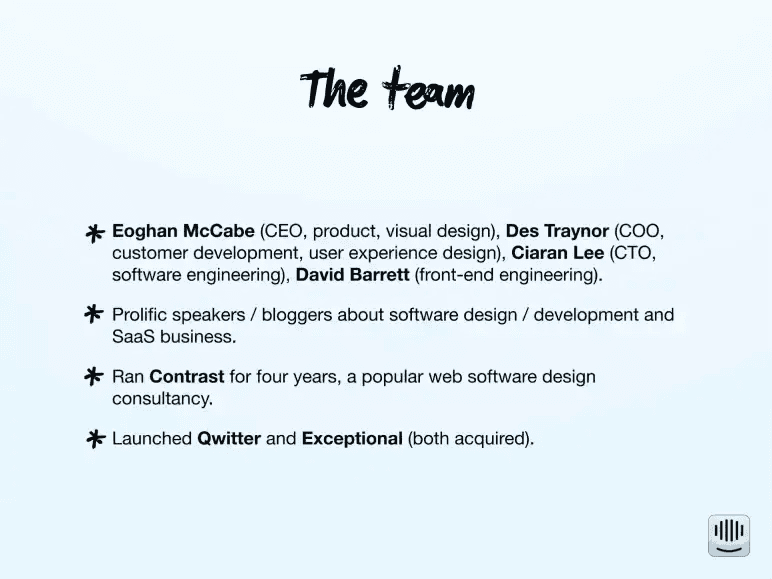
The first decision I find genuinely interesting is that the team comes second, before the problem. Most decks open with the problem, but Intercom had no traction to show, and when that’s the case, the team is the strongest card you’re holding. Burying it would be a waste.
What makes the slide work is that each credential quietly closes a different investor fear:
- Ran Contrast for four years answers survival; they’ve run a real business and won’t fold if the next round is slow to come.
- Built and sold two products answers execution; they finish what they start, and buyers wanted the result.
- Prolific speakers and bloggers look like filler but are the sleeper: Des Traynor’s writing became Inside Intercom, one of the most-read blogs in SaaS. They were claiming an audience before they even had a product.
My one quibble is that the slide lists what these founders did but never says why it matters for this product. Designers who spent four years watching software teams fail to talk to their users are the obvious people to fix that, but the deck leaves the investor to connect that dot alone.
Takeaway: When the team is your only proof, lead with it, but spell out why that background makes you the right people to build this. Don’t leave the investor to connect it.
3) The problem
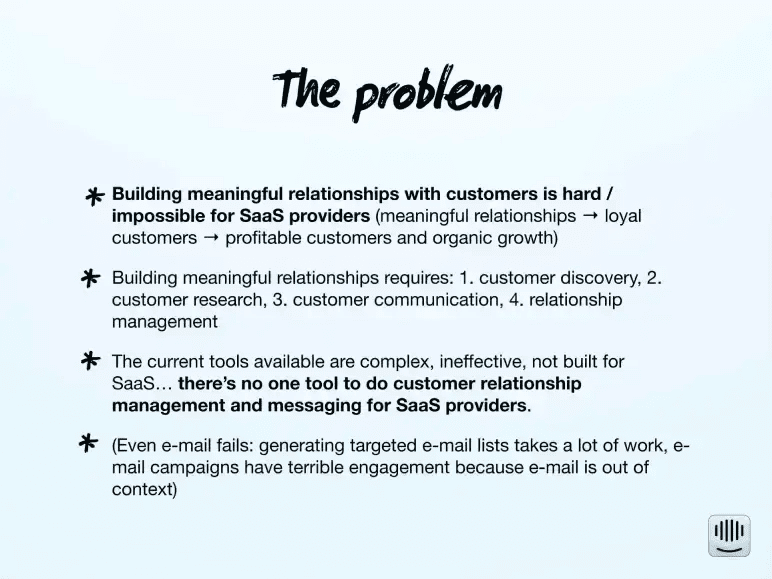
The problem is framed as a chain, not a complaint: relationships are hard for SaaS companies to build, and relationships are what drive loyalty, profit, and organic growth. That framing is what makes it fundable.
“Relationships” on its own is soft, and no investor funds soft; tied to retention and growth, it becomes a revenue argument. It then splits that into four jobs, discovery, research, communication, and relationship management, which quietly become the backbone of the next two slides.
The sharpest idea in the whole deck, though, is tucked into a parenthesis at the bottom: email fails because it’s out of context. Messaging people inside your product, while they’re using the thing you want to discuss, beats emailing them about it later.
That’s a claim about human attention, not a feature, and it’s the reason Intercom exists. I’d have made it the headline; instead, it’s the smallest text on the page.
Takeaway: Don’t bury your sharpest insight in parentheses.
4) The solution
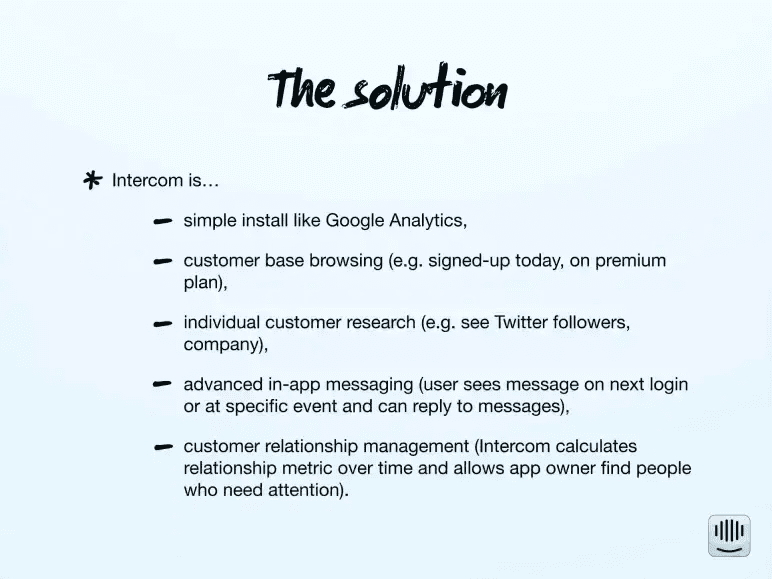
The whole solution turns on six words: “simple install like Google Analytics.”
That line kills the biggest objection to any B2B infrastructure product before anyone can raise it. Every investor in the room had installed Google Analytics and knew the cost: one snippet, five minutes, no engineering project. To me, that one familiar comparison does the work of an entire technical slide.
The four bullets that follow mirror the four jobs from the problem slide, in the same order, so the product reads as a direct answer to what was just laid out.
And notice which bullet won: the flashiest one, a relationship score that flags customers needing attention, went nowhere, while the plainest one, in-app messaging, became the business.
Takeaway: Anchor your adoption story to something your investor has already installed.
Build faster. Pitch better.
Build compelling pitch decks faster and easier with AI
Plans starting from $14/month

5) The market
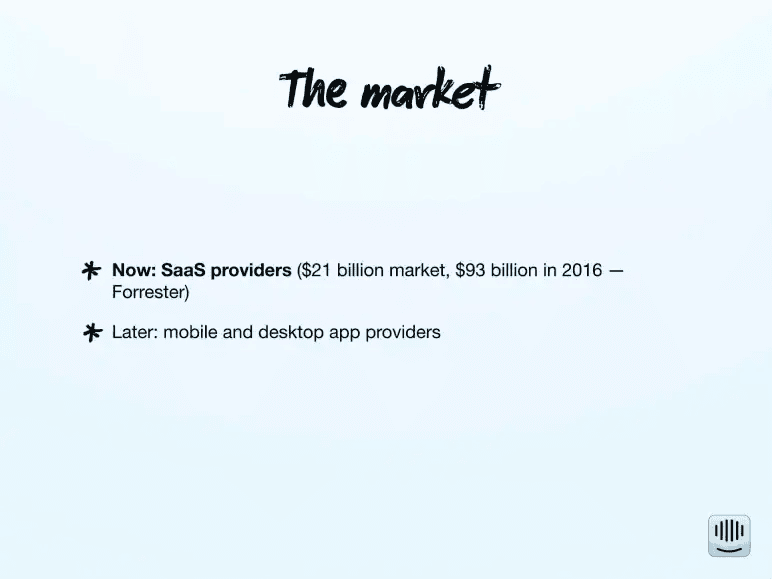
The market is sized at $21 billion, growing to $93 billion by 2016, credited to Forrester.
The number is real; Forrester’s April 2011 forecast put SaaS at $21.2 billion, reaching $92.8 billion by 2016, but I’d argue it’s the wrong number. That’s what SaaS companies sell, not what they’d spend on customer communication software, which is Intercom’s actual market and a small fraction of it.
And yet it works, for a reason the slide never states. What matters isn’t the $21 billion; it’s the ratio: 4.4x in five years. The real claim underneath is “the pool of companies who could buy this is about to quadruple”, and for a picks-and-shovels business selling into a boom, that’s the honest signal.
Takeaway: Size the market you’ll be paid from, not the market your customers operate in.
6) The competitors
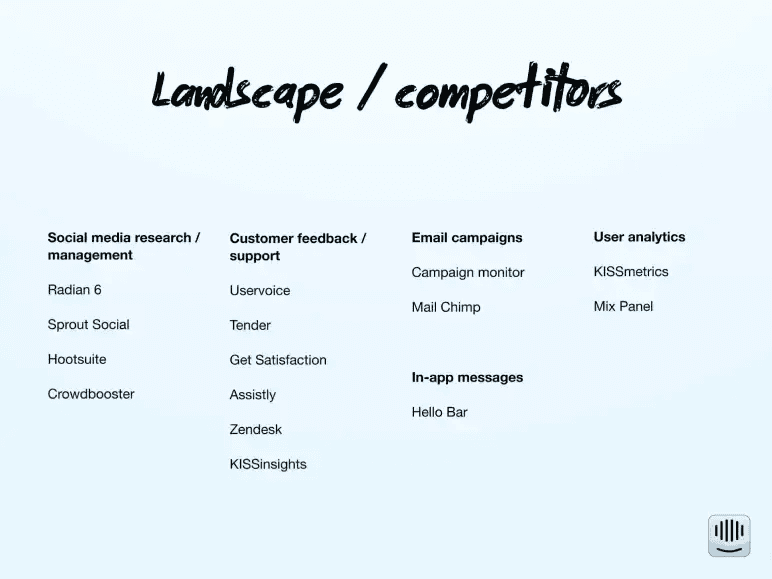
Thirteen competitors sorted into five buckets, and each bucket maps back to one of the four jobs from slide three. The argument is strong: look how many separate tools you have to stitch together to do one job, and notice there’s no column for a company doing all of it.
The problem is that the argument is never written down. It’s a list with no sentence on it, which leaves a half-listening investor to connect the dots alone.
One line: a SaaS company needs five of these; Intercom replaces them, would turn the list into a thesis. It’s the single edit I’d most want to make to this deck.
Takeaway: Show the gap, then say what it means. A competitor slide needs a sentence on it.
7) Progress
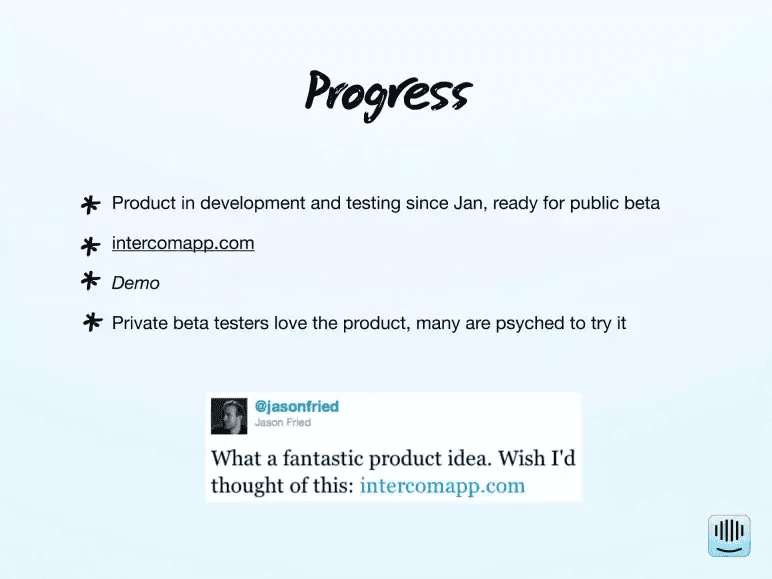
With no numbers to show, the best slide in the deck leans on a single tweet from Jason Fried: “What a fantastic product idea. Wish I’d thought of this: intercomapp.com”
This isn’t celebrity endorsement, and that distinction matters. In 2011, Fried was about as credible as a voice could get in front of SaaS angels: Basecamp’s founder, co-author of Rework, a loud advocate for good software for small businesses.
And Basecamp was exactly the kind of company Intercom was built to sell to. So this is the target customer, in public, unprompted, wishing they’d built it. That’s the most efficient traction you can show when you have none.
The weakness sits right next to it: “private beta testers love the product” has no number attached, and investors read unquantified enthusiasm as a number too small to print.
Takeaway: With no metrics, borrow credibility from the voice your buyer already trusts, but never let vague enthusiasm sit where a number belongs.
8) What we’re looking for
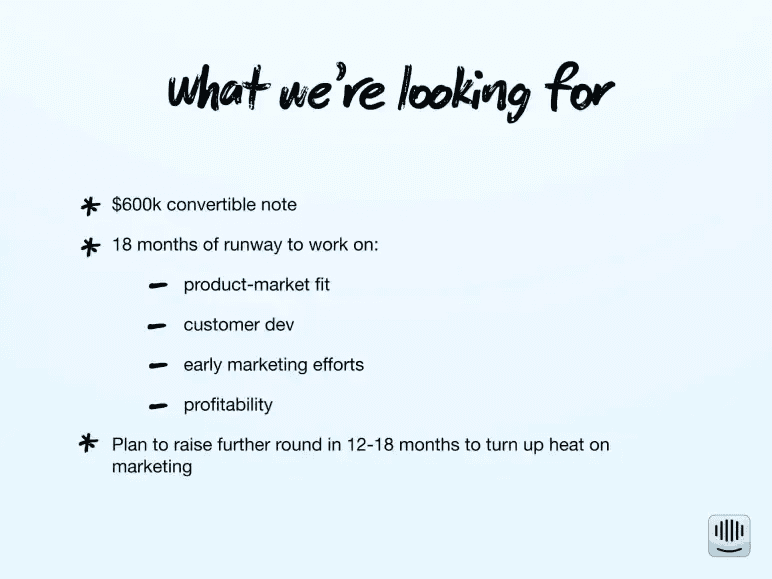
The ask is a $600k convertible note for eighteen months of runway. Two things about it are unusually good. It says “profitability” out loud in a seed request, the mark of founders who’d run a consultancy for four years and think in terms of a sustainable business, not just the next round.
And it names the follow-on round with a timeline, which most founders hide for fear it signals weakness; stated plainly, it reads as planning.
What’s missing is a milestone. Eighteen months of runway is a plan-shaped sentence, not a plan.
It never answers the question every seed investor asks: what will be true in eighteen months that isn’t true today? (McCabe later admitted he genuinely thought $600k might get them to profitability. They went on to raise about $290 million.)
Takeaway: Fund a milestone, not a duration.
What did I like the most about this deck?
Nothing here is trying to impress anyone, and that’s the strength. A few things stand out:
- The team slide comes second and earns it, each credential closing a different risk.
- “Simple install like Google Analytics” removes the biggest adoption objection in six words.
- The Jason Fried tweet is the right kind of proof: not a famous name, but the target customer.
- It says the unfashionable things out loud, “profitability” and “we’ll raise again”, and both build trust.
There’s also a quieter reason it holds together. Slides 3, 4, and 6 are the same four ideas told three ways: as a problem, as a product, and as competitors sorted into those buckets.
Repeat one spine three times and eight sparse slides start to feel like a finished argument. That, more than the low slide count, is the part worth copying.
And it went out stamped DRAFT. They sent it anyway, because the thinking was finished even though the file wasn’t.
Conclusion
You probably can’t copy Intercom’s approach exactly. Most founders aren’t pitching investors who already know their work, their previous company, or the way they think.
But the principle still holds. Build the deck around one clear argument, support it with the strongest evidence you have, and make a specific ask. That evidence does not always need to be a revenue chart or a long list of metrics. Early customer feedback, beta usage, or even a public customer comment can help if it proves the point you’re making.
Intercom left a lot out because it could. Your deck may need to do more of the explaining.
Upmetrics’ AI pitch deck generator can help you turn your business idea and key details into an investor-ready pitch deck in minutes, with the structure and slides investors expect.
Your Next Pitch Deck Starts Here.
Go from idea to investor-ready pitch decks in minutes.

Frequently Asked Questions
How much money did Intercom's pitch deck raise?
What's the biggest lesson from Intercom's pitch deck?
Why did investors fund Intercom with so little traction?
What made Intercom's pitch deck effective?
More pitch decks, broken down
See all 26



Vinay Kevadia
Vinay Kevadiya is the founder and CEO of Upmetrics, the #1 business planning software. His ultimate goal with Upmetrics is to revolutionize how entrepreneurs create, manage, and execute their business plans. He enjoys sharing his insights on business planning and other relevant topics through his articles and blog posts. Read more