


From dubbed videos to audiobooks to AI narration, there’s a good chance you’ve already heard ElevenLabs at work, maybe without even realizing it. This AI voice company went from nothing to an $11B valuation in roughly three years. So it’s only natural to want to see the deck that started it all.
But the deck I want to show you is from before any of that, back in early 2023, when it was a pre-seed startup with no office and two ex-Google and Palantir engineers trying to raise their first $2M.
And that’s exactly what makes it worth studying if you’re building your own first investor deck. It wins on clarity. No flashy design, no jargon, just the essentials, in an order that makes sense.
So let me walk you through it, slide by slide. But first…
About ElevenLabs (then vs. now)
ElevenLabs was founded in 2022 by two friends from Poland, Piotr Dąbkowski and Mati Staniszewski. Piotr had been a machine learning engineer at Google and studied at Cambridge and Oxford, while Mati had worked as a deployment strategist at Palantir.
The idea came from a shared frustration: both were tired of how badly American films were dubbed into other languages, and they believed AI could finally fix it. So they built a tool that could dub a video into another language while keeping the speaker’s real voice, emotion, and timing.
In January 2023, they launched the beta and raised a $2M pre-seed, led by Credo Ventures with Concept Ventures joining. At that point, there was almost nothing to show: no revenue, no big-name customers, no office, just a working beta and this deck.
A strong founder background surely helped open doors, but a good résumé only gets you the meeting. The deck still had to win the room, and it did. The growth that followed has been rare even by AI standards.
ElevenLabs made over $330M in revenue in 2025, and by April 2026 that had passed $500M. And that February 2026 Series D, led by Sequoia Capital, valued the company at $11 billion.
And the product has grown far beyond dubbing. Its AI voices are now used by roughly 41% of the Fortune 500, including Deutsche Telekom, Revolut, and Klarna for customer support, alongside media, gaming, and publishing companies.
But here’s the interesting part: even after all that growth, the pitch hasn’t really changed. What ElevenLabs sold on these early slides (natural-sounding voice at a fraction of the cost and time) is still what the company is built on today.
Now, let’s get into that deck.
Detailed ElevenLabs pitch deck analysis (slide by slide)
I’ll go slide by slide. For each one, I’ll cover what it shows, what works, and the takeaway you can apply to your own deck.
Here’s a quick reminder as we go: this is a 14-slide deck with two slides redacted, so a few will be shorter than others, and I’ll flag those when we reach them.
Slide 1: Cover
The opening slide is about as bare as it gets: the “Eleven” logo and a single line, “Powering content in any language with automatic dubbing.” That’s it. No tagline stack, no “the future of AI audio.”
What I like is that this one line does real work. In eight words, someone who has never heard of the company knows what it does and who it’s for. There’s no attempt to sound clever or futuristic. And that restraint is exactly right for a technical product in a space investors don’t fully understand yet.
Takeaway: Your cover line should make sense to someone outside your industry. If it needs jargon to make sense, it’s not ready.
Slide 2: Introduction
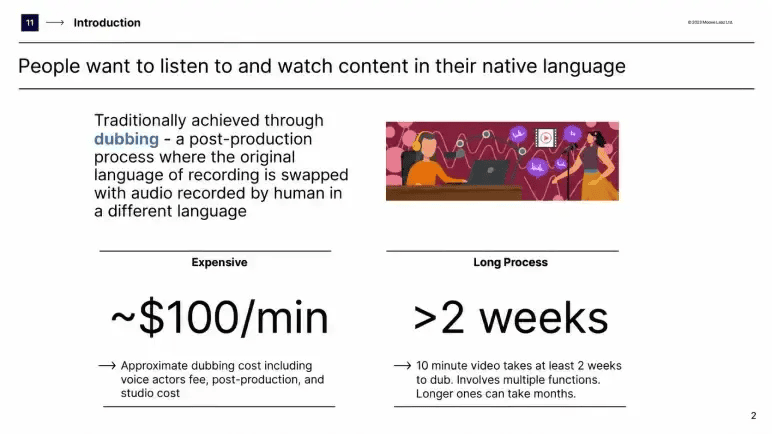
This slide sets up the problem, and it does it well. It opens with a statement it doesn’t bother to prove: “People want to listen to and watch content in their native language.” That’s obviously true, so no chart is wasted on it.
It then explains that this is traditionally solved through dubbing, and lands two numbers: dubbing costs about $100 per minute, and a 10-minute video takes over two weeks to produce (longer videos can take months).
What I like is how selective it is. The obvious claim gets a single sentence; the painful part, the cost and the time, gets the big, bold figures. That’s how you make a reader feel a problem instead of just reading about it.
Takeaway: Don’t spend evidence proving what your audience already believes. Save your data for the friction that actually hurts.
Slide 3: Problem
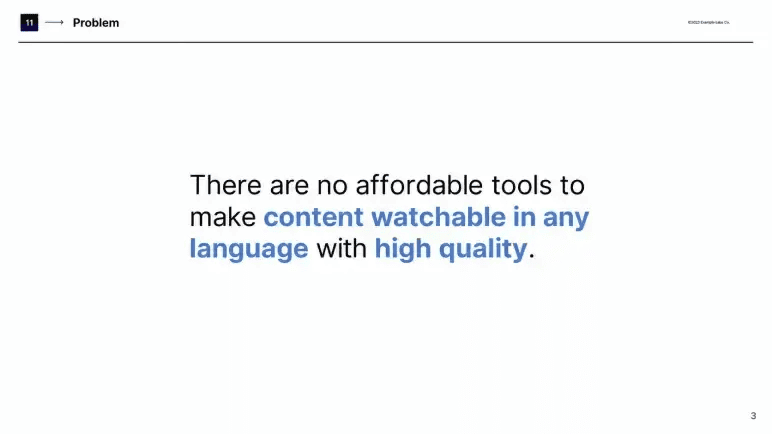
This is a transition slide, and a single sentence carries it. A few words are highlighted on purpose, because those are the things every existing option fails at.
On its own, it’s a plain slide. But sitting right after the cost-and-time numbers, it works, because it names the exact gap those numbers just opened up.
If I’m nitpicking, it’s almost too minimal, and a reader who skipped the previous slide might breeze past it. In sequence, though, it’s a clean hinge from the problem into the solution.
Takeaway: A one-line problem slide only works if the slides around it set it up. Sequence matters as much as the sentence itself.
Slide 4: Solution
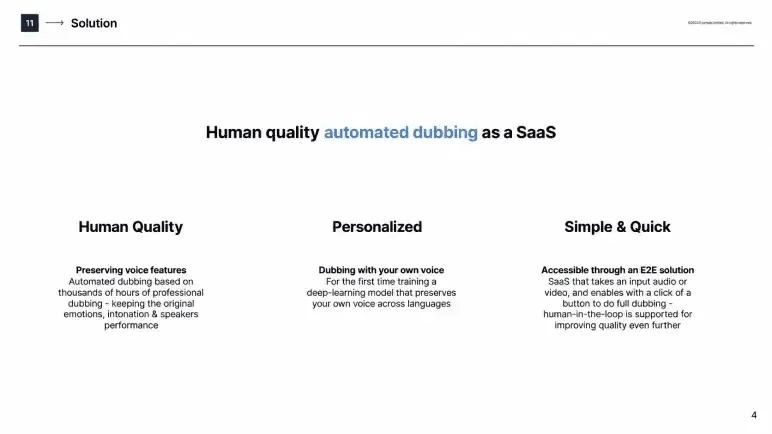
After two slides of problem, here’s the payoff: “Human-quality automated dubbing as a SaaS.” Underneath sit three pillars:
- Human Quality (preserving emotion, intonation, and the speaker’s performance)
- Personalized (dubbing in your own voice across languages)
- Simple & Quick (an end-to-end tool where one click does the full dub, with a human-in-the-loop option to push quality even higher).
What I appreciate is that these three pillars quietly answer “why will you win?” without ever using those words. It isn’t just cheaper; it’s cheaper, it keeps the emotion, and it’s easy to use. That’s the classic “10x better” argument, framed as benefits rather than a feature list.
Takeaway: Turn your solution into two or three benefit pillars a reader can repeat back. Features tell people what your product does; pillars tell them why it wins.
Ditch your old-school pitch deck creation methods
Make compelling pitch decks in minutes with AI
Plans starting from $14/month

Slide 5: Solution Prototype Deep-dive
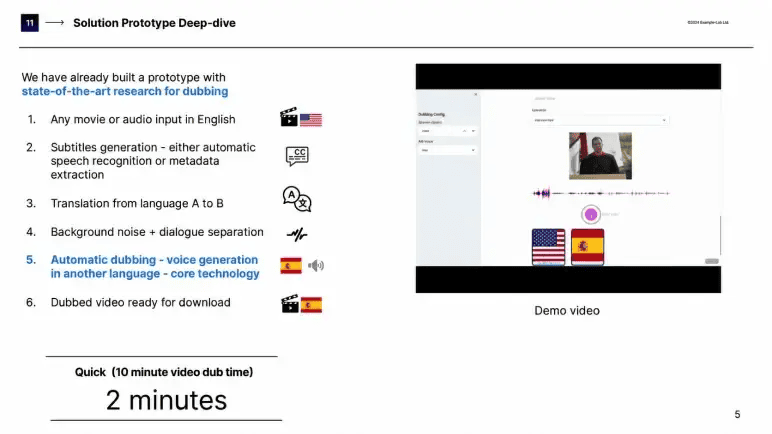
This is where the deck proves it’s real. It lays out the six-step dubbing pipeline, from English audio input through subtitles, translation, and background-noise separation, to a downloadable dubbed video. This involves the automatic voice-generation step flagged as the core technology.
There’s a demo video, and at the bottom, the number that ties the whole thing together: a 10-minute video dubbed in 2 minutes.
That “2 minutes” is not a random stat. It’s placed to slam against the “2 weeks” from Slide 2, and that single contrast is the entire pitch in one line. I also like that this is a prototype slide, not a concept slide, which tells investors the team can build, not just imagine.
Takeaway: Show a working build, and anchor it against the pain you opened with. A concrete before-and-after beats any adjective you could write.
Slide 6: Team
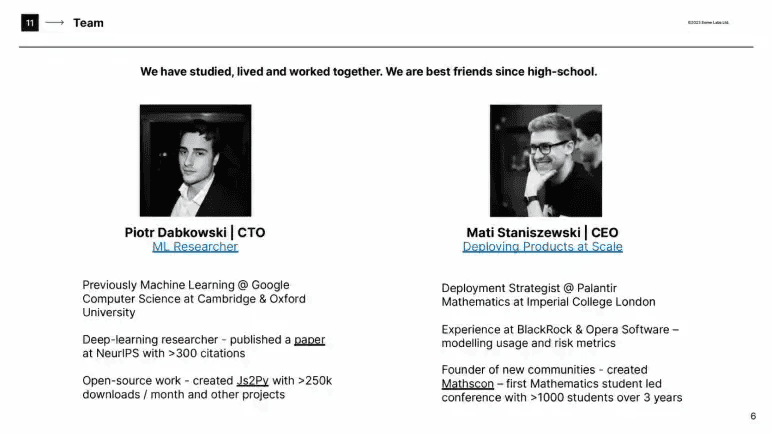
The header on this slide is unusual: “We have studied, lived, and worked together. We are best friends since high school.” The credentials follow, and they’re strong:
- Piotr (CTO) did machine learning at Google, studied at Cambridge and Oxford. He published a NeurIPS paper and built an open-source project.
- Mati (CEO) was a deployment strategist at Palantir, studied maths at Imperial, and had worked at BlackRock and Opera.
Here’s what stands out to me: they lead with the friendship, not the résumés. For a frontier idea where no one has decades of direct experience to point to.
That’s a smart call, because what investors are really betting on at pre-seed is whether these two will hold together when things get hard. The pedigree then backs that up.
Takeaway: For an early, unproven idea, founder conviction and cohesion can matter as much as the CV. Lead with the story, and let the credentials support it.
Slide 7: Vision
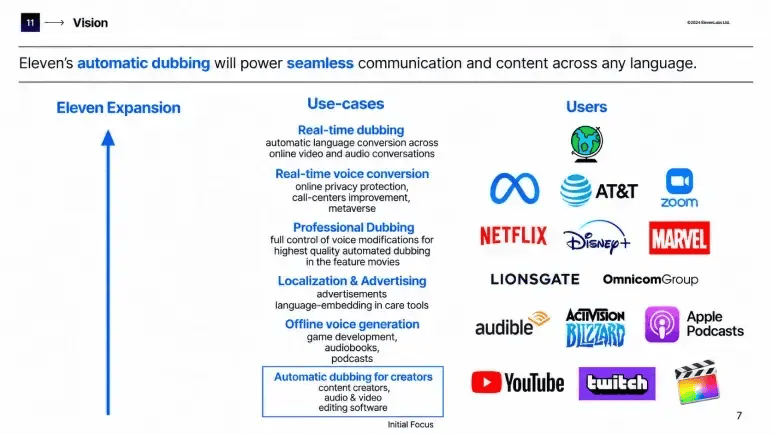
This 7th slide maps a ladder of use cases against the users at each level. It starts narrow at the bottom, dubbing for creators (YouTube, Twitch).
As you climb, it moves through offline voice generation, advertising and localization, professional dubbing (Netflix, Disney, Marvel), and finally real-time voice conversion and dubbing (Zoom, Meta).
I think this is one of the more quietly clever slides, because it’s a vision slide and a roadmap at once. It doesn’t just say “we’ll be huge”; it shows the order of the land-and-expand, starting narrow with creators and climbing toward enterprise and real-time. The sequencing is the message.
Takeaway: A vision slide is stronger when it shows order, not just ambition. Where you start and what you climb toward tells investors you’ve thought about how you’ll actually get there.
Slides 8 & 9: Market
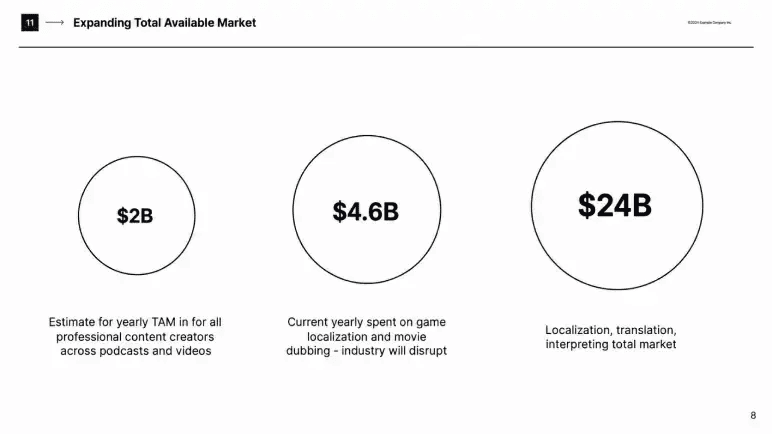
The market case runs across two slides, best read together.
Slide 8 sizes the opportunity top-down with three growing circles:
- $2B yearly market for professional content creators
- $4.6B currently spent on game localization and movie dubbing
- $24B total localization, translation, and interpreting market
The point isn’t just “big”; it’s that the market expands as the technology gets cheaper.
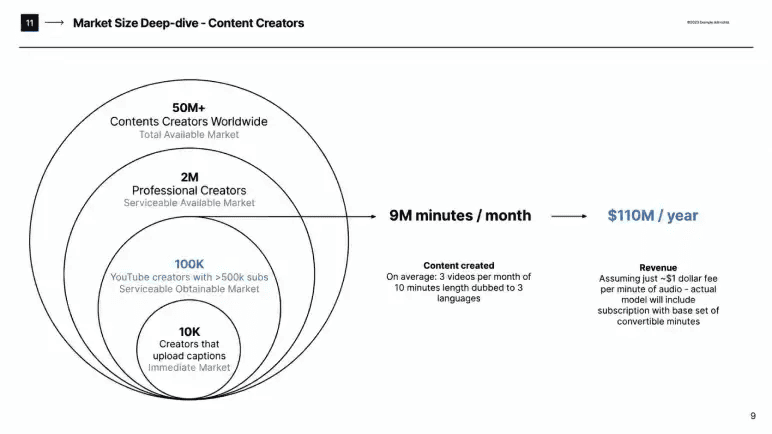
Slide 9 is the one I’d point any founder to. Instead of asserting that $24B, it builds up from the floor, from 50M+ creators worldwide down to an immediate market of just 10K who already upload captions.
Then it does the math out loud: 3 videos a month, dubbed into 3 languages, works out to 9M minutes a month, and at roughly $1/minute, $110M/year.
That immediate-market pick is the sharp move. Creators already uploading captions are people doing this work manually today, which makes them the easiest first customers to convert. And tying it to a transparent revenue number makes the whole opportunity feel earned rather than claimed.
Takeaway: Don’t just show a big market; show it’s growing. Then back it with one specific first customer and simple revenue math. A bottom-up number beats a top-down guess.
Slide 10: Our Start – Content Creators
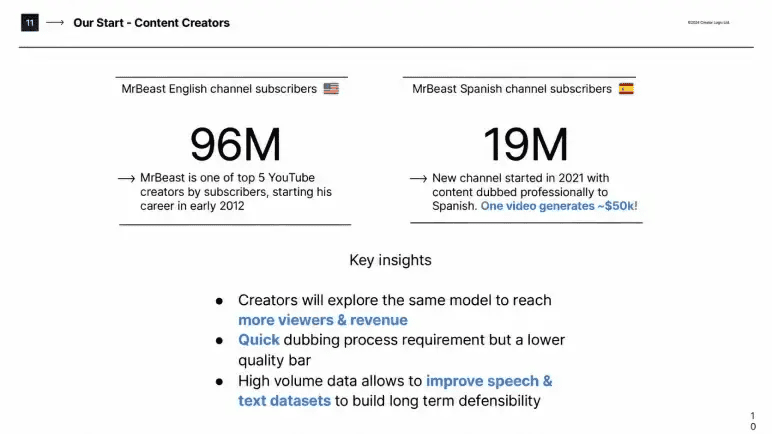
This slide makes the wedge concrete with one example: MrBeast. His main English channel had 96M subscribers; his Spanish-dubbed channel had already reached 19M, and the deck notes a single dubbed video can generate around $50k.
Below that are the key insights: creators will chase this to reach more viewers and revenue, that they’ll tolerate a lower quality bar for speed, and that high volumes of data build long-term defensibility.
What I like here is the reframe. This isn’t “dubbing saves you money”; it’s “dubbing makes you money.” That flips the product from a cost line into a revenue driver, which is a far easier thing to sell to a creator, and a far more exciting thing to show an investor.
Takeaway: Wherever you can, position your product as revenue, not just savings. One believable case study that proves upside is worth more than a page of feature claims.
Slide 11: Traction & Feedback (redacted)
It’s an empty slide except for the word “Redacted”. That’s because ElevenLabs deliberately hid the content before releasing the deck publicly, most likely because early traction numbers were sensitive. So there’s nothing to review here.
Takeaway: Just know that traction is where proof of demand goes, such as early users, signups, a growing waitlist, or standout feedback. It is one of the most important slides in any deck.
Slide 12: Competition
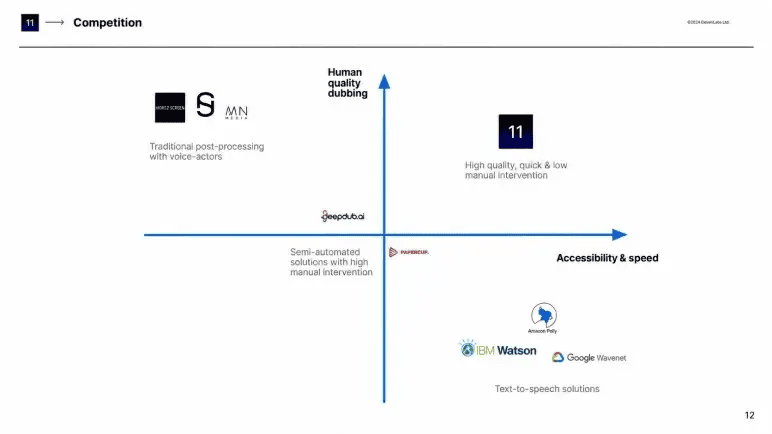
This is a clean 2×2, plotting human-quality dubbing against accessibility and speed.
- Traditional voice-actor work sits top-left (high quality, slow).
- Semi-automated tools like Deepdub and Papercup sit in the manual-heavy middle.
- Text-to-speech players, Amazon Polly, IBM Watson, and Google Wavenet, sit bottom-right (fast but low quality).
- ElevenLabs stands alone in the top-right: high quality, quick, and low effort.
It works because the axes are chosen so ElevenLabs owns an empty quadrant. Notice that cost isn’t an axis; that’s deliberate, since free text-to-speech tools already exist and competing on price would muddy the story.
Takeaway: Pick competition axes that reflect where you win, and be honest about the ones you leave out. A 2×2 only persuades if your quadrant is genuinely empty.
Slide 13: Competitive Advantage – Research
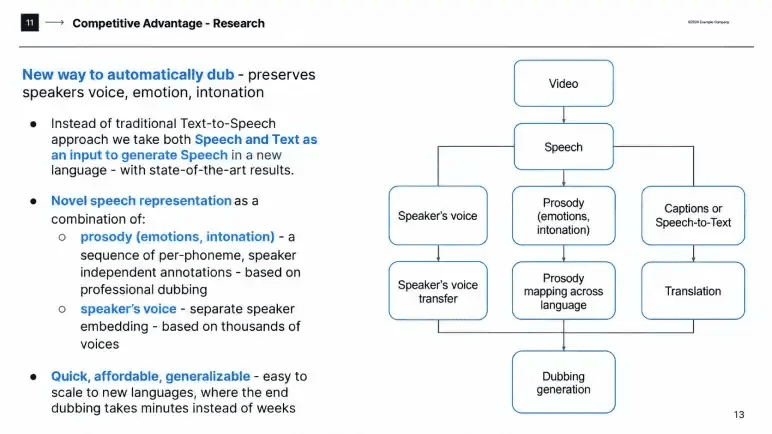
The most technical slide, and it stays impressively readable.
The core claim: instead of standard text-to-speech, ElevenLabs feeds both speech and text into the model to generate speech in a new language, preserving the speaker’s voice, emotion, and intonation. A flow diagram walks from video to speech to a finished dub.
For a pre-seed audience, this is the right depth, enough to show there’s a real technical moat, without burying a non-technical investor in model architecture. It answers “why can’t a bigger player just copy this?” without pretending the answer is simple.
Takeaway: Your moat slide should convince a technical reader and stay legible to a non-technical one. Explain the “how” plainly, and save the deep detail for the follow-up.
Slide 14: Timeline (redacted)
Like Slide 11, this one is also a redacted slide. But a timeline slide normally lays out the company’s plan for the next 12–18 months: the milestones they’re aiming for, and what the money they’re raising will help them achieve.
Takeaway: A timeline slide shows investors your roadmap, where you’re headed and what their money will help you reach. It’s worth including in your own deck, even if you’d hide it in a public version.
And that’s the full deck: all 14 slides, including the two that ElevenLabs redacted.
You might notice a 15th slide if you open the file, but it’s just the cover shown again at the end, a closing bookend, so there’s nothing new to review there.
So that’s the whole ElevenLabs pitch: 14 slides, two of them blank, used to raise $2M. Before the broader lessons, one thing stands out: there’s nothing extra here. Each slide has a clear purpose, and that’s what makes the deck worth learning from.
What I liked most about the ElevenLabs deck?
Stepping back, here’s what stood out to me most: the things that make this deck punch well above its length:
The way the numbers hand off to each other
You can follow the whole pitch on the figures alone: $100/min and 2 weeks, down to 2 minutes, up to $50k a video and $110M a year. Each number leads into the next.
The bottom-up market sizing
Building from 10K ready-to-buy creators up to a concrete revenue number is the most credible market case I saw anywhere in the deck.
How selectively it uses proof
It skips the obvious claims and backs the important ones with real evidence, a working prototype, and a creator’s actual results, which keeps the deck short and convincing.
None of these are design tricks. They’re simple habits any founder can copy. It’s a genuinely strong deck, but not a perfect one. There are a couple of gaps worth knowing about before you model yours on it.
Where does the deck fall short?
For all its strengths, the deck leaves out two things I’d want to see before pitching:
The funding ask
The deck never says how much they’re raising or what they’ll spend it on, which is the whole point of a pitch. Without it, investors are left guessing. (This may have been one of the redacted slides, but it’s worth flagging.)
Unit economics
The deck says ElevenLabs charges about $1 per minute, but never what a minute of audio actually costs to produce. So there’s no way to tell if each sale makes money.
Neither gap stopped ElevenLabs from raising. But in a tougher market, these are the first two things an investor will ask about, so cover both in your deck.
Conclusion
The lesson from ElevenLabs’ pre-seed deck is simple: you don’t need 20 slides or slick design to raise money. You need to be clear.
Every slide does one job: name the problem, show the product, prove the market, and let the numbers tell the story. ElevenLabs did it in 14 slides, two of them blank, and walked away with $2M.
So keep yours simple. Say what you do, show that it works, and back it with real numbers. That’s what got ElevenLabs their first check, and it’s what will get you yours.
If you’re building your deck now, Upmetrics’ AI pitch deck generator gives you a proven slide-by-slide structure and an investor-ready deck in minutes. So you cover everything that matters, including the slides ElevenLabs left out.
Turn Your Story Into a Powerful Pitch
Create an investor-ready pitch deck that brings your business vision to life.

Frequently Asked Questions
How many slides is the ElevenLabs pitch deck?
Do I need traction to raise a pre-seed round?
How long should a pre-seed pitch deck be?
Can I copy the ElevenLabs deck structure for a non-AI startup?
More pitch decks, broken down
See all 26

Vinay Kevadia
Vinay Kevadiya is the founder and CEO of Upmetrics, the #1 business planning software. His ultimate goal with Upmetrics is to revolutionize how entrepreneurs create, manage, and execute their business plans. He enjoys sharing his insights on business planning and other relevant topics through his articles and blog posts. Read more