Executive Summary
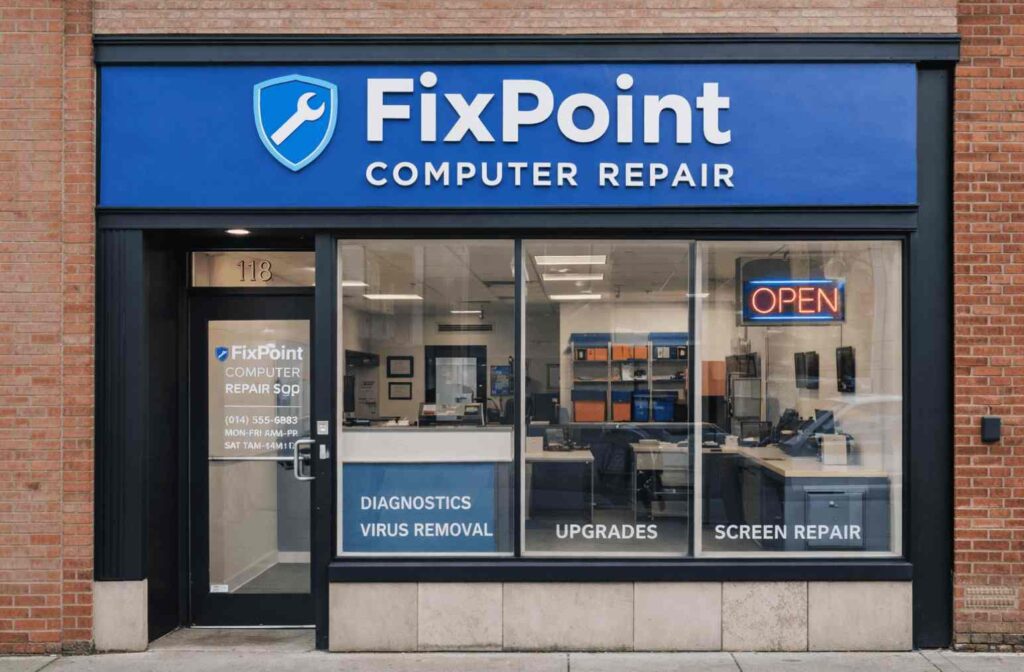
FixPoint Computer Repair is going to start as a walk-in computer and laptop repair shop situated at 118 West Main Street in downtown Columbus. The business meets the local demand for fast, affordable repairs, serving consumers and small businesses who prefer repairs over replacements.
The owner, Ajay Patel, has 8 years of hands-on technical experience and will manage customer intake, repairs, and business operations with 1 full-time technician.
The target market includes Columbus residents, students, freelancers, and small business owners within a three-mile radius of the storefront. This group increasingly relies on their devices, which are used for a longer lifespan before needing replacement.
The global computer hardware repair services market was valued at approximately $28.6 billion in 2024 and is projected to grow at a 7.6% CAGR from 2025 to 2033, as users continue to opt for professional repair services instead of replacing their devices.
The main competitive strengths of FixPoint include next-day diagnostics, open pricing, and owner-controlled quality. Although the Columbus market has approximately 15 independent repair shops, the majority of them are not located within the central downtown area or do not offer clear prices and rapid turnaround.
The main source of revenue is the consumer repair ticket, averaging $125, which covers hardware diagnostics, screen and battery replacement, operating system installation, and virus removal. Secondary revenue comes from small business IT support, billed at $95 per hour in Year 1. The business will not sell devices or pursue managed contracts, keeping inventory risk low and operations focused.
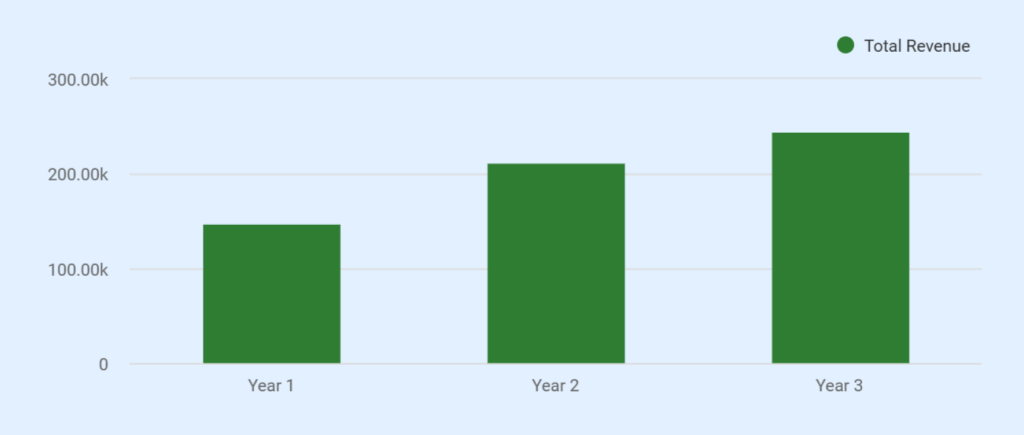
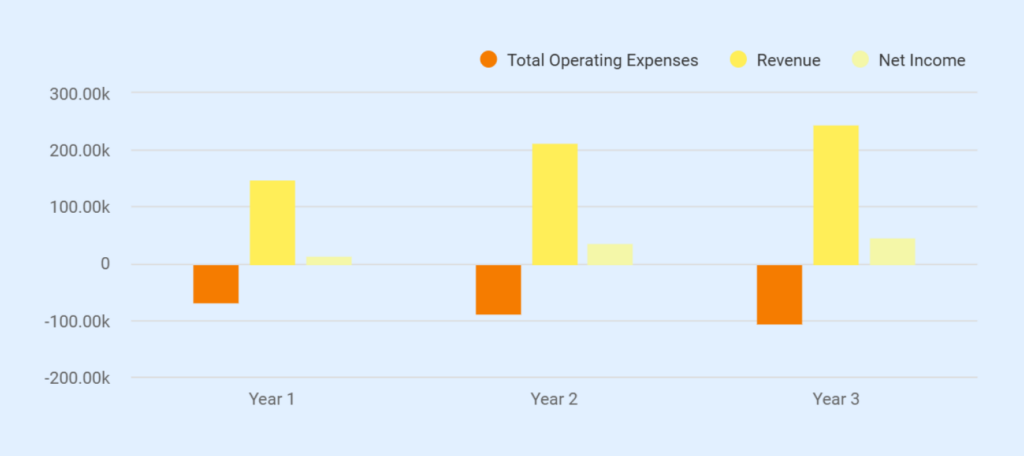
According to a conservative estimate of ticket sales and time, FixPoint will have revenue of $148,000 in the first year. Revenue will improve to $212,000 in Year 2 and to $245,000 in Year 3 due to the expansion of customers through local marketing and referrals. Gross margins are estimated as 62-65%. With no owner compensation, the business will experience a pre-tax net income of $14,300 in Year 1 and an increase of $45,400 in net income in Year 3 with a small owner salary.
The company will need $70,000 startup capital to cover the buildout, tools, preliminary inventory, and working capital. Ajay Patel will be carrying a personal capital of $20,000 and will be requesting a term loan of $50,000 with an amortization schedule of 7 years. The cash flow produced in the early days of sales will be sufficient to pay back debt, and in Year 3, the debt service coverage ratio will be more than 2.5x.

Don’t spend weeks on your first draft
Complete your business plan in less than an hour
Company Description
Business Identity
FixPoint Computer Repair is a single-member limited liability company, which is registered in the State of Ohio. It’s an in-store repair shop specializing in the repair of laptops, desktop computers, and other peripheral devices.
Hardware diagnostics, battery change, screen change, installing operating systems, and removing viruses are among the core services. Secondary services involve data recovery, device maintenance, and hourly IT services to smaller businesses.
FixPoint does not sell apparatus and does not seek big managed IT deals. This service-focused model limits operations to a few services, reducing inventory risk and ensuring predictable margins.
Legal Structure
The single-member LLC structure provides liability protection while maintaining tax simplicity. Business income passes through to the owner’s personal tax return. Ohio requires annual registration renewal and maintains standard regulatory requirements for service businesses.
Business registration and permits are included in startup costs at $1,500. Legal and accounting setup adds $2,000 for initial professional guidance.
Location and Facility
FixPoint is based in a 600-square-foot leased retail space at 118 West Main Street, Columbus, OH 43215, a business area offering exposure and accessibility to pedestrians.
The space includes:
- A customer intake and waiting area
- Two repair workbenches
- Secured parts storage and inventory
- A small administrative office area
The layout supports efficient intake, repair workflow, and customer pickup without excess space or overhead.
Ownership
Ajay Patel is the sole owner and operator (100% ownership). He brings technical expertise in computer hardware and software repair, with hands-on experience diagnosing and fixing consumer devices.
The owner’s role encompasses:
| Function | Responsibility |
|---|---|
| Repairs | Direct repair work alongside a technician |
| Customer intake | Diagnosis explanation, pricing, and pickup coordination |
| Vendor coordination | Parts ordering, supplier relationships |
| Financial management | Bookkeeping, cash flow monitoring, and reporting |
The owner works in the business daily, not as an absentee manager. This direct involvement ensures quality control and keeps labor costs manageable during the startup phase.
Operating Philosophy
FixPoint is built on three principles: fast turnaround, transparent pricing, and owner-operated quality control.
Most repairs will be completed within 24 to 48 hours, with pricing communicated upfront after diagnosis. The owner personally handles repairs and oversees every job, ensuring quality control. This model builds trust in a market where customers often feel uncertain about repair quality and pricing.
The business launches with conservative volume assumptions and no owner compensation in year 1. Growth is gradual and funded by operations, not additional debt.
Regulatory Compliance
FixPoint complies with all local, state, and federal regulations necessary to operate a computer repair business in Ohio. This includes:
- Business Registration: Ohio requires businesses to register annually with the Ohio Secretary of State.
- Licensing and Permits: The business complies with Ohio’s service business licensing and permit requirements, ensuring that it meets local city ordinances.
- Data Security and Consumer Protection: The company adheres to regulations related to secure data handling, ensuring customer privacy and the protection of personal information. This includes compliance with the Ohio Data Protection Act.
- Electronic Waste Handling: As a business that handles electronic devices, FixPoint follows local and state guidelines for managing and recycling electronic waste.
These regulatory measures ensure that FixPoint operates legally and ethically, while maintaining a reputable and trustworthy service for customers.
Service offerings
FixPoint concentrates on a defined set of high-frequency repairs rather than a broad “fix everything” model.
Each repair follows a structured intake process. The device is logged at the counter, the issue is documented, and a diagnostic fee is quoted when required. After testing, the customer receives a clear repair estimate before any work begins. No repair proceeds without written approval.
The service mix is intentionally narrow. The shop does not take on motherboard-level rebuilds, large commercial IT rollouts, or open-ended troubleshooting projects that tie up bench capacity. This keeps workflow predictable, reduces stalled jobs, and supports consistent margins.
Computer & Laptop Diagnostics
Computer and laptop diagnostics serve as the primary entry point for most customer interactions. It is an expedited service that will help define the issues, set the scope of repair, and transform qualified jobs into authorized work without committing labor early.
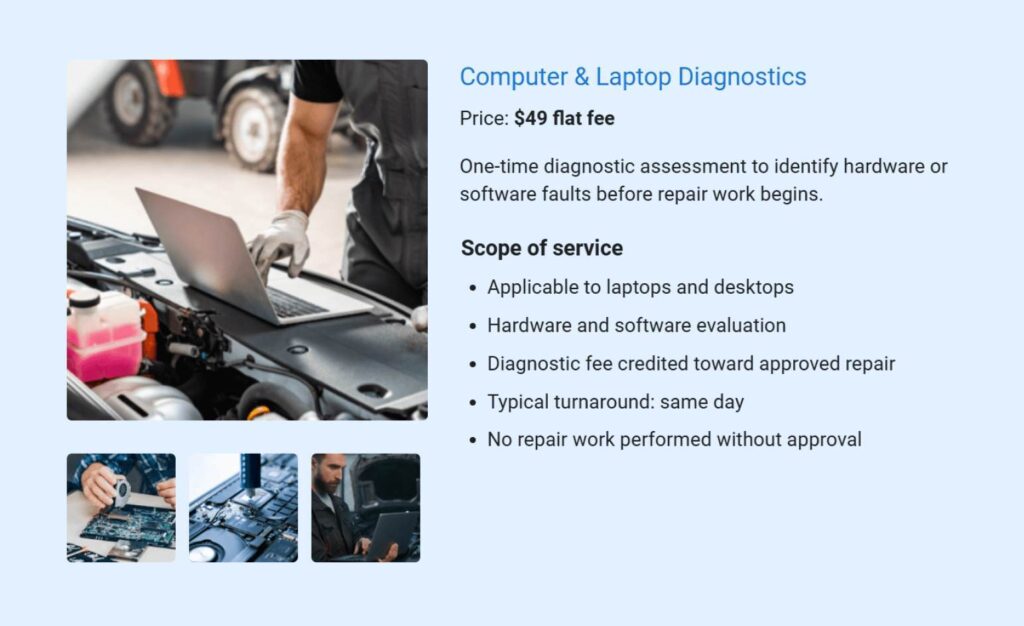
This will save on rework, guarantee the scheduling accuracy, and also make sure that the technician’s time is only spent on approved repairs.
Screen Replacement Services
Screen replacement is a high-frequency repair category driven by accidental damage and normal wear. The service follows a standardized replacement process with predictable labor time and model-based pricing.
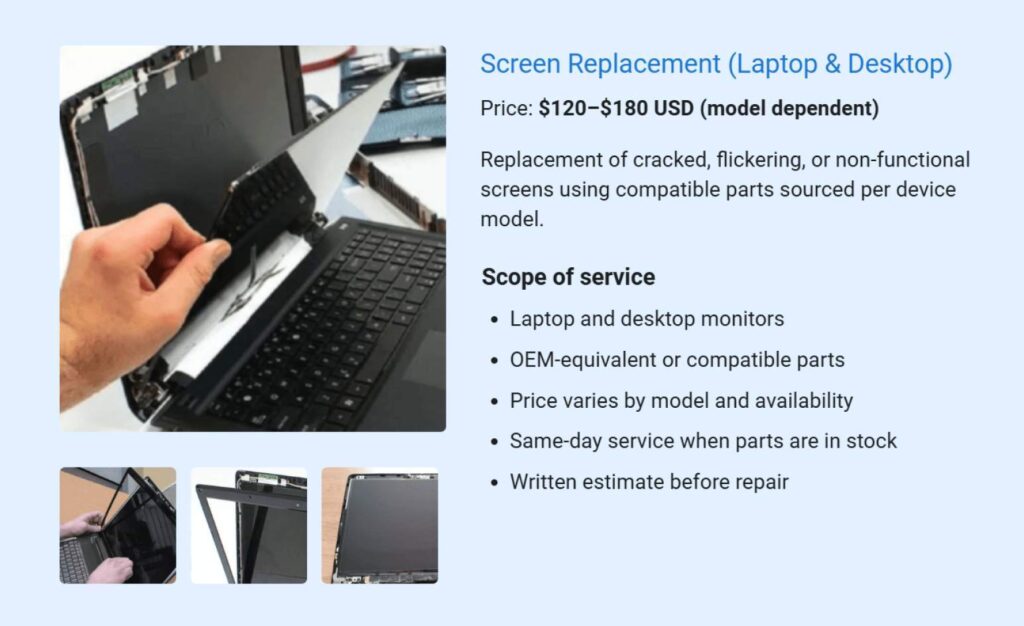
The consistency of parts sourcing and labor time allows reliable turnaround and stable margins.
Battery Replacement Services
Battery replacement restores usability in aging portable devices without requiring full device replacement. The service involves limited diagnostic complexity and short execution windows.
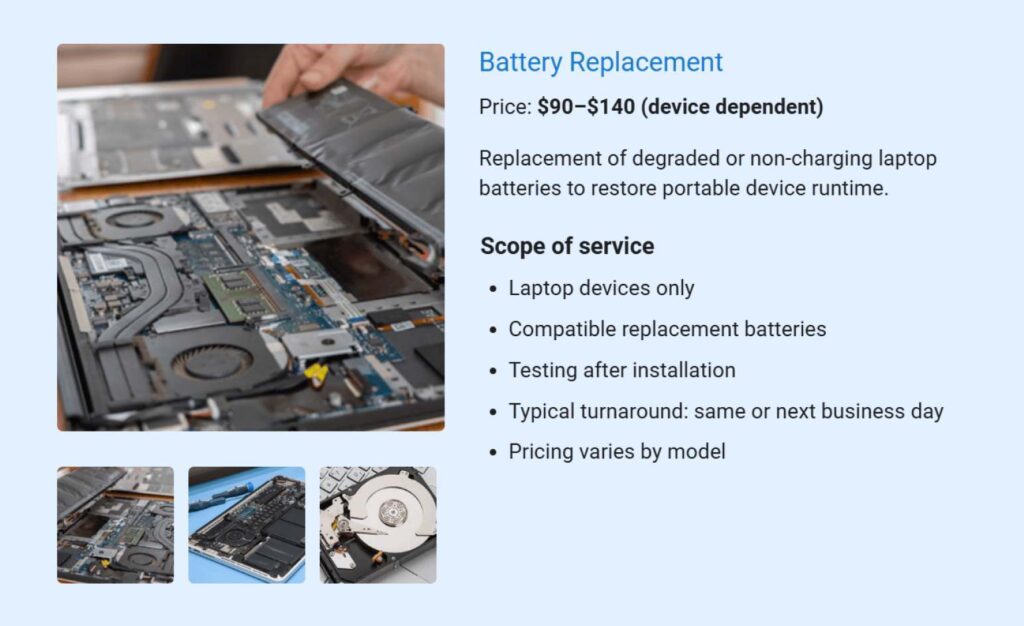
This service balances low parts risk with consistent labor requirements, supporting steady daily throughput.
Operating System Installation & Repair
Operating system services address software corruption, performance degradation, and failed updates. These services rely mainly on labor, with a streamlined process from intake to completion.
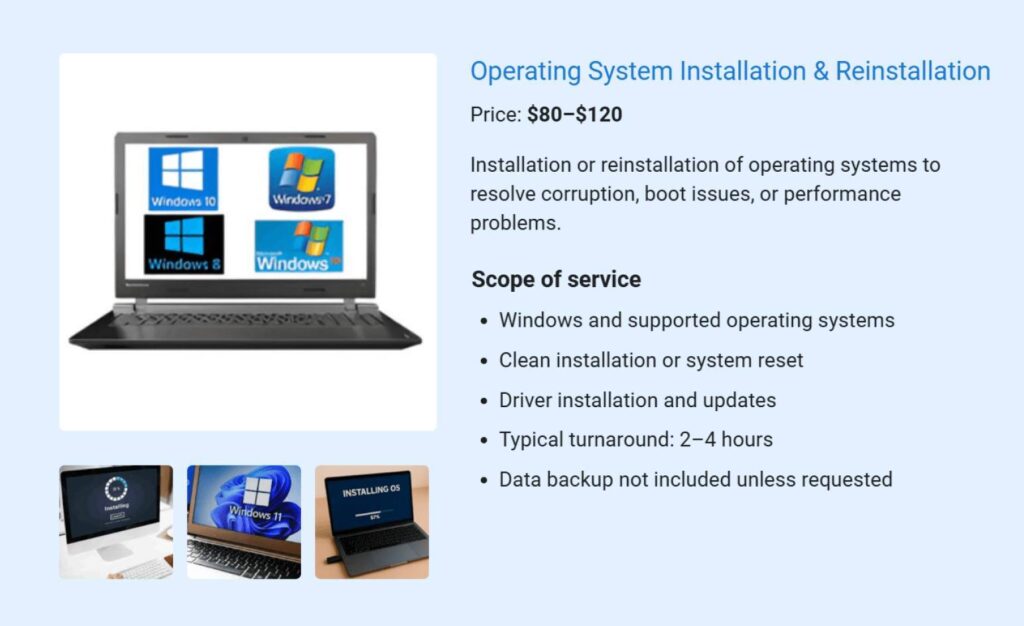
The defined scope and low inventory dependency make this service easy to schedule alongside hardware repairs.
Virus Removal & System Cleanup
Virus removal and system cleanup services address malware-related performance and usability issues. Demand is steady among home users and freelancers.
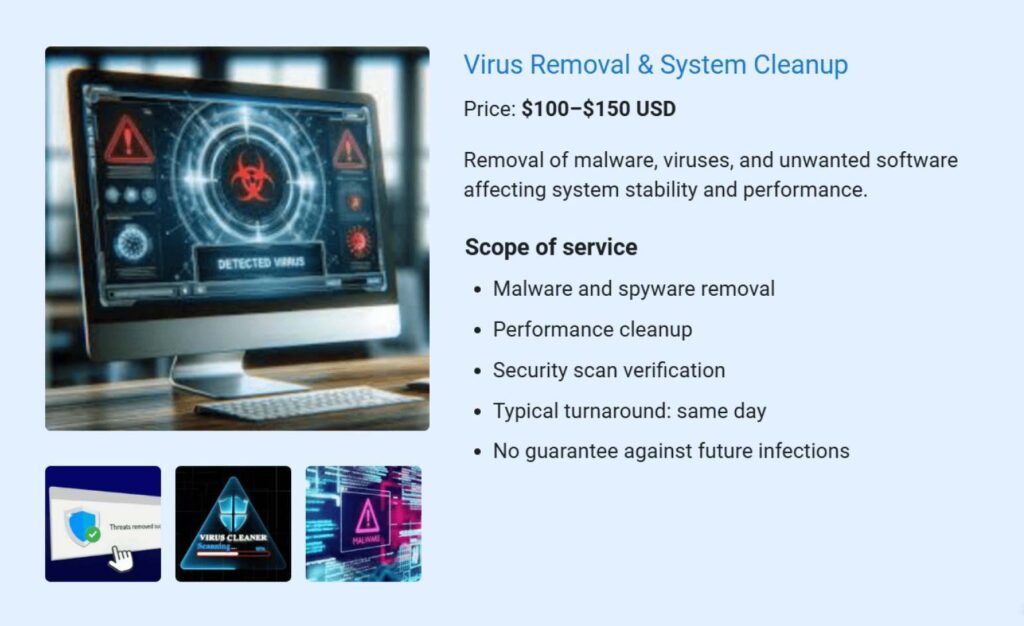
This service supports consistent demand with minimal material cost and controlled labor input.
Small Business IT Support Services
A small business IT support service provides supplemental revenue through scheduled, time-based work. The service targets businesses that need occasional assistance without long-term service commitments.
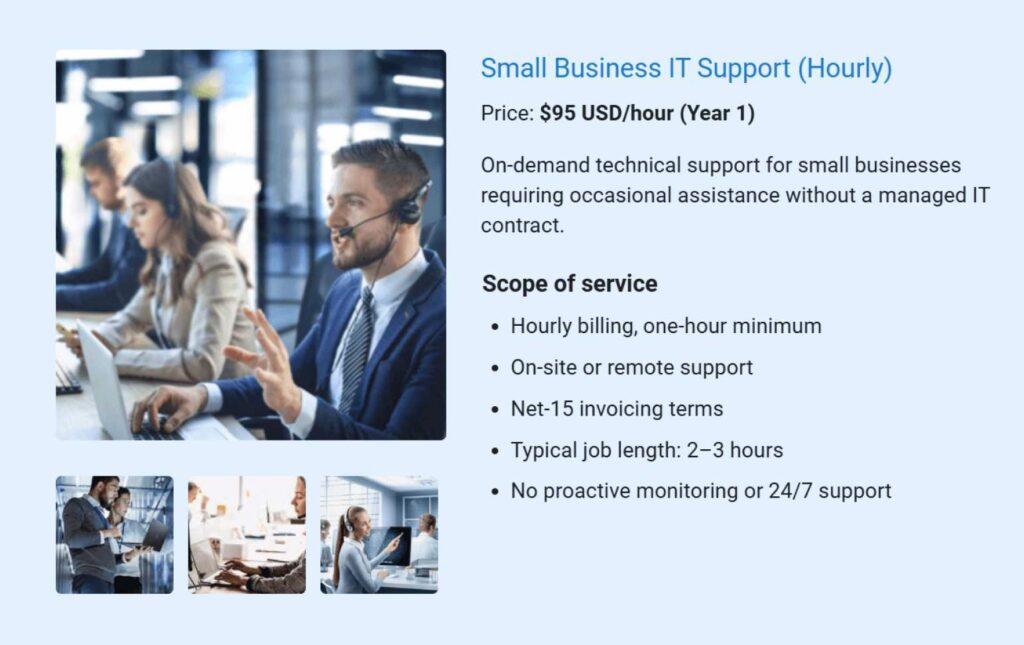
Scheduled work improves technician utilization without disrupting walk-in repair operations.
Data Recovery Services
Data recovery services address accidental deletions and storage failures. Simple cases are handled internally, while complex physical damage cases are coordinated externally.
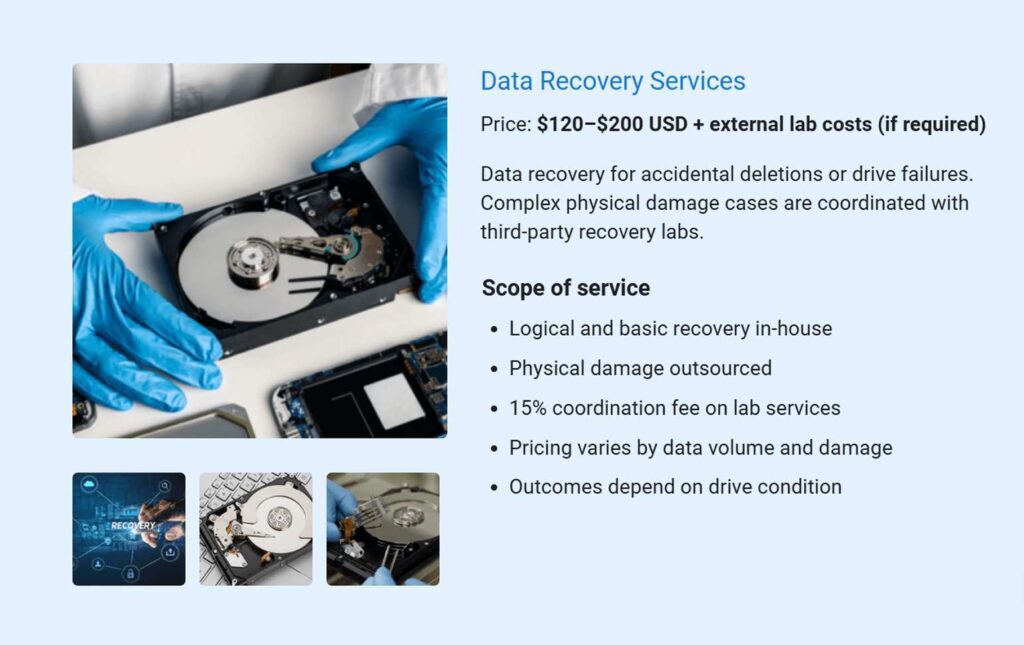
This service broadens capabilities by offering data recovery without the need for specialized equipment or significant inventory investment. Basic recovery is handled in-house, while complex physical damage cases are outsourced to third-party labs.
Flat-fee pricing is used for common repairs where time and parts requirements are known. For example, most screen or battery replacements are completed within one to two hours of bench time, with a 24 to 48-hour turnaround depending on part availability. More complex jobs are quoted separately.
Market Analysis
Local Market Context
Columbus’s population is projected to reach approximately 946,000 by 2026, with over 2.2 million people in the broader metropolitan area. As the largest city in Ohio, it supports a dense base of students, professionals, and small businesses that rely on laptops and desktops for daily work and study.
At the same time, the cost of replacing devices has increased, especially for productivity-focused laptops. For many users, repairing a $125–$250 issue is more practical than replacing a $900–$1,500 device. This cost dynamic, combined with heavy daily device usage, creates steady demand for local repair services rather than seasonal or one-time activity.
The downtown location further captures foot traffic from nearby neighborhoods, campuses, and office corridors, reinforcing consistent walk-in demand.
High population density alone would not support repair demand without widespread device usage. Over 96% of homes in Columbus have a computer, and over 92% have a subscription to broadband internet. This means computing technologies have become part of everyday life, work, education, and personal management.
The city’s younger population, along with a high concentration of students and early-career professionals, increases the demand for device usage. This, in turn, leads to a higher level of device malfunctions and performance problems that need prompt repair.
Due to these reasons, the local walk-in repair shops are the best. They maintain low downtime and trouble. Even a minor malfunction in a city where people use devices at work, study, and in their everyday activities makes a new repair urgent. Customers do not want to wait till the schedules on repair set up by large companies.
U.S. Industry Overview
The electronic and computer repair business in the U.S. generates approximately $17 billion annually, and most of these are smaller, independent stores. The competition is local due to the division of the market into numerous small units. The customers seek rapid diagnosis, transparent prices, and reliable hardware and data services.
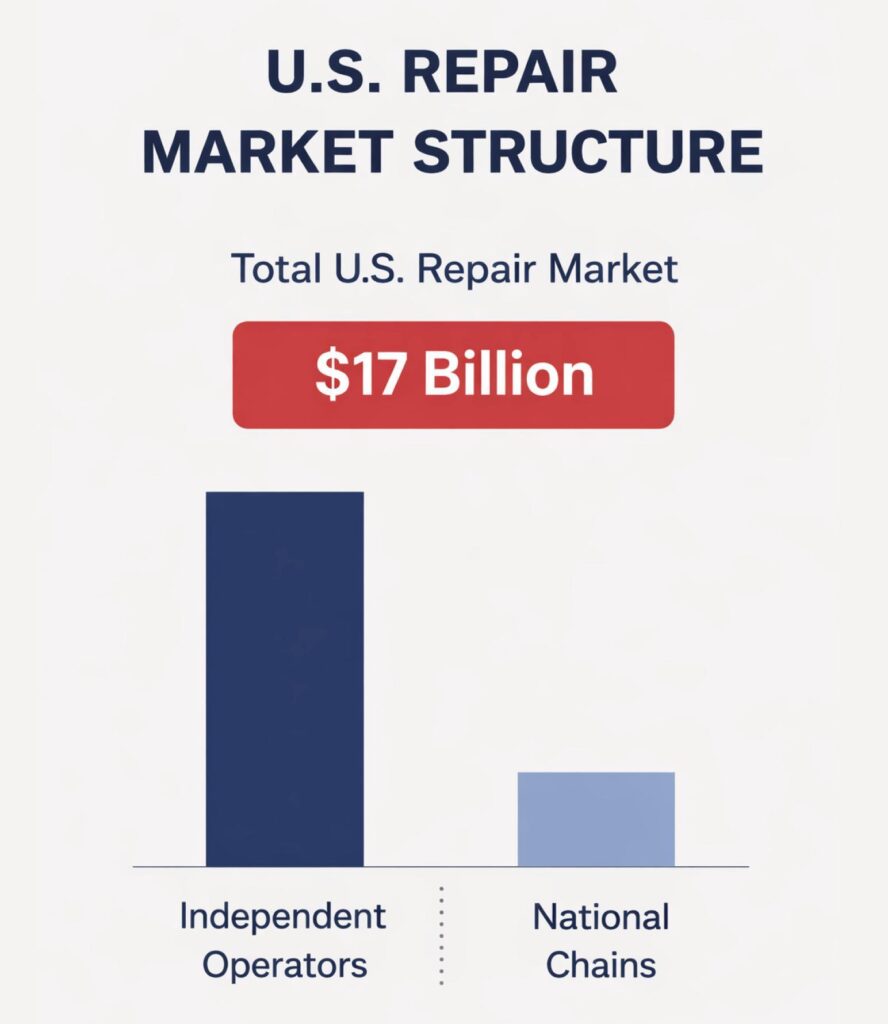
Hardware has fallen in price; however, repair can continue to save on productivity devices such as laptops and desktops, where downtime is detrimental to business. The constant demand and the presence of numerous competitors facilitate the work of independent stores that center on a rapid pace, rapid turnover, and transparent prices.
Global Industry Trends
The global electronic parts repair market is predicted to expand, and the computer part repair market is set to reach $7.26 billion in 2026. This expansion is due to the extended life of devices, more complex systems, and the reality that it is cheaper to fix rather than to replace.
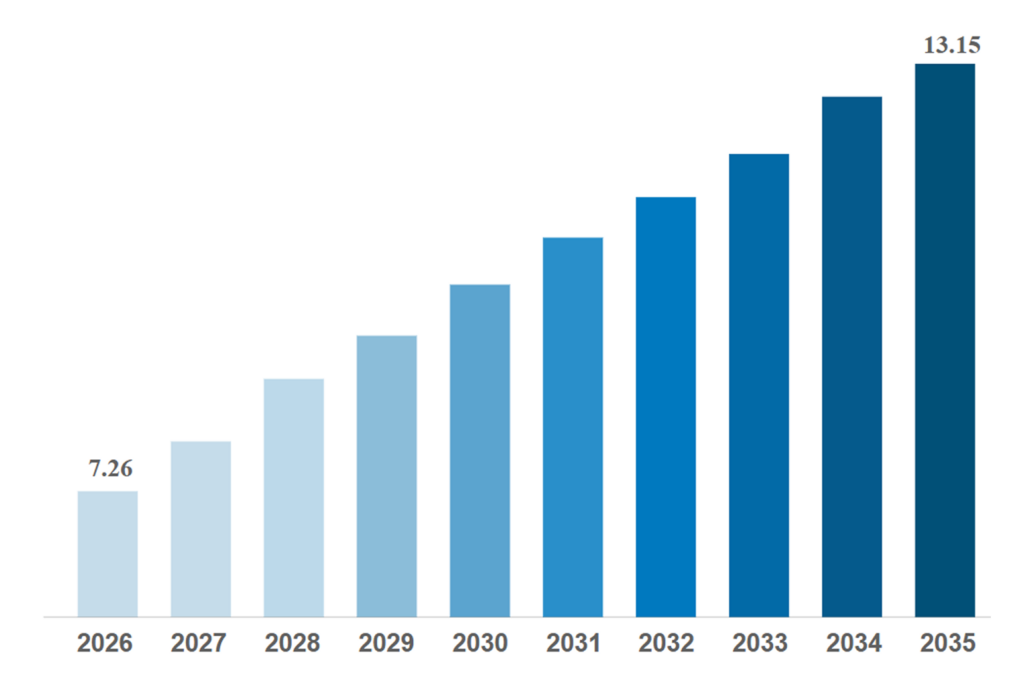
There is a growing trend that repair is not a down-and-out or a dying service worldwide. Rather, it has become a sustainable coating of the electronic life cycle, with the help of economic and behavioral changes.
Target Customer Focus
The focus is on customers who make urgent, proximity-based decisions:
- Local residents and students dealing with device failures that disrupt work or study
- Remote employees and freelancers needing repairs within a short timeframe
- Small businesses requiring occasional technical support
These customers value speed, price transparency, and trust over promotions or brand recognition. The business emphasizes availability, the range of repairs offered, clear turnaround times, and service expectations, rather than discounts or package deals.
Competitive Landscape
The repair services market in Columbus reflects the national pattern: highly localized and execution-driven. Many independent shops in the city are listed in local directories and review sites, yet there is no single player that controls the industry. The customer reviews have always focused on the turnaround time, clarity of pricing, and trust rather than brand name or size.
Large retailers and manufacturer service options exist, but often involve longer wait times or higher friction, especially for out-of-warranty devices. This makes a lot of customers seek local providers with direct communication and quicker resolution.
Direct Competitors
Direct competition consists of independent walk-in repair shops in Columbus and neighboring areas, specialty stores dedicated to a particular type of device, and service desks of major electronics retailers. The competition between these providers is mainly based on price, perceived knowledge, and turnaround time.
| Competitor Name | Service Focus | Competitive Position |
|---|---|---|
 |
In-store computer diagnostics and repair | Strong brand recognition, but longer wait times and less personalized service |
 |
Computer and laptop repair | Competes on price and walk-in availability |
 |
Device repair, including computers | Broad service scope but less specialization in computer-only repairs |
 |
Electronics and computer repair | Franchise model with standardized pricing and processes |
Indirect Competitors
Indirect competitors include manufacturer mail-in repair programs, which often involve shipping delays and higher costs, as well as DIY repair attempts using online guides and aftermarket parts. While DIY options attract users with technical skills, many end up with incomplete repairs or further damage, prompting them to seek professional help.
National retailer service portals also compete indirectly, but they typically lack urgency and personalized support, especially for time-sensitive repair needs.
| Competitor Type | Example | How They Compete |
|---|---|---|
| Manufacturer Mail-In Repair | Apple, Dell, HP service programs | Longer turnaround times, shipping friction, and higher costs for out-of-warranty devices |
| Big-Box Retail Service Counters | Best Buy Geek Squad | Less flexible scheduling and slower service for non-priority repairs |
| DIY Repair & Online Guides | iFixit, YouTube repair tutorials | Appeals to technically confident users but carries risk and no service warranty |
| Replacement Purchase | New laptop or desktop purchase | Chosen when repair cost approaches replacement price |
Marketing Plan
Marketing Objective
FixPoint’s marketing objective is to generate consistent walk-in repair volume within its immediate trade area while building repeat and referral business over time. The strategy prioritizes high-intent demand capture and local visibility rather than broad brand awareness or paid reach beyond the service radius.
Marketing efforts are closely tied to staffing capacity, minimizing the risk of overwhelming demand that the business cannot handle effectively.
Primary Acquisition Channels
FixPoint focuses its customer acquisition efforts on channels that target high-intent, location-based demand rather than broad awareness or promotion.
Local Search and Map Listings
Most new customers find FixPoint by searching for urgent repair solutions nearby. The primary keywords targeted include:
- “computer repair Columbus OH.”
- “laptop screen repair near me”
- “MacBook repair Columbus”
- “PC repair downtown Columbus”
- “Battery replacement laptop Columbus.”
- “Virus removal Columbus OH.”
The Google Business Profile is structured around these high-intent searches. Service categories are clearly defined, repair types are listed individually, and pricing ranges are shown where possible. The profile includes:
- Before-and-after repair photos (screen replacements, battery swaps)
- Bench workspace images to signal credibility
- Turnaround time references in service descriptions
- Active review responses highlighting speed and clarity
The strategy focuses on proximity ranking and conversion rather than broad content reach. Since most repair decisions are made within minutes of search, visibility in the map pack and strong review signals matter more than long-form awareness content.
Reviews and Reputation Management
Customer reviews serve as a critical trust signal in repair services. FixPoint actively requests reviews following completed repairs and addresses feedback promptly. The volume and consistency of positive reviews facilitate the conversion and local search visibility.
Reputation management is centered on service quality and communication instead of incentivized/promotional review strategies.
Storefront Visibility and Walk-In Traffic
The downtown storefront spot serves the local organic pedestrian traffic of residential, campus, and mixed-use neighborhoods. Clear signage and visible operating hours reinforce walk-in accessibility.
This channel requires minimal ongoing cost and complements digital discovery by converting nearby awareness into immediate visits.
Referral and Repeat Business Strategy
FixPoint builds repeat revenue through structured follow-up, not passive goodwill.
After each completed repair, customers receive:
- A written summary of the work performed
- Clear warranty terms
- Preventive care recommendations
- A reminder of related services (battery health checks, tune-ups, data backup)
Customers are encouraged to leave a Google review at pickup through a direct QR prompt at the counter. Review acquisition is built into the closing process. For small business clients, repeat work is supported through:
- Simple service logs for each visit
- Net-15 billing for convenience
- Scheduled quarterly check-ins for system cleanups or updates
Rather than offering cash referral bonuses, the shop relies on visible proof of service quality: documented repairs, consistent turnaround times, and public review responses. In a local repair market, reputation density in a small geographic area drives recurring demand more reliably than one-time incentives.
Don’t waste time using spreadsheets
Operations Plan
Operating Model
FixPoint operates as a walk-in computer repair shop with a controlled intake and labor-based capacity management model. The shop will not accept jobs simply because a customer requests them. The timing of repair work is determined by the availability of technicians, so there is no backlog, no hurry, and no compromise on quality.
The store operates six days a week with normal retailing hours. Each customer begins at the service desk, where the representative will record the device, document the issue, and obtain permission to proceed with repair. No labor is performed without written customer authorization.
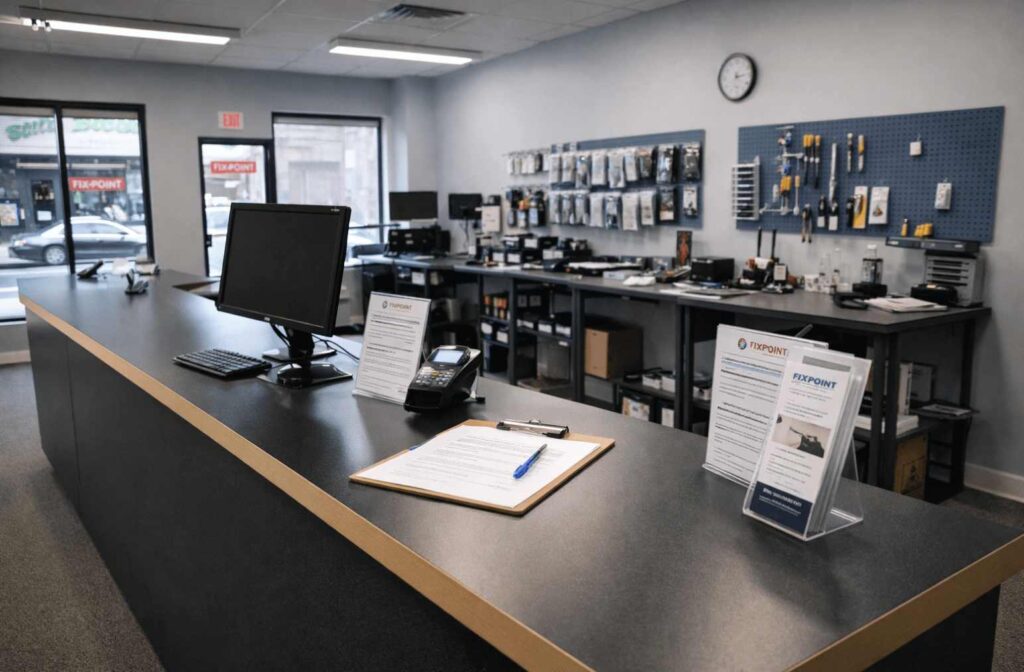
This intake-first model ensures predictable workflow and limits unapproved labor costs.
Staffing and Labor Structure
The shop operates with two people: the owner and one full-time technician.
| Role | Compensation | Responsibilities |
|---|---|---|
| Owner-operator | $0 Year 1; $36,000 Year 2; $48,000 Year 3 | Repairs, intake, vendors, finances |
| Technician | $38,000 Year 1; $40,000 Year 2; $42,000 Year 3 | Repair execution, diagnostics |
The technician is hired from day one to provide adequate capacity for projected volume. Technician wages include a 10% load for payroll taxes and benefits.
No additional hires are planned through year 3. If volume exceeds two-person capacity, the first response is extended hours or scheduling optimization rather than immediate hiring.
Repair Workflow and Turnaround Management
FixPoint follows a standardized repair workflow:
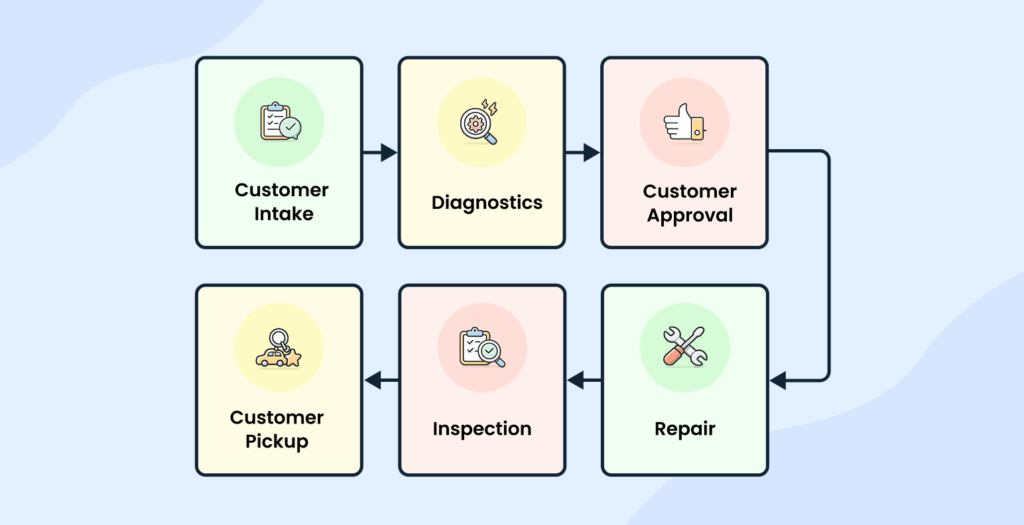
- Repair per technician: Each technician completes an average of 10-12 repairs per week, based on the difficulty of the repair.
- Repair capacity for the week: The current setup allows the shop to repair up to 25 people a week.
- Mean time to repair: The vast majority of repair jobs take an average of 1-2 hours, with a complete turnaround of 24-48 hours based on the availability of parts.
- Parallel job handling capacity: A technician will be able to handle 2-3 repairs simultaneously during the slow times.
- Daily intake limit: The shop is limited to receive no more than 10 repairs a day to maintain a continuous high quality and turnaround time.
Only minor repairs are hurried to be completed the same day. The 48-hour turnaround prioritizes more complex jobs to maintain the workflow. It is a structured process that eliminates rework, minimizes customer complaints, and makes the daily operations predictable.
Parts Sourcing and Inventory Control
FixPoint keeps a small stock of high-frequency parts and consumables on hand and orders less frequently used components at customer requests. This will reduce inventory holding expenses, minimize the risk of obsolescence, and conserve working capital.
The company obtains parts based on set deals with distributors to ensure that it keeps a steady supply and price. Management checks the inventory regularly and orders stock according to service mix trends observed.
Quality Control and Rework Prevention
The owner checks each job before returning the repaired items to the customer, ensuring the repair is complete and all services were performed as promised.
The store also keeps a record of all warranty repairs, helping identify recurring issues and whether they are caused by faulty components, poor repairs, or customer actions. This process helps improve customer satisfaction.
Customer Communication and Payment Handling
FixPoint also keeps customers updated about repairs in a more transparent manner, giving them updates about the status of the repair and any delays due to parts. When the customer collects the device, payment is made either in cash or by card.
Small business clients are billed on Net-15 terms and therefore have no consumer accounts receivable and immediate cash flow. The payment system makes the cash flow straightforward and reduces operating risk.
Operational Risk Controls
FixPoint minimizes risk through establishing definitive boundaries of its actions. The shop does not:
- Give managed IT contracts
- Promise 24-hour/emergency service
- Retail equipment or holding up costly inventory
- Add services that require more staff than the one staff member has
FixPoint has contingency plans for primary risks:
- Technician or Owner Unavailability: If the technician or owner is unavailable, the shop can remain open or reschedule repairs to continue without hiring new staff immediately.
- Parts Delays Beyond 48 Hours: If a part is delayed, the owner will notify the customer, cancel the repair if necessary, and provide an updated timeline on when the work can be completed.
- Exceeding Daily Intake Capacity: When repair demand exceeds available capacity, the shop will prioritize jobs based on urgency and extend operating hours if needed.
Expansion relies on actual customer demand and available staff capacity. Decisions are based on whether the current team can handle the projected work, rather than assumptions or estimates.
Financial Plan
The financial forecast of FixPoint is based on the operating realities of a small, owner-operated computer repair company with low equipment intensity and labor capacity constraints.
The model assumes stable prices, controlled costs, and gradual growth in utilization rather than immediate full performance. The owner will not receive compensation in the first year to maintain cash flow and cover debt interest.
The business drives revenue growth through higher daily repair volume, repeat customers, and limited small-business support work. The forecast does not rely on price increases, service expansion, overtime labor, or unmanaged intake growth. Instead, it ties financial performance directly to execution consistency and controlled throughput.
Startup Costs
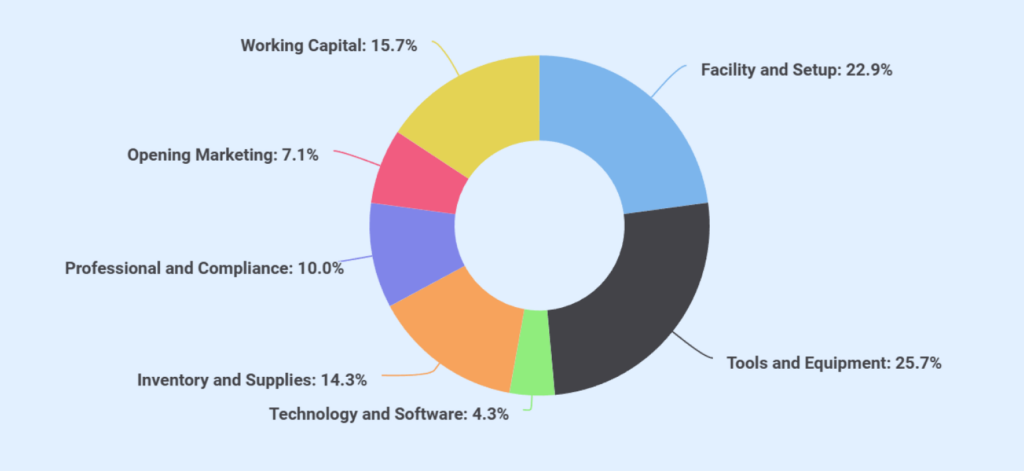
The service-based nature of the business is reflected in its startup costs. FixPoint invests primarily in tools, diagnostic equipment, initial parts stock, and working capital, rather than heavy fixed assets. The startup budget is sufficient to cover initial operations without relying on deferred costs or unpaid suppliers.
The nature of the business is service-based and is reflected in startup costs. FixPoint is not heavily invested in heavy fixed assets but increases investment in tools, diagnostic equipment, initial parts stock, and working capital. The amount of liquidity needed in the startup budget is enough to fund initial operations without depending on deferred costs or unpaid suppliers.
| Category | Line Item | Amount |
|---|---|---|
| Facility and Setup | Lease security deposit (2 months) | $4,000 |
| First month’s rent | $2,000 | |
| Minor build-out and signage | $10,000 | |
| Tools and Equipment | Diagnostic tools and meters | $6,000 |
| Repair tools and kits | $5,000 | |
| Workbenches and storage | $4,000 | |
| POS hardware and peripherals | $3,000 | |
| Technology and Software | Repair management software | $1,500 |
| Accounting and admin software | $1,500 | |
| Inventory and Supplies | Initial parts inventory | $8,000 |
| Consumables and packaging | $2,000 | |
| Professional and Compliance | Business registration and permits | $1,500 |
| Insurance (initial premiums) | $3,500 | |
| Legal and accounting setup | $2,000 | |
| Opening Marketing | Launch promotions and signage | $2,500 |
| Website and local SEO setup | $2,500 | |
| Working Capital | Opening cash buffer | $11,000 |
| Total Startup Costs | $70,000 |
Funding Sources
| Source | Amount | Share |
|---|---|---|
| Bank term loan | $50,000 | 71% |
| Owner capital | $20,000 | 29% |
| Total Funding | $70,000 | 100% |
Key Financial Assumptions
| Category | Key Assumptions |
|---|---|
| Forecast Period | 3 years (Year 1 stabilization, Years 2-3 growth) |
| Operating Days | 6 days per week |
| Average Repair Ticket | ~$125 |
| Repair Volume Ramp | Gradual increase in tickets per day |
| Service Mix | ~70% consumer repairs, ~30% small business hourly |
| Pricing Strategy | Flat-fee repairs and hourly business support |
| COGS | Parts, consumables, card fees, and job-linked labor |
| Parts Cost | ~20% of repair revenue (declining modestly over time) |
| Rent | ~$2,000 per month |
| Marketing | $600–$800 per month |
| Owner Compensation | $0 (Year 1), partial in Years 2–3 |
| Receivables | None for consumers; limited Net-15 for businesses |
| Tax Treatment | Pre-tax model only |
Revenue Forecast (3 Years)
Revenue growth is driven by increased repair volume through referrals and local visibility rather than service expansion.
| Year 1 (in $) | Year 2 (in $) | Year 3 (in $) | |
|---|---|---|---|
| Consumer | 104,000 | 148,000 | 168,000 |
| Repair Services | |||
| Small Business Hourly Support | 44,000 | 64,000 | 77,000 |
| Total Revenue | 148,000 | 212,000 | 245,000 |
Income Statement
| Line Item | Year 1 (in $) | Year 2 (in $) | Year 3 (in $) |
|---|---|---|---|
| Revenue | 148,000 | 212,000 | 245,000 |
| Parts & Consumables | (34,000) | (46,000) | (52,000) |
| Direct Labor | (22,000) | (30,000) | (34,000) |
| Total COGS | (56,000) | (76,000) | (86,000) |
| Gross Profit | 92,000 | 136,000 | 159,000 |
| Gross Margin | 62.2% | 64.2% | 64.9% |
| Operating Expenses | |||
| Rent | (24,000) | (24,600) | (25,200) |
| Utilities & Internet | (4,200) | (4,400) | (4,600) |
| Insurance | (3,600) | (3,800) | (4,000) |
| Marketing | (5,000) | (5,500) | (6,000) |
| Software & Tools | (2,400) | (2,500) | (2,600) |
| Technician Fixed Wages (idle time) | (28,000) | (30,000) | (32,000) |
| Owner Compensation | 0 | (18,000) | (30,000) |
| Total Operating Expenses | (67,200) | (88,800) | (104,400) |
| EBITDA | 24,800 | 47,200 | 54,600 |
| Depreciation | (6,000) | (6,000) | (6,000) |
| Interest Expense | (4,500) | (3,800) | (3,200) |
| Net Income (Pre-Tax) | 14,300 | 37,400 | 45,400 |
Cash Flow Statement
| Line Item | Year 1 (in $) | Year 2 (in $) | Year 3 (in $) |
|---|---|---|---|
| Net Income (Pre-Tax) | 14,300 | 37,400 | 45,400 |
| Depreciation (Non-Cash) | 6,000 | 6,000 | 6,000 |
| Working Capital Changes | (2,300) | (2,400) | (2,400) |
| Cash from Operations | 18,000 | 41,000 | 49,000 |
| Equipment & Tools (Capex) | (18,000) | 0 | 0 |
| Cash from Investing | (18,000) | 0 | 0 |
| Loan Proceeds | 50,000 | 0 | 0 |
| Owner Capital Contribution | 20,000 | 0 | 0 |
| Loan Principal Repayment | (6,000) | (6,000) | (6,000) |
| Owner Distributions | 0 | (10,000) | (20,000) |
| Cash from Financing | 64,000 | (16,000) | (26,000) |
| Net Change in Cash | (6,000) | 35,000 | 43,000 |
| Beginning Cash | 28,000 | 22,000 | 57,000 |
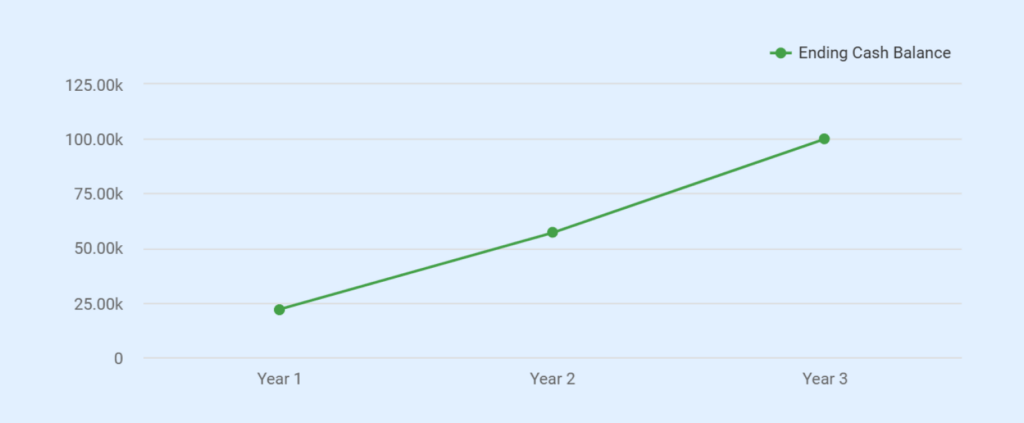
| Ending Cash | 22,000 | 57,000 | 100,000 |
Balance Sheet
| Line Item | Year 1 (in $) | Year 2 (in $) | Year 3 (in $) |
|---|---|---|---|
| Assets | |||
| Cash | 22,000 | 57,000 | 100,000 |
| Inventory & Parts | 8,000 | 10,000 | 12,000 |
| Prepaid Expenses | 3,000 | 3,200 | 3,400 |
| Total Current Assets | 33,000 | 70,200 | 115,400 |
| Equipment & Tools (Net) | 12,000 | 6,000 | 0 |
| Total Assets | 45,000 | 76,200 | 115,400 |
| Liabilities | |||
| Accounts Payable | 4,000 | 5,000 | 6,000 |
| Term Loan Balance | 44,000 | 38,000 | 32,000 |
| Total Liabilities | 48,000 | 43,000 | 38,000 |
| Equity | |||
| Owner Capital | 20,000 | 20,000 | 20,000 |
| Retained Earnings | (23,000) | 13,200 | 57,400 |
| Total Equity | (3,000) | 33,200 | 77,400 |
| Liabilities + Equity | 45,000 | 76,200 | 115,400 |
Break-Even Analysis
| Category | Line Item | Monthly Amount (USD) |
|---|---|---|
| Fixed Operating Costs | Rent | 2,000 |
| Utilities & Internet | 350 | |
| Insurance | 300 | |
| Software & Tools | 200 | |
| Marketing | 420 | |
| Technician Fixed Wages (idle time) | 2,330 | |
| Owner Draw (steady-state) | 2,500 | |
| Total Fixed Monthly Costs | 10,100 | |
| Variable Cost Structure | Parts & consumables | ~23% of revenue |
| Job-linked technician labor | ~15% of revenue | |
| Rework & spoilage allowance | ~3% of revenue | |
| Total Variable Cost Ratio | ~41% of revenue | |
| Contribution Margin | 1 – variable cost ratio | ~59% |
| Break-Even Calculation | Fixed costs ÷ contribution margin | 10,100 ÷ 0.59 |
| Monthly Break-Even Revenue | ~17,100 | |
| Annualized Break-Even Revenue | ~205,000 | |
| Unit-Level View (Context) | Average ticket value | ~$125 |
| Tickets needed per month | ~137 | |
| Tickets per operating day | ~5.3 | |
| Median-case capacity (Y2+) | ~6–7 tickets/day | |
| Margin of Safety (Steady-State) | Avg monthly revenue (Y2) | ~17,700 |
| Revenue above break-even | ~600 |
Funding Requirements
FixPoint Computer Repair needs startup financing of $70,000 to start its first physical location and cover initial operation needs during the initial ramp-up phase. The financing request aligns with the business’s operating model, which prioritizes controlled execution, low capital requirements, and sufficient working capital over aggressive growth or heavy fixed investment.
The company seeks a $50,000 bank term loan, supported by a $20,000 owner capital contribution. This equity investment shows the owner’s commitment and reduces lender risk. The loan amount is appropriate for the business scale and aligns with its cash-generating capacity.
Loan term details:
- Loan Amount: $50,000
- Repayment Term: 7-year amortization
- Interest Rate: Estimated at 8.5% annually (subject to approval)
- Purpose: Primarily used for build-out, equipment, inventory, and initial working capital
- Repayment Schedule: Monthly installments with a principal and interest structure
The loan will cover one-time startup costs, including tools, equipment, initial inventory, and working capital, and will not be used for ongoing operational expenses. The business model ensures that loan funds are allocated for essential setup needs rather than regular operational costs.
This loan structure ensures the business maintains operational efficiency without depending on debt to cover routine expenses or payroll.
Capital Structure and Repayment Capacity
The proposed capital structure balances debt and equity conservatively. The bank term loan represents approximately 71% of total startup funding, with the remaining 29% funded by owner capital.
Forecasted operating cash flow will meet scheduled loan principal and interest payments across all forecast years. The financial model presumes that there is no deferred payroll, no outstanding vendors, and no recourse to further borrowing to finance debt. With the stabilization and subsequent increase in repair volume, cash flow improves further, enhancing the debt service coverage.
Funding Adequacy
The requested funding is sufficient to cover all the startup expenses and gives adequate working capital to fund initial operations without extra funds. At the three-year forecast period, FixPoint does not expect follow-on funding when the operations are within the modeled utilization range.
This funding structure supports a controlled launch, preserves liquidity, and aligns lender exposure with realistic operating performance.
The Quickest Way to turn a Business Idea into a Business Plan
Fill-in-the-blanks and automatic financials make it easy.

Upmetrics
Upmetrics is the #1 business planning software that helps entrepreneurs and business owners create investment-ready business plans using AI. We regularly share business planning insights on our blog. Check out the Upmetrics blog for such interesting reads. Read more