If you’re planning to start a courier business, you probably have questions about what to charge, how many deliveries you can handle, and whether you need one van or two. But putting those decisions into a business plan, especially one you can use to apply for funding, takes a little more work.
That’s where a realistic example can help.
This sample follows Brisklane Courier, a fictional two-van delivery business in Boise, Idaho, seeking an $85,000 SBA 7(a) loan. It shows how the owner plans delivery routes, sets prices, hires drivers, and manages cash while waiting for customers to pay.
You’ll also find three years of financial projections to help you understand how the numbers fit together before building your own plan.
Executive Summary
Business name: Brisklane Courier
Legal structure: Limited Liability Company (LLC)
Location: Boise, Idaho
Jamal Pruitt spent 12 years driving and dispatching for a Treasure Valley courier. Now he is starting Brisklane Courier, a two-van delivery service for Boise-area businesses.
We will make our first deliveries on Thursday, April 1, 2027, from a rented bay near the Boise Airport. Our vans will serve Boise, Meridian, Eagle, Garden City, Kuna, and Nampa.
At Brisklane Courier, our mission is simple: get what Boise businesses need across town the same day, on time, with proof of delivery for every stop.
We will earn money in two ways.
- On scheduled routes, we stop at each customer’s door at fixed times every weekday. Each stop costs $14, and customers get one bill each month.
- We also offer same-day, rush, and supply runs for $34 to $65 each, which customers book as they need them.
Route stops will make up 65% of our Year 1 deliveries. These steady stops help us plan each van’s day, and same-day jobs fill the time between route loops.
Our customers will be local offices and shops, including law firms, title companies, dental offices and labs, independent pharmacies, auto parts stores, repair shops, print shops, and building supply houses.
These businesses often need documents, parts, and supplies delivered across town without waiting for standard shipping services.
Demand for this work is steady. U.S. couriers and local delivery services will bring in $241.3 billion in 2026, up 4.0% from 2025.
In Boise, the larger couriers want long contracts and high route minimums. App-based drivers don’t run routes at all. This leaves many small offices without a good option.
Brisklane will fill that gap. We will offer a known driver on each route, a five-stop weekly minimum, and simple month-to-month agreements.
Six local businesses signed letters of intent for routes before launch. We aim to have 14 route customers at the end of our first year and 24 by Year 3, using the same two vans.
Financial Highlights
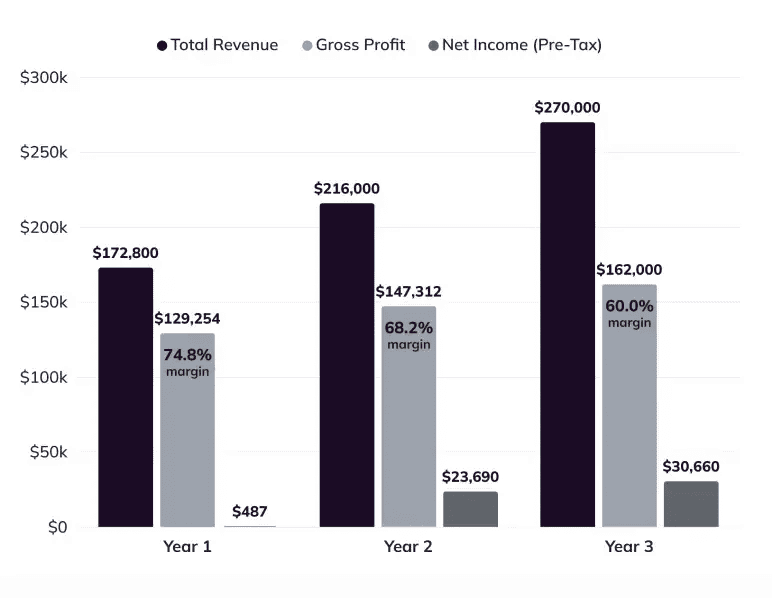
We expect revenue of $172,800 in Year 1, $216,000 in Year 2, and $270,000 in Year 3. Year 1 ends close to break-even, with a $487 pre-tax profit, because we pay $11,400 of one-time launch costs that year. Profit then grows to $23,690 in Year 2 and $30,660 in Year 3.
| Category | Year 1 | Year 2 | Year 3 |
|---|---|---|---|
| Deliveries | 7,200 | 9,000 | 11,250 |
| Total Revenue | $172,800 | $216,000 | $270,000 |
| Gross Profit | $129,254 | $147,312 | $162,000 |
| Net Income (Pre-Tax) | $487 | $23,690 | $30,660 |
| Ending Cash | $34,293 | $58,214 | $86,947 |
To get started, we are asking a Boise community bank for an $85,000 SBA 7(a) loan. Jamal is investing $30,000 of his own savings.
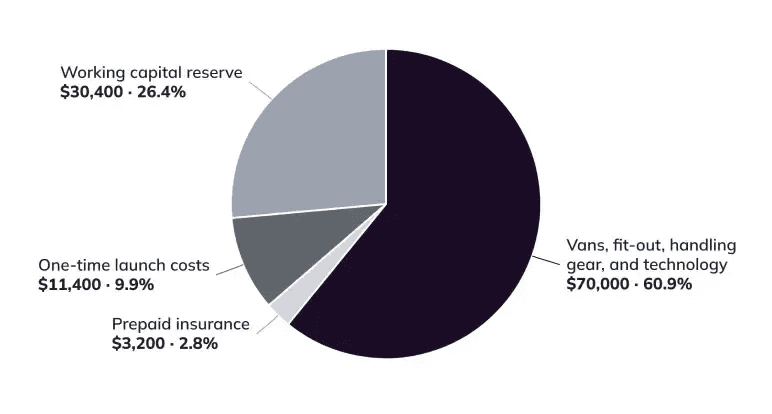
Together, the $115,000 will pay for two used cargo vans, shelving, handling equipment, and technology, along with launch costs and prepaid insurance. It also includes a $30,400 cash reserve to cover expenses while customers pay their invoices.
Writing business plans takes weeks?
Let AI writes your first draft in minutes

Company Overview
Brisklane Courier is a new local delivery business for offices and shops in the Boise area. We will run weekday routes and same-day deliveries for business customers only.
We won’t carry hazardous materials, cash, valuables, lab specimens, or long-haul freight. We also won’t take home deliveries from consumer apps.
Our vision is to become the courier a Boise office manager calls first, because the same friendly driver shows up at the same time every day.
Base & Delivery Zone
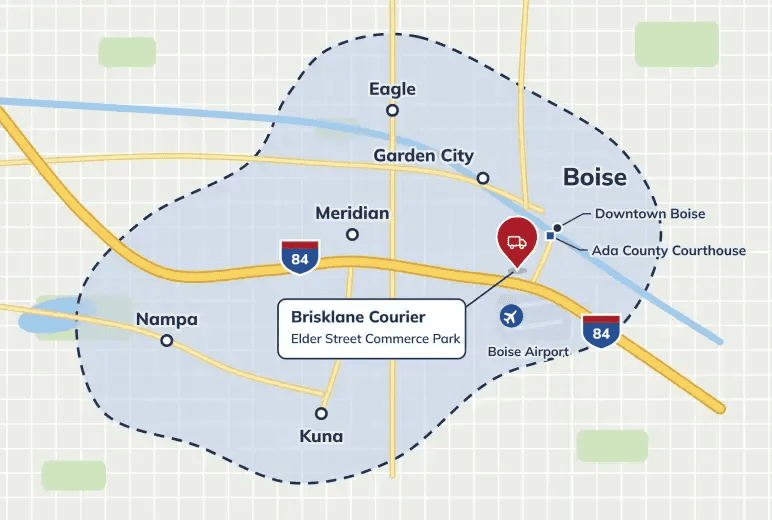
Our base is a flex-space bay at Elder Street Commerce Park, 3420 W. Elder Street, Suite 6, Boise, ID 83705.
The bay has a roll-up door, room for our shelving and totes, and secure overnight parking for both vans. It is in the industrial area near the Boise Airport, a few minutes from I-84.
We chose this spot over a downtown address for two reasons:
- Cost: The rent is $850 a month, far less than downtown space.
- Position: The bay is close to downtown, the medical districts, and the supply stores along the Meridian and Nampa corridors.
The trade-off is an early start. Our vans need to leave by 7 a.m. to reach the first downtown stops on time.
Our delivery zone covers about a 25-mile radius across Ada and Canyon counties. The map below shows the zone and where our bay is:
Ownership & Legal Structure
Jamal Pruitt has spent all 12 years of his career with a regional same-day courier in the Treasure Valley. He drove routes for seven years. He then spent five years as dispatch supervisor, running the daily board for 14 drivers.
In that role, he built contract routes for medical offices and law firms. He also handled the largest accounts whenever a delivery went wrong.
This work taught him what a route stop costs to run and which customers pay late. It also showed him how one missed 4 p.m. courthouse filing can lose a trusted account. He has a clean driving record and completed HIPAA training while he managed pharmacy and dental lab routes.
Smaller Boise businesses kept asking Jamal for a courier that would take a 10-stop route. They didn’t want a long contract or a 50-stop minimum, so he started Brisklane.
He won’t approach his former employer’s customers. His first route customers come from businesses that the company didn’t serve and from referrals through the Boise Metro Chamber.
Jamal formed Brisklane Courier as an Idaho single-member limited liability company (LLC) in December 2026, and he owns all of it. The LLC keeps the business’s debts separate from his personal assets.
Launch Timeline
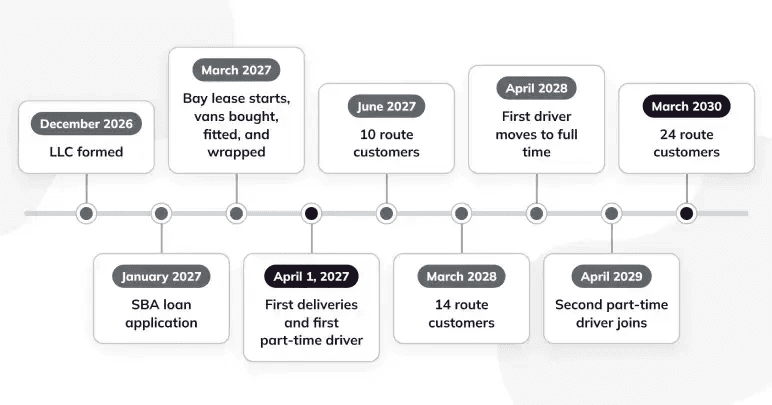
We will lease the bay on March 1, 2027, and buy, fit out, and wrap both vans that month. We want 10 route customers by the end of June 2027 and 14 by March 2028.
We also want 40 Google reviews in our first year, and we aim to keep at least 97% of route stops inside their agreed windows.
The roadmap below shows the main steps through Year 3:
Industry and Market Analysis
Brisklane Courier will serve local businesses that send the same kinds of items across town every weekday. Most of them don’t send enough to keep their own driver and vehicle busy.
For example, a dental lab in Meridian may send finished crowns to the same dozen offices every afternoon. None of those offices wants to wait until tomorrow.
Ada County Businesses
Ada County is Idaho’s most populous county, and it reached 589,500 residents in 2026. Most of our stops will be here, in Boise’s downtown and medical districts and along the main roads west toward Meridian.
Ada County has a large base of local businesses that Brisklane can approach for regular delivery work. According to the U.S. Bureau of Labor Statistics, the county had 26,463 covered business establishments in the third quarter of 2025. These include the offices, repair businesses, and other local employers we plan to serve.
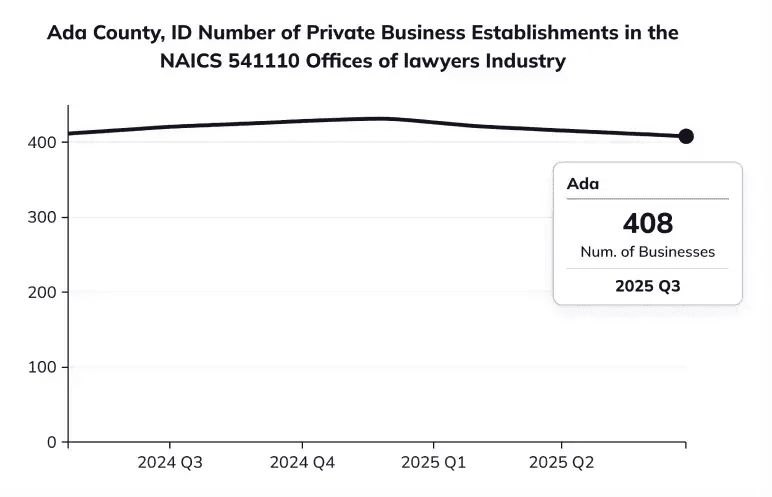
The county had 408 private law-office establishments, based on the U.S. Bureau of Labor Statistics data. Law firms are one of our target customer groups, alongside dental offices, pharmacies, and local repair shops.
We aim to have 24 regular route customers by Year 3. Rather than trying to serve businesses across the entire county, we’ll start with offices and shops that need deliveries several times a week and are close enough together to share the same routes.
As mentioned earlier, U.S. couriers and local delivery services will bring in $241.3 billion in 2026. The industry’s average profit margin, though, fell from 9.3% in 2021 to 7.2% in 2026. For a small courier, this means profit has to come from low costs and busy vans.
Brisklane will also compete with established delivery services. To win customers, we’ll offer predictable pickup times, proof of delivery, a five-stop weekly minimum, and month-to-month agreements.
Our focus will be on keeping both vans busy without adding unnecessary miles. More regular stops along the same routes will help us spread driver, fuel, and vehicle costs across more deliveries.
Target Customers
We will focus on six kinds of local businesses, each with different delivery needs. Some will need regular route stops, while others will book same-day or rush deliveries.
| Target Customers | Typical Delivery Needs |
|---|---|
| Law & title offices | Legal documents, closing packages, and court papers, often on the same day |
| Dental labs & offices | Dental cases, impressions, and supplies on scheduled morning and afternoon routes |
| Independent pharmacies | Prescriptions delivered to clinics, care facilities, and patients through planned routes |
| Auto parts & repair shops | Parts delivered throughout the day, including urgent orders for vehicles under repair |
| Print shops | Finished print jobs and large orders delivered to local business customers |
| Building supply houses | Plumbing, HVAC, and building supplies delivered to contractors and job sites |
Dental labs, pharmacies, and auto parts businesses will be our main targets for recurring routes. Law offices, print shops, and building suppliers will also bring in same-day and rush jobs.
We’ll focus on customers whose deliveries fit within our existing routes, helping us keep both vans busy without adding unnecessary driving time.
Local Delivery Trends
Local businesses have different delivery needs, but most want reliable service without having to send their own employees across town. A few trends are shaping how we plan our services:
(1) Faster delivery expectations
Auto parts stores and repair shops sometimes need supplies the same afternoon to finish a job. A nearby courier can help them avoid delays.
(2) Fewer routine legal deliveries
Most Idaho court filings now happen online, but law and title offices still need signed originals, closing packages, and checks delivered between locations.
(3) More focus on staff time
Dental and medical offices want their employees focused on patients rather than driving between facilities. They need dependable pickups, secure handling, and proof of delivery.
(4) Demand from smaller accounts
Some offices need only a few deliveries each week, making large delivery contracts less practical. These businesses may prefer flexible local courier services.
For Brisklane, the opportunity is to serve these smaller, repeat delivery needs without adding unnecessary miles. We’ll focus on businesses close to our existing routes, where regular stops and same-day jobs can fit into the same van schedule.
Competitive Analysis
Brisklane Courier will compete with a large local courier, a national same-day network, and a small local courier. Each one suits some customers better than others.
Pinemark Courier Group
Pinemark is the largest local courier in the valley. It runs more than 20 vans and box trucks, offers 24-hour dispatch, and holds long contracts with hospital systems and large law firms.
It has the best-known name in town and can handle almost any job size. This makes it a strong, trusted choice for big accounts.
Pinemark asks for one-year agreements. It also prices its routes for customers with about 50 stops a week. A dental office with 8 stops a week can still call Pinemark for one-off jobs, but it rarely gets a route of its own.
Relayline Same-Day
Relayline is a national same-day network that uses local contract drivers in Boise. Customers book through an app or web portal at any hour. The network also reaches cities outside the valley, which suits regional companies.
The trade-off is a different driver on almost every job and little local account service. Relayline doesn’t run fixed daily routes. A pharmacy that needs the same 3 p.m. pickup every day has to book it again each time.
Foxtail Delivery
Foxtail is a two-car courier in Meridian, run by its owner. It charges low prices for envelopes and small packages. Many Meridian law offices like its personal service.
Because Foxtail uses cars, it turns down parts, cases of supplies, and anything bulky. It also stops taking calls at 3 p.m. on most days.
Other Options
A few other choices come up when we talk with office managers:
- App-based delivery drivers: Fast and easy to book, but they drive cars, don’t run routes, and won’t sign agreements for pharmacy or legal items.
- Parcel carriers: Reliable pickups, with delivery the next day at the earliest.
- In-house drivers: Common at larger parts stores and supply houses, but a slow day still means paying for a driver and a vehicle.
Competitive Edge
Brisklane will focus on smaller businesses that need regular local deliveries but don’t have enough volume for a large courier contract. We plan to compete by making those smaller accounts worth serving, rather than chasing the biggest delivery jobs.
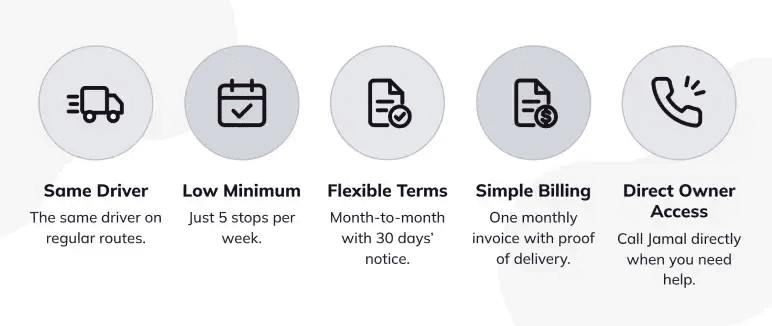
These benefits matter most to offices and shops with 5 to 30 stops a week. They need someone who knows their schedule, handles deliveries consistently, and is easy to reach when plans change.
Pinemark will stay the stronger choice for hospitals and large firms. Relayline will stay the better fit for companies that ship across the region.
With two vans, we will also turn down large one-time jobs that need several vehicles at once. We accept these limits, because our customers are offices with 5 to 30 stops a week that want someone they know.
Services & Pricing
Brisklane Courier will offer four delivery services. About two of every three deliveries will be route stops that customers book before the week starts. The rest will be same-day jobs, which earn more per job.
Scheduled Route
A Scheduled Route gives a customer fixed weekday stops inside agreed time windows, such as a morning pickup and an afternoon drop-off. We put all route stops into one loop per van. Each van can run about 18 stops in a three-hour loop.
A route stop costs $14 in Year 1. Each agreement runs month to month, with a five-stop weekly minimum and 30 days’ notice to end it.
For pharmacy and dental routes, we use sealed, tamper-evident bags. Drivers also take an electronic signature at every stop.
Some of these customers ask their courier to sign a business associate agreement under HIPAA, the federal privacy law for health records. We will sign one whenever a customer asks.
Same-Day Standard
Customers book a Same-Day Standard delivery by noon, and we deliver it by 5 p.m. anywhere in our zone. It costs $34 for packages up to 50 pounds. These jobs fit into the middle of the day, between our two route loops.
Rush 2-Hour
A Rush 2-Hour job reaches its destination within two hours of pickup. We accept rush jobs until 3:30 p.m., and each one costs $52.
We take a rush job only when a van can reach the pickup within 30 minutes without missing a route window. If we can’t, we tell the customer before they book.
This rule helps us keep our route customers’ trust, and they bring in most of our steady work.
Supply & Bulk Run
A Supply & Bulk Run moves up to 1,000 pounds from a supply house, print shop, or loading dock to a job site or office. We use our larger Transit 250 van for these runs. Each run costs $65, including up to 15 minutes of loading time.
Pricing Strategy
We price routes by the stop, because stops take up most of the time on a short loop. Route stops earn the least of any service. Even so, they are close together on one loop, and we know about them days ahead.
On-demand jobs have one flat price for each service anywhere in the zone. Customers know what they will pay before they book.
Our prices will rise about 3% to 4% a year. Each route agreement also includes a fuel surcharge. It starts only when regional gas prices rise more than 15% above the price on the day the customer signed.
Large route customers get small volume discounts, worth about 1% to 2% of our list revenue. After these discounts, an average delivery brings in $24.
Three-Year Delivery & Revenue Projections
Here are our prices and expected deliveries for each service over the first three years:
| Service | Year 1 Price | Year 1 Deliveries | Year 2 Price | Year 2 Deliveries | Year 3 Price | Year 3 Deliveries |
|---|---|---|---|---|---|---|
| Scheduled Route stop | $14.00 | 4,700 | $14.50 | 6,100 | $15.00 | 7,800 |
| Same-Day Standard | $34.00 | 1,450 | $35.00 | 1,700 | $36.00 | 2,050 |
| Rush 2-Hour | $52.00 | 650 | $54.00 | 750 | $56.00 | 900 |
| Supply & Bulk Run | $65.00 | 400 | $67.00 | 450 | $69.00 | 500 |
| Total Deliveries | – | 7,200 | – | 9,000 | – | 11,250 |
| List Revenue | – | $174,900 | – | $218,600 | – | $275,700 |
| Volume discounts | – | ($2,100) | – | ($2,600) | – | ($5,700) |
| Net Revenue | – | $172,800 | – | $216,000 | – | $270,000 |
Marketing & Sales Strategy
Brisklane Courier’s marketing focuses on meeting office managers in person. Most of them choose a courier they have met and tried. This is why Jamal will sell Brisklane one office at a time, with route customers as the main goal.
First 90 Days
In April 2027, Jamal will turn our six letters of intent into signed route agreements. These first customers will also help us test our stop windows before we add more routes.
From April through June, he will visit about 40 businesses a month in our target groups. At each visit, he will:
- Leave a rate card and a sample sealed bag
- Offer one week of free route stops, so the office can try us before signing
- Ask about the same-day jobs the office sends each week
Our goal is four more route customers by the end of June 2027. Many of these visits will also bring in same-day jobs.
A $7,000 launch budget covers the van wraps, our rate cards and sales kit, a first direct-mail wave, and the first month of search ads. The wrapped vans also help us get noticed, since they spend most of the day parked at our customers’ doors.
Marketing Budget
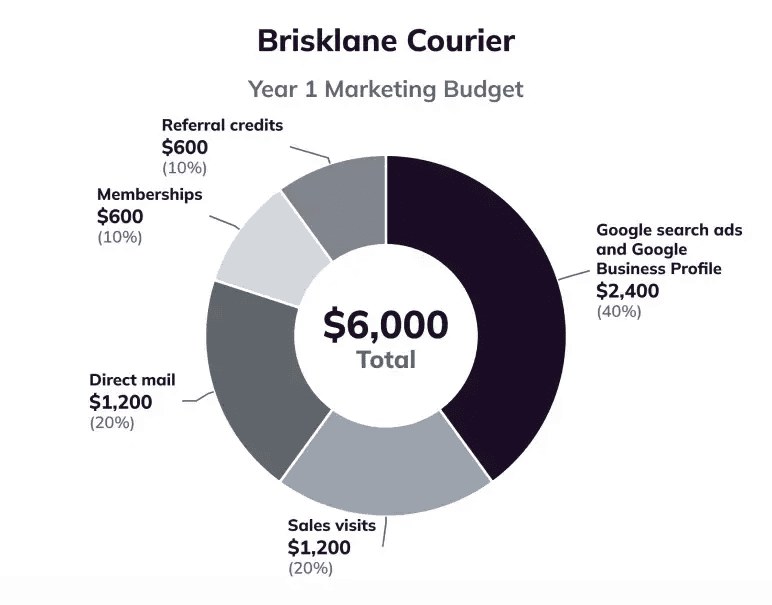
After launch, we will spend $6,000 on marketing in Year 1, $6,600 in Year 2, and $7,800 in Year 3. Here’s where the Year 1 money goes:
Keeping Route Customers
Each route customer keeps the same driver, and the front desk soon knows who is walking in. This simple habit helps us build reliable, long-term accounts.
Once a month, each route customer gets one invoice that lists every stop with its delivery time and signature. Every three months, Jamal will meet each route customer to make sure their stop windows still fit their day.
Most of our growth will come from customers we already serve. For example, a dental lab may add the offices it works with to its route. Businesses on the same route also refer each other, and our referral credit gives them a reason to.
Operations Plan
At Brisklane Courier, we focus on keeping every route stop on time while leaving room for same-day jobs. We plan each day’s route loops the night before, and drivers upload proof of delivery for every stop. Our hours are simple:
- Monday to Friday: 7 a.m. to 6 p.m., 255 days a year
- Saturday: By arrangement at rush prices, which our forecast doesn’t count on
- Holidays: Closed on major holidays, with a month’s notice to route customers
Dispatch & Van Capacity
Each route customer sets its stop windows in its route agreement. Every evening, Jamal plans the next day’s stops in our dispatch and routing software. Each driver then starts the morning with a loop on their phone.
Same-day jobs come in through our web portal, by phone, or by email. Dispatch sends each one to the nearest van with time to spare.
Each van has about 10 usable hours a weekday, or 5,100 van-hours a year for the two vans. Our drivers will average about 2.6 deliveries per driving hour. At that pace, we will use 54% of our van-hours in Year 1, 70% in Year 2, and 85% in Year 3.
The chart below shows how much of the two vans’ time we will use each year:
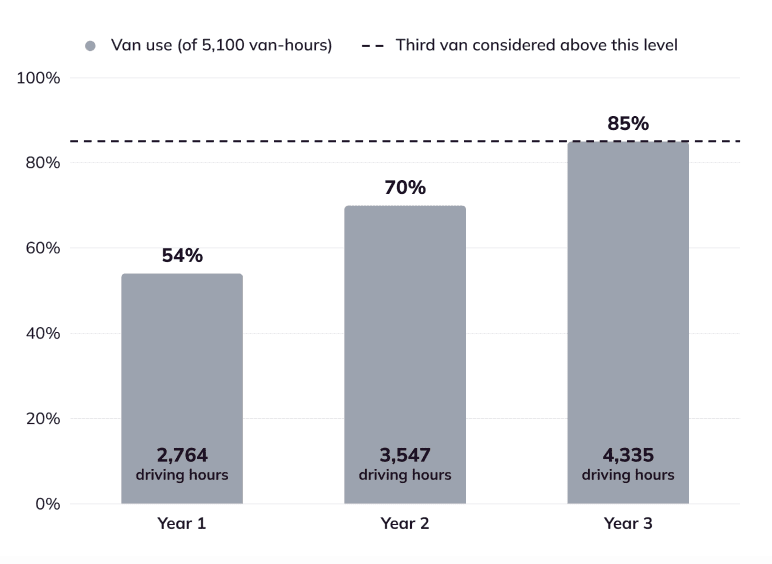
This is why we will hire drivers before we buy vans. Our two vans can handle all three years of growth.
We will add a third van only when route stops pass about 35% a weekday, or when van use stays above 85% for two quarters in a row. Even then, we would pay for it from our cash, with no new debt.
Weekly Schedule
Our routes run every weekday in a morning loop and an afternoon loop, with same-day jobs in between. Route changes start on Mondays. Each Thursday, the drivers walk around both vans and check the tires.
We invoice same-day jobs every Friday and route stops on the first of each month. A repair shop services each van about every 5,000 miles on a Saturday morning. This way, routine service never takes a van off the road on a weekday.
Staffing
Jamal will drive one van and dispatch from it. Our drivers will take on more of the driving each year. Here’s our team for the first three years:
- Jamal Pruitt, owner (from December 2026): Drives about 36 hours a week, dispatches, sells, and manages accounts. In Year 3, he moves about 400 hours a year from driving to sales and dispatch. His salary is $48,000 in Year 1, $52,000 in Year 2, and $56,000 in Year 3.
- Driver 1 (from April 2027): Drives the second van part time, about 19 hours a week. Moves to full time at about 35 hours a week in April 2028, and 40 hours in Year 3. Pay is $21.50 an hour in Year 1, $22.25 in Year 2, and $23.00 in Year 3.
- Driver 2 (from April 2029): Drives about 19 hours a week in either van, at $23.00 an hour.
Every driver passes a driving record check, a background check, and a drug test before we hire them. We review each driving record once a year.
New drivers ride along with Jamal for their first week. This helps them learn the routes and our proof-of-delivery steps.
Jamal’s salary covers his own driving. His hours don’t count in our direct costs. As our drivers take over more of the driving, driver pay grows from 12% of revenue in Year 1 to 25% in Year 3. Our gross margin falls as a result, while Jamal spends more of his time winning new accounts.
Licenses, Insurance & Compliance
Idaho keeps the paperwork for a van courier fairly light. Here are the approvals we need and who issues each one:
| Approval | Issued By | Timing and Cost |
|---|---|---|
| Certificate of Organization (LLC) | Idaho Secretary of State | Filed online in December 2026 for $100; free annual report each December |
| Idaho Business Registration (state withholding and unemployment insurance accounts) | Idaho State Tax Commission, with the Idaho Department of Labor | Before Driver 1 starts in April 2027 |
| Workers’ compensation policy | Private insurer, under Idaho Industrial Commission rules | In place before our first hire, as Idaho requires for any employee |
| Vehicle registration and plates | Ada County Assessor’s motor vehicle office | Both vans, March 2027, renewed yearly |
Both vans stay under 10,001 pounds and never leave Idaho. This means we don’t need a USDOT number from the Federal Motor Carrier Safety Administration, and our drivers need only a regular Idaho driver’s license.
Boise has no general business license. The city’s vehicle licenses cover taxis and passenger shuttles, not parcel vans.
We will carry commercial auto insurance with a $1 million combined limit, cargo coverage of $25,000 per van, and general liability insurance. Larkfield Insurance Group will help us review these limits each year as we add drivers.
Fleet, Equipment & Partners
Our vans and gear are simple and reliable. Each item suits the work our customers send:
- Cargo van 1: A used 2023 Ford Transit 250 high-roof van with about 38,000 miles, for route loops and every Supply & Bulk Run
- Cargo van 2: A used 2022 Ford Transit Connect with about 45,000 miles, small enough for downtown parking and quick rush jobs
- Van fit-out: Steel shelving, partitions, and tie-down tracks in both vans
- Handling gear: Hand trucks, a convertible dolly, totes, insulated bags, lock boxes, and straps
- Technology: A laptop, two rugged phones for signatures and photos, a label printer, and dash cameras in both vans
We also rely on a small group of outside partners to keep the vans moving and the books in order:
- Ironbark Fleet Service: A repair shop near our bay that handles Saturday maintenance and repairs
- A fleet fuel card program: Tracks fuel by van and pays on weekly autopay
- Dispatch and routing software: Plans routes, sends jobs to drivers’ phones, and stores signatures
- Larkfield Insurance Group: An independent Boise broker that places our commercial auto, cargo, and liability insurance
- A local commercial van rental company: Supplies a backup van on short notice under a standing agreement
- A bookkeeper, a small-business attorney, and a SCORE mentor: Keep our books and payroll, review our route agreement, and advise Jamal as we grow
Financial Plan
Brisklane Courier needs $115,000 to start, and most of it goes into the two vans and a cash reserve. We expect a small Year 1 profit after launch costs, growing to $30,660 by Year 3.
Startup Costs
| Category | Amount |
|---|---|
| Used 2023 Ford Transit 250 high-roof cargo van | $36,500 |
| Used 2022 Ford Transit Connect cargo van | $24,500 |
| Van shelving, partitions, and tie-downs | $3,200 |
| Handling gear | $2,800 |
| Laptop, phones, label printer, and dash cameras | $3,000 |
| Prepaid insurance | $3,200 |
| Legal setup | $1,200 |
| Website and dispatch software setup | $2,000 |
| Van wraps and brand identity | $3,500 |
| Launch marketing | $3,500 |
| Licenses and registrations | $400 |
| Opening supplies | $800 |
| Working capital reserve | $30,400 |
| Total Startup Costs | $115,000 |
Funding Sources
| Category | Amount |
|---|---|
| SBA 7(a) loan | $85,000 |
| Owner investment (Jamal Pruitt) | $30,000 |
| Total Funding | $115,000 |
Financial Assumptions
| Assumption | Year 1 | Year 2 | Year 3 |
|---|---|---|---|
| Weekdays operated | 255 | 255 | 255 |
| Total deliveries | 7,200 | 9,000 | 11,250 |
| Average deliveries per weekday | 28.2 | 35.3 | 44.1 |
| Route stops as a share of deliveries | 65% | 68% | 69% |
| Route customers at year end | 14 | 19 | 24 |
| Average net revenue per delivery | $24.00 | $24.00 | $24.00 |
| Fuel, maintenance, and tolls (share of revenue) | 12.0% | 12.0% | 12.5% |
| Hired driving hours | 964 | 1,747 | 2,935 |
| Driver pay per hour | $21.50 | $22.25 | $23.00 |
| Owner driving hours | 1,800 | 1,800 | 1,400 |
| Van use (of 5,100 van-hours) | 54% | 70% | 85% |
| Payroll tax rate | 10% | 10% | 10% |
| Payment processing (share of revenue) | 1.5% | 1.5% | 1.5% |
| Days to collect invoices | 35 | 35 | 35 |
| Loan interest rate (7-year term) | 11.25% | 11.25% | 11.25% |
| Loan payments per year | $17,599 | $17,599 | $17,599 |
| Depreciation | $13,840 | $13,840 | $13,840 |
Projected Profit & Loss
| Category | Year 1 | Year 2 | Year 3 |
|---|---|---|---|
| Revenue | |||
| Total Revenue | $172,800 | $216,000 | $270,000 |
| Cost of Services | |||
| Fuel, maintenance, tires, tolls, and parking | $20,736 | $25,920 | $33,750 |
| Hired driver pay | $20,736 | $38,880 | $67,500 |
| Payroll taxes on driver pay | $2,074 | $3,888 | $6,750 |
| Total Cost of Services | $43,546 | $68,688 | $108,000 |
| Gross Profit | $129,254 | $147,312 | $162,000 |
| Gross Margin | 74.8% | 68.2% | 60.0% |
| Operating Expenses | |||
| Owner salary | $48,000 | $52,000 | $56,000 |
| Payroll taxes on owner salary | $4,800 | $5,200 | $5,600 |
| Insurance | $12,800 | $13,400 | $14,100 |
| Bay rent and van parking | $10,200 | $10,500 | $10,800 |
| Accounting and legal | $2,400 | $2,400 | $2,700 |
| Phone and mobile data | $1,800 | $1,860 | $1,920 |
| Marketing | $6,000 | $6,600 | $7,800 |
| Software and website | $3,600 | $3,900 | $4,500 |
| Supplies | $1,200 | $1,450 | $1,800 |
| Vehicle registration and inspections | $700 | $700 | $720 |
| Driver screening | $300 | $400 | $500 |
| Payment processing | $2,592 | $3,240 | $4,050 |
| Launch costs (one-time) | $11,400 | $0 | $0 |
| Total Operating Expenses | $105,792 | $101,650 | $110,490 |
| EBITDA | $23,462 | $45,662 | $51,510 |
| Depreciation | $13,840 | $13,840 | $13,840 |
| EBIT | $9,622 | $31,822 | $37,670 |
| Interest Expense | $9,135 | $8,132 | $7,010 |
| Net Income (Pre-Tax) | $487 | $23,690 | $30,660 |
Projected Balance Sheet
| Category | At Launch | Year 1 | Year 2 | Year 3 |
|---|---|---|---|---|
| Assets | ||||
| Cash | $41,800 | $34,293 | $58,214 | $86,947 |
| Accounts receivable | $0 | $16,570 | $20,712 | $25,890 |
| Prepaid insurance | $3,200 | $0 | $0 | $0 |
| Vans and equipment (net) | $70,000 | $56,160 | $42,320 | $28,480 |
| Total Assets | $115,000 | $107,023 | $121,246 | $141,317 |
| Liabilities | ||||
| SBA 7(a) loan | $85,000 | $76,536 | $67,069 | $56,480 |
| Total Liabilities | $85,000 | $76,536 | $67,069 | $56,480 |
| Equity | ||||
| Owner capital | $30,000 | $30,000 | $30,000 | $30,000 |
| Retained earnings | $0 | $487 | $24,177 | $54,837 |
| Total Equity | $30,000 | $30,487 | $54,177 | $84,837 |
| Total Liabilities & Equity | $115,000 | $107,023 | $121,246 | $141,317 |
Projected Cash Flow
| Category | Year 1 | Year 2 | Year 3 |
|---|---|---|---|
| Beginning Cash | $41,800 | $34,293 | $58,214 |
| Operating Activities | |||
| Net income (pre-tax) | $487 | $23,690 | $30,660 |
| Depreciation | $13,840 | $13,840 | $13,840 |
| Change in accounts receivable | ($16,570) | ($4,142) | ($5,178) |
| Change in prepaid insurance | $3,200 | $0 | $0 |
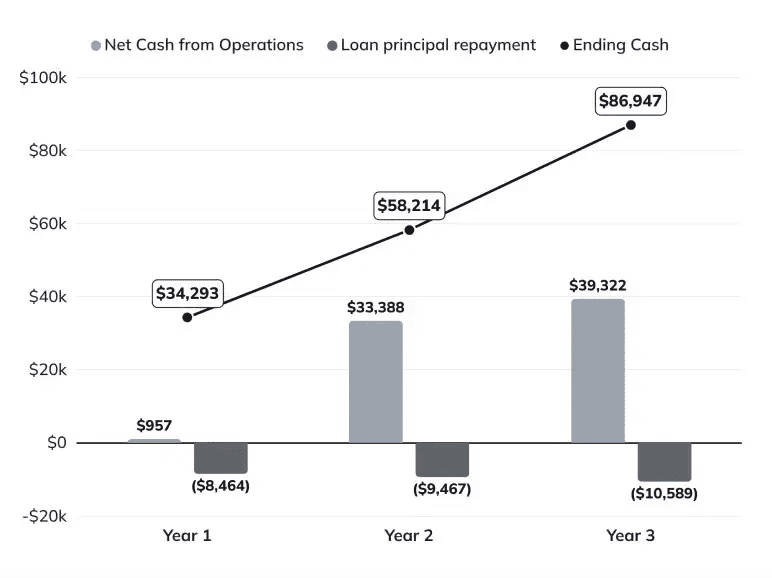
| Net Cash from Operations | $957 | $33,388 | $39,322 |
| Financing Activities | |||
| Loan principal repayment | ($8,464) | ($9,467) | ($10,589) |
| Net Cash from Financing | ($8,464) | ($9,467) | ($10,589) |
| Net Change in Cash | ($7,507) | $23,921 | $28,733 |
| Ending Cash | $34,293 | $58,214 | $86,947 |
Break-Even Analysis
| Metric | Value |
|---|---|
| Average net revenue per delivery | $24.00 |
| Variable cost per delivery (Year 2) | $7.99 |
| Contribution per delivery (Year 2) | $16.01 |
| Fixed operating costs (Year 2, before depreciation and interest) | $98,410 |
| Break-even deliveries per year (before depreciation and interest) | 6,148 |
| Break-even revenue (before depreciation and interest) | $147,552 |
| Break-even deliveries per weekday (before depreciation and interest) | 24.1 |
| Break-even deliveries per weekday (including loan payments) | 28.4 |
| Forecast deliveries per weekday (Year 2) | 35.3 |
Loan Request
Brisklane is requesting an $85,000 SBA 7(a) loan from an SBA-approved community bank in Boise. We will repay it over seven years at $1,466.60 a month. Jamal will personally guarantee the loan, and the two vans will secure it.
Our EBITDA covers the loan payments 1.33 times in Year 1. Before the $11,400 of one-time launch costs, Year 1 coverage is 1.98 times. Coverage then rises to 2.59 times in Year 2 and 2.93 times in Year 3. Each year is above the 1.25 times many lenders look for.
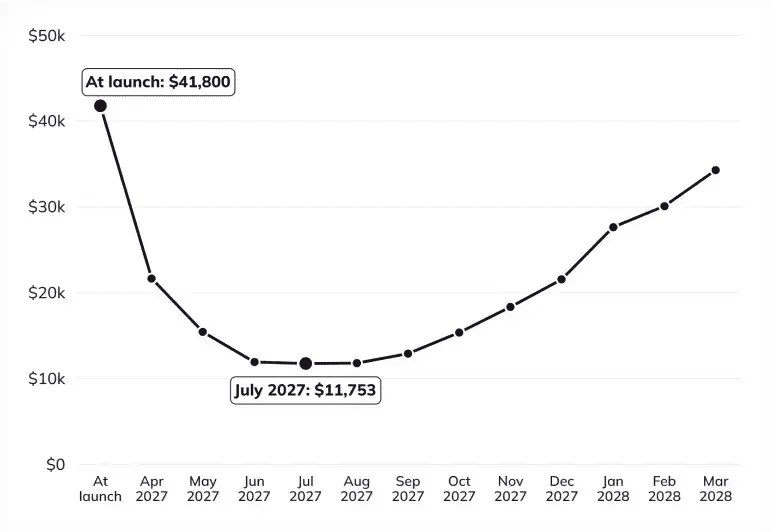
Our cash reaches its lowest point in July 2027, at $11,753. By then, we will have paid our launch costs, and customers will still pay each month’s invoices about 35 days after the work. From August on, payments catch up with our costs, and our cash grows every month for the rest of the year.
The chart below shows our month-end cash through Year 1:
Risk Analysis
Running a two-van courier comes with some risks, but knowing them early helps us plan for them. Our biggest concerns are a van off the road and customers who pay late. Here’s how we will handle each risk:
- Customers who pay late
We bill on 30-day terms and run a credit check on every route customer. We keep cards on file for small same-day accounts. Invoices more than 45 days past due carry a 1.5% monthly late fee, and the $30,400 reserve covers the gap while customers pay.
- A van off the road
We service the vans on Saturdays, and we call our rental partner the moment a van breaks down. If we still lose capacity, we protect every route window first and turn down same-day work until the van is back.
- Losing a large route customer
No customer will make up more than 15% of our revenue. Month-to-month agreements with 30 days’ notice also give us time to fill the empty stops.
- A slow first year
If Year 1 deliveries come in 15% below our forecast, we will cut hired driving hours first. Jamal will cover more of the driving himself, and we will pause paid search ads until route stops recover.
- Fuel price spikes
The fuel surcharge in our route agreements protects us when gas prices jump. We have also budgeted fuel, maintenance, and tolls at 12% to 12.5% of revenue.
- Accidents and claims
Driving record and background checks, dash cameras, and proof of delivery at every stop lower our risk. Our commercial auto and cargo insurance covers the rest.
- Jamal can’t work
Jamal drives one van and runs dispatch, so an injury would hit us hard. Driver 1 will know every route by the end of the first month and can run dispatch from the second van. We will also keep a short list of experienced part-time drivers who can cover shifts.
The Quickest Way to turn a Business Idea into a Business Plan
Fill-in-the-blanks and automatic financials make it easy.


Vinay Kevadia
Vinay Kevadiya is the founder and CEO of Upmetrics, the #1 business planning software. His ultimate goal with Upmetrics is to revolutionize how entrepreneurs create, manage, and execute their business plans. He enjoys sharing his insights on business planning and other relevant topics through his articles and blog posts. Read more