Thinking about opening a pickleball club is one thing. Figuring out how many courts you’ll need, what to charge players, and whether bookings will bring in enough money to cover your expenses is another. And if you’re looking for funding, you’ll need a plan that puts those numbers together.
To show you how that works, we’ve created a sample business plan for Dinkwell Pickleball Club, a fictional six-court indoor facility in Naperville, Illinois. The owner is seeking a $400,000 SBA 7(a) loan to help open the club.
This example covers everything from memberships and court scheduling to staffing, marketing, and three-year financial projections, including how the club plans for slower summer months.
Let’s see how it all comes together in the plan.
Executive Summary
Dinkwell Pickleball Club will open on October 1, 2027, in south Naperville, Illinois. Players will be able to book an indoor court, join a game at their level, or sign up for a league, clinic, or lesson, with or without a membership. Our club sits in the Brookstone Commerce Center, 2740 Quarry Ridge Drive, Suite 100, Naperville, IL 60564.
Courts & Programs
Dinkwell has six cushioned courts with divider netting in a 15,000-square-foot leased building. We will be open from 6 AM to 10 PM on weekdays and from 7 AM to 9 PM on weekends.
We make money by selling time on those courts. Members pay a monthly fee and book courts at low or no cost. Other players pay by the hour or by the session. Full membership costs $99 a month, and Daytime membership costs $69.
We’ll use daytime memberships and organized games to fill quieter hours, while leagues and court bookings will help keep the courts busy during evenings and weekends.
Our owner, Danielle Whitaker, will run the club full time.
Our vision is to become the club Naperville players recommend first.
Players & Competition
In 2025, 24.3 million Americans played pickleball. Naperville already has an active pickleball community, with indoor clubs and dozens of outdoor park courts. But outdoor play becomes less reliable during the colder months.
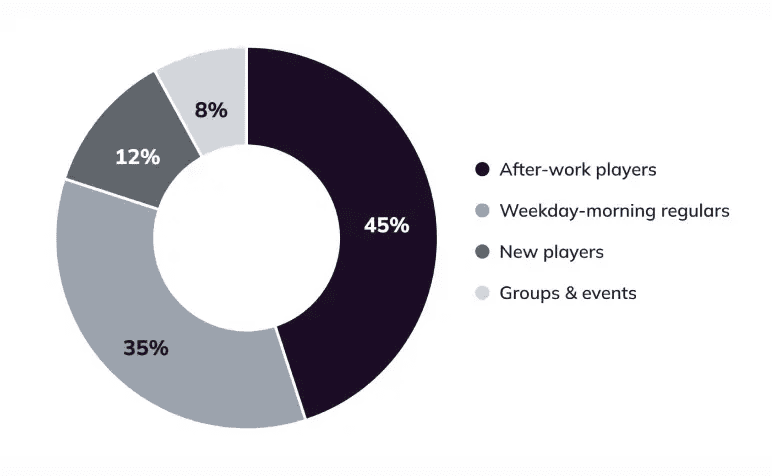
We will serve weekday-morning regulars, after-work players, new players, and groups booking events. Our edge is simple. Players can count on their court time here and on games at their own level.
Our Numbers
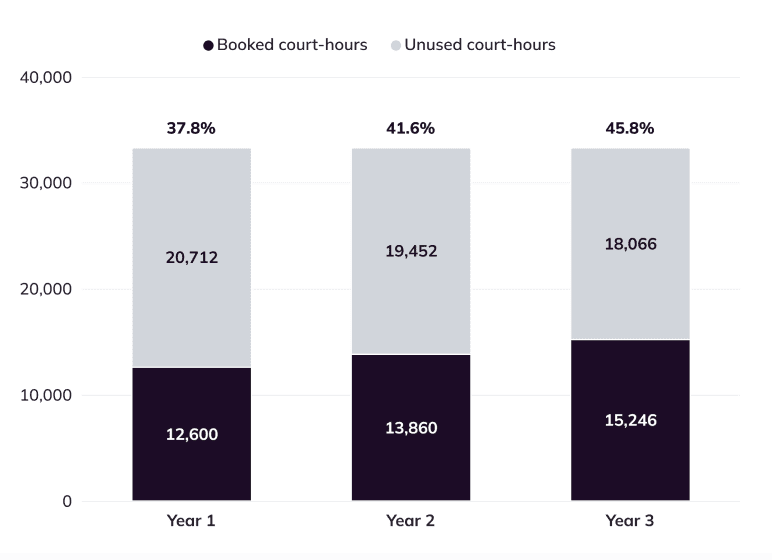
We expect to book 12,600 court-hours in Year 1, or 37.8% of the 33,312 the club can offer. Bookings grow 10% a year, and our prices stay the same for three years. Here are the main results:
| Category | Year 1 | Year 2 | Year 3 |
|---|---|---|---|
| Booked court-hours | 12,600 | 13,860 | 15,246 |
| Court utilization | 37.8% | 41.6% | 45.8% |
| Total Revenue | $699,300 | $769,230 | $846,153 |
| Gross Profit | $503,775 | $557,538 | $613,292 |
| Net Income (Pre-Tax) | ($25,928) | $18,904 | $59,467 |
| Ending Cash | $145,576 | $176,698 | $245,590 |
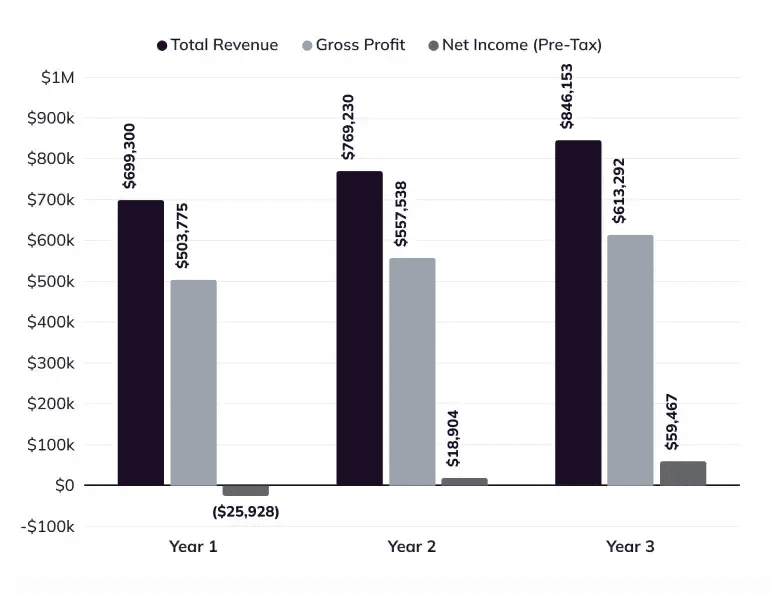
Year 1 shows a loss because we include $53,500 of one-time opening costs that year. Without them, Year 1 would show a $27,572 pre-tax profit.
Loan & Owner Investment
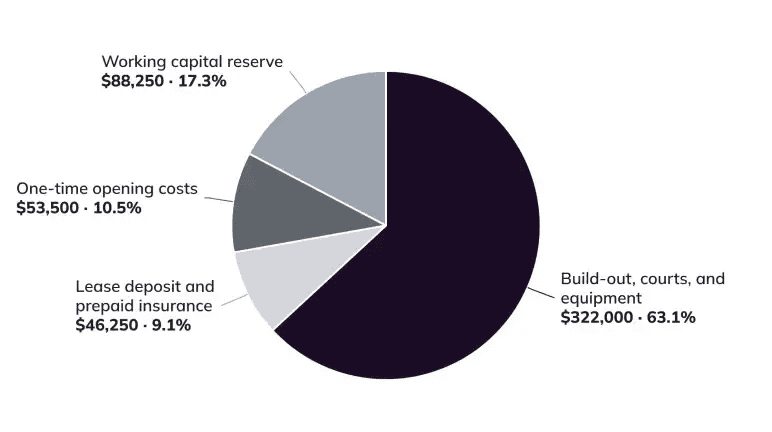
We are asking Brindlewood Bank for a $400,000 SBA 7(a) loan. Danielle is investing $110,000, for $510,000 in total. The $510,000 pays for:
- Build-out, courts, and equipment: $322,000
- Lease deposit and prepaid insurance: $46,250
- One-time opening costs, including the founding-member campaign: $53,500
- A cash reserve for the first summer: $88,250
This reserve will help us cover operating costs during the first summer, when more players may choose outdoor courts and indoor bookings may slow down.

Company Overview
Danielle Whitaker has spent 12 years running racquet-sports programs in Chicago’s western suburbs.
She started by building adult leagues for a park district. She then spent five years as racquet sports director at a private athletic club, where she scheduled courts, leagues, and clinics for about 600 players a week and managed a team of coaches. She is also a certified pickleball coach.
At that club, prime-time courts filled weeks ahead, and players kept asking for games at their own level. Dinkwell Pickleball Club is her answer to both problems.
In February 2027, Danielle formed Dinkwell as an Illinois single-member limited liability company (LLC). She owns 100% of the business and will personally guarantee the SBA loan. Her $110,000 investment comes from her savings and a home-equity line.
Dinkwell will be a staffed, owner-run club with six courts, a front desk, and a small pro shop wall. We won’t run a restaurant or a bar, and we pay no franchise fee. This helps us keep our costs and our team small.
Mission
Our mission is to run a club where every booked court is ready on time and every player can find a game at their level.
Building & Lease
We will lease 15,000 square feet in a single-story flex-industrial building, with a 22-foot clear height and parking for about 70 cars. The six courts need about 10,800 square feet, and they fit in one column-free bay.
Plainfield, Aurora, Bolingbrook, and Lisle are all within about 15 minutes’ drive.
Our rent is $8.75 a square foot, plus $3.75 for taxes and shared building costs. This comes to $187,500 in Year 1, and the base rent rises 3% a year. The 10-year lease also gives us:
- A five-year renewal option
- A landlord allowance toward the build-out
- Three months of free rent during construction
Milestones
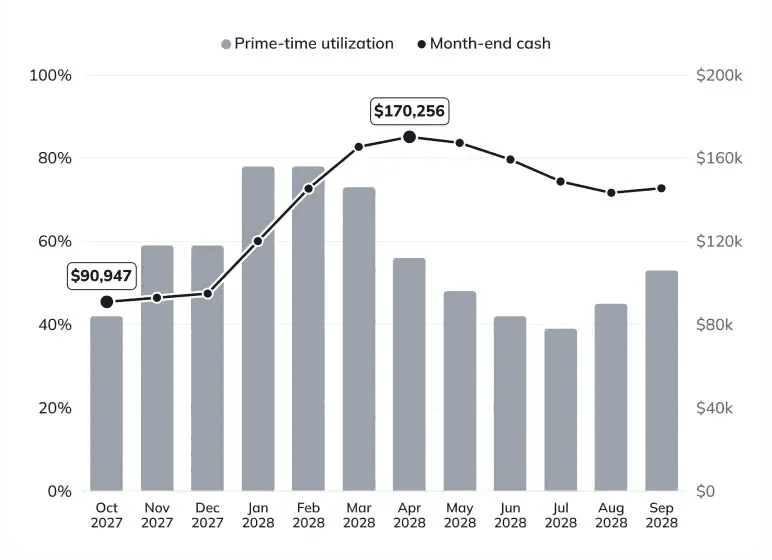
We plan to open on October 1, 2027, with 120 founding members already signed. By March 2028, our first winter should bring us to about 200 paying members. We want to finish that first summer, in September 2028, with at least $140,000 in the bank.
A month later, Danielle will hire a salaried assistant manager to help run the club. We aim to turn a pre-tax profit in our second year. By September 2030, we want our earnings to cover our yearly loan payments more than two times over.
Market Analysis
Dinkwell Pickleball Club will serve players who live within about 15 minutes of south Naperville. From November to March, most of their games move indoors.
The Naperville Park District offers 50 outdoor pickleball courts, including tennis courts with pickleball lines, but it holds its winter skill-level leagues inside at Fort Hill Activity Center.
This means Naperville players already want winter games and level-matched play. They need more indoor courts to get both.
Naperville Players
Naperville is a good fit for a club. The city had 153,337 residents and a median household income of $150,360 in 2024, based on Census estimates. Its median age was 41.5, which fits the 35-to-70 age range of most of our members.
As mentioned earlier, 24.3 million Americans played pickleball in 2025, or about 7 in every 100.
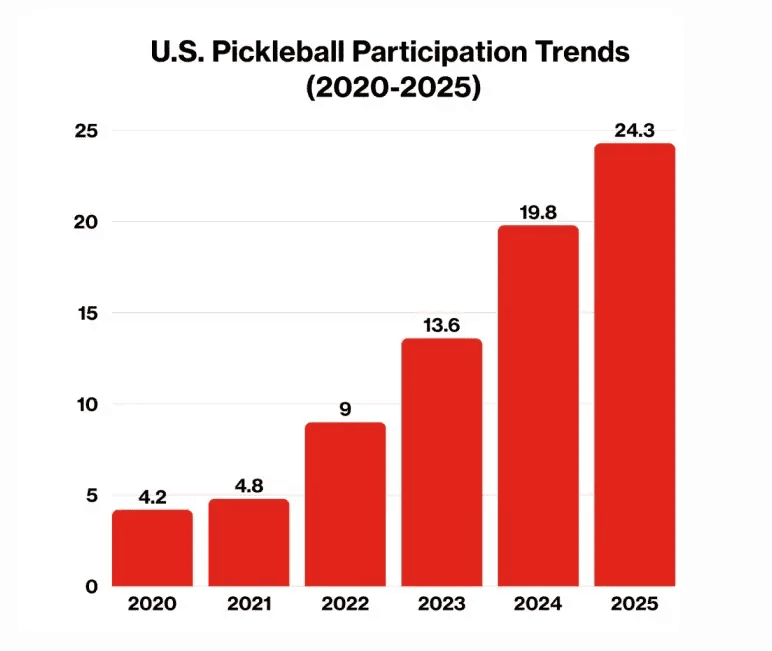
If Naperville plays at the same rate, the city has about 11,000 players, including about 3,400 who play eight or more times a year. Our Year 3 goal of 205 average members is about 6% of those regular players.
What Players Want
Most players already play at clubs and in leagues. In a 2025 survey, 74% of players had played at a club or dedicated facility, and 60% played in a league.
The same survey found two common problems. 44% of players named overcrowded courts as a barrier, and about 39% said it was hard to find players at their skill level. Dinkwell’s booking rules and skill levels answer both.
Changes in How People Play
More players now track a skill rating and want games against people at the same level. This is why we run open play, leagues, and clinics in five Dinkwell Levels.
New players also want live coaching. They want someone on the court to fix their serve or their third shot, which keeps our clinics and lessons busy.
At the same time, new clubs keep opening in the suburbs, and players have more places to try. We plan for steady member growth and earn most of our revenue from court time and programs.
Target Players
We will serve four groups of players, each with its own schedule and needs:
Weekday-Morning Regulars
These players, mostly aged 50 to 70, are retirees, parents of school-age children, and people who work from home. They play three or four mornings a week and want to host open play at their level, plus morning clinics. They make up about 35% of our booked court-hours.
Today, they deal with crowded outdoor courts in summer and few courts at all in winter.
After-Work Players
These working adults, aged 30 to 55, play on weekday evenings and weekend mornings. They book courts with a regular group, play in leagues, and take clinics to move up a level. They make up about 45% of our court-hours.
At other clubs, many find prime-time courts gone a week ahead and open play that mixes every skill level.
New Players
These adults have played a few times at a park or a friend’s club and now want to learn properly. They start with our Learn to Play clinics and then join open play, and many become members in their second or third month. They make up about 12% of our court-hours.
Groups & Events
Local employers, schools, youth teams, birthday parties, and players running their own tournaments book court packages, mostly on weekend afternoons. They make up about 8% of our court-hours.
All four groups already spend money on the sport. What they want is a court they can count on and a game that isn’t lopsided.
Competitive Analysis
Dinkwell Pickleball Club opens in a town that already has indoor pickleball. Each place has its own players, prices, and strengths.
The table below compares Naperville players’ main choices today:
| Competitor | What It Offers | Pros | Cons |
|---|---|---|---|
| Courtline Pickleball | Member-only franchise club, about $139 a month at the full rate | Strong brand, booking app, and leagues and clinics included in membership | No pay-per-play option for casual players |
| Prairie Paddle House | Independent indoor club with 11 courts, memberships, and pay-per-play | The most courts in town, plus tournaments and events | Prime-time courts book out early, and open play mixes levels |
| Gamewell Activity Center | Multi-use venue with open play at $5 to $10 for two hours | Low prices and a fun night out for casual players | Courts share space and time with other activities, with few programs |
| Park district courts | 50 outdoor courts, indoor open gym time, and seasonal skill-level leagues | Free or low cost, and well known to local players | Outdoor courts sit mostly empty from November to March, and indoor time is limited |
Players also have a few other options:
- A new athletic resort club: The city has approved a large full-service club with indoor and outdoor pickleball courts in south Naperville. It will offer pools, a gym, and dining, at a price well above a court-only club.
- Tennis clubs, swim clubs, churches, and school gyms: These offer a few pickleball hours a week on shared courts, with few structured programs.
Competitive Advantages
Prairie Paddle House has nearly twice our courts, and Courtline Pickleball has a better-known name. We will compete on reliability and fair games.
Every booked court starts on time, we cap prime-time bookings, and open play, leagues, and clinics all run in five skill levels. Players can also pay per visit, which a member-only club doesn’t allow.
We also start with clear weaknesses: only six courts, a new name with no reviews, and no pool, gym, or restaurant. We plan for each one:
- We will keep programs small and matched by level.
- We will ask every first-time player for a review.
- We will price Full membership at $99, below Courtline’s full rate.
If you’re not sure how your club stacks up against the courts nearby, use Upmetrics’ AI research assistant to gather competitor details and test your positioning.
Courts, Memberships & Programs
Dinkwell Pickleball Club sells time on its courts in six ways. Each one fills a different part of the week, and each earns a different amount per court-hour.
Members pay a monthly fee and then little or nothing for court time. This helps them play more and stay longer. Nonmembers pay full court rates, which keeps prime time fair for members.
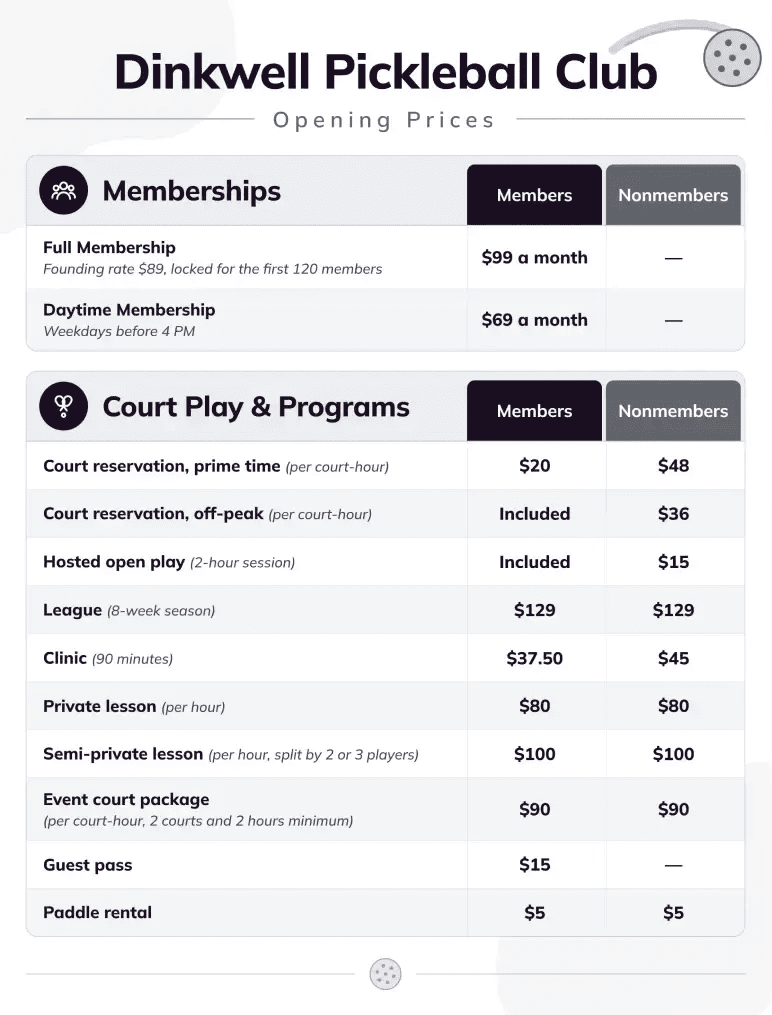
Our prices stay the same for three years. Here are our prices at opening:
Memberships
We expect an average of 175 paying members in Year 1, 190 in Year 2, and 205 in Year 3. After founding rates, Daytime memberships, and summer freezes, our members pay about $86 a month on average.
Members can freeze their membership for up to three summer months at $15 a month. This keeps them with us until the courts get busy again in the fall.
Court Reservations
Reservations are our largest single use, at 6,050 court-hours in Year 1. They earn about $33 per court-hour on average, because many members book off-peak courts for free.
Hosted Open Play
Open play runs in two-hour sessions by Dinkwell Level, on two or three courts at a time. A host runs a paddle rotation to make sure no one waits for more than one game. We expect 3,250 open-play court-hours in Year 1.
Leagues
We will run four eight-week league seasons a year: fall, winter, spring, and summer. Weeknight leagues play Tuesday to Thursday from 7 to 9 PM, and weekend leagues play Saturday and Sunday from 3 to 6 PM, each on four courts.
Matches are round-robin by level, up to five players rotate on each court, and results post to each player’s DUPR rating.
Clinics & Lessons
Clinics are 90-minute group sessions for up to six players, by level. They range from Level 1 Learn to Play to 4.0+ drills on third-shot drops, dinking, and stacking. Clinics earn about $150 per court-hour, more than four times a typical reservation.
Danielle teaches about 300 clinic hours a year, and part-time coaches teach the rest. Our coaches also give private and semi-private lessons.
Events & Tournaments
Court packages suit team outings, birthday parties, and school groups. We also host two club tournaments a year, and a host runs every event.
Our pro shop works on consignment. We earn a commission on paddles and gear without holding any stock.
Booking & Skill Matching
Dinkwell Pickleball Club sets clear rules for booking courts and placing players. We want members to trust their court time and enjoy every game, and these rules help us keep both promises.
Dinkwell Levels
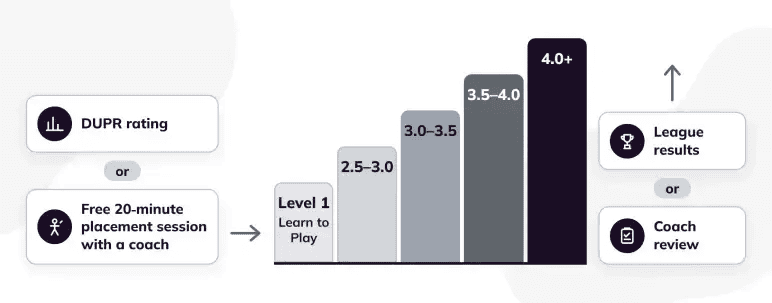
We will place every player in one of five Dinkwell Levels: Level 1 Learn to Play, 2.5–3.0, 3.0–3.5, 3.5–4.0, and 4.0+. Players with a DUPR rating start at the level it shows. Everyone else plays a free 20-minute placement session with a coach on their first visit.
Open play, leagues, and clinics all run by level. Players move up when their league results or a coach’s review show they are ready.
As mentioned earlier, about 39% of players find it hard to find others at their level, and this system answers that directly. The ladder below shows how we place players and how they move up:
Booking Rules
We will explain these rules at the front desk and in the app:
- Booking window: Members book up to 8 days ahead, and nonmembers up to 3 days ahead.
- Prime-time cap: Each member can hold up to three prime-time court bookings a week. This keeps one group from taking the best courts every night.
- Cancellations: Players can cancel for free up to 24 hours ahead, and we charge for later cancellations.
- No-shows: A no-show costs $15, and we release the court to the waitlist 10 minutes after the start time.
- Dinkwell Court Promise: If a booked court isn’t ready at the start time, the player gets a free court-hour credit.
- Open play sign-up: Players reserve a spot in a session at their level, with no more than five players a court.
Sharing Prime Time
Prime time runs from 8 to 11 AM and 4 to 10 PM on weekdays, and from 8 AM to 2 PM on weekends.
In most prime-time hours, two or three courts run open play, two take reservations, and one runs a clinic. On league nights, four courts go to leagues from 7 to 9 PM.
We will review this split each season against the waitlist and no-show reports in our booking software. Prime time makes up 53% of our court-hours but 78% of our Year 1 bookings. This is why these rules matter.
Marketing & Sales Strategy
Dinkwell Pickleball Club will focus on filling its first winter and keeping players through the first summer. We will sign members before we open, then bring them back each week with games at their level.
Founding-Member Presale
Our marketing starts three months before the doors open, with a $20,000 one-time budget.
- In July 2027, we will start selling founding memberships at the locked $89 rate. Each founding member can get a full refund within 60 days if we open late.
- In August and September, we will run free demo sessions at local park courts.
Founding members get a preview night on September 30, and our grand opening weekend on October 9 and 10 offers free placement sessions and open play by level. Our goal is to sign 120 founding members before we open.
Ongoing Marketing
Our ongoing marketing budget is $24,000 in Year 1 and $22,000 a year after that. In Year 1, it covers:
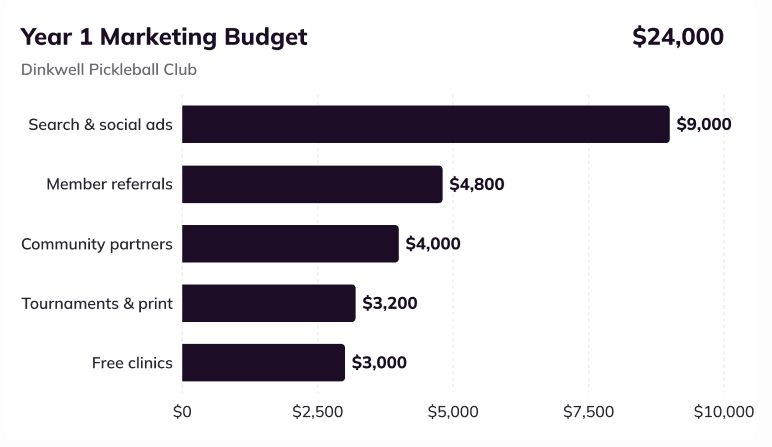
- Search and social ads ($9,000)
Ads aimed at players within 15 minutes’ drive, promoting court bookings and Learn to Play clinics. Our target is 1,500 new player accounts.
- Google Business Profile and reviews ($0)
We will post photos and the court schedule, and ask for a review after every first visit. Our target is 200 reviews with a rating of 4.7 or higher.
- Free placement sessions and Learn to Play clinics ($3,000)
This covers materials and loaner paddles. We want 25% of Level 1 players to become members within three months.
- Community and employer partners ($4,000)
We will work with homeowners’ associations, active-adult groups, local employers, and youth teams. Our target is 15 partners booking events or group clinics.
- Member referral credits
Members get a $40 credit for each friend who joins, and we expect 120 referred members.
- Tournaments, print, and local sponsorships ($3,200)
This covers our two club tournaments, community newsletters, and a sponsored park district event, with a target of 300 tournament entries.
Member Retention
Keeping a member costs less than finding a new one. We will keep members coming back through:
- Summer freezes that keep them on the books through July and August
- Level placement and league results that give them a reason to play every week
- A call from the front desk to any member who hasn’t booked in three weeks
Operations Plan
Dinkwell Pickleball Club runs on a fixed weekly schedule. We give each part of the day to the players most likely to use it. A small staff, a booking app, and clear safety rules make the club simple for one owner to manage.
Weekly Court Schedule
We plan our week around when each group of players likes to play. The timeline below shows how our court activities change between weekdays and weekends:
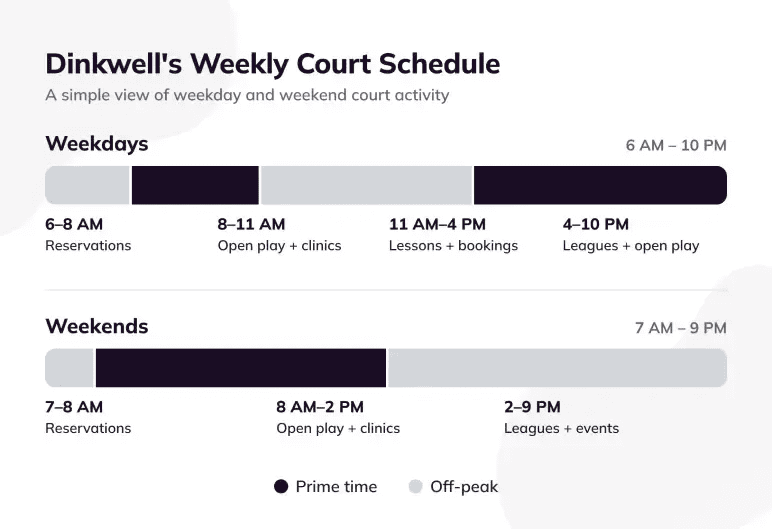
During busy morning hours, we divide the six courts between open play, reservations, and clinics.
Two or three courts usually go to open play, two stay available for reservations, and one is used for a clinic or event. In the evenings, we adjust that mix for leagues and other scheduled games.
Staffing follows the same schedule. Weekday reservations from 6 to 8 AM run through app entry and cameras, with no staff on site and a manager on call.
A desk staffer covers the rest of the day and all weekend hours, while coaches and hosts come in for scheduled activities. Danielle also hosts weekday-morning open play.
Overall, this gives us 33,312 court-hours a year, including 17,568 in prime time. We will close on Thanksgiving, Christmas Day, New Year’s Day, July 4, and Easter Sunday.
Each Monday morning, Danielle sets the week’s schedule, checks the no-show and waitlist report, and plans staff shifts. Our booking software also sends every player a reminder the day before their game.
Winter & Summer
November to March is our busy season. Prime-time courts run about 60% full in November and December and 73% to 78% full from January to March. All league seasons fill, and the desk keeps a waitlist.
From May to August, outdoor courts pull players away, and prime-time use falls to about 40%. During these months, we will:
- Cut host hours
- Run more Level 1 clinics and corporate outings
- Offer summer membership freezes
- Schedule court touch-ups and heating and cooling service
The chart below shows prime-time use and month-end cash through our first year:
Court Care & Safety
Staff clean our cushioned courts every night and inspect them every week, and we replace nets and court tape as they wear. In winter, gas heat and large ceiling fans keep the court area at about 60 to 65 degrees.
Every player signs a waiver in the app before their first booking. Illinois’s Physical Fitness Facility Medical Emergency Preparedness Act requires sports facilities like ours to keep an AED on site and a trained AED user on staff during staffed hours.
Every desk staffer will hold CPR and AED certification, and the AED sits at the court entrance for the early-morning member hours.
Licenses & Permits
Before we open, we will hold these licenses and approvals:
- LLC articles of organization: Illinois Secretary of State, filed in February 2027, with an annual report each year after that
- Employer Identification Number: Internal Revenue Service, before our first payroll
- Certificate of Registration for sales tax: Illinois Department of Revenue, for pro shop and rental sales
- Unemployment insurance employer account: Illinois Department of Employment Security, before our first payroll
- Zoning review for indoor recreation: City of Naperville, confirmed in April 2027 before we sign the lease. If the building’s district needs a conditional use, the request goes to the Planning and Zoning Commission and the City Council.
- Tenant build-out permit and separate fire alarm permit: City of Naperville TED Business Group, with final inspections before we receive our occupancy approval in late September 2027
- Sign permit: City of Naperville, for our building sign
- AED and emergency response plan: Illinois Department of Public Health rules under the Physical Fitness Facility Medical Emergency Preparedness Act
- Workers’ compensation insurance: Required by Illinois law for all employees
- Music licenses: Public performance licenses from ASCAP and BMI for the music we play in the club
Management & Team
Dinkwell Pickleball Club has one owner, a small part-time desk and coaching staff, and an assistant manager from Year 2.
Danielle Whitaker will serve as general manager and programming director. She will handle the court schedule, programs, coaches, members, and the books, working about 50 hours a week on weekdays and two league nights. Her $56,000 Year 1 salary includes the roughly 300 clinic hours she teaches each year.
Our team will include:
(1) Front-desk staff (about 4 part-time)
They check players in, manage bookings and waivers, and run the pro shop. One desk staffer covers every staffed hour, which comes to 5,040 hours a year. They earn $17.50 an hour and hold CPR and AED certification.
(2) Hosts (2 part-time)
Hosts run open-play rotations, league check-in, and events on prime evenings and weekend mornings. They work about 1,750 hours a year combined, fewer in summer, at $17.00 an hour.
(3) Coaches (3 or 4 part-time)
Our coaches hold coaching certifications, and most play at 4.0 or above. They earn $45 per clinic court-hour and 55% of each lesson fee.
(4) Assistant manager (from October 2028)
This salaried role opens the club, builds the staff schedule, handles facility upkeep, and covers weekends, for $46,000 in Year 2 and $48,000 in Year 3.
All our hourly pay sits above Illinois’s $15.00 minimum wage. An outside bookkeeper and CPA, a commercial insurance agent, a real-estate attorney, and a counselor from the local small business development center will also advise Danielle.
Risk Analysis
Running an indoor pickleball club comes with a few clear risks. Here is how we plan for each one:
| Risk | How We Will Handle It |
|---|---|
| Slower first year | Cut host hours and marketing if bookings fall below plan. Our cash reserve gives us room to adjust. |
| Weak summer demand | Use cash earned during winter to cover slower months, reduce staffing, and offer membership freezes. |
| New competition | Keep players through level-matched games, reliable bookings, flexible pricing, and our Court Promise. |
| Rent and utility costs | Limit base rent increases to 3% annually under our lease and use energy-efficient lighting and fans. |
| Player injuries | Require waivers, maintain courts, train staff in CPR/AED, and carry liability insurance. |
| Owner dependence | Train coaches on our system and hire an assistant manager in Year 2. |
What if bookings fall 15% below plan?
If Year 1 bookings drop from 12,600 to 10,710 court-hours, we project a pre-tax loss of about $98,500 and ending cash of roughly $73,000. This would still be above our estimated 9,862 court-hour threshold for covering ongoing operating costs, but we would reduce discretionary spending to protect cash.
Financial Plan
Dinkwell Pickleball Club needs $510,000 to open, funded by a $400,000 SBA 7(a) loan from Brindlewood Bank and $110,000 from Danielle. We expect a Year 1 loss after one-time opening costs, then a $59,467 pre-tax profit by Year 3. In Year 1, our earnings cover only 0.82x of our loan payments. Our startup funds already pay for the $53,500 of one-time costs, and our cash still grows that year.
Startup Budget
| Category | Amount |
|---|---|
| Leasehold improvements (after landlord allowance) | $185,000 |
| Court surfaces, nets, and divider netting | $78,000 |
| Furniture and fixtures | $24,000 |
| Door access, cameras, and front-desk technology | $16,000 |
| Ball machines, AED, and coaching equipment | $11,000 |
| Building sign and entry graphics | $8,000 |
| Lease security deposit | $31,250 |
| Prepaid first-year insurance | $15,000 |
| Legal and setup | $6,000 |
| Permits | $7,500 |
| Website and booking software setup | $5,000 |
| Brand identity and photography | $3,000 |
| Founding-member campaign and opening events | $20,000 |
| Pre-opening hiring and training | $7,000 |
| Opening supplies | $5,000 |
| Working capital reserve | $88,250 |
| Total Startup Costs | $510,000 |
Source of Funds
| Source | Amount |
|---|---|
| SBA 7(a) loan (Brindlewood Bank) — 78.4% | $400,000 |
| Owner equity (Danielle Whitaker — savings and a home-equity line) — 21.6% | $110,000 |
| Total Startup Capital | $510,000 |
Forecast Assumptions
| Assumption | Year 1 | Year 2 | Year 3 |
|---|---|---|---|
| Available court-hours | 33,312 | 33,312 | 33,312 |
| Booked court-hours | 12,600 | 13,860 | 15,246 |
| Overall court utilization | 37.8% | 41.6% | 45.8% |
| Prime-time utilization | 56% | 60% | 64% |
| Off-peak utilization | 18% | 21% | 25% |
| Average revenue per booked court-hour | $55.50 | $55.50 | $55.50 |
| Average paying members | 175 | 190 | 205 |
| Average monthly dues per member | $86 | $86 | $86 |
| Direct materials (share of revenue) | 2% | 2% | 2% |
| Desk, host, and coach pay (share of revenue) | 23.6% | 23.2% | 23.2% |
| Payroll tax rate | 10% | 10% | 10% |
| Owner salary | $56,000 | $60,000 | $64,000 |
| Assistant manager salary | $0 | $46,000 | $48,000 |
| Rent | $187,500 | $191,438 | $195,493 |
| Card processing fees (share of revenue) | 2.9% | 2.9% | 2.9% |
| Loan interest rate (10-year term) | 9.75% | 9.75% | 9.75% |
| Loan payments per year | $62,770 | $62,770 | $62,770 |
| Depreciation | $39,615 | $39,615 | $39,615 |
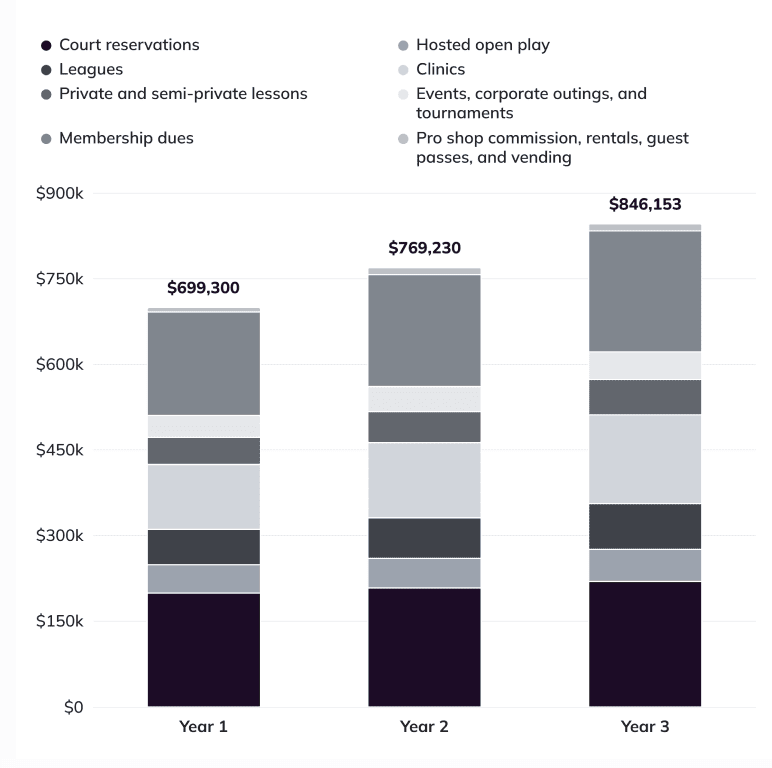
Revenue by Court Use
| Category | Year 1 | Year 2 | Year 3 |
|---|---|---|---|
| Court reservations | $199,650 | $207,900 | $219,600 |
| Hosted open play | $48,750 | $52,500 | $56,250 |
| Leagues | $62,000 | $70,400 | $79,600 |
| Clinics | $114,000 | $132,000 | $156,000 |
| Private and semi-private lessons | $47,600 | $54,400 | $62,050 |
| Events, corporate outings, and tournaments | $38,700 | $43,200 | $48,240 |
| Membership dues | $180,600 | $196,080 | $211,560 |
| Pro shop commission, rentals, guest passes, and vending | $8,000 | $12,750 | $12,853 |
| Total Revenue | $699,300 | $769,230 | $846,153 |
Profit & Loss Forecast
| Category | Year 1 | Year 2 | Year 3 |
|---|---|---|---|
| Revenue | |||
| Total Revenue | $699,300 | $769,230 | $846,153 |
| Cost of Goods Sold | |||
| Direct materials | $13,986 | $15,385 | $16,923 |
| Desk, host, and coach pay | $165,035 | $178,461 | $196,307 |
| Payroll tax on direct pay | $16,504 | $17,846 | $19,631 |
| Total Cost of Goods Sold | $195,525 | $211,692 | $232,861 |
| Gross Profit | $503,775 | $557,538 | $613,292 |
| Gross Margin | 72.0% | 72.5% | 72.5% |
| Operating Expenses | |||
| Owner salary | $56,000 | $60,000 | $64,000 |
| Payroll tax on owner salary | $5,600 | $6,000 | $6,400 |
| Rent | $187,500 | $191,438 | $195,493 |
| Utilities | $43,500 | $45,000 | $46,500 |
| Insurance | $15,000 | $15,500 | $16,000 |
| Assistant manager salary | $0 | $46,000 | $48,000 |
| Payroll tax on assistant manager salary | $0 | $4,600 | $4,800 |
| Accounting, payroll service, and legal | $7,200 | $7,400 | $7,600 |
| Phone, internet, and music licenses | $3,600 | $3,600 | $3,700 |
| Marketing | $24,000 | $22,000 | $22,000 |
| Booking software and technology | $9,600 | $9,900 | $10,200 |
| Janitorial and restroom supplies | $18,000 | $18,500 | $19,000 |
| Repairs and maintenance | $6,000 | $9,000 | $11,000 |
| Staff training and certifications | $2,400 | $2,400 | $2,400 |
| Card processing fees | $20,280 | $22,308 | $24,538 |
| One-time opening costs | $53,500 | $0 | $0 |
| Total Operating Expenses | $452,180 | $463,646 | $481,631 |
| EBITDA | $51,595 | $93,892 | $131,661 |
| Depreciation | $39,615 | $39,615 | $39,615 |
| EBIT | $11,980 | $54,277 | $92,046 |
| Interest Expense | $37,908 | $35,373 | $32,579 |
| Net Income (Pre-Tax) | ($25,928) | $18,904 | $59,467 |
Balance Sheet Forecast
| Category | At Launch | Year 1 | Year 2 | Year 3 |
|---|---|---|---|---|
| Assets | ||||
| Cash | $141,750 | $145,576 | $176,698 | $245,590 |
| Prepaid insurance | $15,000 | $0 | $0 | $0 |
| Lease security deposit | $31,250 | $31,250 | $31,250 | $31,250 |
| Fixed assets (net) | $322,000 | $282,385 | $242,770 | $203,155 |
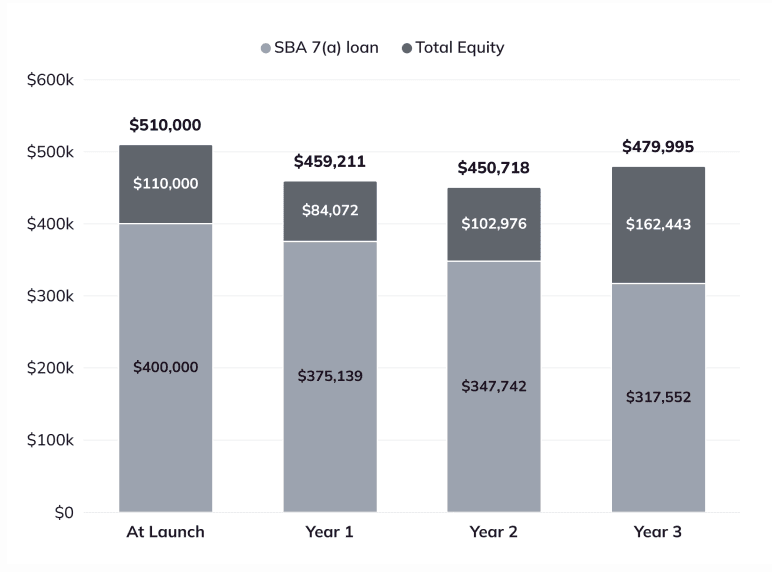
| Total Assets | $510,000 | $459,211 | $450,718 | $479,995 |
| Liabilities | ||||
| SBA 7(a) loan | $400,000 | $375,139 | $347,742 | $317,552 |
| Total Liabilities | $400,000 | $375,139 | $347,742 | $317,552 |
| Equity | ||||
| Owner investment | $110,000 | $110,000 | $110,000 | $110,000 |
| Retained earnings | $0 | ($25,928) | ($7,024) | $52,443 |
| Total Equity | $110,000 | $84,072 | $102,976 | $162,443 |
| Total Liabilities & Equity | $510,000 | $459,211 | $450,718 | $479,995 |
Cash Flow Forecast
| Category | Year 1 | Year 2 | Year 3 |
|---|---|---|---|
| Beginning Cash | $141,750 | $145,576 | $176,698 |
| Operating Activities | |||
| Net income (pre-tax) | ($25,928) | $18,904 | $59,467 |
| Depreciation | $39,615 | $39,615 | $39,615 |
| Change in prepaid insurance | $15,000 | $0 | $0 |
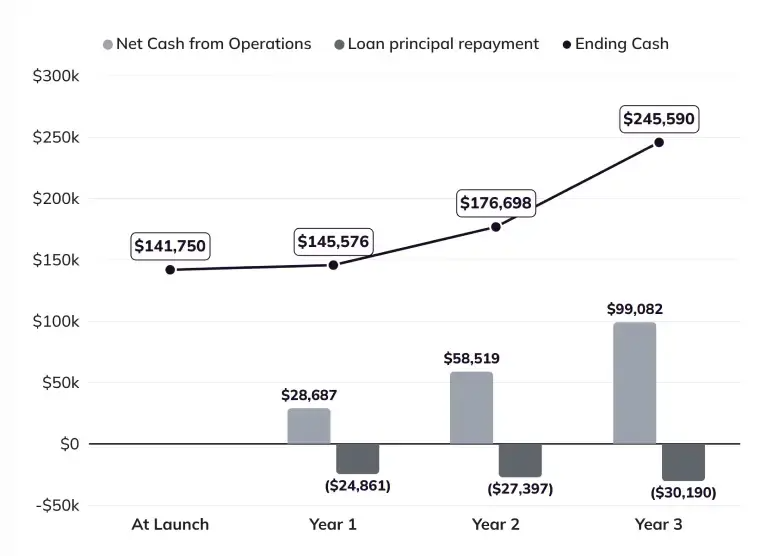
| Net Cash from Operations | $28,687 | $58,519 | $99,082 |
| Financing Activities | |||
| Loan principal repayment | ($24,861) | ($27,397) | ($30,190) |
| Net Cash from Financing | ($24,861) | ($27,397) | ($30,190) |
| Net Change in Cash | $3,826 | $31,122 | $68,892 |
| Ending Cash | $145,576 | $176,698 | $245,590 |
Break-Even & Loan Coverage
| Metric | Value |
|---|---|
| Average revenue per booked court-hour | $55.50 |
| Variable cost per court-hour (Year 2) | $16.88 |
| Contribution per court-hour (Year 2) | $38.62 |
| Contribution margin (Year 2) | 69.6% |
| Fixed operating costs (Year 2, before depreciation and interest) | $441,338 |
| Break-even court-hours per year (Year 2) | 11,429 |
| Break-even court-hours per open day (Year 2) | 32 |
| Break-even utilization (Year 2) | 34.3% |
| Break-even revenue (Year 2) | $634,310 |
| Forecast court-hours (Year 2) | 13,860 |
| Break-even court-hours on Year 1 costs | 9,862 |
| Forecast court-hours (Year 1) | 12,600 |
| Debt service coverage (Year 1) | 0.82x |
| Debt service coverage (Year 1, before one-time opening costs) | 1.67x |
| Debt service coverage (Year 2) | 1.50x |
| Debt service coverage (Year 3) | 2.10x |
The Quickest Way to turn a Business Idea into a Business Plan
Fill-in-the-blanks and automatic financials make it easy.


Upmetrics
Upmetrics is the #1 business planning software that helps entrepreneurs and business owners create investment-ready business plans using AI. We regularly share business planning insights on our blog. Check out the Upmetrics blog for such interesting reads. Read more