A tennis club business plan can look simple at first. You have courts, you have players, and members pay monthly dues.
A lender will look closer. Most players want a court on weekday evenings and weekend mornings, so those few hours decide how many members a club can take. Dues alone rarely pay all the bills, which is why lessons, junior programs, and summer camps matter as much as memberships.
Baselark Tennis Club, a fictional six-court club in Frisco, Texas, answers these points for its $195,000 bank loan. It lays out court use at the busy hours, what each program earns, and the club’s cash through its first year.
Let this example guide you as you shape a tennis club business plan for your own courts and players.
Executive Summary
Club Overview
Baselark Tennis Club is a new community tennis club in west Frisco, Texas. It opens on Saturday, March 6, 2027, at Westhollow Tennis Center, 12410 Eldorado Parkway, Frisco, TX 75036.
The club has six lit outdoor hard courts and a small clubhouse. A member-owned club played on these courts until it closed in 2025, and Baselark has now leased them for 10 years.
Our mission is to give Frisco families and adult players a court they can count on and coaching that helps them keep enjoying the game.
Our vision is to be the club west Frisco players think of first when they want to learn, practice, or play a match.
Courts and Coaching
Baselark earns money in two simple ways: monthly dues for court time and fees for coaching. Its main offerings are:
- Monthly memberships with no initiation fee, from $55 for weekday daytime play to $155 for a family
- Private lessons from $85 per hour
- 90-minute adult drills from $30 per player
- A junior academy at $165 per month
- Half-day summer camps at $255 per week
Nadia Brennan, the owner and head pro, has taught tennis for 16 years and will lead a small team of coaches and desk staff.
Why Frisco Needs a Club
More Americans are picking up a racquet each year. The U.S. reached 27.3 million tennis players in 2025, the sixth straight year of growth.
This means more adults and children are looking for a friendly place to learn and play.
In Frisco, most public courts are first-come, first-served or must be reserved ahead. This makes it hard for players to get the same time each week or steady coaching.
Baselark gives them both in one place, which gives players peace of mind when they plan their week.
Forecast Highlights
Baselark expects to open with 128 founding memberships. Membership grows to 205 by February 2030.
Revenue starts at $432,879 in Year 1 and reaches $561,672 in Year 3.
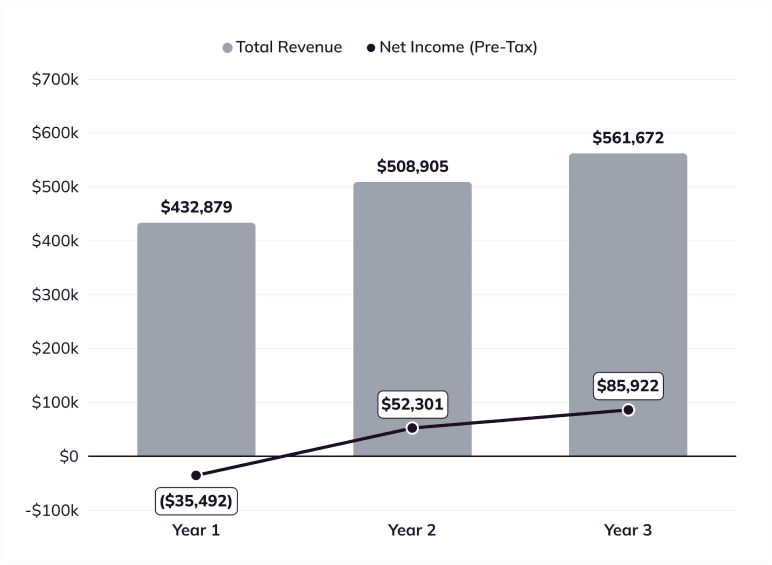
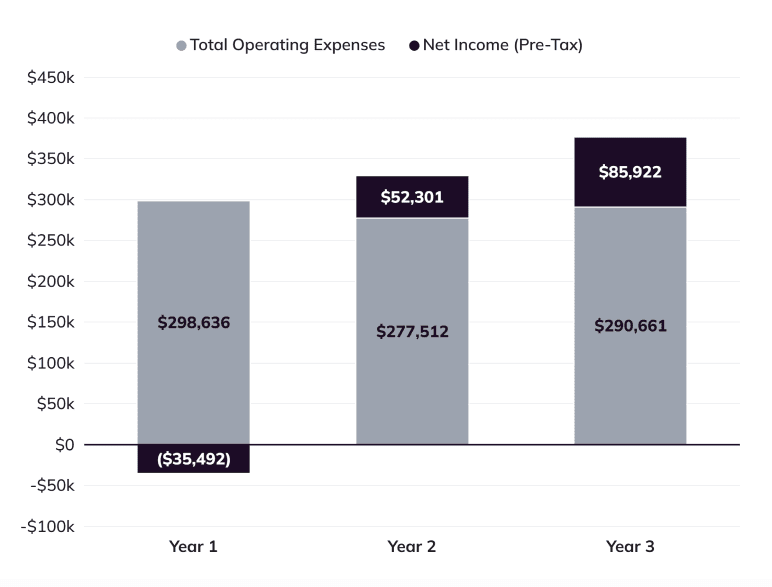
Year 1 shows a loss of $35,492. Most of it comes from $32,200 of one-time startup costs.
Baselark expects a profit of $52,301 in Year 2. Profit rises to $85,922 in Year 3.
Term Loan Request
We are asking for a $195,000, 7-year term loan from Larchmere Bank at 8.25% interest. Nadia will add $90,000 of her own savings, bringing the total to $285,000.
The lease runs longer than the loan, with two renewal options after its first 10 years. This means the club keeps its courts for as long as it repays the bank.
The $285,000 will pay for:
- LED court lighting: $84,000
- Court, teaching, and maintenance equipment: $55,000
- A cash reserve: $43,900
- A clubhouse refresh: $42,000
- Launch costs: $32,200
- The lease deposit, first-year insurance, and opening shop stock: $27,900

Company Overview
Baselark Tennis Club will reopen six existing courts in west Frisco, led by a head pro who already coaches many local players. Because the courts and the coach are both in place, the club can welcome members on its very first day.
Courts & Clubhouse
A member-owned club ran these courts for 18 years. In 2025, its members voted to close it and sold the property to a local investor.
Before handover, the landlord resurfaced all six courts. The club will add new LED lights to the existing poles. This lets members play comfortably into the evening.
It will also refresh the 2,200 sq ft clubhouse. Inside, players will find a front desk, a pro shop counter, a lounge, and restrooms.
A shaded patio between the courts gives players and parents a cool place to rest. The parking lot has 48 spaces, which makes parking easy on busy evenings.
The site plan below shows the courts and clubhouse:
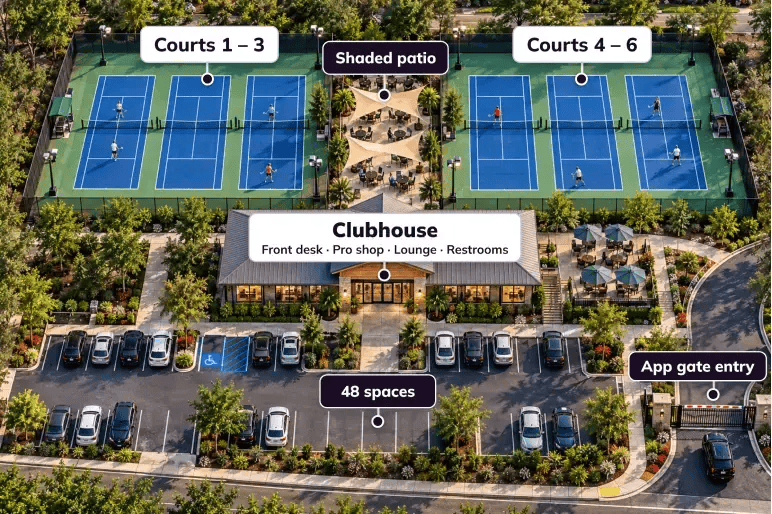
The site is about 10 minutes from several large west Frisco neighborhoods and the Frisco ISD schools their children attend. This makes it easy for families to stop by after school or work.
Nadia Brennan
Nadia brings 16 years of teaching experience to Baselark, including the last 12 at a private club in the Dallas area.
She played college tennis in Texas and holds a degree in sport management. She is also certified by the Recreational and Sports Professionals Association (RSPA).
Her experience at the Dallas-area club includes:
- Six years as head pro and director of junior programs
- Growing the junior academy to about 90 players
- Running the summer camps and the court schedule
- Captaining and coaching USTA league teams
Nadia lives in west Frisco, and about 40 of her current lesson clients and junior players live within a short drive of the courts.
This gives the club a group of players who are ready to join on day one.
Nadia will also personally guarantee the loan.
Legal Setup
Nadia formed Baselark Tennis Club LLC in December 2026 as a single-member Texas limited liability company (LLC).
The LLC signs the lease and the loan. This keeps business debts and player claims separate from her personal assets.
For its first three years, Baselark will focus on tennis only, on six outdoor courts. Pickleball lines, a pool, food service, and indoor courts would each need more space or money. Nadia will look at them only after membership is steady.
Club Targets
Nadia has set clear targets for the club’s first three years:
- Open on March 6, 2027, with 128 founding memberships and all six courts lit
- Reach 170 paying memberships by February 2028
- Grow the junior academy to 48 players by the 2029–2030 school year
- Fill more than three-quarters of the busy court hours in Year 3
- Reach 205 paying memberships by February 2030, with enough cash saved for the next court resurfacing
Market Analysis
Baselark will draw most of its players from west Frisco and the nearby parts of Prosper and Little Elm. Tennis is popular in this part of Texas, and the local numbers show room for a club of this size.
Texans play tennis more often than most Americans. A record 2.6 million Texans aged 6 and older played in 2025. That is 9.4% of Texans, or about 1 in 11, compared with 1 in 12 Americans.
At that rate, roughly 23,500 of Frisco’s 249,511 residents may play tennis.
Even counting every player on a family plan, Baselark’s 205 memberships in Year 3 would reach fewer than 2 in every 100 of them. This means the club can grow steadily without needing a large share of local players.
Many of these players are new to the game. Across the U.S., a record 4.9 million people played tennis for the first time in 2025.
Beginners and returning players usually take lessons and drills before they buy a membership. This is why about half of Baselark’s revenue comes from coaching and programs.
Frisco has many public courts, but players can’t always count on getting one. The city lists more than 100 public courts at parks and schools, and players can walk on or reserve one for $11 per 90 minutes.
School courts are open to the public only on weekday evenings and weekends. One city contractor also runs all lessons on city and school courts.
This leaves room for a club that offers what public courts can’t easily give: a reserved court, daytime play, and coaching on the same courts.
Target Customers
Baselark serves four groups of players, and each one needs something a little different from a club:
| Group | Who They Are | What They Need | What Baselark Offers |
|---|---|---|---|
| Families with school-age children | Parents in west Frisco with children aged 5–15 | A sport the whole family can play, and coaching for the children | Family membership, junior academy, summer camps, family clinic days |
| Recreational adult players | Adults aged 30–60 who play doubles, USTA league, or social tennis | An evening court they can book ahead | Individual membership, drills, round robins, league home matches |
| Daytime players | Retirees, parents while children are at school, and shift and remote workers | Courts and partners during the day | Weekday daytime membership, morning drills, ball machine time |
| Middle and high school players | Players on Frisco ISD teams | More court time and coaching in the off-season | Junior membership, academy squads, private lessons |
Families and adult players will book most evening and weekend courts. Daytime players and juniors use the hours in between.
This mix helps keep all six courts busy through the whole week.
Market Trends
A few changes in how people play tennis shape Baselark’s programs and schedule.
More adults are coming back to tennis after years away. Many want a group class at their own level before they commit to a membership, and Baselark’s adult drills give them a friendly, low-pressure first step.
Frisco has added pickleball lines to some public tennis courts. Many tennis players now look for courts kept for tennis only, and Baselark’s six courts are just that.
Families now book and pay for activities on their phones. Our app makes this easy, with courts, lessons, and camps all in one place.
Competitive Analysis
Frisco players already have several places to play. Baselark’s direct competitors are the other places in and around Frisco to book a court or a lesson. Its indirect competitors are the other ways the same players spend their sports time.
Here’s how the main options compare:
| Option | Type | Price | Strengths | Weaknesses |
|---|---|---|---|---|
| Public courts at city parks and schools | Direct | Free walk-on, or $11 per 90 minutes reserved; lessons $65–$100 per hour through the city’s contractor | More than 100 courts and the lowest price in town | Walk-on courts are first-come; school courts open to the public only on weekday evenings and weekends; no lessons at middle schools; no clubhouse |
| Private racquet club in north Frisco (opened 2024) | Direct | Hourly booking or membership; prices not published | Seven new lighted courts, plus padel and pickleball | Tennis shares the club with two other sports |
| Large athletic club chains with tennis | Direct | Memberships from about $280 per month | Courts, pools, gyms, and classes in one membership | More than three times Baselark’s individual dues |
| Country clubs with tennis | Direct | Initiation fee plus monthly dues | Full amenities and a busy social calendar | High initiation fees, and golf often comes first |
| Pickleball venues, HOA courts, and private coaches | Indirect | Varies | Close to home, with flexible times | No reserved courts, club leagues, or junior program |
The athletic clubs and country clubs will keep their bigger facilities, and public courts will stay cheaper.
Baselark is for the players in between, who want a reserved court, good coaching, and a friendly club at a monthly price well below the big clubs.
Why players choose Baselark:
- A reserved court in 90-minute blocks, booked up to 7 days ahead, from early morning every day
- No initiation fee, and dues paid month to month
- Coaching all day on the same courts, led by two certified pros
- Lit courts until 10 PM on weekdays, with a clubhouse, restrooms, and shade
- A full club calendar, with in-house leagues, Friday round robins, and two tournaments a year
Together, these make Baselark an easy, welcoming choice for players who want more than a public court.
Memberships & Programs
We keep our pricing simple. Members pay a monthly fee for court time, and everyone pays separately for coaching, the way most community clubs work.
Memberships
Each membership gives free court bookings to the people it covers:
| Membership | Who It’s For | Includes | Price per Month |
|---|---|---|---|
| Individual | Adults who play evenings and weekends | Free court bookings, member prices on lessons and drills, league entry | $85 |
| Family | Up to two adults and their children under 18 | Individual benefits for everyone in the household, plus family clinic days | $155 |
| Junior | Players under 18 | Court bookings outside the busy hours, member prices on the academy and camps | $45 |
| Weekday daytime | Anyone who plays Monday–Friday before 4 PM | Court bookings and member prices on morning drills before 4 PM on weekdays | $55 |
There is no initiation fee, and members can cancel with 30 days’ notice. This makes joining an easy, low-risk choice for new players.
Private Lessons
Private lessons are the quickest way for a player to improve. Players of any level can book one-on-one or pairs lessons with Nadia, the assistant pro, or a part-time coach.
Lessons run 30 or 60 minutes, and players can add ball machine time for extra practice.
Price: $85 per hour for members and $95 for non-members. Thirty-minute lessons cost half, and semi-private lessons cost $55 per player per hour.
Adult Clinics
Adult drills are friendly group sessions for players of every level, from beginners to strong league players.
Each drill runs 90 minutes, with up to eight players on one court, grouped by level. Every week has a set focus, such as the serve, net play, or doubles positioning.
On weekday mornings, “back to tennis” drills help returning players get their timing back in a relaxed setting.
This helps players see their game improve week by week while they meet new partners at their level.
Price: $30 for members and $38 for non-members.
Junior Academy
The junior academy is Baselark’s program for players aged 5 to 17, from first lessons to high school teams.
Each child trains in two 90-minute sessions a week from September to May. Groups have no more than six players per coach, so every child gets real attention.
Families receive a progress card each term, which makes it easy to see how their child is growing.
Younger players start with softer balls on smaller courts, and they move up as their skills grow. Here’s how the academy groups players:
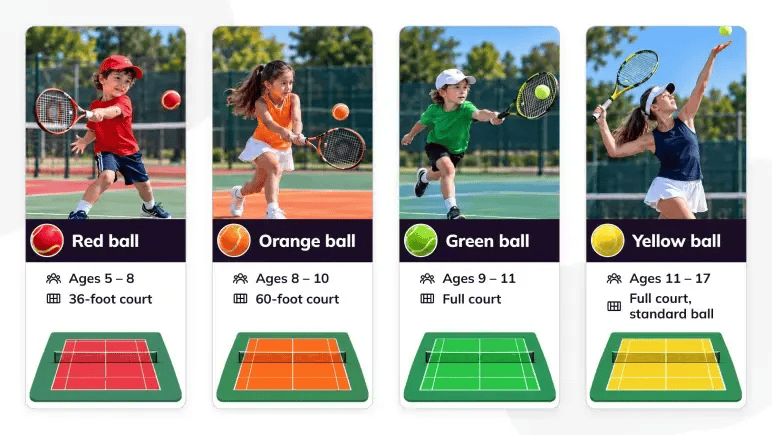
Price: $165 per month, billed monthly, with 10% off for siblings.
Summer Camps
Summer camps give children aged 6 to 15 a fun, active start to their summer days.
Baselark runs ten half-day camp weeks from early June to mid-August. Each camp day runs from 8:00 to 11:30 AM, before the worst of the heat.
Campers enjoy drills, games, and match play on all six courts. Coaches give a water break every 30 minutes to keep everyone safe and comfortable.
Price: $255 per week, with 10% off for members.
Leagues and Round Robins
Adults who want regular matches can join these club events:
- In-house flex leagues three times a year, from $45 per season for members
- Friday night round robins at $15 per player
- Two club tournaments a year, with entry at about $45
- Home courts for USTA league teams
These events help members find regular partners and make the club feel like a community.
Guest Passes & Pro Shop
Members can bring a guest for $12 per visit, which makes it easy to introduce friends to the club.
Non-members can book open courts outside the busy hours for $20 per court-hour.
The pro shop at the front desk sells balls, grips, strings, and a few racquets. Staff string racquets within 48 hours.
Marketing & Sales Strategy
Baselark’s marketing starts three months before opening, with the people most likely to join first. After opening, programs bring in new families, and a busy club calendar keeps members coming back.
Founding Members Before Opening
We will sell founding memberships at Year 1 prices from December 2026 to February 2027.
Nadia will reach out to three groups first: former members of the closed club, her current lesson clients, and the junior players she coaches now. The landlord shares the old club’s mailing list, with the members’ consent.
These players already know the courts or know Nadia. This makes them the most likely to join early.
A founding-member open house on Saturday, March 6, 2027, opens the club. Guests can enjoy free court time, demo drills, kids’ games, and camp sign-ups.
The launch campaign costs $12,000. Setting up the brand, website, booking app, and photos costs another $6,800.
Bringing In New Players
After opening, we will find new players through six local channels:
- Google Business Profile and search ads for “tennis lessons Frisco,” “tennis club near me,” and “tennis camp Frisco,” shown to people within about 10 miles
- Nextdoor and neighborhood Facebook groups in west Frisco, where parents ask for coaching and camp ideas
- School flyers, PTA sponsorships, and booths at school events for the junior academy and summer camps
- Free “Try Tennis” Saturday clinics once a month for adults and children who haven’t played in years
- Outreach to USTA league captains, with home courts and practice times for their teams
- A referral credit of one month’s dues for any member who brings in a new member
Here’s the flyer Baselark sends home with elementary school families:

Ongoing marketing costs $15,000 in Year 1, with the most spent before spring, summer camps, and fall:
| Channel | Monthly Budget | Share |
|---|---|---|
| Search ads and Google Business Profile | $450 | 36% |
| Social media and Nextdoor ads | $300 | 24% |
| School flyers and PTA sponsorships | $200 | 16% |
| Free intro clinics | $150 | 12% |
| Referral credits | $150 | 12% |
| Total | $1,250 | 100% |
Keeping Members
Members stay when they have people to play with and a reason to come back each week. We work to give them both.
In a new member’s first month, coaches match them to drills and round robins at their level. This helps new members feel welcome and find partners quickly.
The club hosts a members’ night every month and posts league and ladder results at the front desk.
Coaches also check in with any member who hasn’t booked a court in three weeks.
Nadia reads every cancellation reason and tracks the monthly cancellation rate next to revenue. This helps her fix a problem before more members leave.
Operations Plan
Baselark’s daily work focuses on two things: making sure members find a court when they want to play, and keeping six courts in great shape. It all starts with a lease that gives the club those courts for the next 10 years.
Why a Cheap Facility Lease Can Become an Expensive Mistake
Before signing, Nadia had an offer for a similar six-court site in Frisco at $4,200 per month.
That rent would have saved about $31,200 each year. The terms, however, would have cost the club far more, for three reasons.
1. Repairs on the tenant. The courts came as-is. Baselark would have paid about $60,000 to resurface all six before opening. After that, the club would have paid for slab cracks, fencing, drainage, and light poles.
2. A term too short for the loan. The cheaper lease ran three years with no renewal option, and the bank would lend only within the lease term. With the resurfacing added, Baselark would have needed a $255,000 loan repaid in three years, at about $8,020 per month.
The club could also have lost its $126,000 of lighting and clubhouse work when that short lease ended.
3. Courts the landlord keeps. The landlord wanted three courts on weekday afternoons in the school year and on Saturday mornings. That came to 2,244 court-hours a year, about a quarter of all the hours Baselark expects to book in Year 1.
The lease Nadia signed costs $6,800 per month and rises 3% a year. It runs 10 years, with two 5-year renewal options, and gives Baselark all six courts at all hours.
The landlord keeps the slab, drainage, fencing, and pole structure. The lease also includes the landlord waiver the bank asked for.
Even before counting the lost court time, the shorter loan would have cost the club about $28,300 more each year than the cheaper rent saved. This is why the higher rent is the safer choice for both the club and the bank.
Hours and Court Booking
Clear hours and fair booking rules help every member get court time. The club keeps these hours:
- Monday to Friday: 6 AM – 10 PM
- Saturday and Sunday: 7 AM – 9 PM
Members can enter through an app-based gate before the front desk opens, which makes early play easy.
Members book courts for free in 90-minute blocks, up to 7 days ahead.
The busy hours are weekday evenings from 5 to 10 PM and weekend mornings from 8 AM to noon. To keep things fair, each member can hold up to three bookings a week in those hours.
Programs may use no more than four courts during the busy hours. This keeps at least two courts open for member play. Non-members can book only outside the busy hours.
Plans change, so members can cancel a court for free up to 24 hours ahead. A $10 no-show fee keeps busy-hour courts from sitting empty.
Lessons and programs follow the same 24-hour rule, and camps refund up to 14 days before the week starts.
For everyone’s safety, courts close when lightning is within 10 miles. They also close after rain until the surface is dry.
Weekly Court Use
Members, programs, and guests share the courts across the week in a set pattern:
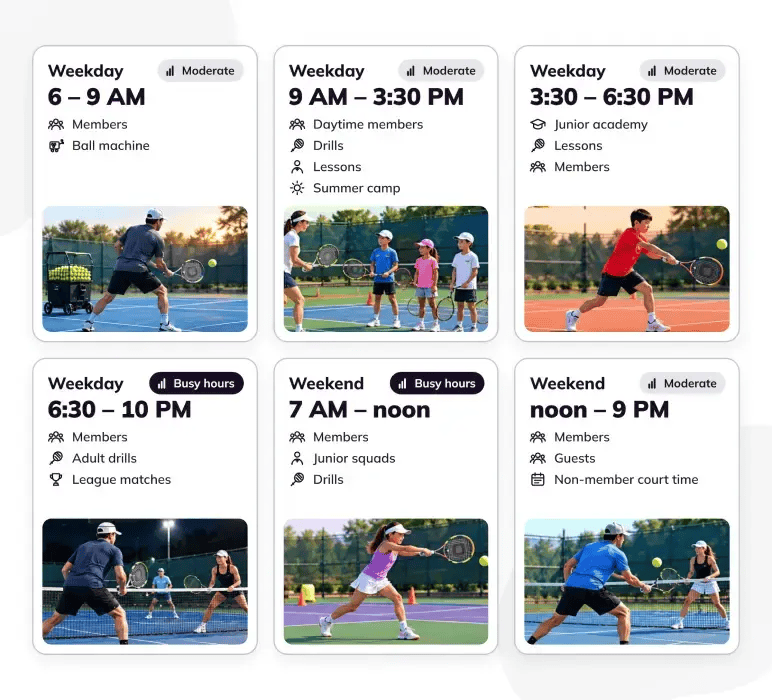
After rain, cold mornings, and holiday closures, Baselark’s six courts have 31,085 open court-hours a year.
Members, programs, and guests will book 9,493 of those hours in Year 1. By Year 3, bookings grow to 11,919 hours.
The busy hours set the real limit on growth. They are 62.0% full in Year 1, and they reach 77.8% by Year 3.
This is why growth after Year 2 comes mostly from daytime members, morning drills, and camps. These all use the quieter hours.
Staffing
Baselark starts with a small team that covers the busy hours and the junior programs:
| Role | Who | Hours | Year 1 Pay |
|---|---|---|---|
| Owner, general manager, and head pro | Nadia Brennan | Full-time; runs the club and teaches private lessons | $58,000 |
| Assistant pro and junior program director | Full-time hire, RSPA- or PTR-certified | Full-time; leads the academy and half of the junior squads | $46,000 |
| Part-time coaches | Three coaches | Weekday evenings and Saturdays; paid 60% of their lesson fees plus an hourly rate for drills and squads | $32,132 |
| Front desk staff | Several part-time employees | 40 hours a week, weekday afternoons and evenings and weekend mornings, at $16.50 per hour | $34,320 |
| Summer camp staff | Two coaches and two junior counselors | June to August mornings | $15,200 |
| Total (before payroll tax) | $185,652 |
Every adult who works with juniors completes USTA Safe Play before the first session. This includes SafeSport training and a background check, which gives parents peace of mind.
Desk staff learn the court rules, first aid, and the booking system. This helps them answer members’ questions on the spot.
Court and Facility Care
Well-kept courts are a big part of what members pay for. The team keeps them in shape with a simple routine:
- Blow off the courts every morning, and roll off standing water after rain
- Check nets, straps, and windscreens every week
- Check for cracks every month, and have the court contractor fill them before they spread
- Tie the light timers to bookings, so courts light only when someone is playing
- Clean the clubhouse daily, and check the restrooms every two hours on busy days
The next acrylic resurfacing is the club’s own cost and is due around 2032 or 2033. Nadia budgets about $10,000 per court at today’s prices and is setting cash aside for it.
This careful upkeep helps the courts stay safe, smooth, and pleasant to play on for years.
Licenses and Insurance
The club registers as an LLC with the Texas Secretary of State. Beyond that, these approvals matter most for a tennis club in Frisco:
| Approval | Issued By | Why It Matters |
|---|---|---|
| Sales and use tax permit | Texas Comptroller | Texas taxes club dues and court fees as amusement services, but not sports lessons |
| Certificate of occupancy | City of Frisco | The clubhouse needs one for the new tenant before it opens |
| Youth camp license | Not needed | Texas licenses longer camp days with several outdoor activities, and Baselark’s camp runs 3.5 hours and teaches only tennis |
Insurance covers general liability, with abuse and molestation coverage for junior programs, plus property and workers’ compensation. The Year 1 premium is $9,800.
Financial Plan
Baselark Tennis Club needs $285,000 to open. This comes from a $195,000 term loan from Larchmere Bank and $90,000 of Nadia’s savings. The club expects a loss of $35,492 in Year 1, mostly from one-time startup costs, and a profit of $52,301 in Year 2.
Startup Costs
| Category | Amount |
|---|---|
| Courts & Clubhouse | |
| LED retrofit of the six courts’ lights | $84,000 |
| Clubhouse refresh (restrooms, lounge, pro shop counter, front desk, patio seating) | $42,000 |
| Equipment | |
| Nets, posts, windscreens, dividers, and benches | $19,800 |
| Ball machines, stringing machine, ball carts, and junior nets and balls | $13,500 |
| Gate access, cameras, front desk computer, and card readers | $14,500 |
| Court blower, water rollers, and used utility cart | $7,200 |
| Deposits, Insurance & Stock | |
| Lease security deposit | $13,600 |
| First-year insurance (prepaid) | $9,800 |
| Opening pro shop stock | $4,500 |
| One-Time Launch Costs | |
| LLC formation and attorney review of the lease | $5,200 |
| Brand, website, booking app setup, and photos | $6,800 |
| Launch marketing | $12,000 |
| Pre-opening payroll and staff training | $6,400 |
| Staff hiring, background checks, and SafeSport and first aid training | $1,800 |
| Working Capital | |
| Cash reserve | $43,900 |
| Total Startup Costs | $285,000 |
Financial Assumptions
| Assumption | Year 1 | Year 2 | Year 3 |
|---|---|---|---|
| Open court-hours (6 courts) | 31,085 | 31,085 | 31,085 |
| Booked court-hours | 9,493 | 11,039 | 11,919 |
| Court utilization, all open hours | 30.5% | 35.5% | 38.3% |
| Court utilization, busy hours | 62.0% | 72.1% | 77.8% |
| Paying memberships at year-end | 170 | 192 | 205 |
| Average memberships billed per month | 150 | 181 | 199 |
| Average dues per membership per month | $94.60 | $97.48 | $100.74 |
| Private lesson hours | 740 | 769 | 794 |
| Average private lesson price per hour | $90 | $93 | $96 |
| Average adult drill price per player | $32 | $33 | $34 |
| Junior academy child-months | 328 | 394 | 422 |
| Junior academy price per month | $165 | $170 | $175 |
| Summer camper-weeks | 230 | 240 | 250 |
| Summer camp price per week | $255 | $265 | $275 |
| Pro shop goods cost (share of shop sales) | 55% | 55% | 55% |
| Card and bank processing (share of revenue) | 2.8% | 2.8% | 2.8% |
| Front desk pay per hour | $16.50 | $17.00 | $17.50 |
| Payroll tax (share of wages) | 8.9% | 8.9% | 8.9% |
| Base rent per month | $6,800 | $7,004 | $7,214 |
| Loan payment per month | $3,063.66 | $3,063.66 | $3,063.66 |
Projected Profit & Loss
| Category | Year 1 | Year 2 | Year 3 |
|---|---|---|---|
| Revenue | |||
| Membership dues | $170,280 | $212,214 | $240,970 |
| Court rentals and guest fees | $11,660 | $13,570 | $15,000 |
| Private lessons | $66,600 | $71,517 | $76,224 |
| Adult clinics and drills | $41,669 | $46,324 | $49,528 |
| Junior academy | $54,120 | $66,980 | $73,850 |
| Summer camps | $58,650 | $63,600 | $68,750 |
| Leagues, round robins, and tournaments | $9,300 | $11,300 | $12,750 |
| Pro shop and stringing | $20,600 | $23,400 | $24,600 |
| Total Revenue | $432,879 | $508,905 | $561,672 |
| Cost of Revenue | |||
| Pro shop goods | $11,330 | $12,870 | $13,530 |
| Balls and program supplies | $5,758 | $6,493 | $7,028 |
| Card and bank processing | $12,121 | $14,249 | $15,727 |
| Coaching pay (assistant pro, part-time coaches, camp staff) | $93,332 | $99,571 | $104,458 |
| Payroll tax on coaching pay | $8,307 | $8,862 | $9,297 |
| Total Cost of Revenue | $130,848 | $142,045 | $150,040 |
| Gross Profit | $302,031 | $366,860 | $411,632 |
| Gross Margin | 69.8% | 72.1% | 73.3% |
| Operating Expenses | |||
| Owner salary | $58,000 | $63,000 | $68,000 |
| Front desk staff | $34,320 | $35,360 | $36,400 |
| Payroll tax on owner and desk wages | $8,216 | $8,754 | $9,292 |
| Base rent | $81,600 | $84,048 | $86,569 |
| Lease pass-through charges | $17,400 | $18,000 | $18,600 |
| Utilities | $13,200 | $13,700 | $14,200 |
| Insurance | $9,800 | $10,300 | $10,800 |
| Court and grounds upkeep | $8,400 | $9,600 | $10,800 |
| Marketing | $15,000 | $13,500 | $14,000 |
| Club software and website | $6,000 | $6,200 | $6,400 |
| Accounting, payroll service, and legal | $5,400 | $5,600 | $5,800 |
| Phone and internet | $2,400 | $2,450 | $2,500 |
| Clubhouse supplies | $4,500 | $4,700 | $4,900 |
| Memberships, certifications, and staff screening | $2,200 | $2,300 | $2,400 |
| One-time startup costs | $32,200 | – | – |
| Total Operating Expenses | $298,636 | $277,512 | $290,661 |
| EBITDA | $3,395 | $89,348 | $120,971 |
| Depreciation | $23,600 | $23,600 | $23,600 |
| Interest expense | $15,287 | $13,447 | $11,449 |
| Net Income (Pre-Tax) | ($35,492) | $52,301 | $85,922 |
Projected Balance Sheet
| Category | Opening | Year 1 | Year 2 | Year 3 |
|---|---|---|---|---|
| Assets | ||||
| Cash | $76,100 | $53,307 | $105,385 | $189,375 |
| Pro shop inventory | $4,500 | $3,725 | $4,231 | $4,448 |
| Prepaid insurance | $9,800 | $0 | $0 | $0 |
| Lease security deposit | $13,600 | $13,600 | $13,600 | $13,600 |
| Lighting, clubhouse, and equipment, net | $181,000 | $157,400 | $133,800 | $110,200 |
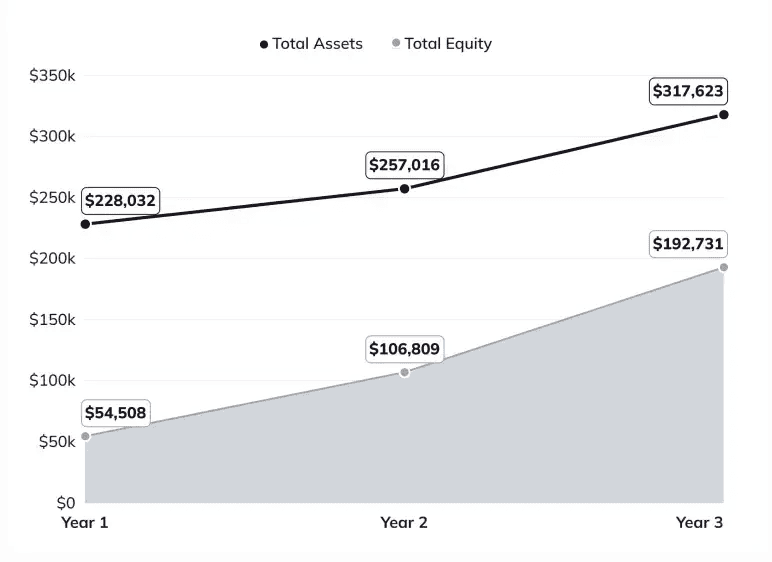
| Total Assets | $285,000 | $228,032 | $257,016 | $317,623 |
| Liabilities | ||||
| Term loan | $195,000 | $173,524 | $150,207 | $124,892 |
| Total Liabilities | $195,000 | $173,524 | $150,207 | $124,892 |
| Equity | ||||
| Owner’s capital | $90,000 | $90,000 | $90,000 | $90,000 |
| Retained earnings | $0 | ($35,492) | $16,809 | $102,731 |
| Total Equity | $90,000 | $54,508 | $106,809 | $192,731 |
| Total Liabilities & Equity | $285,000 | $228,032 | $257,016 | $317,623 |
Projected Cash Flow
| Category | Year 1 | Year 2 | Year 3 |
|---|---|---|---|
| Beginning Cash | $76,100 | $53,307 | $105,385 |
| Operating Activities | |||
| Net income (pre-tax) | ($35,492) | $52,301 | $85,922 |
| Depreciation | $23,600 | $23,600 | $23,600 |
| Change in pro shop inventory | $775 | ($506) | ($217) |
| Change in prepaid insurance | $9,800 | $0 | $0 |
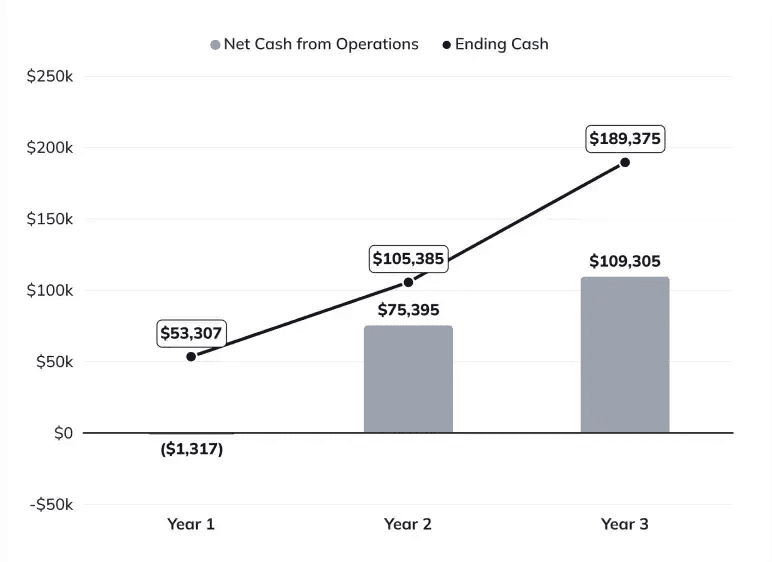
| Net Cash from Operations | ($1,317) | $75,395 | $109,305 |
| Financing Activities | |||
| Loan principal repaid | ($21,476) | ($23,317) | ($25,315) |
| Net Cash from Financing | ($21,476) | ($23,317) | ($25,315) |
| Net Change in Cash | ($22,793) | $52,078 | $83,990 |
| Ending Cash | $53,307 | $105,385 | $189,375 |
Break-Even Analysis
| Metric | Value |
|---|---|
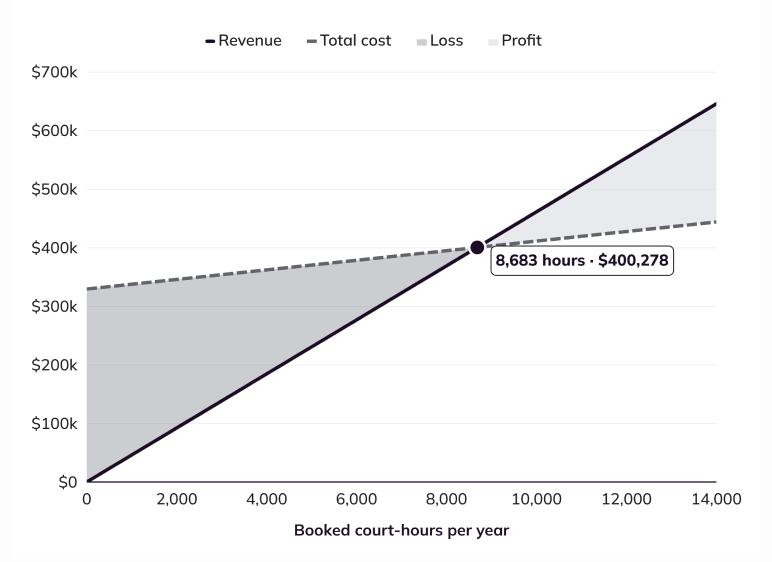
| Annual fixed costs, including the assistant pro (Year 2) | $329,240 |
| Average revenue per booked court-hour (Year 2) | $46.10 |
| Variable cost per booked court-hour (Year 2) | $8.18 |
| Contribution per booked court-hour | $37.92 |
| Contribution margin | 82.3% |
| Break-even booked court-hours per year | 8,683 |
| Break-even court utilization | 27.9% |
| Break-even revenue (before depreciation and interest) | $400,278 |
| Booked court-hours to also cover loan payments | 9,652 |
| Planned booked court-hours (Year 2) | 11,039 |
Loan Repayment & Debt Coverage
| Category | Year 1 | Year 2 | Year 3 |
|---|---|---|---|
| Interest | $15,287 | $13,447 | $11,449 |
| Principal | $21,476 | $23,317 | $25,315 |
| Total loan payments | $36,764 | $36,764 | $36,764 |
| Ending loan balance | $173,524 | $150,207 | $124,892 |
| EBITDA | $3,395 | $89,348 | $120,971 |
| EBITDA before one-time startup costs | $35,595 | $89,348 | $120,971 |
| Debt coverage | 0.09x | 2.43x | 3.29x |
| Debt coverage before one-time startup costs | 0.97x | 2.43x | 3.29x |
Risks & Stress Test
Like any new club, Baselark faces a few risks. Nadia has tested how much room the numbers leave. This helps the club act early if something goes wrong.
Year 1 is the tightest year. Earnings cover only 0.09 times the loan payments, or 0.97 times before one-time startup costs.
The cash reserve covers that gap. Baselark still starts Year 2 with $53,307 in cash, more than a full year of loan payments.
Year 2 has more room. If revenue came in 10% lower, debt coverage would still be 1.29x. Coverage stays at 1.25x or above unless revenue falls more than 10.4%.
Three risks matter most, and Nadia has a plan for each one:
1. Memberships sell more slowly than planned. The founding-member presale is the first test. If it falls short, Nadia will shift marketing toward the weekday daytime plan and free “Try Tennis” clinics.
Part-time coaches earn a share of each lesson they teach. This means coaching costs also fall when lessons slow down.
2. Heat and rain on outdoor courts. The club already plans for less court play in July, August, December, and January. Camps run before the midday heat, and the lights extend evening play. Coaches also reschedule rained-out lessons instead of refunding them.
3. A coach leaves and takes students. Every lesson is booked and paid through the club, and coaches sign a non-solicitation agreement. With two certified pros on staff, the academy keeps running even if a part-time coach leaves.
These steps help Baselark stay steady through a slow start, a hot summer, or a staff change.
The Quickest Way to turn a Business Idea into a Business Plan
Fill-in-the-blanks and automatic financials make it easy.


Upmetrics
Upmetrics is the #1 business planning software that helps entrepreneurs and business owners create investment-ready business plans using AI. We regularly share business planning insights on our blog. Check out the Upmetrics blog for such interesting reads. Read more