You’ll probably have a basic idea of your customers, right? But still, do you know what kind of problems they try to solve, what factors affect their buying decisions, and why they would choose your business over any other?
That’s exactly where many entrepreneurs face difficulties. They understand their target audience, but lack the knowledge necessary to promote the business effectively.
A buyer persona can help close that gap.
In this guide, I will walk you through what a buyer persona is, how you can create it using customer research, and how you can utilize it to make informed business decisions. In addition, you’ll have a hands-on example and a template to help you begin.
What Is a Buyer Persona?
A buyer persona is a research-based profile that represents a specific type of customer who’s likely to buy your product or service. It is also known as a customer persona.
It brings a particular type of customer to life by describing their professional and personal background, key needs, goals, frustrations, buying habits, and decision-making process.
Although a persona may have a fictional name and background, the insights behind it should come from research into actual or potential customers.
Businesses mainly use buyer personas in order to create more relevant marketing messages and offers, choose the right marketing channels to communicate with their customers, and develop the right products or services for them.
And you don’t need an established business or a big research budget to get started.
Is the buyer persona similar to the target audience?
No. They are different from each other.
Your target audience is the broader group that you want to reach. A buyer persona provides you with a better understanding of a specific type of buyer in that group.
Let’s take one example here. Suppose you’re opening a neighborhood coffee shop.
Your target audience could be working adults between 25 and 45 years old, living or working in the area.
This is a good starting point, but it doesn’t tell you much about what you should do to attract them.
A buyer persona takes it one step further. It could show that some of these professionals buy coffee on their way to work, don’t have much time in the morning, and would prefer shops where they can place their orders ahead and pick up coffee quickly.
That’s the distinction between a target audience and a buyer persona. Both are useful, but they serve different purposes.
How to Create a Buyer Persona? (Step-by-step Guide)
Developing a buyer persona doesn’t have to be complicated. You need to first identify the customers you want to understand, find out details about them, and then use what you know about them to create a useful profile.
A well-researched buyer persona explains more than giving your ideal customer a name, age, and job title. It reflects how a particular type of customer behaves in a real buying situation.
This is how I’d approach it.
Step 1: Decide which customers you want to understand
First of all, look at your target market and identify a customer group that’s particularly important to your business.
You don’t have to list all of the possible customers. Instead, concentrate on one group that is especially important to your business.
When deciding on which group to start, ask yourself the following three questions:
- Who needs my product or service?
- Who will be able and willing to pay for it?
- Which customers can my business realistically serve and reach?
For instance, imagine you’re planning a coffee shop, Sunrise Coffee, in the vicinity of an office area.
Your potential customers could be morning commuters, nearby residents, college students, and even individuals who look for a place where they can work.
They all might go to purchase coffee, but they may visit for different purposes.
If your business will focus on weekday morning takeaway sales, you might narrow your research to office professionals who regularly buy coffee on their way to work.
At this point, you don’t know exactly how often they buy, what they’re willing to spend, or what frustrates them about their existing options.
That’s what you’ll try to understand in the next step.
Step 2: Gather information about your customers
After deciding on a group of potential customers, learn about their daily routines, needs, preferences, and purchasing decisions.
You will need to understand who they are, what their daily life looks like, and how their personal or professional circumstances influence their choices.
If you already have customers, start by talking to them. You can also get details from other sources:
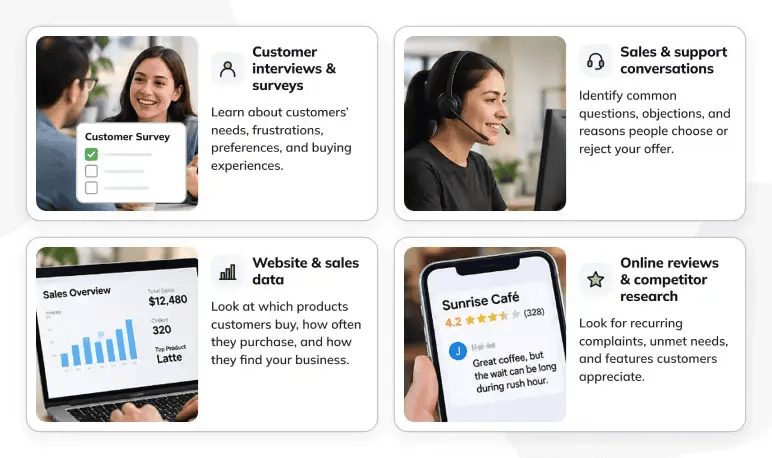
But if you’re starting a business and have no customers yet, you can still do useful research.
First, identify people who fit your intended customer group. You could reach them through local communities, professional networks, relevant online groups, or places where they’re likely to spend time.
For the coffee shop example, you could go to other nearby coffee shops during the morning rush, observe how coffee lovers order and pick up coffee, or talk to regular office employees who buy takeaway coffee on their way to work.
You might start with 5 to 10 exploratory conversations. That doesn’t give a complete picture of your market, but it can help you find out other potential needs and insights worth exploring.
Here are some questions you should ask when you’re talking to prospects:
- What does your typical day or work routine look like?
- How recently have you purchased a product or service like this?
- Which do you use now and why?
- What problems or frustrations do you experience with your current option?
- What would make you consider switching to another business?
- What factors matter most when comparing different options?
- Where do you typically discover businesses like this? And whose recommendations do you trust?
You might also need to gather information about your customers’ age, occupation, income, education, family situation, and technology usage, depending on your business. Focus on details that help explain their needs and buying behavior.
You can also ask follow-up questions to understand the circumstances behind their purchases.
For example, instead of asking, “Would you use our coffee shop’s mobile ordering service?” ask how they currently order coffee and whether waiting in line is a problem. Their responses will help you determine if mobile ordering really addresses a need.
As you gather the feedback, record what customers actually say, including their recurring frustrations, reasons for switching, and factors they consider while making a purchase decision.
You can also note memorable quotes that highlight a customer’s problem particularly well. This might help you better describe the persona later.
Also, keep in mind that competitor reviews and AI research can provide ideas, but they can’t replace learnings you get from your potential customers.
Step 3: Find out common needs and buying patterns
Now, review the information you’ve collected.
You’re searching for similarities in what people want, what they dislike, and what affects their buying decisions.
You may need to look beyond common needs and frustrations. Customers may also share similar backgrounds, daily routines, spending habits, or ways of researching and purchasing products. These details help you build a more realistic picture of the buyer.
Let’s say Sunrise Coffee spoke to eight morning commuters and asked them how they spend their money on coffee. The following are some of their answers.
| What customers said | What it would tell you |
|---|---|
| “I don’t like the café close to my workplace because the line gets too long.” | Long waiting times can discourage purchases. |
| “I will typically go to the same café as I know how quickly I’ll get my order.” | Predictable service may matter more than trying somewhere new. |
| “I’d prefer another café if I knew I could get my coffee quickly.” | Poor service or a negative rating at an existing café could trigger a switch. |
| “I compare the location, cost, and how long it takes to get served.” | These may be important criteria when selecting between cafés. |
These findings are hypothetical and are used to demonstrate the process.
When you put these findings together, you start to see a particular type of buyer: an office professional who regularly buys coffee before work, follows a fairly consistent routine, and needs a café that fits their schedule and budget.
You also have some understanding of their social influences and how they use technology to discover businesses and make purchases.
That’s more useful than simply knowing that working professionals value convenience.
Of course, eight interviews aren’t enough to establish that these patterns apply to your entire customer base. Treat them as initial findings and validate them as you learn more.
You may also discover that people within the same customer group have different buying priorities.
For example, some office professionals might care most about getting their coffee quickly, while others may be willing to wait longer for specialty coffee.
If those differences require different products, services, or marketing messages, you might need separate buyer personas.
How many buyer personas should you create?
Focus on the customer groups most important to your business. For a small business, it’s better to have one or two personas that are well-researched than five or six based on assumptions.
Target customer segments that are most relevant to your business. You can always add others when your research indicates meaningful differences in how those customers buy.
Step 4: Develop the buyer persona profile
Till now, you’ve identified the customer group you need to describe, gathered information, and found the characteristics that make it distinct.
The next step is to combine all of those findings to create a buyer persona.
Don’t include all the interview responses or findings from the research. The aim is to organize the most important data into a profile that clearly explains who your typical customer is and their purchasing decisions.
What should you include in a buyer persona?
A useful buyer persona should cover the customer’s situation, problems, actual needs, existing options, and buying decisions, depending on your business and what you need to understand about your customers.
Here are 8 components that can be used to structure your persona:
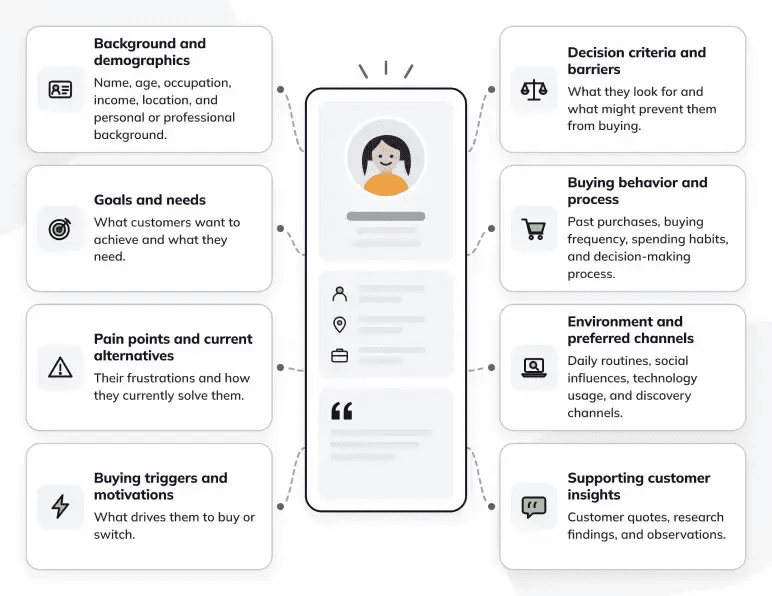
It’s not necessary to provide information about all 8 categories with the same level of detail. What matters depends on your business and your ideal customer.
For instance, a coffee shop may find its customers’ daily habits, workplace locations, and spending patterns more useful than their education or family status. A B2B software company, on the other hand, may need to know about the buyer’s job responsibilities, company size, existing technology, and purchasing authority.
Once you know what information is relevant, you can give the persona a name and describe their situation in a way that makes the customer easier to understand.
For Sunrise Coffee, I’ll call this customer persona Rachel, the morning commuter.
Here’s how some of the research findings might translate into her profile:
| Persona detail | Description |
|---|---|
| Background | A 32-year-old office professional working regular weekday hours. |
| Daily routine | Stops for coffee on her way to the office, usually between 7:45 and 8:15 AM. |
| Buying habits | Purchases takeaway coffee three to four weekdays and typically spends 5-7 per visit. |
| Main frustration | Skips her coffee stop when the queue is too long. |
| Social influences | Considers café recommendations from coworkers. |
| Technology usage | Uses Google Maps to discover cafés and regularly makes contactless payments. |
One thing to note here. These research findings not only describe what Rachel buys but also explain the circumstances in which she makes those purchases. This will help you understand her as a person rather than simply as a member of your target audience.
You can assign a fictional name, age, or photo to make the persona easier to remember. Just make sure that any unverified characteristics aren’t treated as established customer facts.
To help you organize these findings, I have added a customer persona example in the following section.
Step 5: Review and update your persona
Your initial buyer persona isn’t a definitive description of your customers. It is a starting point that you’ll refine as you learn more.
And yes, ensure that its underlying assumptions are backed up by what customers actually say and do before relying on it for important decisions.
A simple way to do this is to look at your persona and ask yourself:
- What information did you take from customers?
- What are the assumptions that we have yet to verify?
- Do our customers’ actual purchases and feedback back up what we’ve written?
For instance, Rachel’s persona reveals that long queues could prevent her from buying coffee. But that doesn’t necessarily mean she wants to order through a mobile app.
Even though she uses Google Maps and contactless payments, she might prefer a quicker walk-in experience that doesn’t require downloading another app.
Sunrise Coffee might consider testing out a faster takeaway checkout process to determine whether more customers respond positively or return in the upcoming weeks.
The results might confirm the persona’s initial findings or highlight something the business hadn’t considered.
You should also revisit the persona when you start to see customers selecting other options, raising new objections, or altering their shopping habits. These may reflect changes in their needs and/or purchasing habits.
It doesn’t need to be rewritten every month if nothing has changed.
Your persona should become more useful and accurate as you gather more information about the customers it represents.
Buyer Persona Examples
Now that you see the process, let’s get your eye drawn to finished buyer persona examples.
B2C Buyer Persona Example: Coffee shop
Let’s stick with our neighborhood coffee shop example. Suppose Sunrise Coffee wishes to increase the number of patrons during the weekday mornings.
Based on the research from the previous steps, here’s what a completed buyer persona could look like.
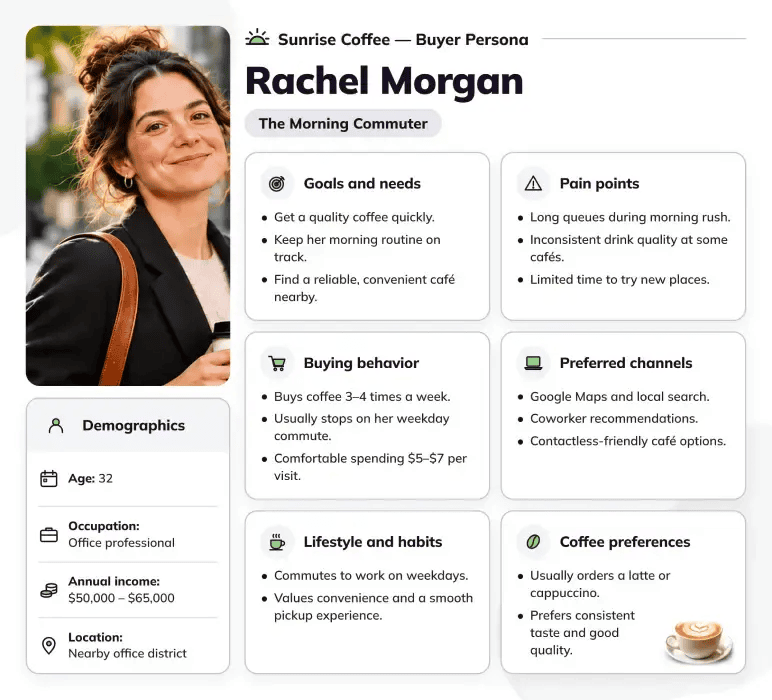
This customer profile is likely to value a quick and reliable experience, and might be switching cafés when frustrated by a long wait time.
Sunrise Coffee may consider those insights to test menu prices, checkout process, or payment options to serve these types of customers.
B2B Buyer Persona Example: Accounting software company
Now, let’s say an accounting software firm wants to appeal to more small business users, specifically marketing agencies.
Based on hypothetical customer research, I’ve developed a fictional buyer persona called Daniel, whom I’ve named “The Growing Agency Owner”. Daniel is looking for a more effective way to keep up with their finances as the agency grows.
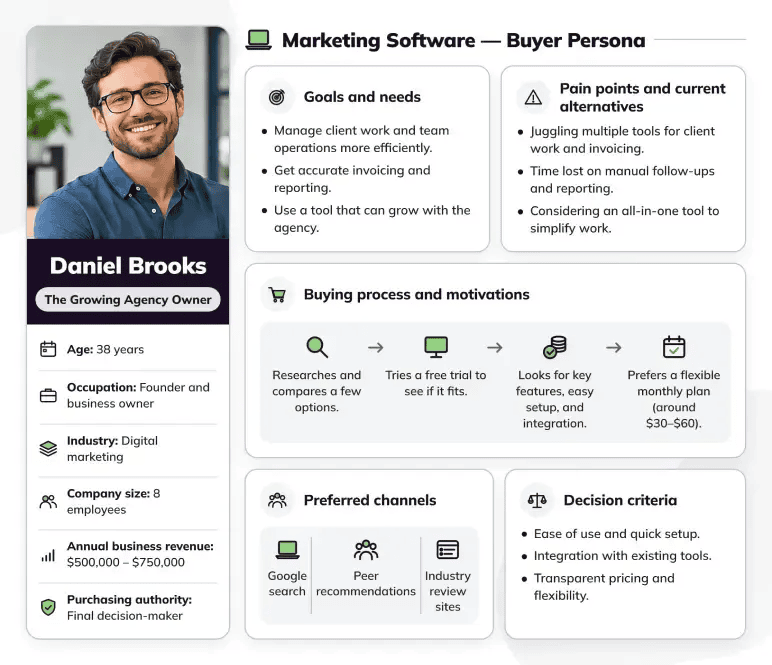
The persona reveals that these types of business owners are looking to simplify their invoicing and expense tracking efforts but are worried about transferring existing data and getting up to speed with the new software.
The accounting software company can use those insights to promote the software’s relevant features, show how easy it is to use, and address setup issues.
How to Use Buyer Personas in Your Business?
Now that you’ve developed your buyer persona, the next question is: What should you do with it?
The real value comes when you apply the customer insights you’ve learned about. This lets you determine the best ways to reach them and the type of product you should offer, as well as decide how to make their purchasing experience better.
These are three great ways to do that:
1. Design marketing content that meets customer needs
By creating a buyer persona, you can gain insight into your target audience’s pain points and benefits. With that information, you can personalize your marketing strategy, including website copy, advertisements, and other marketing messages.
2. Select the right marketing channels
By defining a buyer persona, you gain insights into where customers look for businesses, product/service information, and recommendations. Use those learnings to focus your marketing efforts on channels that your target market uses, rather than trying to reach everyone.
3. Improve your offers and business strategy
Buyer personas aren’t just useful for marketing. They can also help you discover methods that enhance your products, services, pricing, and customer experience.
Final Thoughts
A buyer persona is not just a fictional customer profile with all the details about them. What matters is to understand your customer’s needs, the problems they face, and the factors influencing their buying decisions.
Select one key customer segment, develop an initial customer profile based on the relevant research, and continually update the profile as you learn more.
And if you’re creating a business plan, Upmetrics can help you define your target market description and marketing plan more clearly, based on your customer insights. In this way, your research is incorporated into your approach to attracting and serving customers.
The Quickest Way to turn a Business Idea into a Business Plan
Fill-in-the-blanks and automatic financials make it easy.

Frequently Asked Questions
What are the different types of buyer personas?
What's the difference between a buyer persona and an ideal customer profile (ICP)?
What's the difference between a buyer persona and a user persona?
Can you use AI to build a buyer persona?
How detailed should a buyer persona be?

Vinay Kevadia
Vinay Kevadiya is the founder and CEO of Upmetrics, the #1 business planning software. His ultimate goal with Upmetrics is to revolutionize how entrepreneurs create, manage, and execute their business plans. He enjoys sharing his insights on business planning and other relevant topics through his articles and blog posts. Read more