


You’ve reached the mission statement part of your business plan, but you’re not sure what to add. Then you notice the business plan also has a vision statement section.
Now the confusion starts. The two sound similar, so do you repeat the same thing in both, or are they supposed to say something different?
You look at a few mission statement examples for help, but that can make things even more confusing. Some focus on customers, some on purpose, and others on what the company does. Now you’re left wondering what actually belongs in yours, how specific it should be, and what to do if it starts becoming too broad.
In this guide, I’ll explain what a mission statement is, how it differs from a vision statement, what to include, how to write one step by step, and share real company examples.
What is a mission statement?
A mission statement is a short statement that explains your business’s current purpose and what it exists to do.
It gives readers a quick understanding of what your business is here to do without going into all the details covered elsewhere.
Mission statements are often confused with vision statements, especially when you are writing both for the same business plan.
Mission statement vs. vision statement
Your mission statement focuses on the business today, while a vision statement looks ahead to what you want the business to become or achieve in the future.
| Mission statement | Vision statement |
| Focuses on the present | Focuses on the future |
| Explains why the business exists today | Describes what the business wants to become or achieve |
| Reflects the current purpose of the business | Reflects the long-term direction of the business |
| Changes mainly when the core purpose changes | May change as the business reaches goals or takes a new direction |
They should support each other, but they should not repeat the same idea.
And these statements are not limited to your business plan. You may also use them on your website, company overview, or internal business documents.
How to write your mission statement
Below, I’ll walk you through the process step by step. Follow each step in order, and by the end, you’ll have a clear mission statement ready to include in your business plan.
Step 1: Identify who your business serves
Start by identifying the main group your business is built to serve. Depending on the business, this could be:
- A customer type: Busy parents, homeowners, or first-time founders
- A community: People in a specific location or group
- A business segment: Restaurants, dental practices, or small manufacturers
- A beneficiary: Common for nonprofits, where the people benefiting may not be the ones paying
Ask yourself: Who benefits most from what my business does?
I’d suggest being specific enough to make the audience clear, but not so narrow that the description excludes people you genuinely serve. For example, “businesses” is too broad, while “independent restaurants” gives you a clearer starting point.
If you serve several groups, I wouldn’t list all of them. Focus on the main one or use a broader description that still fits.
You also don’t have to mention the customer directly in the final mission statement. For now, I just want you to be clear about who you are serving.
Step 2: Describe what your business actually does
Now that you know who you serve, define the main thing your business provides to them.
Focus on the core product, service, or activity, not everything you sell.
For example, if you run a bakery that sells bread, cakes, pastries, coffee, and catering, you do not need to list every item. I’d group them under a broader description, such as “fresh baked goods and catering.”
The same applies if you offer several products or services. Look for the broader category that connects them instead of naming each one.
I’d also avoid vague wording such as “quality solutions” or “exceptional services.” These phrases sound good, but they do not tell the reader what your business actually does.
If you haven’t launched yet, describe what the business will provide without implying that you already have customers or results.
You may also have a particular way of delivering your offer, such as mobile service, home delivery, or online access. If that is an important part of your business, you can mention it. Otherwise, leave that detail out.
Step 3: Explain why your work matters
This step is about the “result”, not the product or service itself.
A bookkeeping firm may provide bookkeeping, but the real value could be helping owners understand their finances and stay ready for tax season. A cleaning company may clean offices, but the result is a clean, usable space without the client having to manage it themselves.
I’d keep this part practical. Your mission statement does not need a grand purpose. For many businesses, the value is simply that you help customers:
- Save time
- Reduce stress
- Spend less
- Solve a specific problem
- Get easier access to something
- Get a better or more convenient experience
If several benefits apply, pick the one that matters most to the customer. Avoid adding every possible benefit.
Also, keep the focus on the customer. “Grow our revenue” or “become the market leader” are business goals, not customer outcomes.
By now, you should have three building blocks: who you serve, what you provide, and the value it creates. Next, we’ll decide which of those details are worth keeping in the final statement.
Step 4: Turn your ideas into a mission statement
Now bring together the strongest points from the first three steps and turn them into a sentence.
I’d aim for one clear sentence of roughly 15–30 words. Treat that as a useful target, not a strict rule. If you genuinely need more room, two short sentences can work, but avoid turning the mission into a paragraph.
If you’re not sure how to begin, try one of these structures:
- We help [who you serve] [why it matters] by [what you provide].
- Our mission is to provide [what you provide] to [who you serve] so they can [why it matters].
- We provide [what you provide] for [who you serve] to help them [why it matters].
- [Company name] helps [who you serve] [why it matters] through [what you provide].
- To [what you do] for [who you serve] so they can [why it matters].
These are just starting structures. You can change the order, leave out a part, or combine the ideas differently if that makes the sentence sound more natural.
Also, the three ideas we worked through are not the only things a mission statement can mention. Depending on your business, you may also include:
- How you do the work, if the delivery method is important
- A principle that shapes the business, such as affordability or sustainability
- A broader problem or purpose the business exists to address
I’d only add one of these if leaving it out would make the mission less clear or less true to the business.
Write in the present tense, since your mission describes what the business exists to do now. This also works if the business has not launched yet.
At this point, don’t worry if your sentence still feels a little broad, long, or generic. Get the meaning down first. In the next step, I’ll show you exactly how to tighten and improve it.
Step 5: Refine your mission statement
You have the main sentence now. Before using it in your business plan, give it one editing pass.
I’d check it in this order:
1. Remove anything that slipped in from other parts of the plan
Your mission statement should stay focused on the three ideas we worked through: who you serve, what you provide, and why it matters.
If you added company background, detailed goals, long product or service lists, competitive claims, or extra operational details, cut them unless they’re essential to the mission.
2. Fix anything that feels too broad or generic
Look at the customer, what you provide, and the value you create. If one of those still feels vague, make it more specific.
A useful test is: Could another business in your industry use the same statement with only the company name changed?
If yes, it still needs work.
3. Remove words that sound good but add little
Watch for phrases like:
- “World-class”
- “Committed to excellence”
- “Exceptional service”
- “Industry-leading”
If they do not make the mission clearer, remove them.
4. Check that it is still a mission statement
It should explain what your business exists to do now.
If it mostly talks about future growth, expansion, or what you want the company to become, move that part to the vision statement.
5. Make sure it is not too narrow
Specific is good, but avoid details that may quickly become outdated, such as one location, one product, or one very narrow customer group, unless they are a lasting part of the business.
Finally, read the statement out loud once. If it sounds natural, clear, and specific to your business, it is ready to use.
Mission statement examples
By now, you should have your own mission statement in hand. Before moving on, let’s look at a few small-business examples so you can see how different businesses keep the statement specific without trying to explain everything.
Small business mission statement examples
Bookkeeping business
This works because it names a clear customer group and connects the service to real financial needs rather than using broad wording like “financial solutions.”
Local bakery
This keeps the purpose simple and local without turning the statement into a list of products or making claims about being the best bakery in town.
Mobile veterinary service
Here, the at-home delivery model matters because it directly shapes the value of the service. Including the company name also works well because the statement can stand on its own.
Notice that these statements do not follow the exact same format. One starts with “we,” another with “to,” and another with the company name. That is intentional. The structure can change as long as the statement clearly communicates the business’s purpose.
Mission statement examples from real companies
You’ll see the same variation in real company mission statements. There is no required opening or sentence structure.
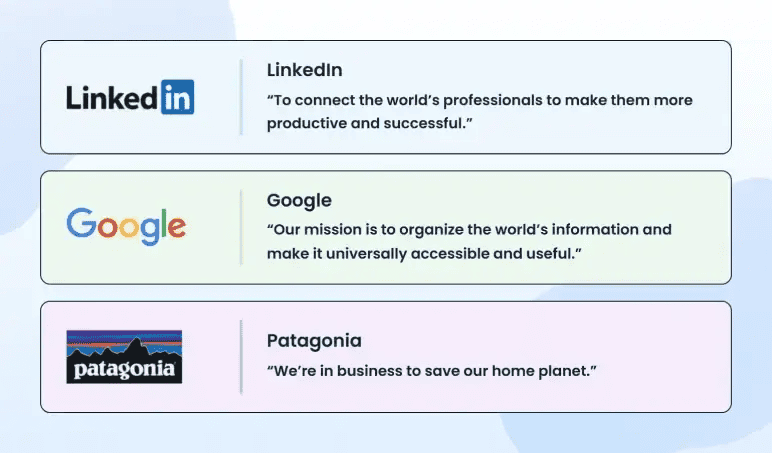
LinkedIn starts directly with what it exists to do and connects that work to a clear result for the people it serves.
Google focuses on its main purpose rather than trying to name all of its products or services.
Patagonia does not follow a typical customer + product + result structure. Instead, it centers the statement on the larger purpose behind the company.
Looking across these examples, the wording changes, but the same principle holds: each statement focuses on the few ideas that best explain the company’s purpose. Use that same approach with yours, and keep only what makes the mission clearer.
Conclusion
Writing a mission statement gets much easier once you focus on clarity instead of trying to make it sound impressive.
Start with who you serve, what you provide, and why it matters. Then turn those ideas into a short statement, remove anything unnecessary, and make sure it reflects what your business exists to do today.
If you need help, Upmetrics’ AI business plan generator can help you draft your mission statement and guide you through the rest of your business plan, section by section.
Turn Your Mission Into a Complete Business Plan
Your mission statement is just one part of a strong business plan. Use Upmetrics to turn your vision into a complete plan with AI guidance and financial projections.

Frequently Asked Questions
How long should a mission statement be?
Do I need a mission statement if I'm not applying for funding?
How often should I update my mission statement?
Can my mission statement and vision statement be combined into one?
Should my mission statement include specific numbers or goals?

Vinay Kevadia
Vinay Kevadiya is the founder and CEO of Upmetrics, the #1 business planning software. His ultimate goal with Upmetrics is to revolutionize how entrepreneurs create, manage, and execute their business plans. He enjoys sharing his insights on business planning and other relevant topics through his articles and blog posts. Read more