Starting a carpet cleaning business involves more than buying equipment and finding customers. You also need to work out how many jobs you can realistically handle each week, what to charge, and whether you’ll earn enough to cover expenses and loan payments.
These are the details your business plan needs to explain, especially if you’re applying for funding.
To show you how, I’ve put together a sample plan for Loomridge Carpet Care, a hypothetical carpet cleaning business in Tucker, Georgia. It covers pricing, daily job capacity, local marketing, and 3-year financials built around a $90,000 SBA 7(a) loan request.
Use this example as a reference and adapt the numbers and strategies to your own business.
Executive Summary
Loomridge Carpet Care is a new carpet cleaning business in Tucker, Georgia. It will clean carpets, rugs, stairs, and upholstery for homeowners, landlords, and, from Year 2, small offices. The business opens on March 1, 2027, with one owner, one van, and a truck-mounted cleaning unit.
Loomridge will work from a heated garage bay at Idlewood Trade Center, 4385 Idlewood Road, Suite B4, Tucker, GA 30084.
Its goal is to build a steady base of repeat homeowners and landlord accounts across northeast DeKalb County.
How the Business Works
With one van and Darnell handling the cleaning himself in Year 1, Loomridge will focus on keeping travel time low and making each job worthwhile.
Here’s how the business will operate:
- Darnell Hughes, the owner, has eight years in the trade and an IICRC carpet cleaning certification, and he will clean every job himself in Year 1.
- Darnell will book jobs by area within about 12 miles of the bay, so the van spends more of each day cleaning and less of it driving.
- Homeowners pay by the room, with a minimum per visit, and landlords pay a flat move-out rate based on the number of bedrooms. This way, both kinds of jobs pay for the van time they use.
Customers and Demand
Homeowners will bring most of the work in Year 1, and landlords will bring about a quarter of it each year.
The Carpet and Rug Institute recommends professional deep cleaning every 12 to 18 months. This gives Loomridge an opportunity to build repeat business, although not every homeowner will book that often. Landlord move-outs and customer referrals will help bring in work between repeat visits.
Financial Outlook
The financial forecast reflects a slower first year as Loomridge builds its customer base, followed by stronger revenue and profits as bookings increase.
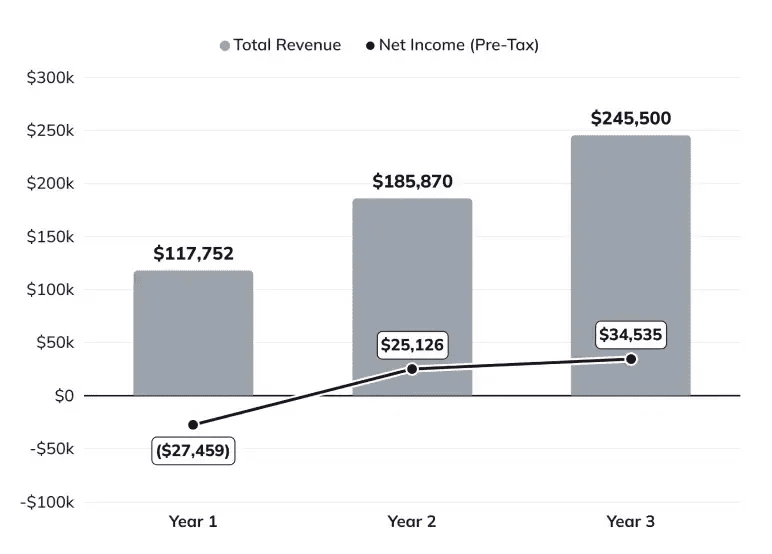
We expect a loss of $27,459 in Year 1. Bookings take time to build, and that year also includes $14,200 of one-time launch costs. Darnell will still draw a salary from the first month.
As repeat customers and property-manager accounts grow, Loomridge should earn a profit of $25,126 in Year 2 and $34,535 in Year 3.
Funding Ask
Loomridge is seeking a $90,000, 10-year SBA 7(a) loan from Larkhollow Community Bank at 10.5% interest, and Darnell will add $30,000 of his own savings. This $120,000 will pay for:
- $76,100 for the van, the truck-mount, and other equipment
- $14,200 of launch costs and $1,800 of prepaid insurance
- A $27,900 cash reserve for the slow first months

Company Overview
Darnell Hughes chose to start Loomridge Carpet Care as an independent business instead of buying a franchise. This lets him set his own prices and keep the money a franchise royalty would take each month.
He formed Loomridge as a Georgia single-member limited liability company (LLC) in November 2026. He owns 100% of the business and will personally guarantee the loan, and the LLC keeps business debts separate from his family’s assets.
Mission Statement
Loomridge’s mission is to clean carpets thoroughly, on time, and at a posted price for the homes and rentals of northeast DeKalb.
About Darnell Hughes
Darnell has lived in Tucker for nine years and has cleaned carpets in metro Atlanta for eight, the last five as a lead technician. His background fits both sides of the business:
- Running a truck-mount van every day and training new technicians, which prepares him for home jobs and for hiring help later
- Apartment turnover work for several property managers, the same work Loomridge’s move-out service will offer
- IICRC certifications as a Carpet Cleaning Technician (CCT) and a Water Damage Restoration Technician (WRT)
Garage Bay & Service Zone
Loomridge’s core zone covers about 12 miles around the garage bay, all in DeKalb County: Tucker, Decatur, Chamblee, Doraville, Brookhaven, Dunwoody, and Stone Mountain. A small zone means shorter drives between jobs and more finished work for one van each day.
The van, chemicals, and hoses stay in a heated 600 sq ft bay, while Darnell handles office work from home. The heat keeps the truck-mount pump and water lines from freezing on winter nights.
The bay also has a floor drain connected to the sanitary sewer, which gives the crew a proper place to empty the waste tank.
Goals for Years 1–3
Darnell has set clear goals for the first three years:
- By the end of Year 1, he wants Loomridge to reach about 50 jobs a month and see its cash balance growing again after the spring launch.
- By the end of Year 2, the targets are a 4.8-star Google average with 150 or more reviews, re-clean requests under 2% of jobs, and debt coverage above 3x.
- By Year 3, Loomridge aims to work with 17 property-manager accounts and run a two-person crew. Darnell will decide on a second van in Year 4.
Market Analysis
Loomridge will draw its customers from one 12-mile zone of its garage in Tucker, Georgia. Homeowners, landlords, and property managers make up most of this market.
Homeowners will provide most of the early bookings, while rental move-outs will bring additional work throughout the year.
Carpet remains a significant part of the U.S. flooring market. In 2025, carpet and area rugs accounted for 42.1% of flooring sales by square footage, even as hard surfaces gained ground.
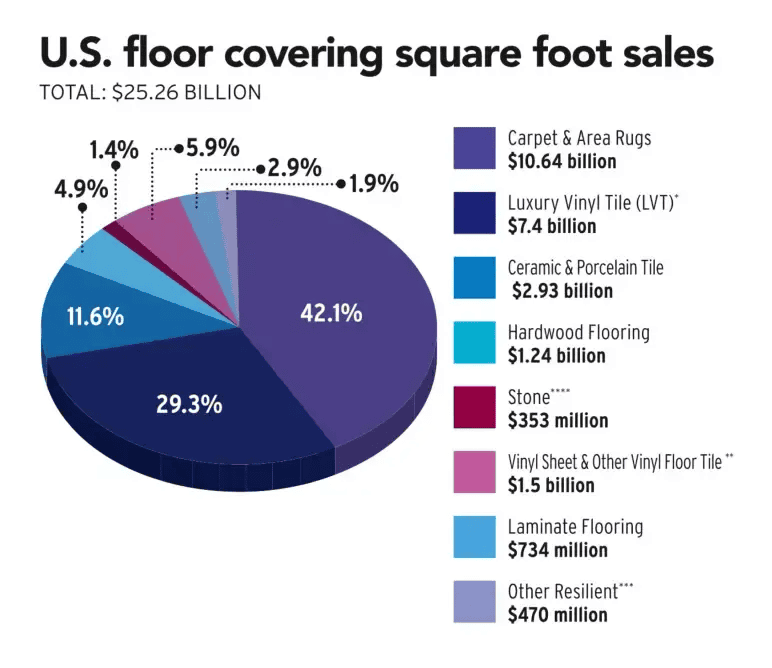
This means many homes in Loomridge’s zone still have carpet that needs regular cleaning.
Across the U.S., the carpet cleaning industry will bring in $6.9 billion in 2026. Carpet cleaning is a local service. Loomridge will grow by winning customers in its own zone and keeping them.
In addition to that, DeKalb County has a mix of owner-occupied and rental housing.
According to Census data, about 42% of its 309,812 households rent their homes. Not every property has carpet, but both homeowners maintaining their floors and landlords preparing units for new tenants are potential customers.
Target Customers
Loomridge will serve three customer groups with different cleaning needs. Homeowners will bring most of the work in Year 1, while rental move-outs and small offices will provide additional bookings as the business grows.
| Customer Group | When They Need Carpet Cleaning |
|---|---|
| Homeowners | Routine cleaning, pet stains and odors, or preparing a home for guests or sale |
| Landlords & property managers | Cleaning carpets between tenants, often on short notice |
| Small offices (from Year 2) | Scheduled cleaning outside business hours |
Homeowners, including pet owners, are expected to contribute about 75% of Year 1 revenue. Landlords and property managers will account for the remaining 25%, bringing in work as rental units become vacant.
Small offices will provide another source of scheduled jobs from Year 2, contributing a projected 7.6% of revenue and increasing to 13.7% in Year 3.
Recent Market Trends
The following changes in how people buy carpet cleaning shape how Loomridge will run:
- Homeowners book online and read reviews before they call, so Loomridge takes bookings online with room counts and asks for a review after every job.
- Landlords turn units faster than before and want proof of a unit’s condition before they keep part of a deposit, so every move-out comes with a dated photo report.
- Store rental machines often leave carpets damp for a day, so many homeowners switch to a professional truck-mounted cleaning that dries in hours.
- Small offices clean carpet on a schedule to make it last longer, and Loomridge will serve them in the evenings from Year 2.
Competitive Analysis
Homeowners and landlords in northeast DeKalb already have several ways to get their carpets cleaned, and some cost less or are better known than Loomridge.
Its direct competitors are the carpet cleaning companies working in the same neighborhoods. Its indirect competitors are the other options people use, from store rental machines to on-site maintenance staff.
Direct Competitors
Three kinds of carpet cleaners already work in the zone, and Steamcrest is the strongest of them.
Steamcrest Carpet Care
Steamcrest is a national franchise with four vans in metro Atlanta. Its brand is well known, and it offers online booking, a call center, and Saturday hours.
Steamcrest advertises three rooms for $99, but the price often grows once add-ons come up in the home. Customers also wait within four-hour arrival windows.
Oakmere Carpet & Rug
Oakmere is a family-owned company in Decatur with three vans and more than 20 years in business. It has loyal repeat customers, many reviews, and its own commercial crews.
Oakmere charges $65 per room with a $199 minimum. In spring and fall, it books two to three weeks out, and property managers wait days for a move-out quote.
Solo Operators
One-person cleaners advertise on Facebook Marketplace and Nextdoor at $30 to $35 per room, and many can come the same week. Their portable machines are weaker than a truck-mount, so carpets dry slowly, and some of these operators carry no insurance.
Indirect Competitors
Some homeowners rent a machine from a grocery or hardware store, which costs little but takes a full afternoon and leaves carpets damp. Apartment and HOA maintenance staff clean between tenants, but they use small machines and keep no photo records.
Water-damage restoration companies have strong equipment, but routine cleaning waits behind their emergency jobs. Janitorial companies already clean offices every week, though carpet extraction is only an add-on for them.
Competitive Advantages
Loomridge won’t be the best-known or the cheapest cleaner in its zone. Customers will still choose it for four reasons:
- A technician they know: Darnell cleans every home job in Year 1 and stays on the van as the crew grows.
- A posted price: Customers pay by the room and see the full written price before any work starts.
- Short arrival windows: A tight zone makes one-hour arrival windows possible.
- Fast move-outs: Property managers get a cleaned unit within two business days, with a photo report.
Services & Pricing
Loomridge prices its work to match the two kinds of jobs it does. Per-room rates for homeowners and flat move-out rates for landlords. Prices will be posted on the company website so customers know what to expect before booking.
To cover travel and setup time while keeping prices clear, Loomridge will follow four pricing rules:
- A room means up to 250 sq ft, and a larger room counts as two.
- The $169 minimum applies to residential per-room bookings, since a small job takes nearly as much van time as a large one.
- Homes outside the core zone pay a $35 trip charge.
- Customers get a written price before work starts, and there’s no upselling in the home.
Here is the Year 1 price list for homes and rentals:
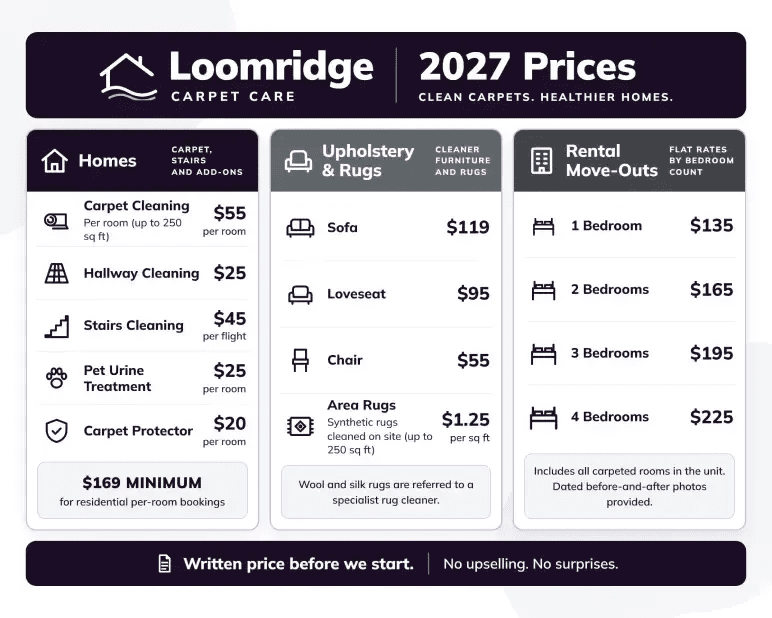
Home Carpet, Upholstery & Rugs
Each home visit includes a walk-through with a written price, furniture moving, pre-spraying, brushing, hot-water extraction from the truck-mount, and air movers to speed drying. A typical visit covers three or four rooms and a hallway.
Pet urine treatment, carpet protector, and stairs are the most common add-ons. The carpet cleaning room price rises to $57 in Year 2 and $59 in Year 3.
Customers may also add a sofa, chairs, or a rug while the van is already there, which raises the ticket without adding drive time. The crew cleans synthetic area rugs on site and sends wool and silk rugs to a specialist rug cleaner.
Rental Move-Out Cleans
Property managers pay a flat rate by the number of bedrooms, and Loomridge invoices them once a month on Net 30 terms. Darnell will complete move-out cleaning within two business days of the request.
Loomridge will provide dated before-and-after photos and note any stains that remain after cleaning. Property managers can use these records when reviewing the unit’s condition.
Commercial Carpet Cleaning
From March 2028, Loomridge will clean small offices after hours at $0.28 per sq ft, with a $350 minimum per visit. Most offices will book quarterly or twice a year.
The service starts in Year 2, once the daytime schedule is steady and a helper joins for the busy seasons. Evening office work will also allow the business to use its existing van without taking time away from daytime home jobs.
Marketing & Sales Strategy
Loomridge’s marketing follows the two kinds of customers described above.
Most homeowners look for a carpet cleaner when they have an immediate need, so Loomridge will focus on showing up where local customers already search.
Property managers, on the other hand, usually hire based on trust and reliability, so Darnell will win those accounts through direct outreach and follow-up.
Launch Plan
Loomridge’s launch period covers its first three months, from March through May 2027. During this time, the goal is to build local visibility, collect early reviews, and start a base of repeat customers and property-manager accounts.
Before the first job, Loomridge’s Google Business Profile will go live, and every customer will get a request for a review.
Postcards will go to the neighborhoods around the bay, and Darnell starts his property-manager visits. As a launch offer, the first 100 homes get a free carpet protector for two rooms.
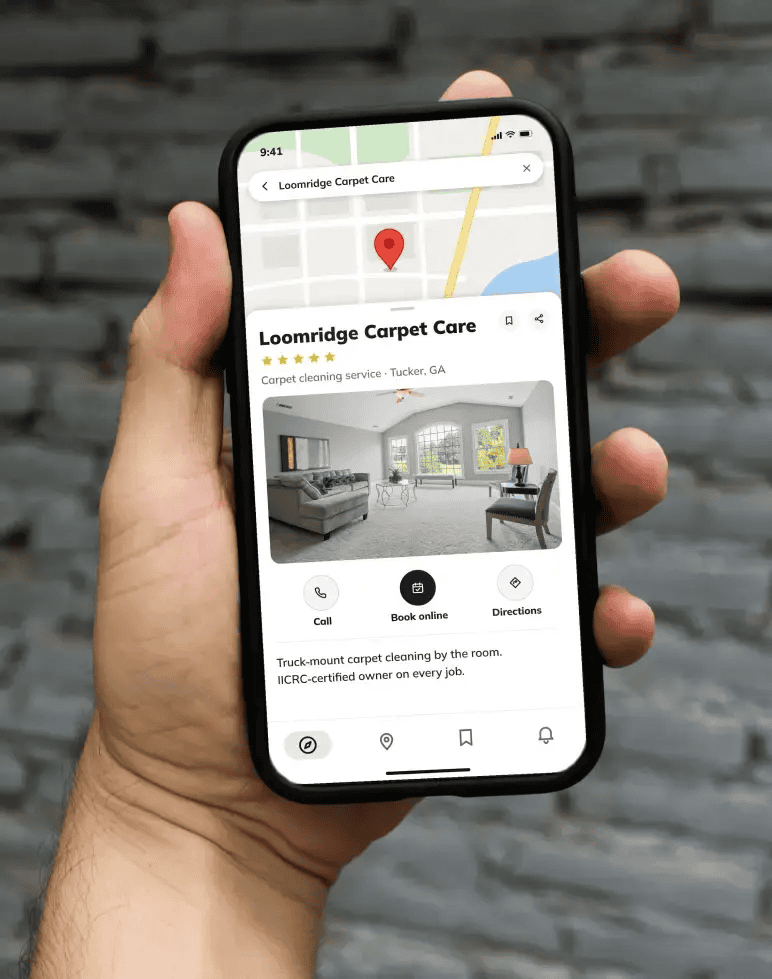
Because many homeowners will first come across Loomridge through a Google search, the Business Profile will be an important part of the launch.
The mockup below shows how Loomridge will appear in local search results:
Marketing Channels
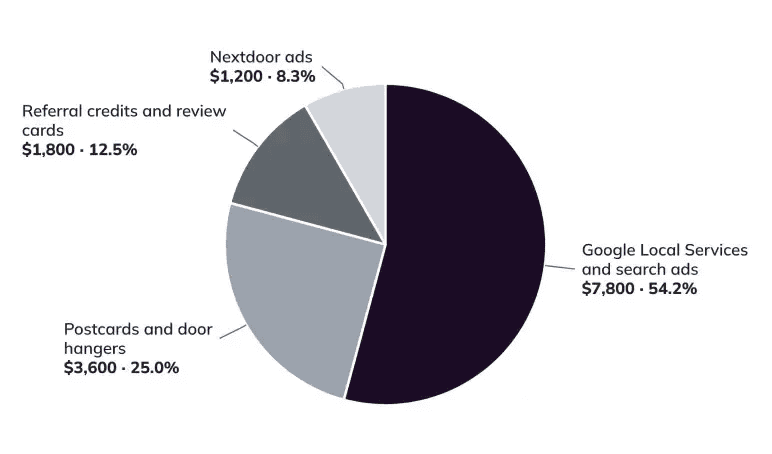
The Year 1 marketing budget is $14,400. Most of it goes toward homeowners, since they will bring most of the first year’s work. The budget is split across a small number of channels that match how customers actually choose a carpet cleaner.
Google Local Services Ads and search ads take the largest share, at $7,800. These ads reach homeowners in Loomridge’s service area who are already searching for a carpet cleaner.
Postcards and door hangers, at $3,600, will introduce Loomridge to homes near the bay and in the neighborhoods where Darnell is already booking jobs.
Nextdoor ads, at $1,200, reach neighbors where they ask each other for recommendations. The remaining $1,800 pays for the referral credits and review cards that bring past customers back.
Here is how the Year 1 budget splits across the channels:
Loomridge’s Google Business Profile and review collection do not require ad spend. By Year 2, marketing spend is expected to fall to $13,200 as more work comes from repeat bookings, reviews, and referrals.
Property-manager outreach works differently from homeowner marketing.
Instead of paid advertising, Darnell will build these accounts through personal visits and follow-up. He will bring a one-page rate sheet, offer the first unit at half price, and show a sample photo report. Each account is expected to send about 20 units a year.
Repeat Customers & Reviews
For a one-van business, repeat customers are especially important because they help fill the schedule without the same advertising cost as a first-time booking. Loomridge will stay in touch with past customers in a simple, predictable way.
Every receipt will show the suggested date of the next cleaning, and twelve months after each visit, the customer gets a text and an email with a link to rebook.
Pet owners will hear from Loomridge sooner, at about six months, because they often need more frequent cleaning. Every job ends with a request for a review, and each referral gives both customers $25 off their next cleaning.
Operations Plan
Loomridge works from one van and one garage bay. Its daily schedule decides how many jobs it can finish. Careful scheduling also helps Darnell keep the one-hour arrival windows he promises customers.
Hours & Service Zones
Loomridge will work Monday through Saturday, with three arrival windows each day:
- 8 to 9 AM
- 11 AM to 12 PM
- 2 to 3 PM
From Year 2, the crew will also clean offices on Tuesday and Thursday evenings from 6 to 10 PM. Customers book online with their room count and photos, or by phone, and they get an “on my way” text before the van arrives.
With Darnell handling every job himself in Year 1, the schedule must allow enough time for cleaning, travel, and equipment setup.
Here’s how a typical three-job day will look:
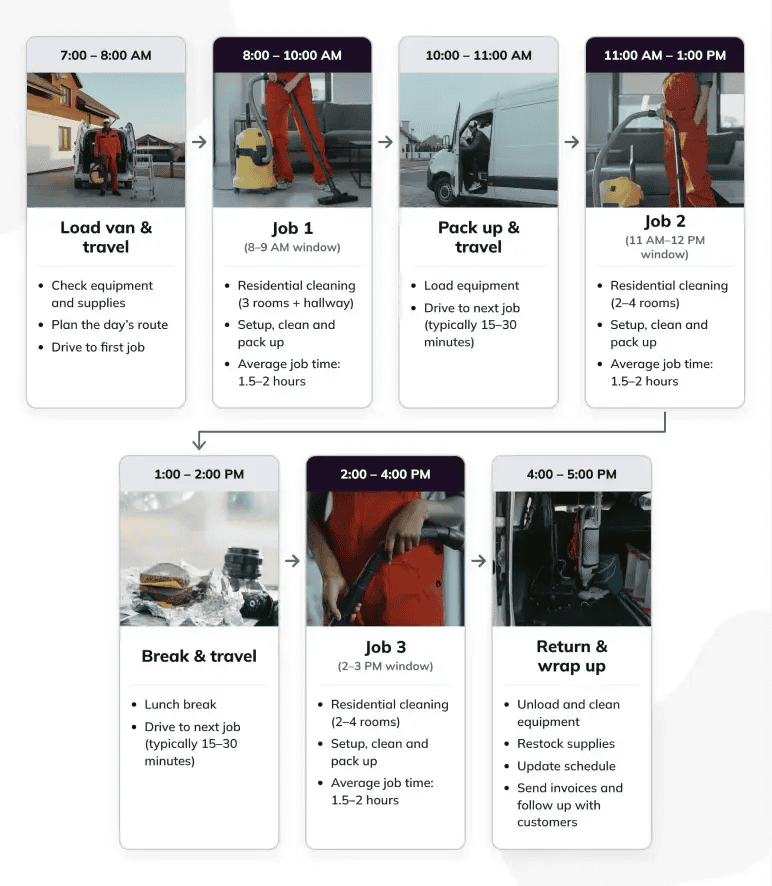
To keep drive time short, Darnell splits the core zone into two areas with set booking days. Tucker, Decatur, and Stone Mountain get Monday, Wednesday, and Friday, while Chamblee, Doraville, Brookhaven, and Dunwoody get Tuesday and Thursday. Saturday is open to both areas.
Move-outs can go on any day, since a vacant unit needs no arrival window. When several units open in one complex, the crew cleans them on the same day.
Booking by area matters because every job takes about 45 minutes of setup and pack-up, whether it covers two rooms or five. Drive time is the part Darnell can control.
For example, a three-bedroom job in Marietta takes 71 more minutes of van time than a similar job in Tucker. After job costs, the Marietta job earns $58.25 per van-hour, compared with $84.45 in Tucker. This is why Loomridge books by area, charges $35 outside the zone, and keeps the $169 minimum.
Darnell will review revenue per van-hour every week, along with jobs and average ticket, as part of the numbers he tracks.
Quality Checks
Because Loomridge depends on repeat customers and reviews, every job follows the same quality steps:
- Darnell walks each room with the customer, notes existing stains and damage, and photographs them before starting.
- A moisture meter checks dampness on the first jobs of each season, and air movers dry most carpets in 4 to 6 hours.
- If a spot comes back within 7 days, the crew returns and cleans it again for free.
Seasons & Staffing
Demand changes with the seasons. In Year 1, the busiest month should be November, with about 71 jobs, as families clean before the holidays. Spring and fall stay steady, and January drops to about 40 jobs. In the slower months, Darnell will focus on property-manager sales, since move-outs come in all year.
Darnell will do every job in Year 1, on a salary of $45,000 that rises to $52,000 in Year 2 and $58,000 in Year 3. As bookings grow, he will add help in two steps.
In March 2028, Darnell will hire a part-time helper for 20 hours a week during the 26 busiest weeks of spring and fall, at $18 per hour.
In March 2029, the helper role becomes a full-time technician job at $19 per hour, and Darnell will train this person toward the IICRC CCT exam. With two people, the van can handle about 4.5 daytime jobs a day, up from 3.5.
Equipment, Suppliers & Software
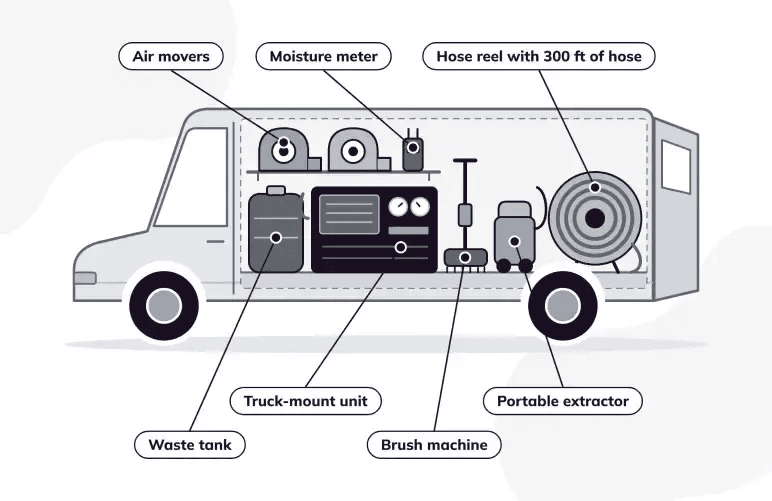
The van and cleaning equipment include:
- A used 2023 Ford Transit 250 high-roof cargo van with about 40,000 miles
- A new gas-powered truck-mount certified under the Carpet and Rug Institute’s Seal of Approval program, with 300 feet of hose
- A portable extractor for high-rise condos and apartments the hose can’t reach
- A brush machine, six air movers, and a moisture meter
Here’s how the van will be set up for each job:
Loomridge will also rely on four outside partners:
- Wendmoor Cleaning Supply, an Atlanta-area distributor, sells chemicals, protector, hoses, and parts.
- Kestrel Fleet Service, a shop in Tucker, services the van and the truck-mount engine every 100 hours.
- Housecall Pro runs online booking, reminders, and invoicing.
- QuickBooks keeps the accounts.
Licenses & Insurance
Before opening, Loomridge will get an occupational tax certificate and zoning approval for the bay from the City of Tucker, and it will renew the certificate each January. The LLC also files an annual registration with the Georgia Secretary of State between January 1 and April 1.
The business insurance covers general liability of $1 million per claim, including damage to customers’ property, plus the van and the truck-mount. Workers’ compensation starts when the helper joins.
Risks We Plan For
A one-van business faces four main risks, and Loomridge has a plan for each:
(1) A slow first year
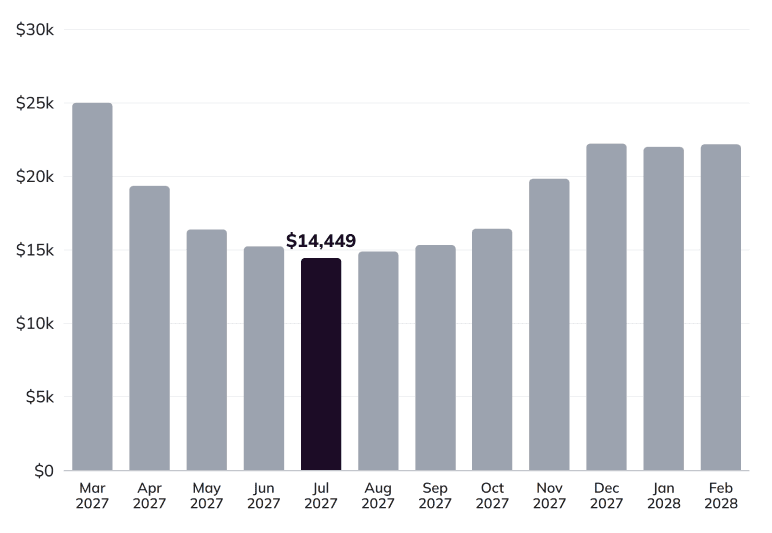
The $27,900 reserve covers the loan payments that Year 1 earnings can’t, and cash stays above its July 2027 low of $14,449. If homeowner bookings lag, Darnell will shift marketing toward property managers.
(2) A van or truck-mount breakdown
Routine servicing at Kestrel lowers the risk, and if the van is in the shop, the portable extractor can still handle small jobs.
(3) Owner injury or illness
Darnell carries personal disability insurance, the helper joins in Year 2, and a trained technician joins in Year 3.
(4) Too much work from a few property managers
Loomridge plans for 17 accounts by Year 3 and will keep any single account below a quarter of its rental jobs.
Financial Plan
Loomridge needs $120,000 to start: a $90,000 SBA 7(a) loan from Larkhollow Community Bank and $30,000 of Darnell’s savings. We expect a loss in Year 1 while bookings build and a profit from Year 2.
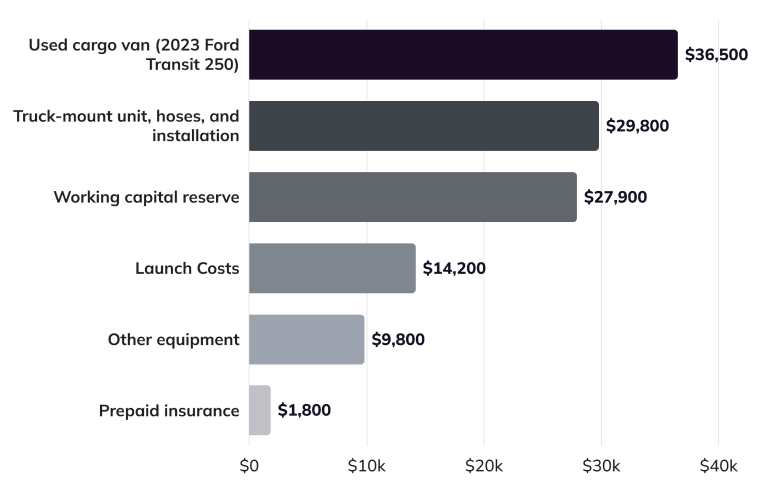
Startup Costs
| Category | Amount |
|---|---|
| Vehicle & Equipment | |
| Used cargo van (2023 Ford Transit 250) | $36,500 |
| Truck-mount unit, hoses, and installation | $29,800 |
| Portable extractor and upholstery tools | $4,200 |
| Brush machine, air movers, and sprayers | $4,100 |
| Tablet, phone, and moisture meter | $1,500 |
| Launch Costs | |
| LLC filing and legal review | $1,200 |
| Occupational tax certificate and zoning approval | $450 |
| Van wrap and brand identity | $3,400 |
| Website, booking, and software setup | $2,500 |
| Launch marketing | $4,200 |
| Opening chemical and supply stock | $1,800 |
| Uniforms, shoe covers, and furniture tabs | $650 |
| Cash & Prepaid | |
| Prepaid insurance | $1,800 |
| Working capital reserve | $27,900 |
| Total Startup Costs | $120,000 |
Funding Sources
| Source | Shares in % | Amount |
|---|---|---|
| SBA 7(a) loan (Atlanta-area community bank, SBA-approved lender) | 75% | $90,000 |
| Owner equity (Darnell Hughes — personal savings) | 25% | $30,000 |
| Total Startup Capital | 100% | $120,000 |
Financial Assumptions
| Assumption | Year 1 | Year 2 | Year 3 |
|---|---|---|---|
| Working days (Monday–Saturday) | 285 | 285 | 285 |
| Households served | 348 | 465 | 540 |
| Returning households | 0 | 152 | 212 |
| Property-manager accounts | 9 | 14 | 17 |
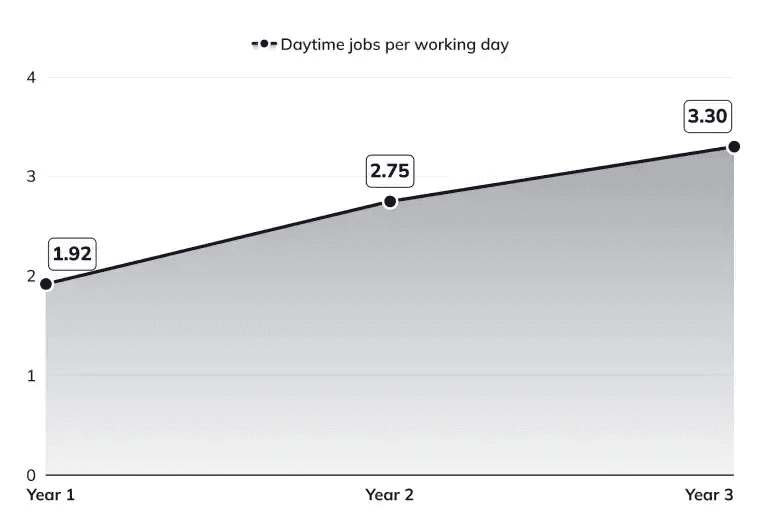
| Daytime jobs per working day | 1.92 | 2.75 | 3.30 |
| Price per room | $55 | $57 | $59 |
| Minimum home visit | $169 | $169 | $169 |
| Direct materials (% of revenue) | 9.5% | 9.5% | 9.5% |
| Card processing (% of revenue) | 2.6% | 2.6% | 2.6% |
| Payroll tax rate | 9% | 9% | 9% |
| Days to collect payment | 8 | 8 | 8 |
| Loan interest rate | 10.5% | 10.5% | 10.5% |
| Monthly loan payment | $1,214.41 | $1,214.41 | $1,214.41 |
Depreciation Schedule
| Asset | Cost | Useful Life | Annual Dep. |
|---|---|---|---|
| Cargo van (2023 Ford Transit 250 high roof, used) | $36,500 | 5 years | $7,300 |
| Truck-mount extraction unit, installed | $29,800 | 7 years | $4,257 |
| Portable extractor & upholstery/stair tools | $4,200 | 5 years | $840 |
| Agitation & drying equipment | $4,100 | 5 years | $820 |
| Technology (tablet, phone, moisture meter) | $1,500 | 3 years | $500 |
| Total | $76,100 | — | $13,717 |
Revenue by Service
| Category | Year 1 | Year 2 | Year 3 |
|---|---|---|---|
| Home Carpet & Upholstery | |||
| Home jobs | 372 | 505 | 600 |
| Average home ticket | $238 | $246 | $254 |
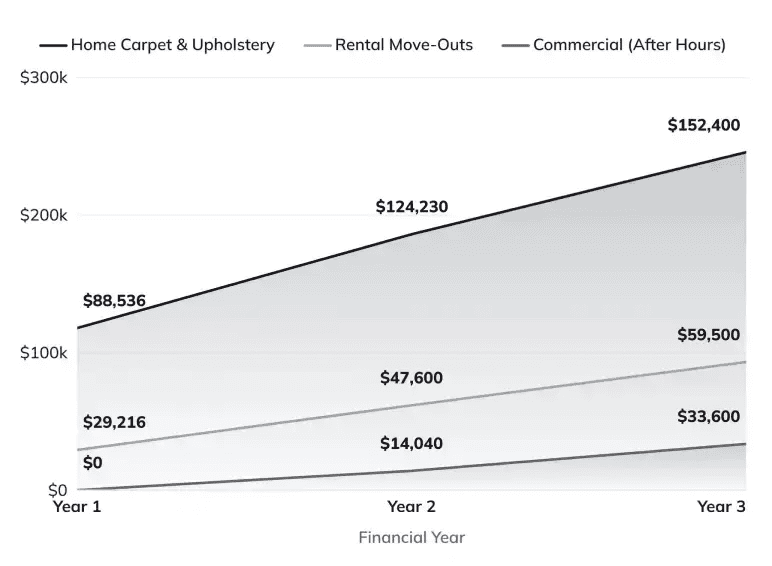
| Home revenue | $88,536 | $124,230 | $152,400 |
| Rental Move-Outs | |||
| Units cleaned | 176 | 280 | 340 |
| Average flat rate | $166 | $170 | $175 |
| Move-out revenue | $29,216 | $47,600 | $59,500 |
| Commercial (After Hours) | |||
| Office visits | 0 | 36 | 84 |
| Average visit | $0 | $390 | $400 |
| Commercial revenue | $0 | $14,040 | $33,600 |
| Total jobs | 548 | 821 | 1,024 |
| Average revenue per job | $214.88 | $226.39 | $239.75 |
| Total Revenue | $117,752 | $185,870 | $245,500 |
Projected Profit & Loss
| Category | Year 1 | Year 2 | Year 3 |
|---|---|---|---|
| Total Revenue | $117,752 | $185,870 | $245,500 |
| Cost of Services | |||
| Direct materials | $11,186 | $17,658 | $23,322 |
| Direct labor | $0 | $9,360 | $39,520 |
| Payroll tax on direct labor | $0 | $842 | $3,557 |
| Total Cost of Services | $11,186 | $27,860 | $66,399 |
| Gross Profit | $106,566 | $158,010 | $179,101 |
| Gross Margin | 90.5% | 85.0% | 73.0% |
| Operating Expenses | |||
| Owner salary | $45,000 | $52,000 | $58,000 |
| Payroll tax on owner salary | $4,050 | $4,680 | $5,220 |
| Garage bay rent | $10,200 | $10,500 | $10,800 |
| Insurance | $5,600 | $7,400 | $8,300 |
| Marketing | $14,400 | $13,200 | $13,800 |
| Vehicle fuel and maintenance | $4,500 | $6,000 | $7,000 |
| Equipment repairs and maintenance | $1,800 | $2,800 | $3,600 |
| Software | $2,700 | $3,000 | $3,200 |
| Phone and internet | $1,400 | $1,450 | $1,500 |
| Accounting and legal | $2,400 | $2,500 | $2,600 |
| Supplies | $1,200 | $1,600 | $1,900 |
| Licenses and vehicle registration | $600 | $600 | $600 |
| Card processing | $3,062 | $4,833 | $6,383 |
| One-time launch costs | $14,200 | $0 | $0 |
| Total Operating Expenses | $111,112 | $110,563 | $122,903 |
| EBITDA | ($4,546) | $47,447 | $56,198 |
| Depreciation | $13,717 | $13,717 | $13,717 |
| Operating Income | ($18,263) | $33,730 | $42,481 |
| Interest expense | $9,196 | $8,604 | $7,946 |
| Net Income (Pre-Tax) | ($27,459) | $25,126 | $34,535 |
Opening Balance Sheet (at Launch)
| Category | Amount ($) |
|---|---|
| Assets | |
| Cash (reserve $27,900 + one-time expense float $14,200) | 42,100 |
| Prepaid insurance | 1,800 |
| Gross PP&E (van, truck-mount, portable extractor, agitation and drying equipment, technology) | 76,100 |
| Total Assets | 120,000 |
| Liabilities & Equity | |
| SBA 7(a) loan | 90,000 |
| Owner’s capital (paid-in) | 30,000 |
| Total Liabilities + Equity | 120,000 |
Balance Sheet (Years 1-3)
| Category | Year 1 ($) | Year 2 ($) | Year 3 ($) |
|---|---|---|---|
| Assets | |||
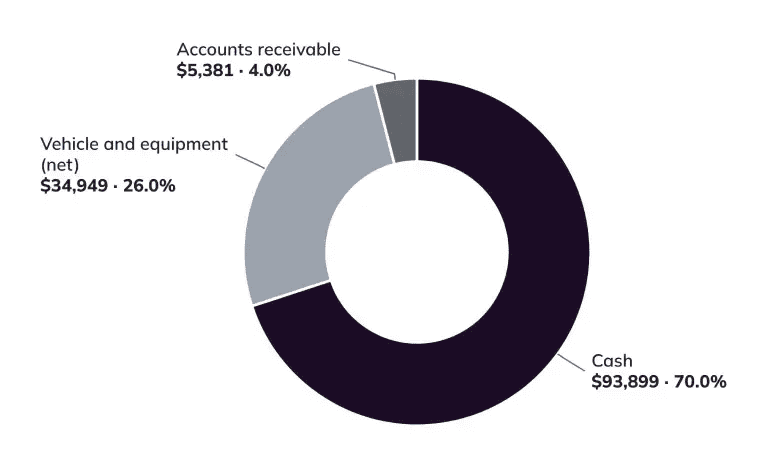
| Cash | 22,200 | 53,581 | 93,899 |
| Accounts receivable | 2,581 | 4,074 | 5,381 |
| Inventory | 0 | 0 | 0 |
| Prepaid expenses | 0 | 0 | 0 |
| Net PP&E | 62,383 | 48,666 | 34,949 |
| Total Assets | 87,164 | 106,321 | 134,229 |
| Liabilities | |||
| Accounts payable | 0 | 0 | 0 |
| SBA 7(a) loan | 84,623 | 78,654 | 72,027 |
| Total Liabilities | 84,623 | 78,654 | 72,027 |
| Equity | |||
| Paid-in capital | 30,000 | 30,000 | 30,000 |
| Retained earnings (cumulative net income) | (27,459) | (2,333) | 32,202 |
| Owner’s Equity | 2,541 | 27,667 | 62,202 |
| Total Liabilities + Owner’s Equity | 87,164 | 106,321 | 134,229 |
Projected Cash Flow
| Category | Year 1 | Year 2 | Year 3 |
|---|---|---|---|
| Beginning Cash | $42,100 | $22,200 | $53,581 |
| Operating Activities | |||
| Net income (pre-tax) | ($27,459) | $25,126 | $34,535 |
| Depreciation | $13,717 | $13,717 | $13,717 |
| Change in accounts receivable | ($2,581) | ($1,493) | ($1,307) |
| Change in prepaid insurance | $1,800 | $0 | $0 |
| Net Cash from Operations | ($14,523) | $37,350 | $46,945 |
| Financing Activities | |||
| Loan principal repayment | ($5,377) | ($5,969) | ($6,627) |
| Net Cash from Financing | ($5,377) | ($5,969) | ($6,627) |
| Net Change in Cash | ($19,900) | $31,381 | $40,318 |
| Ending Cash | $22,200 | $53,581 | $93,899 |
Break-Even Analysis
| Metric | Value |
|---|---|
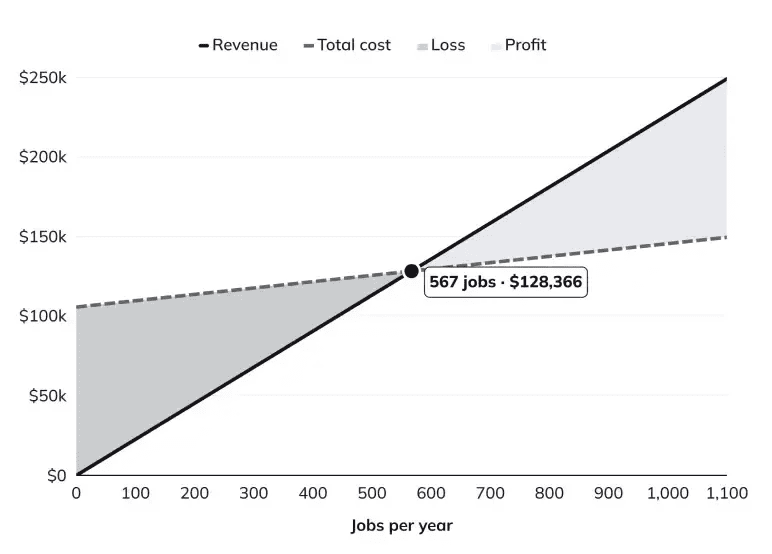
| Average revenue per job (Year 2) | $226.39 |
| Variable cost per job (Year 2) | $39.82 |
| Contribution margin per job (Year 2) | $186.57 |
| Contribution margin (Year 2) | 82.4% |
| Fixed operating costs per year (Year 2) | $105,730 |
| Break-even jobs per year (Year 2) | 567 |
| Break-even jobs per month (Year 2) | 47 |
| Break-even revenue per year (Year 2) | $128,366 |
| Planned Year 2 jobs above break-even | 254 |
Loan Repayment & Debt Coverage
| Category | Year 1 | Year 2 | Year 3 |
|---|---|---|---|
| Interest paid | $9,196 | $8,604 | $7,946 |
| Principal repaid | $5,377 | $5,969 | $6,627 |
| Total loan payments | $14,573 | $14,573 | $14,573 |
| Ending loan balance | $84,623 | $78,654 | $72,027 |
| EBITDA | ($4,546) | $47,447 | $56,198 |
| Debt service coverage | (0.31x) | 3.26x | 3.86x |
The Quickest Way to turn a Business Idea into a Business Plan
Fill-in-the-blanks and automatic financials make it easy.


Vinay Kevadia
Vinay Kevadiya is the founder and CEO of Upmetrics, the #1 business planning software. His ultimate goal with Upmetrics is to revolutionize how entrepreneurs create, manage, and execute their business plans. He enjoys sharing his insights on business planning and other relevant topics through his articles and blog posts. Read more