


 Download Now: Free Business Plan Template
I hear this from founders all the time, and the confusion makes sense. Both explain your business and cover the same basics. But they’re built for different purposes. A pitch deck is meant to communicate your idea quickly, and a business plan walks a reader through the full business details.
Picking the wrong one wastes your efforts. You might spend days on a 40-page plan when an investor wanted a deck. Or you might share a deck when a lender wants a complete plan.
So the question isn’t which is better. It’s which one you need for the conversation coming up next.
That’s what this guide covers. I’ll break down the key difference between a pitch deck and a business plan, when to use each, and which one to build first.
Pitch deck vs business plan: Side-by-side comparison
Before getting into details, here’s the quick comparison:
| Factor | Pitch Deck | Business Plan |
| Format | Visual slide presentation | Written document with sections and supporting data |
| Length | 10 to 15 slides | 20 to 40 pages |
| Purpose | Spark interest and earn the next meeting | Prove the business is viable and worth backing |
| Audience | Investors, VCs, accelerator panels | Banks, SBA lenders, partners, internal teams |
| Level of Detail | High-level highlights and the story | Deep dive with full financials and operational plan |
| Time to Create | Faster, if your strategy and numbers are already clear | Longer, since it needs research, financials, and operational details |
| Primary Use Case | Investor meetings, demo days, pitch competitions | Loan applications, internal planning, partner due diligence |
| Visual Density | High (image, chart, and graphic-driven) | Low to medium (mostly text with supporting tables and charts) |
The simplest way to think about it is: a pitch deck gets you the meeting, a business plan gets you through everything after it.
Now, let’s understand each one in detail, starting with the pitch deck.
What is a pitch deck?
A pitch deck is a short slide presentation, usually 10 to 15 slides, that founders use to introduce their business to investors.
Founders often build one like a compressed version of their plan, every number, every detail crammed in. But that backfires. A deck only has to do one thing: get you the next conversation.
If an investor already has every answer by the last slide, there’s nothing left to discuss. Give them enough to be interested and save the rest for the meeting.
Airbnb’s original 14-slide deck is a good example to look at. It helped them raise their first $600,000 back in 2009. That’s because each slide answered exactly what an investor would ask. So yours has to do the same.
What is a business plan?
A business plan is a detailed written document that explains how the business works, how it will make money, and how it will be executed.
A business plan isn’t there to grab anyone’s attention. It’s giving readers enough information to understand the business and decide if they want to back it. That could be a bank, an SBA lender, or your own management team trying to stay aligned.
If you’re applying for a bank loan or an SBA-backed loan, you’ll need to create a detailed business plan with financial projections. The exact document requirements vary by lender, but they’re all checking for the same thing: how the business makes money and how the loan gets paid back.
Key differences between a pitch deck and a business plan
The table at the top gave you the basic differences side by side. But the contrast between a pitch deck and a business plan goes deeper than slide counts and page counts.
Each one is built for a different purpose, a different audience, and a different kind of evaluation. Here’s what that means in practice.
1. Purpose
A deck and a plan are doing two different jobs. The deck gets someone interested. The plan gives the interested person enough information to make a real decision. Different jobs, written differently.
When you’re writing a deck, you don’t have to answer every question an investor might have. They’ll ask in the meeting. Pick the strongest version of your story and trust that gaps will get filled in conversation.
A plan works the other way. Assume the reader won’t call you with questions, so you have to answer them on the page. If your plan reads like a sales pitch, it won’t survive a banker’s review.
2. Length and format
Most pitch decks are usually around 10 to 15 slides because that’s enough to explain the opportunity without losing the reader’s attention.
The exact count depends on the business and stage. Some complex tech industries might need a few more, while simpler ones might need less.
Guy Kawasaki’s 10/20/30 rule is a useful check here. 10 slides, 20 minutes of presenting, no text smaller than 30-point font. The font part is the one every founder ignores. If you’re cramming paragraphs onto a slide, you’ve already lost. Cut the text or split the slide.
A business plan is different. A traditional plan runs 20 to 40 pages, with 5 to 10 tables doing the heavy financial work (revenue forecast, cash flow, P&L, headcount, market sizing). Lean plans can be 1 to 2 pages, but only for internal use, not for a bank.
The time investment is also worth knowing. Decks come together faster if your strategy and numbers are already clear. Plans take longer because you have to do the research, build the financial model, and map out the operations before you can write it.
3. Content
A deck and a plan cover the same topics, but they’re written differently.
A pitch deck only carries the essentials:
- Problem
- Solution
- Market opportunities
- Business model
- Traction
- Financials with funding ask
- Team
One slide each, built around visuals. Operational details, like hiring plans, contingency scenarios, or risk analysis, get skipped. The investor doesn’t expect that at this stage.
A business plan goes much deeper. It carries everything in the deck, plus everything the deck left out:
- Executive summary
- Company overview
- Market analysis
- Products and services
- Marketing and sales strategy
- Operations
- Management team
- Financial projections (3 to 5 years)
That extra depth isn’t just more sections; it’s more proof behind every line.
A deck can assert, “the market is worth $4 billion,” and move on. A plan has to prove it with the supporting data, assumptions, and reasoning. The reader, usually a banker or partner, needs to follow every number and see where it came from.
4. Audience
A pitch deck gets read by investors, VCs, and accelerator panels. They go through dozens a week and decide fast which ones are worth more time. They’re looking for a strong team, a real problem, traction that’s growing, and numbers that make sense. Make those easy to find.
A business plan goes to a different crowd. Banks, SBA lenders, partners, and your own team. They read it slowly, usually because they answer to someone else, a boss, a partner, a credit committee. They want proof, not promises, so every number and claim has to hold up on its own.
So it’s not really about format. These two documents go to different people, who are deciding different things, so each one has to do a different job.
Use cases: which document for which situation?
It mostly depends on your situation, who you’re dealing with, and what they expect from you.
A simple rule helps: if the person needs a quick reason to care, use a pitch deck. If they need enough detail to approve, fund, lend, partner, or plan, use a business plan.
Here’s how the common ones break down.
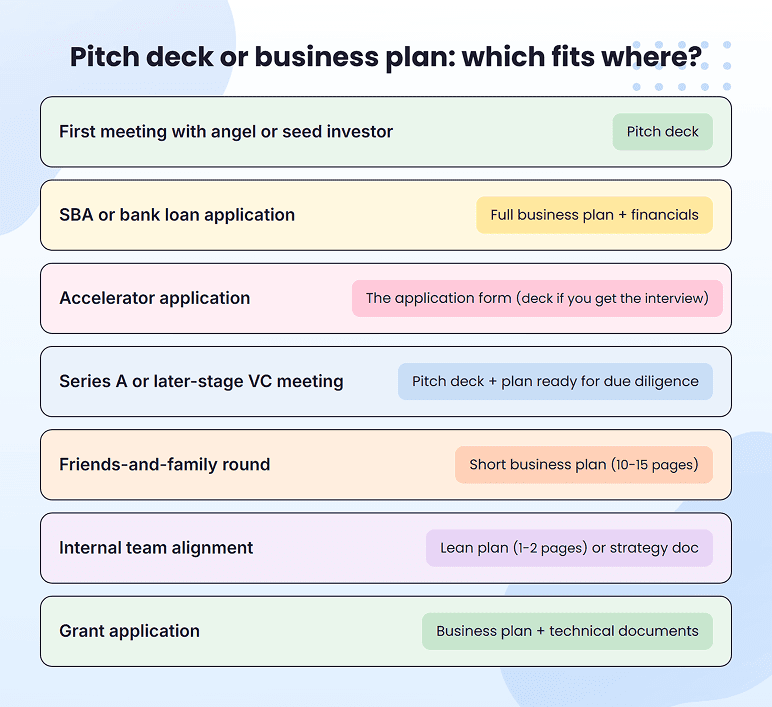
Get the practical details on each one:
Scenario 1: First meeting with an angel or seed investor
Bring a deck, not a plan. The investor spends only a few minutes on a deck before deciding whether to take the next meeting. Sending a 40-page plan at this stage can feel heavy for a first investor conversation.
Scenario 2: SBA or bank loan application
You need a full business plan with 3 to 5 years of financial projections. The loan officer has to defend the decision to a credit committee, so build the plan for them. Every number should have a source.
Scenario 3: Accelerator application (YC, Techstars, regional accelerators)
The application form is the document. Decks come at the interview stage if you get one. Plans rarely come up until after acceptance. Focus your time on the application questions.
Scenario 4: Series A or later-stage VC meeting
The deck still runs the meeting, but this is where the plan earns its keep. The moment a firm gets interested, due diligence starts, and they go through your numbers line by line. Have the plan, model, and a couple of customer references ready.
Scenario 5: Friends-and-family round
Skip the deck. A short (10-15 page) plan fits better here. These people already believe in you, so you’re not selling, you’re showing: where the money goes and when they get it back. A simple projection and a payback timeline do it.
Scenario 6: Internal alignment with your team or co-founders
Internally, a one or two-page lean plan is enough, or even a one-pager. Just cover where you want to achieve in a year, the few numbers you’ll track, and who’s responsible for what. Nobody on your own team reads a 40-page plan.
Scenario 7: Grant applications (SBIR, STTR, or state innovation programs)
A business plan plus the technical documents the program asks for. Grant reviewers score on their own rubric, different from how investors think. Read the program’s requirements first and match your plan to what they’re scoring.
If your situation isn’t on this list, the rule of thumb is to follow the audience. If the person reading wants a fast decision, build a deck. If they need to defend the decision to someone else, build a plan.
What to write first? Business plan or pitch deck?
My advice is to write the business plan first.
Here’s why: A business plan demands thorough research, actual numbers, and clear assumptions. It forces you to understand your business at a level a deck can’t reach on its own, which makes the deck much easier to write afterward.
I see founders who reverse this end up in trouble. A deck written before the plan tends to overstate the market or skip the unit economics. The plan that follows carries the same gaps, and investors notice both.
The one exception is the testing phase. If you’re at a demo day or open office hours, a rough deck is enough to get useful feedback faster than a full plan can.
The bottom line
A pitch deck and a business plan aren’t really competing with each other. They’re built for different jobs. Once you see that, the question of which one to build mostly answers itself.
Use a pitch deck if you want to explain your business idea quickly and get someone interested fast, an investor, an accelerator, or a partner who’ll decide in a few minutes whether to keep talking with you.
Use the business plan when someone needs to study your business strategy, financials, operations, or repayment capacity before making a final decision.
But in some cases, you might end up needing both, just not at the same time. What matters is knowing which one your audience needs.
If you’d like to build both in one place, Upmetrics is worth a look. It helps you create a detailed business plan and then turn the same business details and numbers into a pitch deck. So you don’t need to start from scratch.
Turn Your Plan Into a Pitch Deck
Use your business plan details to create a clear, focused pitch deck.

Frequently Asked Questions
Is a pitch deck similar to a business plan?
Do you need both a business plan and a pitch deck?
What is the 10/20/30 rule for pitch decks?
What should I send first: a pitch deck or business plan?

Upmetrics
Upmetrics is the #1 business planning software that helps entrepreneurs and business owners create investment-ready business plans using AI. We regularly share business planning insights on our blog. Check out the Upmetrics blog for such interesting reads. Read more