Executive Summary
North Loop Esports Facility is a new esports arena and training center planned for 2114 Kramer Lane, Suite 320, in Austin’s Domain District. It will operate as a Texas LLC, co-owned by Ryan Calder (60%) and Mia Navarro (40%). The facility combines open-play gaming, structured coaching, youth programs, and studio-grade streaming bays in one dedicated space.
Austin is a strong market for this business type. The metro area has approximately 2.4 million residents, and as of 2024, Austin ranks number 8 on the list of top gaming cities in the US. The Domain area is known for its tech companies, apartments, and retail, which means a steady flow of young professionals and students who already spend time and money on gaming and streaming. Simultaneously, Esports is among the fastest-growing high school activities nationally, and nearly 500 Texas schools already compete in organized scholastic esports, signaling strong underlying demand for training facilities and practice space in the state.
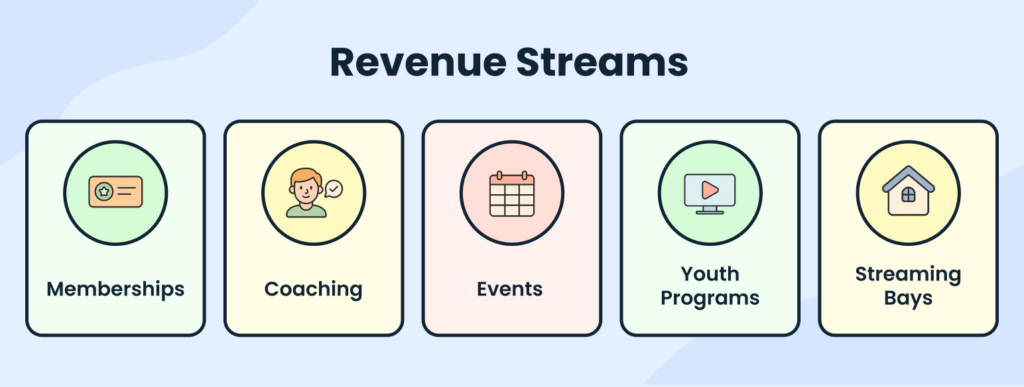
North Loop will earn revenue from several services. Core offerings include day passes at $18, unlimited monthly memberships at $89, student plans at $65, and family plans at $199 per month. Coaching will cover FPS titles like Valorant and CS2 at $45 per hour, MOBA games at $40 per hour, and battle royale coaching at $35 per hour, plus 4-hour team bootcamps at $260. The facility will also rent out sound-treated streaming booths for $22 per hour, host tournament nights for $700 per evening, and conduct corporate team-building events for $1,200 per session. For younger players, North Loop will offer 5-day summer camps at $350 per student and weekend training clinics at $45 per 2-hour session.
The business is seeking a $350,000 angel investment in exchange for 18% equity. The founders will add $90,000 of their own. Startup uses include buildout and sound treatment, 40 high-end gaming PCs with RTX 4070 GPUs and i7 CPUs, VR bays, furniture and seating, networking, software, insurance, permits, branding, website, and 12 months of working capital. Total startup investment for these items is projected at $365,600, with the rest of the round supporting staffing, tournaments, and marketing during the first year.
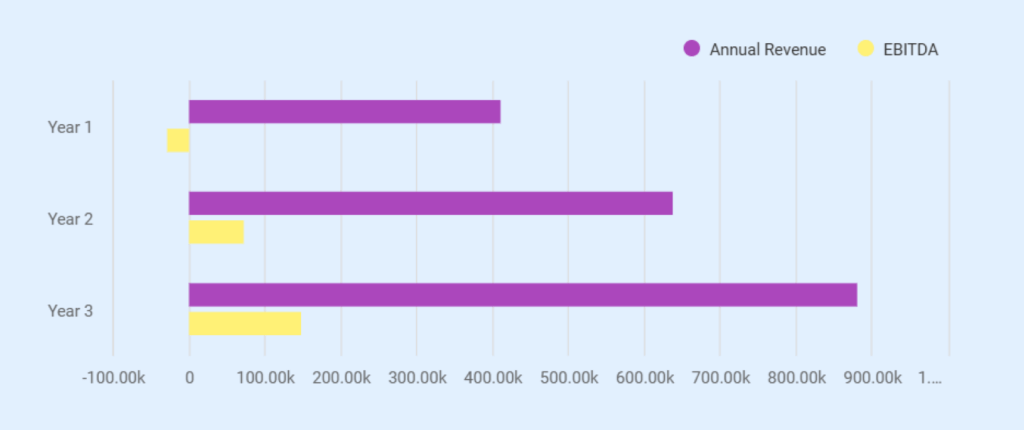
Financial projections show planned revenue of $412,000 in Year 1, $638,000 in Year 2, and $882,000 in Year 3. EBITDA is expected to be around –$28,000 in Year 1, then improve to $72,000 in Year 2 and $148,000 in Year 3 as memberships, coaching, and events build up. Break-even is estimated at roughly $48,000 in monthly revenue, which can be reached with about 420 active memberships or a mix of weekly day-pass users plus 2 to 3 events per month.
With its Domain District location, strong mix of services, and founders who bring both competitive esports and entertainment operations experience, North Loop Esports Facility aims to become Austin’s go-to center for structured gaming, training, and events.
A business plan shouldn’t take weeks
Company Overview
Business Structure and Ownership
North Loop Esports Facility will operate as a Texas limited liability company. The business is co-owned by two founders:
| Owner | Ownership % | Title |
|---|---|---|
| Ryan Calder | 60% | Founder and Head Coach |
| Mia Navarro | 40% | Co-Founder and Operations Lead |
The company will run from a leased commercial space at 2114 Kramer Lane, Suite 320, Austin, Texas 78758. Its structure allows the founders to maintain operational control while presenting a clear equity position to outside investors.
Business Concept
North Loop Esports Facility is designed as an in-person esports venue offering daily gaming, structured coaching, streaming studio access, and event hosting. The concept blends open-play entertainment with training services and organized tournaments so customers can use the space for practice, improvement, and group activities. The facility will also support youth programs such as camps and weekend training sessions.
Facility Layout
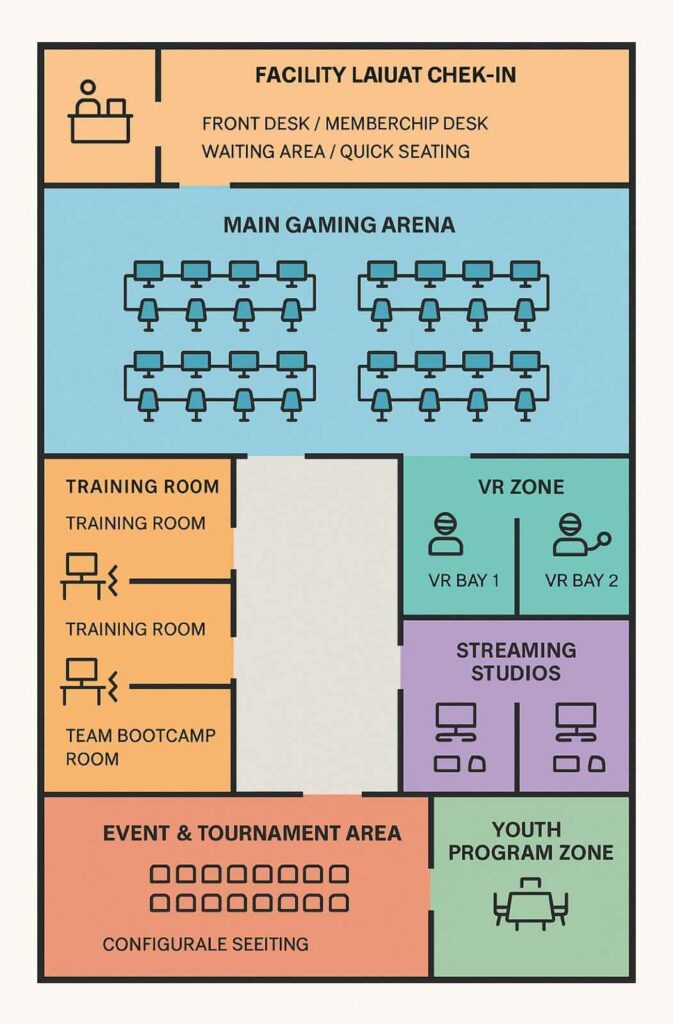
We ensured that our facility layout is built around multiple activity zones to support different types of customers:
- Main Arena: 40 high-performance PCs with RTX 4070 GPUs, i7 processors, and 165 Hz ASUS monitors.
- Training Rooms: Sound-treated spaces for coaching and team scrims.
- Streaming Booths: Studio-grade bays equipped with OBS and audio gear.
- VR Stations: Meta Quest 3 units for immersive or specialty sessions.
- Event and Tournament Area: A configurable zone for competitions, group play, and corporate sessions.
Services and Value Proposition
North Loop’s value comes from offering structured, reliable, high-quality gaming experiences that most individuals can’t replicate at home. Our core offerings include:
- Day passes and memberships
- Coaching across FPS, MOBA, and battle royale games
- Team bootcamps
- Streaming-bay rentals
- Tournaments and venue rentals
- Corporate team-building events
- Youth camps and weekend clinics
This service mix creates both recurring and event-based revenue, helping stabilize monthly activity.
Long-Term Objectives
Our aim is to:
1. Build a Stable Membership Base of 450–550 Active Members by Year 3
Memberships are the financial backbone of a facility-based esports business. Targets include:
- 250–300 members by the end of Year 1
- 350–420 members by Year 2
- 450–550 members by Year 3
This membership base would represent 40–50% of monthly revenue and provide a predictable cash flow that reduces reliance on tournaments.
2. Deliver 1,200–1,500 Coaching Sessions Annually by Year 3
Coaching is one of the highest-margin services in esports. Our operational targets:
- 600 sessions in Year 1 (about 50 per month)
- 1,000 sessions in Year 2
- 1,200–1,500 sessions in Year 3
This reflects growth in FPS, MOBA, and Battle Royale sessions as well as team bootcamps. By Year 3, coaching should represent 20–25% of annual revenue.
3. Become the Primary Practice Site for 10–15 Local School Esports Teams
A core competitive advantage for North Loop is the availability of:
- Sound-treated training rooms
- Structured coaching
- Bootcamp scheduling
Targets:
- 5 school teams in Year 1
- 10–12 teams using the facility regularly by Year 2
- 15 teams by Year 3, representing nearby districts and college clubs
This reduces seasonal revenue dips and supports weekday utilization.
4. Host 40–50 Community Tournaments Per Year by Year 3
Tournaments drive traffic, visibility, and local brand identity. Projected event growth:
- 24–30 events in Year 1 (2–3 per month)
- 36–42 events in Year 2
- 40–50 events in Year 3, including school competitions, league nights, and sponsored events
Tournaments should generate 10–15% of annual revenue and drive new membership conversions.
5. Grow Youth Esports Programs to 300–400 Annual Enrollments
Parents are increasingly seeking structured, supervised gaming programs. Targets:
- 120–150 enrollments in Year 1
- 200–260 enrollments in Year 2
- 300–400 enrollments in Year 3
Youth programs provide stable seasonal revenue and improve weekday afternoon utilization. By Year 3, youth programs should contribute 8–12% of total revenue.
6. Build a Creator Community of 40–60 Regular Streaming Booth Users
Streaming bays differentiate North Loop from casual gaming lounges. Targets:
- 20–25 regular creators in Year 1
- 35–45 creators in Year 2
- 40–60 in Year 3
These creators amplify marketing reach without additional ad spend and help promote tournaments and coaching offerings.
7. Achieve 80–85% Utilization of Training Rooms During Peak Hours
Competitive players require structured scrims and bootcamps. Targets:
- 60% utilization in Year 1
- 70–75% in Year 2
- 80–85% in Year 3
High utilization demonstrates strong demand and supports future expansion (additional rooms or new locations).
8. Reach Break-Even by Month 18–24 With Monthly Revenue of ~$48,000
Break-even is realistic as:
- Memberships reach 350+
- Coaching volume increases
- Tournament activity stabilizes
- Corporate bookings grow
After break-even, the goal is 15–20% year-over-year revenue growth.
Market Overview
Industry Outlook
Esports continues to grow as a mainstream activity across competitive gaming, casual play, and streaming. National participation is strong: According to the Entertainment Software Association (ESA), 61 % of Americans play video games weekly, representing more than 190 million active players in the United States. This broad adoption supports businesses that offer structured in-person experiences, high-performance equipment, and organized events.
While global esports trends matter, North Loop’s business model depends more on local demand for in-person gaming experiences. Austin’s strong tech culture and rising youth esports participation create favorable conditions for a facility that offers high-end hardware, coaching, and event hosting.
Moreover, an overall internet quality, average internet speed on fixed broadband and mobile, and affordable cost of the internet connection are important. All of these things are possible in Austin, Texas.
Local Market Size
The Austin metro area has about 2.3 million residents, with a large tech workforce and active gaming community. The Domain District, where the North Loop Esports Facility will be located, attracts young professionals, students, and remote workers who already participate in gaming and online communities. This represents a large base of potential customers who already spend time on competitive titles, streaming platforms, and online communities.
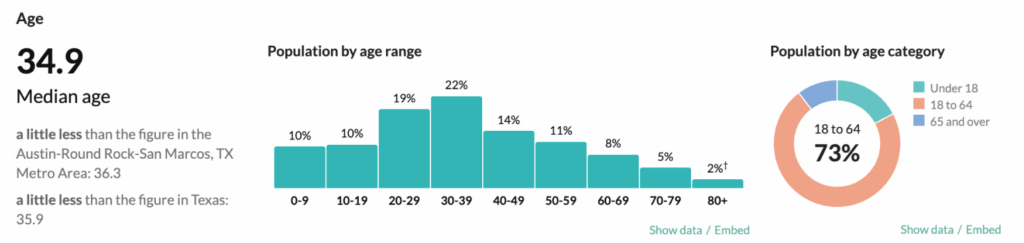
Austin is also home to gaming-related employers like Blizzard, Electronic Arts, and Certain Affinity, further reinforcing local interest in gaming culture. Additionally, Austin has a high concentration of residents in the 13 to 39 age range, which overlaps with the primary gaming demographic.
Target Demographics
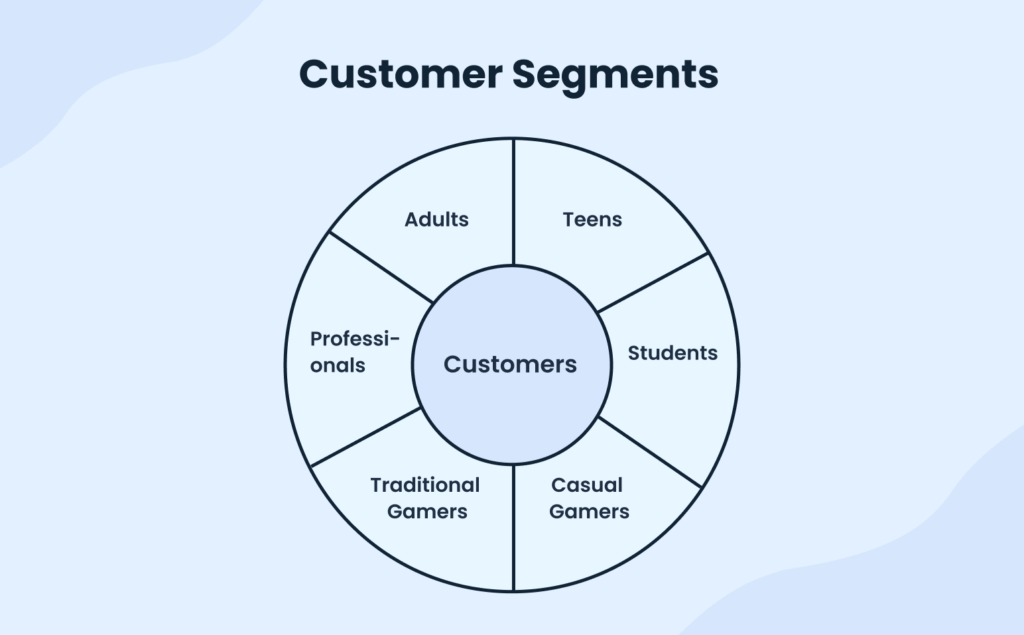
North Loop Esports Facility will serve a wide range of customer groups that regularly participate in gaming activities and seek structured or social experiences:
- Gamers ages 13 to 39
- High-school and college esports teams needing practice space
- Tech employees from the Domain District looking for after-work gaming or corporate events
- Streamers and content creators who need studio-quality production space
- Parents wanting supervised programs, camps, and structured gameplay for their children
Customer Needs and Behaviors
Each customer segment has its own motivations:
| Customer Segment | Primary Needs | Behavior Patterns |
|---|---|---|
| Casual Gamers | Access to high-end PCs, a social gaming environment, and simple pricing | Visit on evenings/weekends; often start with day passes before considering memberships |
| Competitive Players | High-FPS machines, structured coaching, scrim rooms, consistent scheduling | Book repeated sessions; participate in bootcamps; seek measurable improvement |
| High-School & College Teams | Reliable practice rooms, team coordination, and match review support | Attend weekly scrims; schedule multi-hour blocks; return each season |
| Tech Workers (Domain District) | After-work entertainment, group activities, convenient location | Short sessions on weekdays; interest in corporate events or team nights |
| Streamers & Content Creators | Quiet recording space, stable internet, professional lighting/audio | Book multi-hour booth sessions; produce recurring content on-site |
| Parents of Teens | Safe, supervised environment, learning-focused programs, clear schedules | Enroll children in camps/clinics; prefer structured activities over unsupervised gaming |
North Loop’s mix of arena access, coaching, youth programs, and event rentals matches these needs without relying on one customer type alone.
Local Trends
Several local trends strengthen our business’s case:
- High-school Esports participation is growing year after year, increasing the number of teams seeking structured training environments.
- The Domain District has one of Austin’s highest concentrations of tech workers, many of whom already participate in online gaming.
- Streamers and amateur creators are an active community in Austin, but there are few dedicated places for studio-quality content production.
- Parents increasingly look for organized activities that combine skill-building with entertainment.
Market Opportunity
The combination of strong gamer density, growing school esports programs, and an active tech workforce gives North Loop Esports Facility a wide, stable market. The community already spends significant time on gaming, but local options remain limited for:
- High-quality gaming PCs
- Structured coaching programs
- Team practice rooms
- Event-ready arenas
- Supervised youth offerings (programs for minors, monitored and run by adult staff)
North Loop intends to fill this gap by positioning itself as the local hub for daily gaming, competitive improvement, content creation, and organized tournaments.
Stop searching the internet for industry & market data
Get AI to bring curated insights to your workspace
Competitive Analysis
Direct Competitors
According to our research, three primary competitors operate within Austin and influence North Loop’s competitive position:
| Competitor | Location | Strengths | Limitations Compared to North Loop |
|---|---|---|---|
| Gigabyte Esports Center | 700 Lavaca St (Downtown Austin) | Walk-in gaming, central downtown visibility, established casual audience | No structured coaching, no youth programs, no streaming booths, not in North Austin’s Domain District, limited team-focused services |
| The Void Gaming Lounge | 8810 Burnet Rd | PC gaming and VR available, community-oriented casual play | Equipment geared toward recreational use, no team scrim rooms, no coaching curriculum, no dedicated stream-production environment |
| UT Esports Arena | University of Texas Campus | High-quality equipment, a strong competitive environment for UT students | Access restricted to UT students/staff; not open to wider community, youth, school teams, or local players; no corporate event access |
Services Comparison
Compared with competitors, North Loop offers a broader and more structured service lineup:
- High-end gaming rigs with RTX 4070 GPUs
- Dedicated coaching for FPS, MOBA, and battle royale titles
- Team bootcamps and booked scrim rooms
- Studio-grade streaming booths
- VR stationsYouth camps, and weekend clinics
- Corporate team-building events
- Tournament rentals and event hosting
No competitor delivers all of these services in one facility, especially not in a Domain District location with strong foot traffic and proximity to tech employers.
Equipment and Facility Differences
While competitor venues offer gaming PCs, North Loop features:
- 40 custom PCs with consistent hardware standards (RTX 4070 GPUs, i7 CPUs)
- 165 Hz monitors for competitive gameplay
- Sound-treated coaching and scrim rooms
- Professional lighting and audio setups in streaming bays
- A flexible event space designed for tournament flow and seating
This provides North Loop with a more consistent and reliable environment for players seeking serious improvement, content creation, or organized competition.
Location Advantages
North Loop Esports Facility is located in Austin’s Domain District, an area known for its high density of tech workers, young professionals, and students. The neighborhood attracts residents who are already engaged in gaming culture and digital entertainment, which makes it a strong match for services like memberships, coaching, streaming, and structured youth programs. The consistent flow of people from nearby offices, apartments, and retail centers creates reliable foot traffic throughout the week.
The district also offers practical advantages for esports operations. Its mix of shopping, dining, and entertainment venues increases the likelihood of walk-in visits and group bookings, while its central position in North Austin makes it easy for school teams, local creators, and corporate groups to reach the facility. This combination of demographics and accessibility strengthens the business’s ability to build a steady customer base and maintain recurring participation across multiple service lines.
Gaps in the Current Market
We found that there are several key unmet needs in Austin, including a:
- Neutral, bookable space for high-school and college esports teams
- Consistent coaching program backed by experienced staff
- Supervised, safe setting for youth gaming programs
- Streaming-friendly space for amateur creators
- Tournament-ready arena for community and local events
- Corporate-friendly environment for gaming-based team sessions
North Loop’s combination of services, equipment, and structure directly targets these gaps.
Competitive Position
North Loop positions itself as the only facility in North Austin offering:
- High-end competitive hardware
- Structured coaching
- Youth-focused programming
- Streaming studios
- Bookable training rooms
- Corporate gaming events
- A Domain District address
Services
North Loop Esports facility offers a multi-service model built around daily access, structured training, content creation, and organized events. Our goal is to provide customers with a complete in-person gaming environment that supports casual play, individual improvement, and team-based activities. Each service category is designed to bring in a different type of customer while encouraging repeat visits through memberships, coaching sessions, or event participation.
Arena Access
Arena Access is our core offering and represents the primary point of entry for new customers. It allows visitors to use the main arena’s 40 gaming PCs, VR stations, and open-play seating. This service appeals to players who want a consistent gaming experience without maintaining their own equipment and to those who prefer a social environment over playing at home.
Day Pass
The North Loop Esports facility will offer a standard $18 day pass. It will grant customers full access to gaming PCs, VR stations, and open-play areas during business hours. This option will target casual players, weekend visitors, and customers trying the facility for the first time. It also serves as an entry point into membership conversions.
Monthly Memberships
To encourage recurring use, the facility will offer several membership tiers:
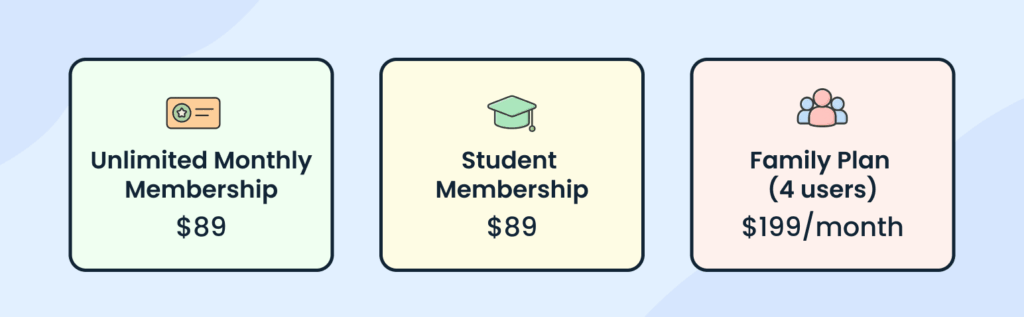
These memberships are designed for regular players, high-school and college students, and families seeking safe recreational options. They provide predictable monthly revenue and strengthen customer retention.
Coaching Programs
Individual Coaching
Coaching will be available across the most in-demand esports genres, each priced according to specialization:
- FPS Coaching (Valorant, CS2) – $45/hour
- MOBA Coaching (League of Legends) – $40/hour
- Battle Royale Coaching – $35/hour
Each session covers skill development, gameplay review, communication habits, and role-based strategy. These programs attract players who want structured improvement rather than casual play.
Team Bootcamps
For teams preparing for tournaments or ranked seasons, we have a 4-hour Bootcamp Session, $260/team.
Bootcamps are held in sound-treated rooms that allow teams to practice with minimal distractions. They include match review, scrim blocks, and coach-led drills. These sessions also support repeat bookings from school and community teams.
Streaming and Content Creation
Streaming Booth Rentals
We will provide several sound-treated streaming booths equipped with Open Broadcaster Software (OBS), high-quality lighting, and audio gear for $22/hour.
These booths are for local streamers and content creators who don’t have access to controlled recording environments at home. This service also supports influencers who want to host live sessions from the facility.
Event and Tournament Hosting
Tournament Venue Rental
| Service | Description | Pricing | Primary Users |
|---|---|---|---|
| Tournament Venue Rental | Evening or full-night rental of the event zone for competitions, community events, school matches, or group gatherings. Includes seating layout, check-in area, staff support for basic coordination. |
$700/night | Local leagues, school teams, community groups, gaming clubs, birthday groups |
| Corporate Team-Building Sessions | Structured group gaming sessions tailored for companies in the Domain District. Sessions may include casual matches, mini-tournaments, or guided gameplay depending on group goals. |
$1,200/event | Tech companies, office teams, and corporate groups seeking workplace engagement activities |
Youth Programs
Summer Esports Camp
A five-day structured program designed for students interested in improvement, teamwork, and supervised gaming:
Cost: $350/student for a 5-day session
Weekend Training Clinics
These clinics offer skill drills, gameplay review, and basic strategy guidance:
Cost: $45/2-hour session
Parents value these programs because they provide oversight, clear learning goals, and a safe environment.
VR Experiences
Although not a primary revenue driver, VR stations using Meta Quest 3 headsets enhance customer appeal. These stations diversify our gameplay options and support special events or themed sessions.
Value Proposition
North Loop Esports Facility differentiates itself through:
- A complete lineup of services under one roof
- High-performance hardware and stable network infrastructure
- Structured coaching for individuals and teams
- A safe, supervised environment for youth
- Studio-level streaming booths are not found in most local venues
- Amenities designed for competitive players rather than casual play only
This combination positions the business as Austin’s go-to destination for training, improvement, and organized gaming.
Operations Plan
Overview
North Loop Esports Facility’s operations are designed to keep the arena, training rooms, streaming booths, and event areas functioning smoothly throughout the week.
We combine daily gaming activity, scheduled coaching sessions, team scrims, youth programs, and event rentals, so our operations must support a consistent flow of customers with different needs. The goal is to maintain reliable equipment, structured scheduling, and a safe environment while keeping the facility flexible enough to accommodate both casual users and organized groups.
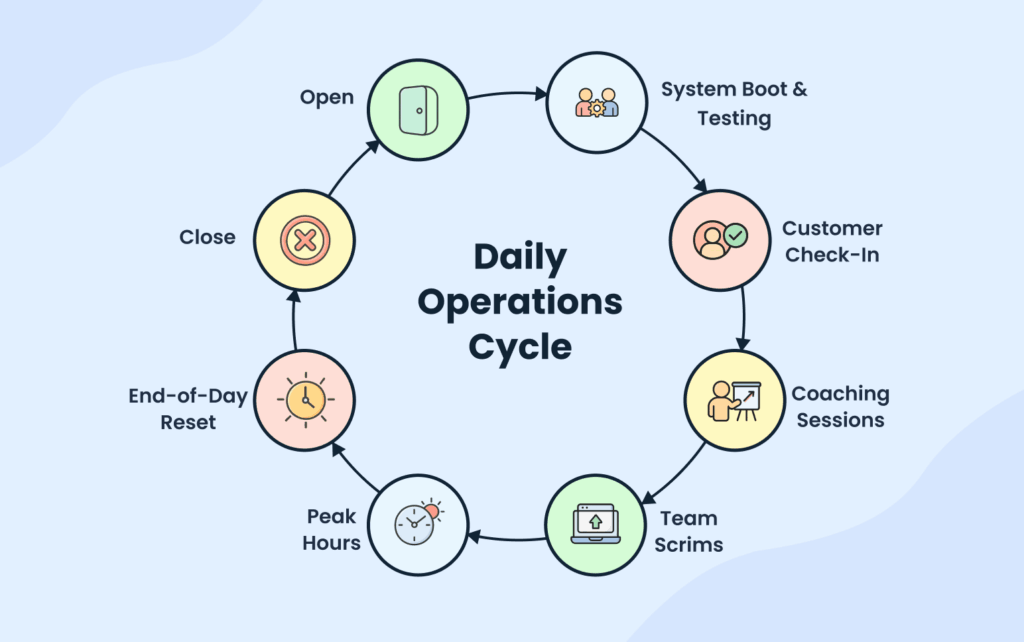
Daily Operations Cycle
Daily operations begin before opening hours with a full equipment check. Staff power on all PCs, verify software settings, confirm stable connections to the network, and inspect peripherals for wear or damage.
We clean our gaming stations regularly to maintain a professional environment and reduce hardware issues caused by dust or improper handling. We also inspect streaming booths for audio, lighting, and OBS readiness, while VR stations undergo lens cleaning and controller calibration.
Throughout the day, the front desk manages check-ins, resolves membership questions, and guides new customers. Coaches and staff monitor reserved rooms and ensure scheduled sessions begin on time. As customers move between open play, training rooms, or VR stations, staff adjust seating, reassign stations, and prepare areas for the next group. Closing procedures include a full reset of all systems, software updates as needed, and nightly cleaning of shared spaces.
Hardware & Network Management
North Loop’s gaming equipment is central to customer satisfaction. The facility uses 40 custom-built PCs with RTX 4070 GPUs and i7 CPUs, paired with ASUS 165 Hz monitors and Secretlab TITAN Evo chairs. To ensure consistent performance:
- PCs receive a daily clean and software reset
- Staff perform weekly hardware checks for fans, peripherals, and thermal performance
- The facility conducts monthly servicing to extend equipment life and reduce downtime
- The network uses Ubiquiti UniFi Pro access points to support high-speed, low-latency connectivity throughout the arena
These procedures help maintain stable gameplay, which is especially important for coaching, team scrims, and tournaments.
Event Day Workflow
Events require a different operational rhythm. For larger tournaments, we increase staffing levels to 6-8 team members to manage check-ins, bracket updates, match coordination, and crowd flow. Our coaches or trained staff may supervise tournament play, assist with match timing, and help players navigate between rounds. The event space is configured to support both seated spectators and active players, depending on the event type.
During corporate sessions, staff prepare gaming stations in advance, set up group-specific playlists or game modes, and provide a brief orientation. For school events, our operations focus on structured time blocks and clear communication with team coaches or sponsors. After events conclude, we restore the arena to its standard layout and reset equipment for regular use.
Vendor and Equipment Ecosystem
We mainly rely on established suppliers to maintain hardware consistency and to ensure replacement parts can be sourced quickly. Key vendors include:
- CLX Custom Gaming – PC rigs
- ASUS – high-refresh-rate monitors
- Meta Quest – VR units
- Secretlab – arena seating
- Ubiquiti – networking infrastructure
- Aim Lab Pro, OBS, Discord Premium – core software tools
Standardizing vendors reduces variability in performance and simplifies maintenance scheduling. It also helps maintain a consistent customer experience across all stations.
Safety and Compliance
The facility will meet Austin’s required commercial occupancy standards and maintain fire and electrical load approvals. Liability insurance covers both general operations and youth programs. Required signage will be displayed for age restrictions related to mature-rated game titles.
Youth safety is a priority for camps and weekend clinics. All youth programs occur in supervised areas, and activities are scheduled to avoid overlap with adult tournaments or late-night events. Additional safeguards, such as check-in/check-out procedures and room visibility measures, are incorporated into daily workflow.
Service Scheduling & Resource Allocation
Scheduling practices ensure that the business can accommodate casual players, coaching clients, and teams simultaneously:
- Coaching rooms and scrim rooms use a reservation system that prevents conflicts.
- Streaming booths operate on timed rental blocks.
- Youth programs use dedicated time windows to reduce overlap with peak adult hours.
- Monthly calendars help allocate time for recurring events, tournaments, and partner school activities.
This structure keeps the facility organized and reduces operational bottlenecks.
Management and Staffing Plan
Leadership Structure
The North Loop Esports Facility is led by two founders with complementary backgrounds in competitive gaming and entertainment operations.
Ryan Calder – Founder and Head Coach (60% owner)
Ryan oversees all coaching programs, training standards, team development, and competitive curriculum. He was a former semi-professional Valorant player. So his eight years of coaching experience provide the expertise needed to run structured improvement programs. He will develop training modules, supervise part-time coaches, and set the performance expectations for all coaching-related services.
Mia Navarro – Co-Founder and Operations Lead (40% owner)
Mia directs day-to-day operations, scheduling, customer flow design, and event logistics. She has managed a VR entertainment center. That shows experience in arena management, staff supervision, and the coordination required for tournaments, youth programs, and corporate sessions. She will also oversee staff training, customer service processes, and facility readiness.
Year 1 Staffing Plan
The facility uses a hybrid staffing model built around full-time roles, part-time support, and specialized contractors. This allows the business to scale labor costs according to daily demand, event schedules, and program activity.
| Role | Compensation | Type |
|---|---|---|
| General Manager | $62,000/year | Full-time |
| Head Coach (FPS Specialist) | $48,000/year | Full-time |
| MOBA Coach | $35/hr | Part-time |
| Event Coordinator | $42,000/year | Full-time |
| Arena Technicians (2) | $20/hr | Full-time |
| Front Desk Associates (2) | $17/hr | Part-time |
| Social Media Manager | $850/month | Contract |
| Bookkeeper | $1,200/year | Contract |
This staffing plan balances operational coverage with cost control. Full-time roles support everyday activity. The part-time and contract roles flex with peak hours and event schedules.
Staff Responsibilities and Workflow Alignment
| Role | Key Responsibilities | Workflow Contribution |
|---|---|---|
| General Manager | Oversees operations and staff | Maintains daily facility flow |
| Head Coach | Leads coaching programs | Ensures training quality and schedule consistency |
| MOBA Coach (PT) | Provides specialized coaching | Expands coaching availability |
| Event Coordinator | Plans and runs events | Keeps tournaments and group sessions organized |
| Arena Technicians (2) | Maintain PCs and equipment | Ensure stations stay functional throughout the day |
| Front Desk Associates (2) | Handle check-ins and memberships | Manage customer entry and reservations |
| Social Media Manager | Post updates and promotions | Supports event turnout and brand visibility |
| Bookkeeper | Manages financial records | Maintains accounting and reporting accuracy |
Staffing Schedule and Coverage
The facility’s operating hours (12 PM to 11 PM on weekdays, extended hours on weekends) require staggered shifts. The schedule ensures:
- Front desk coverage during all open hours
- Coaching availability during peak demand periods (afternoons, evenings, weekends)
- Technician coverage for maintenance and event prep
- Event staffing on tournament nights, requiring up to 6–8 team members
This approach protects service quality without overextending labor costs.
Staffing Ratios During Events
| Event Type | Required Staffing | Workflow Needs |
|---|---|---|
| Small Tournament (≤ 32 players) | 1 Event Coordinator, 1 Technician, 1 Front Desk, 1 Coach (support) | Bracket updates, check-in, station assignment, basic troubleshooting |
| Medium Tournament (32–64 players) | 1 Event Coordinator, 2 Technicians, 1–2 Front Desk, 1 Coach | Match flow, player rotation, equipment resets, and communication with teams |
| Large Tournament (64+ players) | 1 Event Coordinator, 2–3 Technicians, 2 Front Desk, 1 Coach, GM | Full event management, crowd control, streaming booth support, and supervisor oversight |
| Corporate Team-Building Event | 1 Event Coordinator, 1 Technician, 1 Front Desk | Group orientation, game setup, timing management, and customer assistance |
Training and Internal Standards
All staff undergo initial training covering:
- Customer service procedures
- Hardware care and troubleshooting basics
- Safety and youth-program guidelines
- Facility layout and event-day expectations
Coaches follow a structured methodology defined by the Head Coach, ensuring players receive consistent instruction regardless of game title or coach availability.
Marketing and Community Strategy
North Loop Esports Facility will use a blended marketing approach that combines digital channels, school partnerships, influencer engagement, community events, and locally targeted outreach in the Domain District. Our goal is to build steady membership growth, maintain frequent event attendance, and position the facility as the central hub for competitive and recreational gaming in North Austin.
The strategy supports both recurring revenue (memberships, coaching, youth programs) and event-based revenue (tournaments, corporate sessions). Marketing efforts will focus on reach, local relevance, and consistent engagement rather than broad national visibility.
Channel Strategy
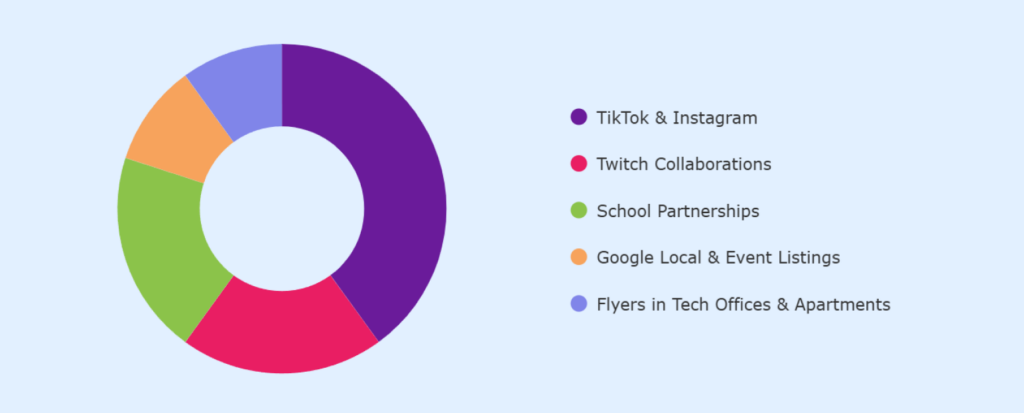
We will use a channel mix that provides a balance between digital awareness and local community engagement:
| Marketing Channel | Share of Effort | Purpose | Key Activities |
|---|---|---|---|
| TikTok & Instagram | 40% | Reach teens, young adults, and creators; build consistent visibility | Short-form gameplay clips, arena tours, coaching tips, event highlights |
| Twitch Collaborations | 20% | Engage local streamers and their audiences; highlight streaming booths | Co-streams, on-site broadcasts, creator nights, equipment showcase sessions |
| School Partnerships | 20% | Attract high-school and college teams; support youth programming | Scrim blocks, team bootcamps, club sponsorships, discounts for school groups |
| Google Local & Event Listings | 10% | Capture search-driven traffic from people seeking gaming, events, or venues | Google Business updates, event postings, SEO-targeted local keywords |
| Flyers in Tech Offices & Apartments | 10% | Reach Domain-area workers and nearby residents; promote memberships | Printed flyers, lobby placements, resident welcome packets, and office outreach |
Community Programs
Community engagement is central to North Loop’s growth. Structured, recurring programs create predictable traffic and deepen user attachment. Key activities include:
- Weekly game-specific tournaments for Valorant, League of Legends, and other popular titles
- Scrim nights for school and amateur teams
- Influencer nights, where local creators stream from the facility
- Viewing parties for major esports events
- Youth gaming clinics that offer structured, supervised skill development
- After-school club support, including discounted practice blocks for school teams
These programs allow North Loop to serve as both a meeting place and an improvement hub for different segments of the gaming community.
Corporate Engagement
The Domain District provides direct access to companies with large employee populations. Gaming is a natural team activity because it is accessible to a wide range of skill levels and doesn’t require physical ability. To support corporate demand, we will:
- Offer $1,200 corporate team-building sessions with structured mini-tournaments or cooperative games
- Provide weekday booking options that align with corporate schedules
- Develop packages for office groups, including private room use or reserved arenas
- Build relationships with HR and team leads to encourage recurring bookings
Launch Strategy
Our facility’s opening will be supported by high-visibility promotions designed to drive early memberships and foot traffic:
- Founding 200 Memberships offered at $79/month as a locked-in rate
- Opening Week “Unlimited Play” to encourage trial visits
- Free coaching session for the first 100 members
- Launch tournaments for major titles with prize pools to attract competitive players
These offers help establish early momentum and build a strong initial membership base.
Membership Conversion Flow
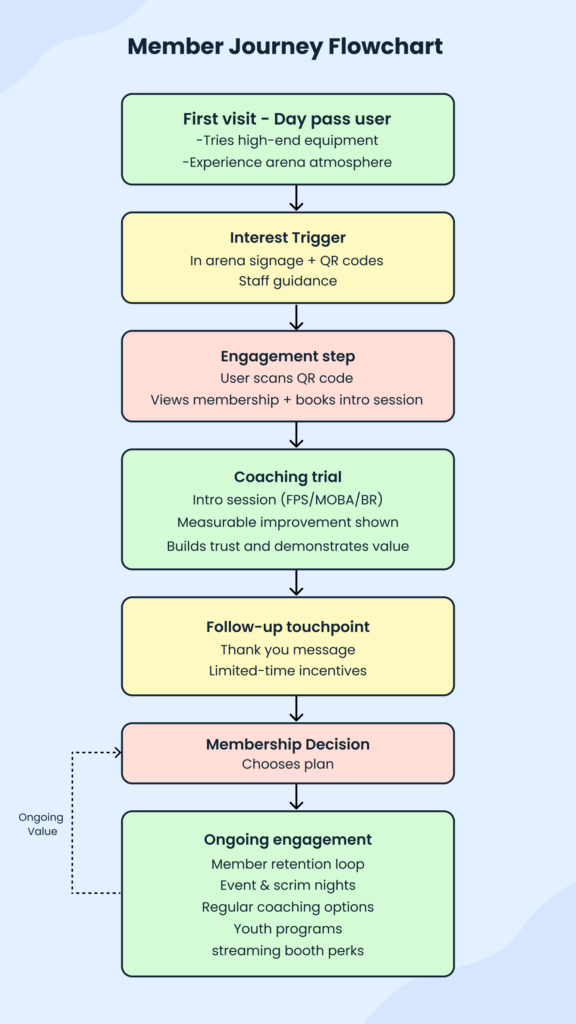
We’ve built our membership strategy around converting day-pass visitors into recurring customers. The conversion path includes:
Marketing Budget
The brief indicates a monthly budget of approximately $4,500 for the first six months. This budget will be allocated across paid social campaigns, influencer support, school outreach materials, and local promotional events. Cost per click (CPC) in the gaming category typically ranges from $0.65 to $1.40, which supports efficient early-stage traffic generation.
Long-Term Marketing Approach
Beyond launch, the strategy shifts toward:
- Strengthening repeat participation through seasonal tournaments
- Expanding youth programming during school breaks
- Growing partnerships with schools and community groups
- Supporting local streamers to build word-of-mouth reach
- Collecting user feedback to refine services and facility layout
Financial Plan
Overview
North Loop Esports Facility’s financial model is built on multiple revenue streams, controlled startup costs, and a clear path to profitability as memberships, coaching programs, and events expand. The business combines recurring revenue with event-driven income, allowing for both stability and seasonal spikes.
Startup Costs
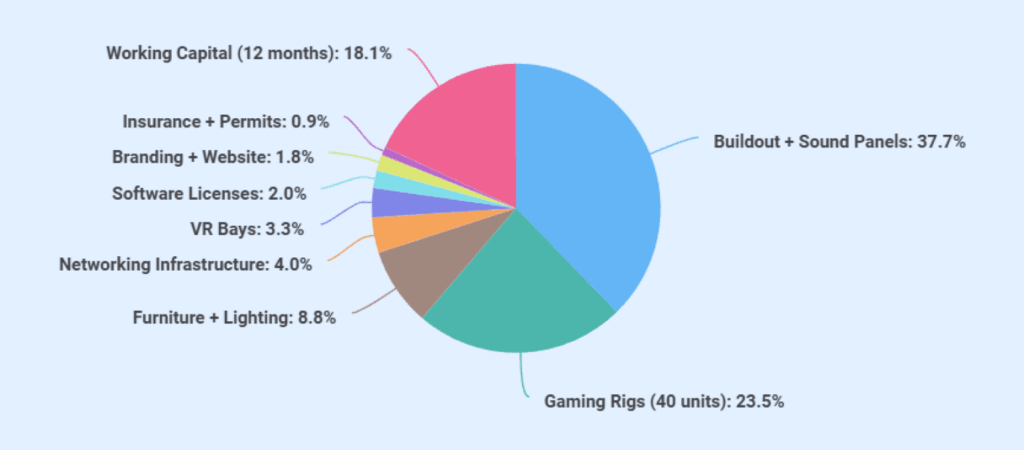
Startup expenses total $365,600, covering buildout, equipment, networking, VR bays, software licensing, insurance, permits, branding, website, and a full year of working capital.
| Startup Costs Breakdown | |
|---|---|
| Category | Cost |
| Buildout + Sound Panels | $138,000 |
| Gaming Rigs (40 units) | $86,000 |
| Furniture + Lighting | $32,000 |
| Networking Infrastructure | $14,500 |
| VR Bays | $12,000 |
| Software Licenses | $7,200 |
| Branding + Website | $6,500 |
| Insurance + Permits | $3,400 |
| Working Capital (12 months) | $66,000 |
| Total Startup Investment | $365,600 |
Funding Requirement
We’re seeking an angel investment in the range of $350,000, supplemented by $90,000 in founder capital. This funding level aligns directly with the facility’s verified startup costs of $365,600, which include buildout, equipment, software, networking infrastructure, insurance, and working capital for the launch period. By raising only the capital required to open and stabilize operations, our company maintains a disciplined financial structure and avoids unnecessary dilution for both founders and investors.
Use of Funds
Seed funding will cover:
- Completion of buildout and sound treatment
- Final hardware purchases (rigs, monitors, chairs, streaming equipment)
- Staffing for the first operating months
- Tournament and event launch budget
- Marketing spend for customer acquisition
- Cash buffer for a 12–15 month runway
Revenue Model (Years 1–3)
Revenue Breakdown
| Financial Metric | Year 1 | Year 2 | Year 3 |
|---|---|---|---|
| Annual Revenue | 412,000 | 638,000 | 882,000 |
| EBITDA | -28,000 | 72,000 | 148,000 |
Revenue growth will depend on increased membership adoption, stronger coaching demand, more frequent tournaments, corporate events, and full enrollment in youth programs.
Profit & Loss (Income Statement) 3-Year
| Category | Year 1 | Year 2 | Year 3 |
|---|---|---|---|
| Revenue | $412,000 | $638,000 | $882,000 |
| Cost of Goods Sold (COGS) | $52,000 | $68,000 | $86,000 |
| Gross Profit | $360,000 | $570,000 | $796,000 |
| Operating Expenses | |||
| Staff Costs | $270,000 | $305,000 | $332,000 |
| Facility Rent & Utilities | $96,000 | $98,000 | $100,000 |
| Marketing | $54,000 | $45,000 | $45,000 |
| Maintenance & Equipment | $28,000 | $32,000 | $36,000 |
| Insurance & Admin | $12,000 | $14,000 | $16,000 |
| Total Operating Expenses | $460,000 | $494,000 | $529,000 |
| EBITDA | -$28,000 | $72,000 | $148,000 |
| Depreciation | $35,000 | $35,000 | $35,000 |
| Net Income | -$63,000 | $37,000 | $113,000 |
Break-Even Analysis
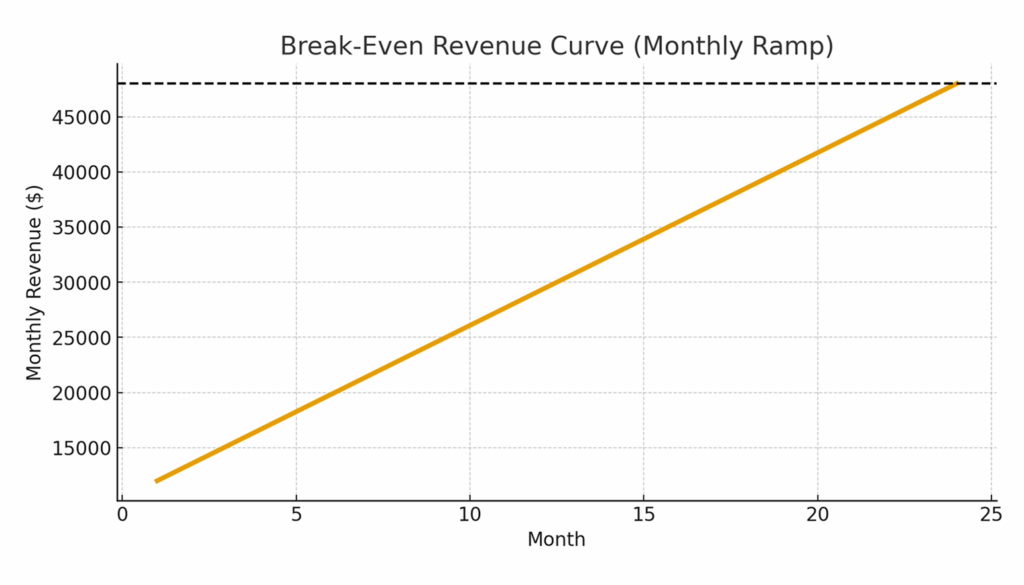
Our facility expects to reach break-even once monthly revenue reaches approximately $48,000. This target covers operating expenses, including staffing, facility costs, equipment upkeep, marketing, and recurring service subscriptions. Revenue at this level can be reached through a mix of memberships, day-pass activity, coaching sessions, youth programs, and event bookings.
There are two practical paths to achieving break-even. The first is building a strong membership base, which naturally creates predictable month-to-month income. Approximately 420 active memberships would meet the revenue requirement on their own. The second path uses a blended model that combines regular day-pass visitors with recurring coaching clients and 2–3 paid events each month, such as tournaments or corporate team sessions.
Because the business offers multiple services with different margins, the most realistic outcome is a combination of memberships and event-driven revenue. As the customer base grows, tournaments scale, and youth programs expand, the facility gradually moves toward the revenue threshold needed to sustain ongoing operations.
Cash Flow Statement (3-Year)
| Category | Year 1 | Year 2 | Year 3 |
|---|---|---|---|
| Cash Inflows | |||
| Revenue Collected | $412,000 | $638,000 | $882,000 |
| Capital Raised (Equity) | $440,000 | — | — |
| Total Inflows | $852,000 | $638,000 | $882,000 |
| Cash Outflows | |||
| Operating Expenses | $460,000 | $494,000 | $529,000 |
| Capital Expenditures | $365,600 | $25,000 | $25,000 |
| Loan Payments (if any) | — | — | — |
| Total Outflows | $825,600 | $519,000 | $554,000 |
| Net Cash Flow | $26,400 | $119,000 | $328,000 |
| Ending Cash Balance | $26,400 | $145,400 | $473,400 |
Spreadsheets are exhausting & time-consuming
Build accurate financial projections w/ AI-assisted features
Runway and Liquidity
The seed round is structured to provide 12–15 months of operating runway, supported by:
- Working capital is already included in startup costs
- Controlled staffing model with a mix of full-time, part-time, and contract roles
- Predictable baseline revenue from memberships and youth programs
This runway allows the business to reach scale before major expenses or upgrades are necessary.
Cash Flow Drivers
While early operations rely heavily on memberships and day passes, margin expansion comes from programs with higher pricing relative to resource use:
| Category | Driver | Why It Matters |
|---|---|---|
| Higher-Margin Revenue | Coaching Sessions (FPS, MOBA, Battle Royale) | Uses existing space and equipment; strong hourly rates; scalable with additional coaches |
| Higher-Margin Revenue | Team Bootcamps | Multi-hour blocks increase revenue/reservation; strong demand from school and amateur teams |
| Higher-Margin Revenue | Tournament Hosting | Generates event fees and draws new users; increases food, merch, and future bookings |
| Higher-Margin Revenue | Corporate Team-Building Events | Premium pricing; reliable weekday demand; supports partnerships with Domain-area companies |
| Stable-Margin Revenue | Youth Camps & Weekend Clinics | Predictable enrollment; strengthens weekday/seasonal usage; increases parent-driven referrals |
| Stable-Margin Revenue | Streaming Booth Rentals | Low operational load; steady demand from content creators; uses compact dedicated spaces well |
As these higher-margin services grow, EBITDA strengthens from Year 2 onward.
Balance Sheet (3-Year)
| Category | Year 1 | Year 2 | Year 3 |
|---|---|---|---|
| Assets | |||
| Cash | $26,400 | $145,400 | $473,400 |
| Equipment & Furniture (Net) | $330,600 | $295,600 | $260,600 |
| Other Current Assets | $15,000 | $18,000 | $20,000 |
| Total Assets | $372,000 | $459,000 | $754,000 |
| Liabilities | |||
| Accounts Payable | $20,000 | $15,000 | $12,000 |
| Accrued Expenses | $8,000 | $10,000 | $12,000 |
| Total Liabilities | $28,000 | $25,000 | $24,000 |
| Equity | |||
| Owner + Investor Equity | $440,000 | $440,000 | $440,000 |
| Retained Earnings | -$96,000 | -$6,000 | $290,000 |
| Total Equity | $344,000 | $434,000 | $730,000 |
| Liabilities + Equity | $372,000 | $459,000 | $754,000 |
Financial Outlook
The financial projections show a viable and scalable business model. By Year 3, increasing coaching demand, regular event schedules, and a larger membership base collectively push the business into stronger profitability. High-end equipment and structured programs support pricing power relative to casual gaming venues.
The Quickest Way to turn a Business Idea into a Business Plan
Fill-in-the-blanks and automatic financials make it easy.

Upmetrics
Upmetrics is the #1 business planning software that helps entrepreneurs and business owners create investment-ready business plans using AI. We regularly share business planning insights on our blog. Check out the Upmetrics blog for such interesting reads. Read more