


Starting a nonprofit feels like the easy part. You have the mission. You know who you want to help. And you’re ready to make it happen.
Then comes the part nobody warns you about.
Putting it all down on paper in a way that makes a grant committee, a board member, or a big donor actually say yes. That’s where most founders get stuck. I’ve seen it happen more times than I can count.
There are 1,935,344 registered nonprofits in the US. But around 50% of them don’t survive the first twelve months. It’s not because the mission wasn’t worth it. But because there was no solid planning behind it.
A good nonprofit business plan can fix that.
Don’t know how to write one? This guide walks you through every section. There’s also a free template at the end, so you can start building your own.
How is a nonprofit business plan different from a for-profit one?
Most founders ask this before they start writing: Can I just take a regular business plan template and change a few things?
The short answer is no. It won’t work that way.
A for-profit plan exists to make money for owners and investors. A nonprofit plan exists to show how you’re going to serve a community and deliver on your mission.
The structure looks similar on paper. But they’re fundamentally different in purpose, language, and what you need to say in each section.
Here’s the clearest way to see the difference:
| Category | For-Profit | Nonprofit |
| Bottom line | Profit for owners/investors | Mission impact for the community |
| Revenue model | Sales of products or services | Donations, grants, sponsorships, earned income |
| Financial documents | Income statement, balance sheet, cash flow statement | Statement of activities, statement of financial position, statement of cash flows |
| Success metrics | Revenue growth, profit margins | Lives impacted, programs delivered |
| Stakeholders | Shareholders and customers | Donors, board members, and community |
| Tax status | Standard corporate taxation | 501(c)(3) tax-exempt status |
| Governance | Owner or executive-driven | Board of directors governed |
One thing worth clearing up before you move forward: A nonprofit can absolutely generate revenue. The difference is that any surplus gets reinvested back into the mission rather than distributed to owners.
So the financial section of your plan still matters. It just tells a different story.
Keep in mind that your plan will be read by grant committees, board candidates, and major donors. They all have different questions. But they’re all trying to figure out the same thing: Is this organization worth backing?
And that’s a real difference between a for-profit and a nonprofit plan, I would say. You’re not proving you can make money. You’re proving you can make a difference and keep a real plan to do that.
How to write a detailed nonprofit business plan?
Writing a nonprofit business plan is more manageable than most founders think. Break it down section by section. Each one covers a different part of your organization, and together they give your readers the full picture.
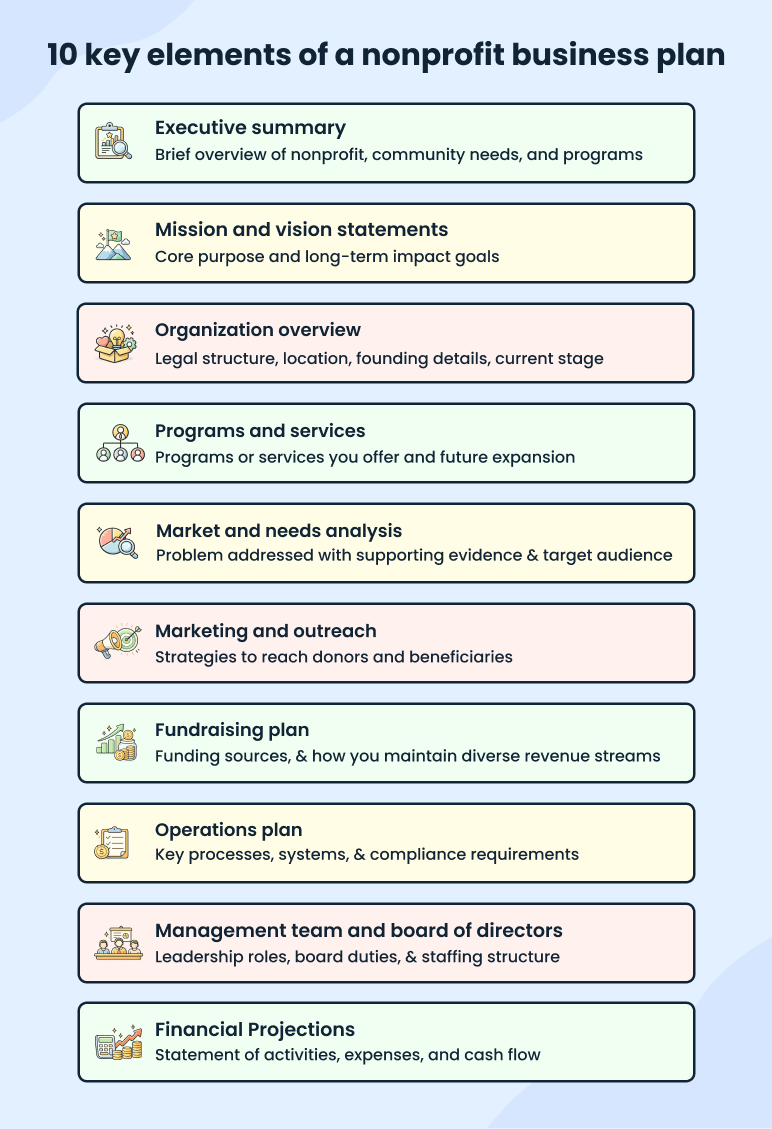
1. Executive summary
Your executive summary is a quick snapshot of your entire nonprofit business plan. It’s the first thing anyone reads. And busy grant reviewers sometimes only read this section before making a decision.
You may think of it as your organization’s elevator pitch on paper. That’s why it should be clear, straightforward, and engaging for readers.
Here’s what to cover in your plan summary:
- A brief description of your nonprofit and what it does
- The community need you’re addressing
- Your key programs and who they serve
- Your funding needs and growth goals
When writing, aim for 1-2 pages max. Be clear and get to the point quickly.
But for grant applications, funders often have their own length limits for executive summaries. Some want just one paragraph. Always check the grant requirements before you write yours and adjust accordingly.
Do I need to write my executive summary first or last?
Most founders write it first because it appears at the top of the document. But don’t do that.
Come back to it after you’ve finished the rest of the plan. Once everything else is written, summarizing it becomes a lot easier because you’ve already done the thinking.
The biggest mistake founders make here is: Writing a vague executive summary might lose the reader immediately before they even get started. So try to write something that works well. For instance:
“BrightPath Youth Foundation provides free after-school tutoring to 200 low-income students in grades 3 through 8 across Austin, Texas.”
This tells the reader exactly what your nonprofit does, who it serves, and what it needs.
2. Mission and vision statements
Your mission and vision statements are two of the most important lines in your entire plan. Get these right and everything else becomes easier to write. They set the tone for everything that follows.
Your mission is what your nonprofit does today. Your vision is the future you’re working toward. One is grounded. The other is aspirational. But both belong in your plan.
Mission statement
Keep it to one or two sentences. In my experience, the best mission statements answer three things: who you serve, what you do, and where.
A formula that works well is finishing this sentence: “We provide [what] to [who] in [where].”
If it takes more than two sentences to explain, it needs simplifying. Grant reviewers should be able to read it once and immediately understand what your organization does.
Vision statement
Your vision doesn’t need to be specific about programs or locations. It describes what the world looks like if your work succeeds. Keep it ambitious but not vague.
I’d suggest writing it: “A future where every child has equal access to quality education, regardless of income”. This tells you something meaningful. “A better world for everyone” tells you nothing.
Keep it to one sentence if you can. The best vision statements are the ones people remember after reading them once.
Here’s what weak vs strong looks like for both:
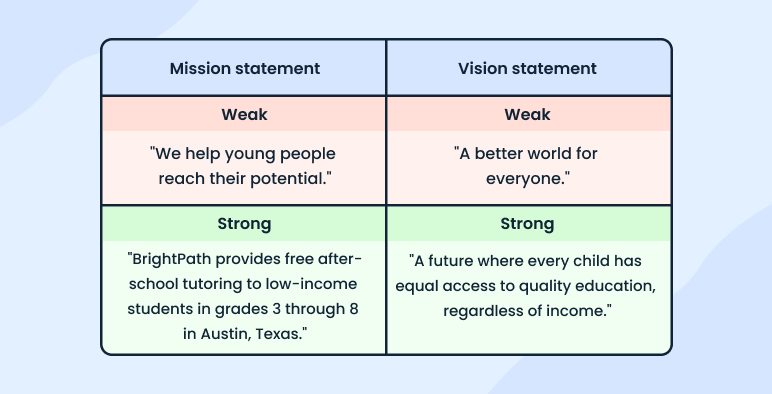
The stronger versions tell you exactly who you’re serving, what you’re doing, and what change you’re working toward. The weaker ones could apply to almost any organization.
One thing I always tell founders: Write your mission statement before any other section. Every part of your plan (be it programs, fundraising, or financials) should connect back to it.
3. Organization overview
The organization overview is the backstory of your nonprofit. While your executive summary tells people what you do, this section shows them who you are, where your nonprofit came from, and where it stands today.
Here’s what you need to cover in this section:
- The legal structure (501(c)(3) status or you’re still in the application process)
- When and where your organization was founded
- Your location and the community you serve
- A brief history of how you got started
- Your current stage (early, growing, or established)
Keep it factual and to the point. This isn’t the place for program descriptions or big mission statements. Those have their own sections. This is simply about who you are as an organization on paper.
Now, if you’re not officially incorporated yet, don’t worry about it.
Just write about what you’re building. Share what structure you’re planning, who you want to help, and where you are in the process right now. Every nonprofit starts from zero, and funders know that.
4. Programs and services
This is where you show people what your nonprofit actually does. Not in broad strokes, but specifically. The more detail you give here, the more credible your plan looks.
Most founders write something like “we provide educational programs for youth.” That sounds fine on the surface, but it tells the reader almost nothing.
Who exactly? How many? Doing what? Where?
A grant reviewer reading that description has no idea what your organization actually does. Here’s what a well-written program description looks like:
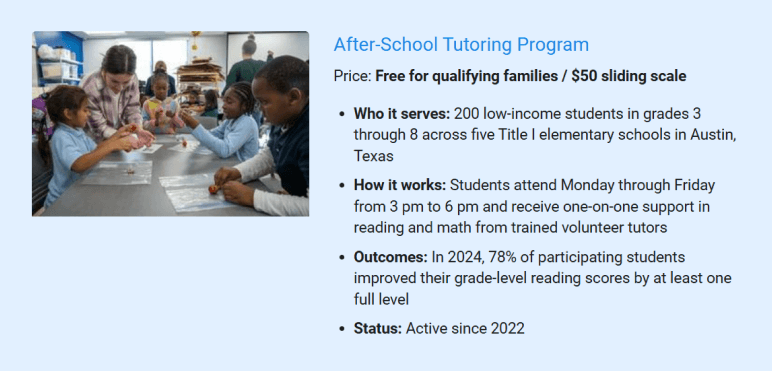
That’s the level of detail every program description in your plan should aim for. Who, how, where, and what it produces.
Should I include future programs or only current ones?
If some programs are still in the planning stage, include them anyway. Just be clear about which ones are running and which ones are coming.
And if none of your programs exist yet, describe what you’re building. Describe what each program will look like, who it will serve, and what you’re hoping to achieve.
If there’s data from similar programs elsewhere that supports your approach, mention it. That’s how you build credibility before you have a track record.
Writing your plan from scratch?
Let AI draft your nonprofit business plan in minutes

5. Market and needs analysis
In the nonprofit world, market analysis isn’t about sizing up competitors or calculating market share. It’s about documenting a real problem in a real community and showing why your organization needs to exist. Think of it as your needs assessment.
This section needs to cover four things. Here’s how to approach each one.
Community needs
First, mention the problem your nonprofit plans to solve. Keep it clear and easy to understand.
I always say, avoid using complex phrases like “we address systemic inequities in educational access.” Nobody connects with that. Instead, write the way you’d explain it to a friend. Something like:
“In Travis County, Texas, 1 in 3 students reads below grade level by third grade. That’s a gap linked to long-term academic and economic outcomes.”
It should be specific and impossible to ignore. Tell the reader what the problem is, why it matters in your community, and what happens if nobody does anything about it.
Data that supports the need
This is where most founders get stuck. They know the need is real. They’ve seen it firsthand. But putting numbers behind it feels overwhelming.
It doesn’t have to be. Here’s where to look:
| Source | What It Gives You | Best For |
| U.S. Census Bureau | Income, poverty rates, and local demographics | Any nonprofit needing community data |
| Annie E. Casey Foundation Kids Count | Child and family well-being data by state and county | Youth and family-focused nonprofits |
| Local school district or health department | Hyperlocal data specific to your community | Nonprofits serving a specific area |
| National Council of Nonprofits | Nonprofit existing services and gaps | Understanding what others are doing |
| Community surveys or interviews | Firsthand data from the people you serve | Nonprofits with direct community access |
You don’t need to conduct your own study. Credible third-party data that’s recent and specific to your community is enough. Just make sure whatever you cite actually supports the need you’re describing.
Population we serve
Now, describe exactly who is affected and where they live.
For example: “BrightPath serves low-income students in grades 3 through 8 living across five neighborhoods on Austin’s east side, where the median household income is below $35,000 a year.”
That one sentence shows: Who are they? How old? Where do they live? How many people are we talking about?
The more specific you are, the more real the need feels to whoever is reading your plan.
Gaps in current services
A lot of founders skip mentioning other nonprofit organizations doing similar work. They worry it weakens their case. But it doesn’t. Grant reviewers want to see that you understand the existing nonprofit services.
Talking about what other organizations are already doing isn’t a bad thing. Actually, it makes your application stronger.
Just show where your services complement theirs rather than duplicate them. And most importantly, explain the specific gap they aren’t filling and why your approach addresses it in a way they don’t.
That’s not competition. That’s context.
6. Marketing and outreach strategy
Most nonprofit founders think marketing is just about raising money. But it’s not.
Outreach builds awareness. Fundraising asks for money. Both belong in your plan. But they do completely different jobs.
In a nonprofit, you’re trying to reach two completely different groups. The people your programs serve. And the people who fund them. What works for one usually doesn’t work for the other. So your strategy needs to think about both.
Here’s what actually works for nonprofits and who each channel reaches:
Social media
It’s one of the easiest places to start for a nonprofit. Donors follow you to see your impact. Beneficiaries find you through community shares, local Facebook groups, and neighborhood pages.
Skip the generic posts. Keep your content focused on real stories and real outcomes instead. For instance:

Both posts are about the same program. But they’re written for completely different people with completely different needs. That’s the whole point.
Community events and partnerships
I think it’s the best way to reach the people you serve. Show up at local schools, churches, community centers, and neighborhood events. This puts your organization in front of the people who need it most.
Partnerships with umbrella organizations or fiscal sponsors are especially valuable for early-stage nonprofits. They give you instant credibility and access to established donor and volunteer networks.
Email marketing
It serves two purposes for a nonprofit. For donors, it’s a stewardship tool. For beneficiaries, it’s a way to share program updates, upcoming events, and new opportunities to get involved.
For donors, a simple cadence works best:
- Thank them personally within 48 hours of every gift
- Send a short monthly update showing what their support is producing
- Check in mid-year with a progress report, not an ask
- Close the year with your annual appeal
For beneficiaries, keep it practical. Let them know what’s available, when it’s happening, and how to sign up.
Word of mouth
It’s the most underrated channel for an early-stage nonprofit. In close communities, a personal recommendation (from someone trusted) carries more weight than any social media post.
This is especially true for volunteer recruitment. Most volunteers don’t find organizations through ads. They hear about them from a friend, a neighbor, or someone they respect in the community. Every volunteer you recruit well becomes your next best recruiter.
Local media and press
This builds credibility with both audiences at once. One story in a local paper or community blog reaches both donors and beneficiaries at the same time. And it costs nothing but a good pitch.
You don’t need a big budget for this. The nonprofits that reach the most people early are the ones that show up consistently in the right places. Not the ones spending the most on ads.
7. Fundraising plan
This section answers one simple question: Where does the money come from?
Every organization needs funding to run its programs, pay its staff, and keep operations going. But here’s something I always tell founders when they’re writing this section: Grant reviewers aren’t just asking “how will you spend this money?”
The harder question they’re asking is “what happens to this program when our grant runs out?” That one question should shape everything you write here.
So before we get into the specifics, it helps to understand where nonprofit funding generally comes from. As per the Urban Institute’s nonprofit report, here’s how the typical funding breakdown looks:
- Private sources: 50%
- Government grants: 28%
- Earned revenue: 18%
- Other sources: 4%
That breakdown tells you something important. No single source dominates. A healthy funding strategy looks similar and is spread across multiple streams, so you’re never dependent on just one.
Here are the most common funding sources to cover in your plan:
| Funding Source | What It Includes |
| Individual donations | One-time gifts and recurring monthly donors |
| Foundation grants | Private and community foundations that fund your focus area |
| Government grants | Federal, state, and local funding programs |
| Corporate sponsorships | Businesses that support causes aligned with their values |
| Fundraising events | Galas, community drives, and online campaigns |
| Earned income | Fees for services or program-related revenue |
One thing you need to understand before writing this section: Not all funding sources work the same way.
Restricted funds have conditions attached. For example, a foundation grant might only be used for a specific program. Nothing else. Unrestricted funds involve no rules attached and can be used wherever your organization needs them most.
Grant reviewers want to see that you understand this distinction. So be clear about which sources in your plan are restricted and which are flexible.
What if I haven’t raised any money yet?
That’s okay. Write about the funding sources you’re planning to approach, why they make sense for your nonprofit, and what steps you’re already taking to secure them.
A well-reasoned plan carries more weight than a short funding history.
And don’t just list your funding sources. I’d specifically recommend addressing what sustainability looks like beyond the first grant cycle. Show funders a clear path from grant-dependent to community-supported.
- What does your funding look like in year two or three?
- Are you building a recurring donor base?
- Developing earned income?
- Or cultivating corporate sponsorships that renew annually?
You don’t need to have it all figured out. But showing you’ve thought about the “day after the grant” makes your plan significantly more fundable.
Also, don’t rely too heavily on one source. A nonprofit organization that gets 80% of its funds from one grant is way more likely to be rejected. Show that your funding strategy is distributed across multiple sources.
And you don’t need to name every foundation you’re planning to pursue. But if there’s one or two major grants you’re actively working toward right now, mention it. This shows funders you’ve done your homework.
8. Operations plan
Your operations plan explains how your nonprofit runs day to day, or how the actual work gets done behind the scenes.
I think of it as the infrastructure behind your mission. Funders want to know your organization has what it takes to actually deliver on what it promises.
Key processes
Be specific about your daily processes. Show how your programs actually get delivered. For that, answer a few questions:
- What is the sign-up procedure, and how do beneficiaries learn about your services?
- How do you supervise and onboard volunteers?
- How will you report outcomes to grant funders?
- How will you plan and execute fundraising campaigns?
These recurring workflows will help you keep your organization running smoothly. And funders really want to see that you’ve thought them through.
To give you a clearer picture, here’s what those three core processes typically look like in practice:
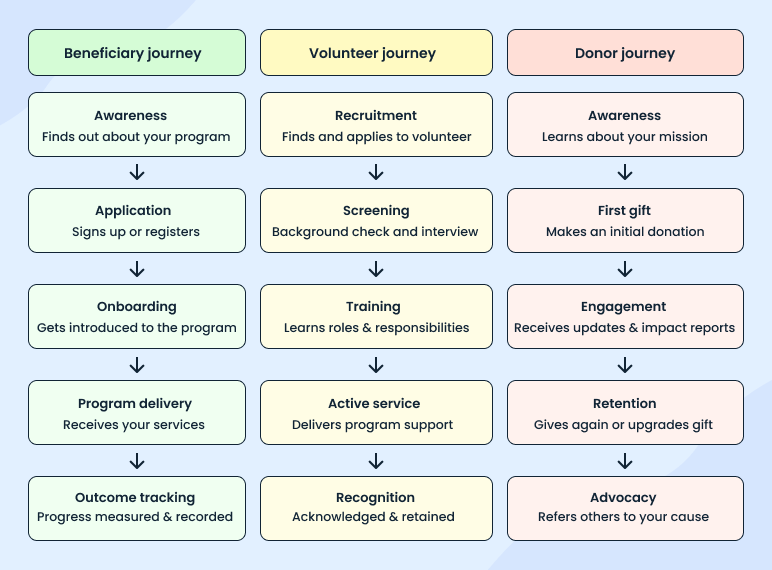
Technology and tools
What software or platforms does your nonprofit use to manage programs, communicate with donors, or track outcomes?
Even basic tools are worth mentioning. A donor management system, a project management platform, or a simple spreadsheet setup tells the reader you have systems in place.
Facilities and location
Where does your work happen? An office, a community center, a school, or entirely online? Be specific about what you currently have and what you’ll need as your programs grow.
Compliance and legal requirements
Every nonprofit has ongoing legal obligations. Annual IRS filings, state charity registrations, and financial audits, depending on your size.
Note that if your gross receipts are under $50,000, you can file the simplified Form 990-N instead of the full Form 990.
These requirements vary by state and organization. Hence, it’s worth checking IRS.gov early to understand exactly what applies to you. This will help you stay in good standing, not just run programs.
9. Management team and board of directors
This section is simply about the people running your nonprofit and the people overseeing it.
Start with your staff. For each person, share their name, what they do, and a little about their background. If someone is handling multiple roles right now, that’s fine. Just make it clear who is responsible for what.
Next, introduce your board members. Most early-stage nonprofits start with three to five people, which is enough to satisfy most state requirements.
For each board member, mention their name, what they do professionally, and why that’s relevant to your mission.
It’s worth noting that the board members carry legal responsibilities. They might have these 3 core duties:
- Care (make informed decisions)
- Loyalty (act in nonprofit’s interests first)
- Obedience (follow the mission and laws)
I must say: Including board members who understand these responsibilities strengthens your plan’s credibility with grant reviewers.
And if nobody on your board has nonprofit experience, that’s okay.
What matters more is that they bring professional skills, like finance, legal knowledge, or community connections that your organization actually needs. That mix can make a strong board.
What if your team isn’t fully built yet?
Don’t leave this section blank. Describe the roles you’re actively recruiting for and the specific skills you’re looking for in each position.
This approach shows funders you’ve thought carefully about what the organization needs to succeed, even if you’re not there yet.
Lastly, mention your advisory board if you have one. Just remember, they’re different from your board of directors.
Advisory members give specific expertise or networks that your board of directors doesn’t have. They offer guidance but have no legal responsibilities or voting power.
10. Financial projections
This section feels intimidating for most founders. But it doesn’t have to be. You don’t need to be a financial expert to write it. You just need to show that you’ve thought seriously about the money side of your mission.
And here’s why it matters: This is the section that grant reviewers and major donors scrutinize most. They can forgive a rough program description. They’re far less forgiving about numbers that don’t add up.
Before you start writing, two quick distinctions are worth knowing.
(1) Statement of activities
Early-stage nonprofits often start with basic financial reports and transition to formal statements as they grow.
They use a statement of activities as an income statement. It covers the same ground, revenue in, expenses out, but it’s framed around your mission rather than profit.
(2) Budget vs financial projection
A budget and a financial projection aren’t the same thing.
Your budget is what you plan to spend. And your financial projection is what you expect to earn and spend based on documented assumptions. Both belong in your plan, but they serve different purposes.
The following is what your financial projections actually need to cover:
| Category | What it means |
| Income | Grants, donations, sponsorships, earned income, fundraising events |
| Program costs | Direct costs of running each program |
| Operating costs | Staff salaries, office costs, and technology |
| Fundraising costs | How much you spend to raise money |
| Cash flow | Monthly income vs expenses |
I always recommend owners to project at least three years out. Year one shows your starting point. Years two and three show that you’ve thought beyond just getting off the ground.
Another thing reviewers will look at is your overhead ratio. It’s basically how much of your budget actually goes toward your programs versus administrative costs and fundraising.
Charity Navigator states that healthy nonprofits put at least 70% of their money directly into programs, leaving overhead at 30% or under. When your numbers fall in that range, it tells funders you’re being careful with money and not wasting it on the back-office stuff.
What if you have no funding history?
If you’re just starting out and have no financial history to draw from, that’s okay. Most nonprofits start exactly where you are.
Build your projections from the ground up using your best honest estimates. Program costs, funding sources, and expected income. Write down the reasoning behind every number.
An honest, documented assumption is far more convincing than inflated numbers with nothing to back them up.
What do grant reviewers actually look for?
Most founders write their plan thinking about what they want to say. Grant reviewers read it, thinking about one thing: Can we trust this organization with our money?
That shift in perspective changes everything about how you should write your plan.
I’ve seen well-intentioned plans get passed over, not because the mission wasn’t compelling. But the plan couldn’t answer the questions a reviewer was silently asking while reading it. And those questions are almost never about formatting or word count.
The first thing a reviewer looks for is whether the need is real or not. It must be proven with data, community evidence, and specific numbers. If your needs assessment reads like an opinion, it won’t hold up.
Then they look at your team. Not just who’s listed, but whether those people have the credibility to actually deliver. A compelling mission with an unproven team is a risk most grant committees won’t take.
After that, they look at your numbers. Not to see if they’re impressive, but to see if they’re honest.
Inflated projections and unrealistic timelines are spotted immediately by anyone who reviews plans regularly. What builds trust is a financial picture that’s grounded, conservative, and clearly explained.
That last part is the one most founders miss. A plan that can’t answer “what happens after our funding ends?” signals dependency, not sustainability. And dependency is one of the fastest ways to lose a reviewer’s confidence.
Before you submit, read your plan the way a reviewer would. Not as someone who built it, but as someone seeing it for the first time and deciding whether to trust it.
Can a one-page plan work for your nonprofit?
A lot of founders ask this, and honestly, it’s a fair question.
The answer really depends on what you need it for.
A one-page plan works well in the early stages. If you’re still figuring out your ideas and not yet talking to anyone outside your organization, a one-page plan works fine.
It’s basically a rough draft for yourself, just to get clear on what you’re building.
But the moment someone else needs to read it, things change. A one-page plan usually isn’t enough.
- Grant committees want to see detailed financials and a clear funding strategy.
- Board candidates want to understand the organization’s direction before they commit.
- Major donors want proof that you’ve thought this through carefully. None of that fits on one page.
A good rule of thumb: Use a one-page plan to get your thinking straight. Use a full plan to get people on board.
This guide is built around the full version. Not because longer is better, but because a complete nonprofit business plan is what actually opens doors.
Nonprofit business plan template
Writing every section of your nonprofit business plan from scratch takes time. If you’re ready to build, use a free business plan template for nonprofit and customize it for your organization.
This professionally-written plan shows you the right level of detail for each section. It also gives you a sense of the tone and language that works, and helps you see how everything fits together as a complete plan. Use it as a reference to write your own.
Write a complete nonprofit business plan using Upmetrics
You now have everything you need to write a solid nonprofit business plan. But if you want to make the process even faster, Upmetrics’ AI Business Plan Generator can make a real difference.
It helps you create a complete, professional plan that you can actually use for grant applications, board recruitment, and donor conversations. Also, it saves you hours of manual writing.
All you have to do is just answer a few simple questions about your nonprofit. And its AI assistant will generate a first draft of your business plan in minutes. So you’re not starting from a blank page. You just review and customize to make it your own.
So wait no longer. Start planning now with Upmetrics!
The Quickest Way to turn a Business Idea into a Business Plan
Fill-in-the-blanks and automatic financials make it easy.

