




 Download Now: Free Business Plan Template
 If you’re not planning to raise capital anytime soon, you don’t need a traditional (40-page) business plan.
Interesting, so why does every consultant and advisor say every business needs a plan?
Well, that’s an internal business plan they’re talking about; it’s for yourself and your team. It can be for anything: launching a new product or service, expanding into new markets, or considering a major pivot.
In this article, let’s discuss internal business plans. How is it different from a traditional plan, what does it include, and how to build one for your team (for different use cases). Let’s get started.
What is an internal business plan?
I’m not a big fan of conventional definitions, so I’ll try to put it simply. An internal business plan is a document that helps you align your team with your strategy. It answers three questions: where are we going, how are we getting there, and who is responsible for what.
No two internal business plans are the same. They change depending on what they’re written for and what purpose they serve. For instance, an internal plan written for the business expansion would be totally different from one written for leadership onboarding.
Still, one similarity they have is that they are for internal use only, so no funding ask, market size graphs, or exit strategy would be there. And it doesn’t necessarily have to be 40 pages long.
How is it any different from a traditional (external) plan?
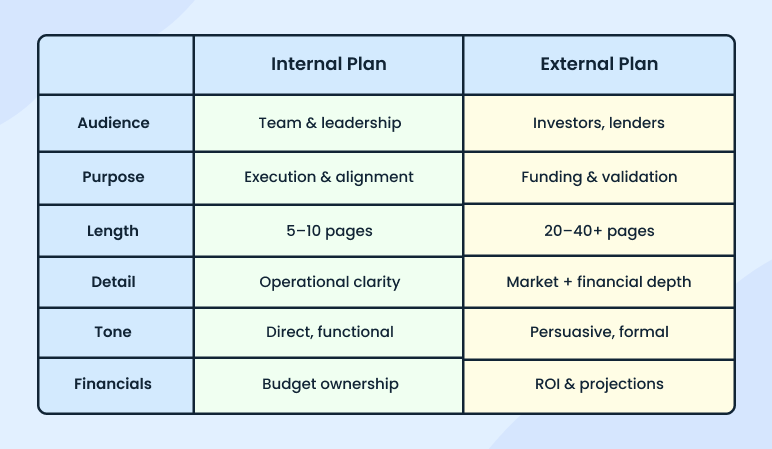
Who’s reading the business plan is the biggest difference, I’d say. Your traditional business plan is often read by investors, lenders, and bank officers who don’t know your business and need to be convinced it’s worth being able to make monetary decisions. Every section, every word is designed to persuade.
That’s not the case with the internal plan; it assumes the reader already believes in the business. Obviously, they work there.
That changes how both are written. External plans are long because they have to be thorough for a stranger. Formatting matters because first impressions count. You write in refined paragraphs because the document is also a reflection of your professionalism.
Internal plans don’t need any of that. Your team doesn’t care about your company history section. They care about what they’re supposed to do next quarter and how success gets measured. So you write accordingly: shorter, more direct, structured around action rather than narrative.
When should you create an internal business plan?
The signs are usually right in front of you. Lack of clarity among team members, stretched deadlines, missed milestones, and decisions being made without context. You don’t need a separate checklist to know something is off.
When we expanded our team from 5 individuals to a 35-member team, we ran into this firsthand. We had people, but we didn’t have clarity. Communication was inconsistent, processes weren’t documented, and everyone was busy but not necessarily aligned.
Writing an internal plan forced us to put the strategy on paper, define who owned what, and build the processes around it; and the difference was immediate.
If your operations feel like a mess and your team is moving in circles, that’s your signal. But beyond that general gut check, here are the specific moments when an internal plan is the right tool:
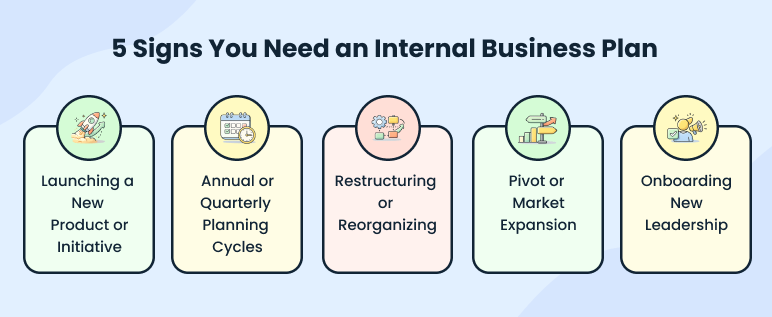
- Launching a new product line or initiative. A new direction often needs documented goals and ownership before you implement them.
- Planning annual or quarterly planning cycles. Instead of running meetings off memory, an internal plan gives everyone a reference point.
- Restructuring or reorganizing departments. Changes in roles and processes create confusion; a written plan helps clarify the new structure and workflow.
- Preparing for a major pivot or market expansion. There are often shifts in strategies and workflows in these scenarios. An internal plan here helps the team understand why and what changes for them.
- Onboarding new leadership who need to understand the business direction. A new executive shouldn’t spend their first month learning business direction from scattered conversations.
If any of these scenarios sound familiar, an internal plan is probably overdue. The good news is it doesn’t take long to put together — and the next section walks you through exactly what to include.
What does your internal business plan “actually” include?
I’ll be honest, there’s no universal template for an internal business plan. It’s an internal plan, what goes in yours depends entirely on what it is written for. A plan built to align your team on a product launch looks different from one written to onboard a new VP or manage a restructure.
That said, there are some core building blocks most internal plans are built upon. Here’s what each one covers, when to include it, and where most people go wrong.
Executive Summary (must have)
This is where you summarize the plan for your team. Write it when you finish your plan as a summary. By the time you’ve written every other section, you’ll know what actually matters, so it’s easier that way.
No matter what the purpose of your plan is, your executive summary should answer the following questions:
- Why does this plan exist, and what problem is it solving?
- Where is the business headed in the next 12-24 months?
- What are the goals or priorities this plan is built around?
If a team member reads nothing else, this page should be enough to orient them.
Goals and Objectives (must have)
List your goals, then put a name next to each one. Basically, what you’re doing is setting goals and assigning roles (who’s responsible for making that happen). I’d also recommend using the SMART framework here as it forces specificity.
“Grow revenue” is not a goal. “Reach $80K MRR by Q3, owned by the sales lead” is.
Market and Competitive Analysis (for market direction)
This is an optional section, included only when your plan involves a new direction, expansion, or positioning shift. Skip it if your team already has a full market context.
When using internally, this section isn’t about decorated market research (like an investor plan); it exists here to provide context to your team to make good decisions. Cover who you’re competing with, where you’re positioned, and what threats the team should be aware of.
Keep it to one page. If it’s longer than that, you’re writing it for investors, not for your team.
Marketing and Sales Strategy (for growth-oriented plan)
Again, an optional section for those working on a growth-oriented plan. Include when your plan covers growth, a new product, or a channel shift.
The mistake most teams make here is listing channels without assigning budgets or owners. “We’ll drive conversions through website content and paid ads”; that’s not a strategy. The internal version of this section should answer: who runs each channel, what’s the budget, and what does success look like by when.
Operations Plan (for execution-focused plan)
This one is less critical for leadership alignment or onboarding plans. Include when your plan is focused on execution. While it’s probably the most neglected section during writing, it’s usually the most referenced one once the plan is in use.
One thing worth doing here: document the workflows that actually exist (not the ideal ones you wish existed). Your plan must reflect your actual workflows for it to get used. If it describes a perfect process, but nobody actually follows it, it tends to get ignored.
Team Structure and Responsibilities (team alignment & restructuring)
Unlike a traditional plan, you don’t need an org chart here. What your team actually needs to know is who makes which decisions and who to go to when something falls outside their lane. Decision rights matter more than reporting lines. If two people could reasonably think they own the same call, your plan hasn’t done its job.
Financial Projections and Budget (must have)
Finally, a must-have section. But the level of detail isn’t the same; calibrate the depth to your purpose. Internal plans should go one level deeper than external ones on the budget.
Don’t just show revenue targets — show each team what they’re working with and what they’re accountable for. Budget transparency cuts down on the “why did that get approved” conversations. And, review numbers every quarter instead of just looking at them at the start of the year.
Spreadsheets are exhausting & time-consuming
Build accurate financial projections w/ AI-assisted features

Now that you know what goes into an internal business plan, let’s discuss how to actually write one for your team.
How to write your internal business plan (the process)
My advice to founders: never start with a blank page. Write down everything you know, goals, numbers, challenges, and build outward from there.”
Dump all you know about your business, goals, numbers, everything. You can always go back and fix things. (Plus, we now have AI to assist)
The executive summary you’ll keep at last. By the time you’ve written everything else, you’ll know exactly what belongs in it.
Before you write anything, talk to your key stakeholders: department heads, team leads, and anyone whose work the plan will directly affect. Not to get approval, but to get input. A plan people helped build is the plan they follow. This one conversation saves you rounds of revision after the fact.
A few things that make the process easier:
- Set a deadline for the first draft before you start. Without one, internal plans get deprioritized indefinitely.
- Keep a working draft visible to the team as you write. It invites early feedback and removes the “I had no idea this was coming” reaction at sign-off.
- Don’t aim for perfection on the first pass. Get the structure down, fill in what you know, and flag the gaps. A rough draft with honest gaps is more useful than a polished draft built on assumptions.
- Assign every goal to an owner before you consider the draft complete. If a section has no names in it, it’s not finished.
How do I get my team to actually read (and use) it?
What if I told you we didn’t discuss the hardest part of the process yet? Yes, it’s getting your team to use and implement it (this HBR report backs my claim).
You don’t want your plan to get read once and forgotten. The ones that don’t have one thing in common: rather than a document to revisit once in a while, they become the default reference point for decisions.
Here’s a tip: Share the draft before it’s final. When team members give input mid-draft, they develop ownership over the outcome. By the time it’s signed off, it’s already theirs. Tools like Upmetrics make this easier; you can collaborate on the plan directly instead of managing feedback across email chains and comment threads.
Tie your plan to something that already exists in your team’s workflow and processes. A monthly review, a quarterly planning meeting, a weekly standup. If using the plan requires a new habit, it won’t stick. If it plugs into something the team already does, it will.
Brew & Ground Coffee Co. (Sample Internal Business Plan)
Wondering how the final internal plan should look? Here, I’ve created a sample internal plan for Brew & Ground Coffee Co. (a fictitious company). It’s written as a market expansion plan. Review it for structural reference.
Note: I’ve kept it lean as it is only for reference. Your internal plan can run anywhere from 8 to 10 pages.
Plan Type: Market Expansion
Prepared by: Jordan Mills, Co-Founder
Period: Q3 2026 — Q2 2027
Status: Draft — pending leadership sign-off
Executive Summary
Brew & Ground has operated two locations in Austin, TX since 2022. Both locations are profitable, operationally stable, and consistently rated among the top independent coffee shops in the city. We’re ready to grow.
This plan covers our expansion into San Antonio in Q3 2026. The goal is to open one location, validate the model in a new market, and use that experience to inform a second expansion to Dallas in early 2027.
The core challenge isn’t operational. We know how to run a coffee shop. The challenge is entering a market with established local players who already have community loyalty. This plan exists to make sure every person on our team understands the strategy, owns their piece of it, and knows what success looks like.
Key goals:
- Open the San Antonio location by September 2026
- Hit break-even by month 4
- Reach $45K monthly revenue by month 6
- Use learnings to prepare Dallas expansion plan by Q1 2027
Goals and Objectives
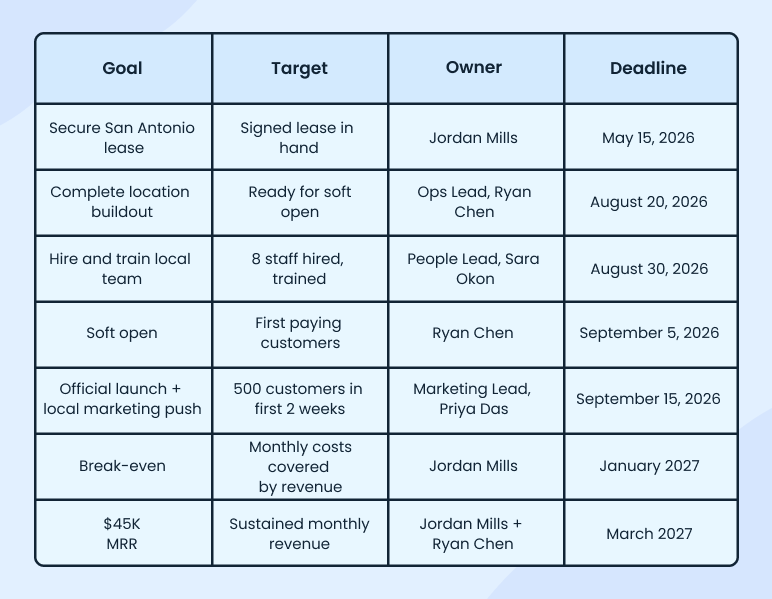
Every goal has one owner. If something isn’t happening, we know exactly who to talk to.
Market and Competitive Analysis
The San Antonio market
San Antonio has a population of 1.5 million and a growing specialty coffee culture, particularly in the Pearl District, Southtown, and Alamo Heights neighborhoods. Independent coffee shop density is lower than in Austin, but three local chains have strong community footholds: Rosella Coffee, Brown Coffee Co., and Local Coffee.
The challenge
These aren’t weak competitors. They’ve built loyal followings over 10+ years and are deeply embedded in their neighborhoods. Walking in with an Austin brand and expecting local loyalty is the wrong approach.
Our positioning
We’re not positioning Brew & Ground as an Austin import. We’re positioning it as a neighborhood coffee shop that happens to have two years of operational experience behind it. Local hiring, local sourcing where possible, and a community-first launch strategy.
What we’re not doing: competing on price or volume. That’s not our model in Austin, and it won’t be our model in San Antonio.
Target neighborhood: Southtown. Foot traffic, demographics, and existing independent retail density match our Austin locations most closely.
Marketing and Sales Strategy
Goal: 500 customers in the first two weeks. 1,200 unique monthly customers by month 3.
Owner: Priya Das, Marketing Lead
Budget: $8,000 for launch quarter (Q3 2026)
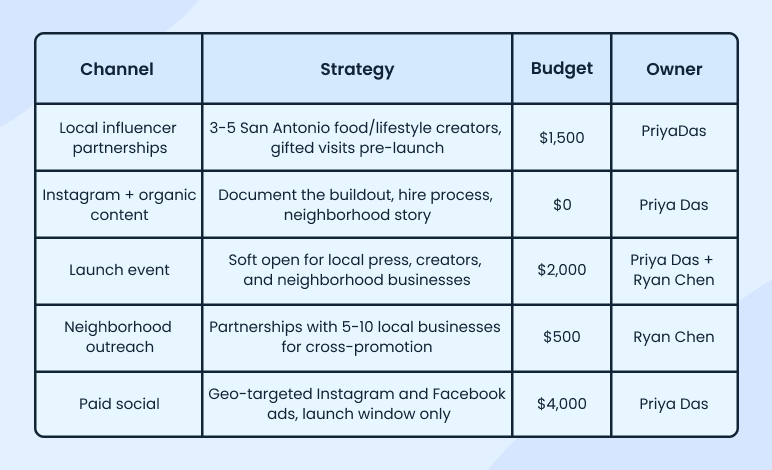
What we’re not doing this quarter: Google ads, loyalty app push, or citywide campaigns. Too broad for a neighborhood launch. We focus hyperlocally first.
Operations Plan
Existing model: Both Austin locations run on the same supplier relationships, equipment vendors, and staffing structure. The San Antonio location replicates this model as closely as possible.
What’s different about this expansion:
- Primary coffee supplier (Cuvée Coffee, Austin-based) delivers to Austin locations twice weekly. San Antonio requires a separate delivery arrangement or a secondary local supplier. Ryan to confirm by May 1.
- Equipment sourcing and installation lead times are 10-12 weeks. The order must be placed by June 1 to hit the August buildout completion.
- Local health permits and food handler certifications in Bexar County differ slightly from Travis County requirements. The compliance checklist is being finalized by the end of April.
Staffing model:
8 staff for opening: 1 shift supervisor, 2 full-time baristas, 5 part-time baristas. All hired locally. Training happens at the Austin location (1 week) before San Antonio opens.
Workflow documentation: All SOPs from Austin locations apply. Printed ops manual provided to shift supervisor on day one. No improvising on core processes during the first 90 days.
Team Structure and Responsibilities
This expansion runs lean with three people to carry the core ownership:
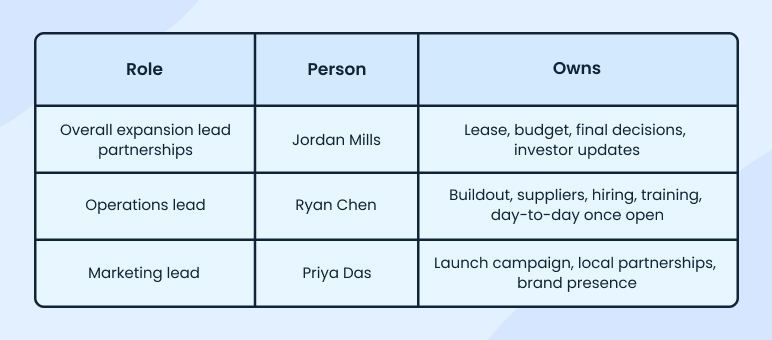
Decision rights:
- Anything above $2,000 in unplanned spend: Jordan approves
- Hiring decisions: Ryan recommends, Jordan signs off
- Marketing spend within budget: Priya decides independently
- Supplier changes: Ryan decides, Jordan informed
If a decision doesn’t fit cleanly into the above, Jordan is the default owner. We don’t let ambiguity slow things down.
Financial Projections and Budget
Expansion budget: $185,000 total
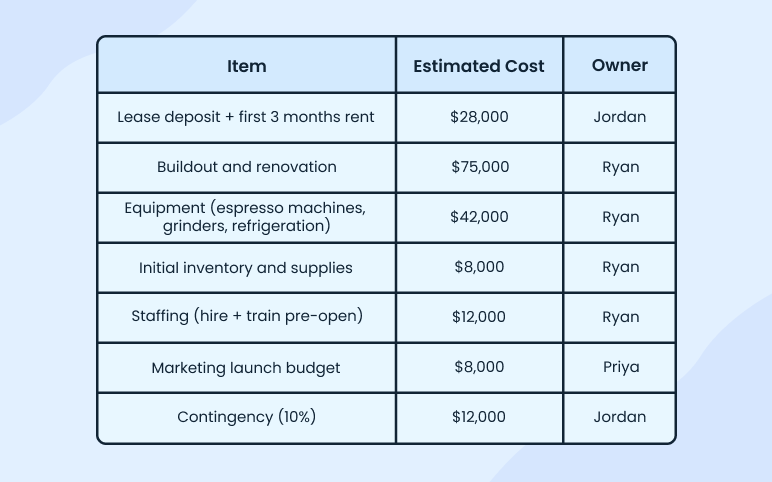
Revenue projections (San Antonio location)
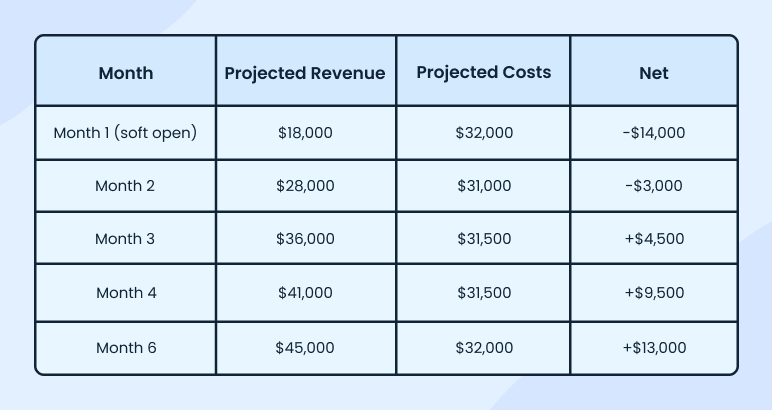
Break-even projected at month 3. Month 1 and 2 losses are expected and budgeted for.
Review cadence: Numbers reviewed monthly by Jordan and Ryan. Full plan reviewed at the end of Q3 2026 and Q1 2027.
Milestones and KPIs
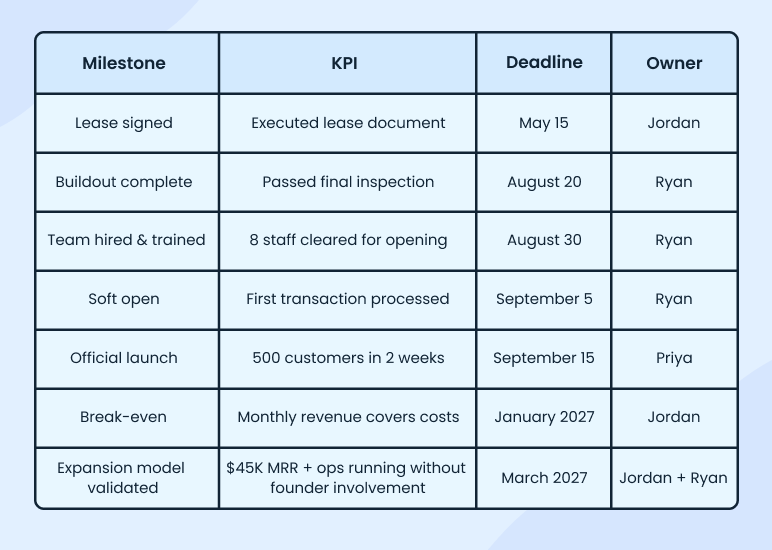
The last milestone is the most important one. If the San Antonio location needs Jordan or Ryan on-site to function by month 6, the model isn’t ready to scale to Dallas.
The bottom line
The biggest difference between a traditional and internal plan is that it’s not a formality. It’s not that a lender/investor asks you, and you build it. You create one because you think you need one to grow or achieve any specific goal you have in mind.
Keep it short, keep it honest, and make sure every goal has a name next to it. The sections you include matter less than whether the people reading it can actually use it to make decisions.
Start with whatever section you have the most clarity on today. Get a rough draft in front of your team before it’s perfect. Then set a date to review it before you even finish writing it, because a plan without a review cadence is just a document due to go stale.
If you want to build and collaborate on your internal plan without the back-and-forth of shared docs and email threads, consider giving Upmetrics a try. That’s all you need to put together a structured, actionable plan.
Not sure yet? Try building yourself a free plan first →
The Quickest Way to turn a Business Idea into a Business Plan
Fill-in-the-blanks and automatic financials make it easy.

