


I don’t think every founder needs to start with a long business plan. But I do think every founder should be able to explain the business on one page.
If you cannot clearly fit the idea, problem, customer, offer, competition, revenue model, marketing focus, basic numbers, and next 90 days on one page, the business may still be a little fuzzy. And that is fine. That is the whole point of this exercise.
A one-page business plan helps you see what is clear, what is missing, and what needs more work before you spend more time or money. I’ll help you write one in 30 minutes or less.
First, here is a definition of what a one-page business plan is, and how it differs from the 40-page version.
What is a one-page business plan?
A one-page business plan is a simple snapshot of your business idea: what you sell, who it is for, why they need it, how you will make money, and what you should do next.
I like to think of it as the version of your business idea that you create for a busy reader with no intention of reading it in its entirety!
The U.S. Census Bureau reported 503,171 new business applications were filed in the US in April 2026 alone. Most of those founders are short on time, juggling a day job or trying to explain the business to a banker or partner this week. A one-pager is better for this, and a one-pager is the format to have.
A one-page plan is not the only short-form planning format. The two you will most often see compared with it are the Lean Canvas and the Business Model Canvas. They look similar from the outside, but they are not the same.
- The Lean Canvas is built for testing whether an idea is worth pursuing. Use it when you have an idea but no proof of demand yet.
- The Business Model Canvas is built for mapping how an existing business creates and delivers value. Use it when you have a running business and want to see how the pieces connect.
For a full side-by-side of the two canvas formats, see our guide on the Lean Canvas vs. Business Model Canvas.
A one-page business plan is different because it turns your thinking into a simple written plan you can use, share, and act on. But once you commit to one page, every line has to earn its place. So let’s look at the eight things that actually belong there.
The 8 essential sections of a one-page business plan
A one-page plan is one page because it leaves out everything that is not essential. To keep yours focused, I would build it around eight questions only:
- What does this business do, and who is it for?
- What problem does it solve?
- What are you selling?
- Who is buying?
- Who else serves them?
- How does the business make money?
- How will customers find you?
- What needs to happen next?
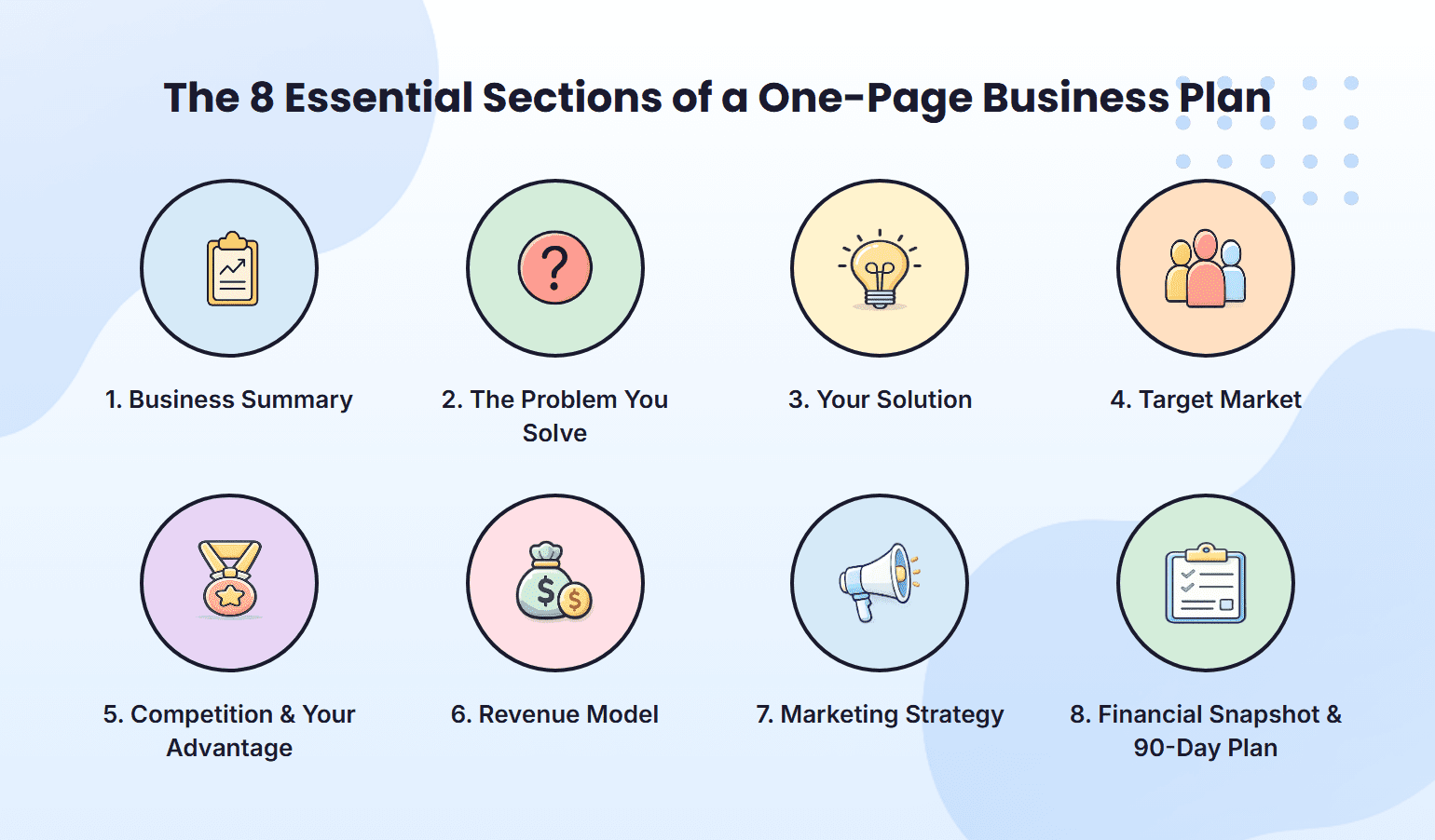
Each of the eight sections below answers one of those questions.
1) Business summary
The business summary should tell the reader, in one sentence, what the business does and who it serves. If you cannot explain that clearly in a single line, the rest of the plan will probably drift.
Describe the business in one plain sentence. That single sentence should tell the reader your offer, the customer, and the market. Here is a useful shape to follow: “[Business name] is a [type of business] that helps [target customer] with [main outcome] in [location or market].”
For example: “Brew & Bite is a neighborhood coffee shop serving morning commuters and remote workers in downtown Austin.”
2) The problem you solve
The problem section explains why the business needs to exist. The goal is to describe the customer’s frustration in the way they would actually say it, not in polished business language.
Get specific. Is the current option too slow, too expensive, too far away, too unreliable, or too complicated? For Brew & Bite, the problem is not “the coffee market is competitive.” The real issue is that downtown workers have plenty of places to grab quick coffee, but fewer places where they can sit, charge a laptop, and work for an hour.
3) Your solution
The solution section connects what you sell to the problem you just named. This is not a product catalog. It is the short version of your offer and the one reason that the offer fits this customer.
A one-page plan does not need every feature, package, add-on, or future idea. If the problem is that downtown workers cannot find a quiet place to work, the solution is not just “coffee and pastries.” A stronger version is: “a coffee shop designed for morning service and laptop work, with reliable seating and outlets near office buildings.”
4) Target market
The target market section defines the specific group of people most likely to buy from you. The narrower this is, the more useful the rest of the plan becomes.
Narrow the customer by location, situation, and buying reason. For a coffee shop, that may look like: “remote workers, freelancers, and office employees within a 1-mile radius who need coffee, Wi-Fi, and a quiet workspace between 7 a.m. and 2 p.m.” If you include market size, use a number you can defend, not a loose guess.
5) Competition and your advantage
The competition section shows that you understand who else serves the same customer and why someone would pick you instead. Every customer has options, even when those options do not look like direct competitors.
Name two or three real alternatives, then explain your edge in one sentence. That edge could be location, price, speed, quality, niche focus, customer experience, or convenience. I would never write “we have no competition.” That is a red flag to any reader.
6) Revenue model
The revenue model section shows how money will come into the business. Keep this simple: what you sell, what you charge, and the sales volume the business needs to make sense.
A reader does not need a full forecast here. They need the core money logic. For example: “Brew & Bite will sell coffee, pastries, and light lunch items with a target average ticket of $9 and a goal of 200 daily transactions by month 6.”
7) Marketing strategy
The marketing strategy section explains how customers will find you. A good version shows that you have made a choice, not built a wish list.
I wouldn’t recommend listing every channel (Instagram, TikTok, SEO, paid ads, referrals, flyers, partnerships, email, and events) at once. That makes the plan look scattered. Pick two or three channels that fit the customer, then name the one you will focus on first.
8) Financial snapshot and 90-day plan
The financial snapshot gives the short version of the numbers behind the business, paired with what you plan to do next. This helps a reader, including future you, judge whether the business has a path forward.
Include only four things: Year 1 revenue target, major cost lines, break-even point, and three to five milestones for the next 90 days.
Now, let’s turn the blank page into a rough first draft in 30 minutes.
How to write your one-page business plan in 30 minutes
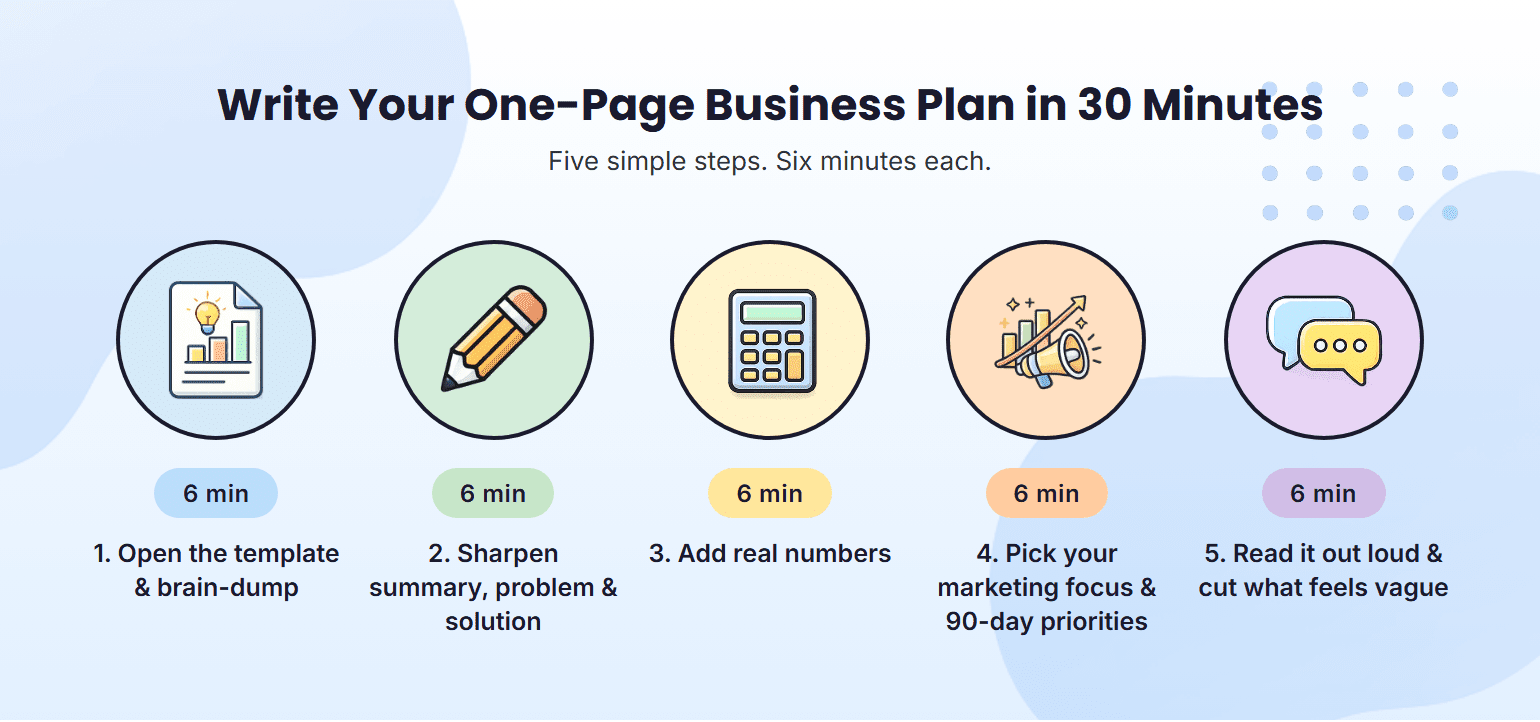
Use our one-page business plan template as your starting point. Open it, set a 30-minute timer, and start filling it in. Do not worry about making every line perfect. The point of this first draft is to get the business out of your head and onto the page.
Let’s start!
- Fill in the easy parts first: business name, offer, customer, location, pricing, and next steps. Do not pause to research every blank. If something is unclear, leave yourself a quick note and keep going.
- Tighten the first three sections (business summary, problem, and solution) as they need to be clear before anything else. Write them in plain language that a customer, banker, or partner would understand.
- Add the numbers you have. Use your pricing, expected sales volume, major costs, revenue target, or break-even point if you know them. If you do not, use a realistic estimate and label it clearly.
- Pick the first channel you will focus on, then add one or two support channels if they truly matter. The plan should show your priorities, not every possible idea.
- Map your first 3 to 5 milestones. Add the next few actions that will move the business forward, with dates or clear outcomes.
Lastly, read it out loud and send it to one person. Read the whole page once. Cut anything that sounds stiff, crowded, or unclear. Then send it to someone you trust and ask one question: “Can you understand the business in one minute?” If they can, you have a working first draft.
Whatever you have is your draft.
One-page business plan template + free generator
From here, you have two ways to create your one-page business plan.
The first is using the template we talked about in the last section. This works best when you already have a clear sense of the business and just need a clean structure to write into. The template follows the same eight sections we covered above, so you are not starting from a blank page.
The second is using our free one-page business plan generator. This works best when you are short on time, stuck on how to start, or want a quick draft to edit. All you have to do is answer a few short questions about your business, and the generator creates the one-pager for you in less than a minute.
Either way, you end up with a working draft you can revise, tighten, and make your own.
If you are still wondering how all of this looks once filled in, here is a simple example. I will use a coffee shop so the numbers, customers, and next steps are easy to picture.
A real one-page business plan example: a coffee shop
I have used the Upmetrics one-page business plan template for this example, so you can see exactly how the eight sections come together in a finished draft.
Brew & Bite is a coffee shop opening in downtown Austin. I am using a coffee shop example because it is easy to picture: rent, foot traffic, average ticket size, staffing, local competition, and a clear opening timeline.
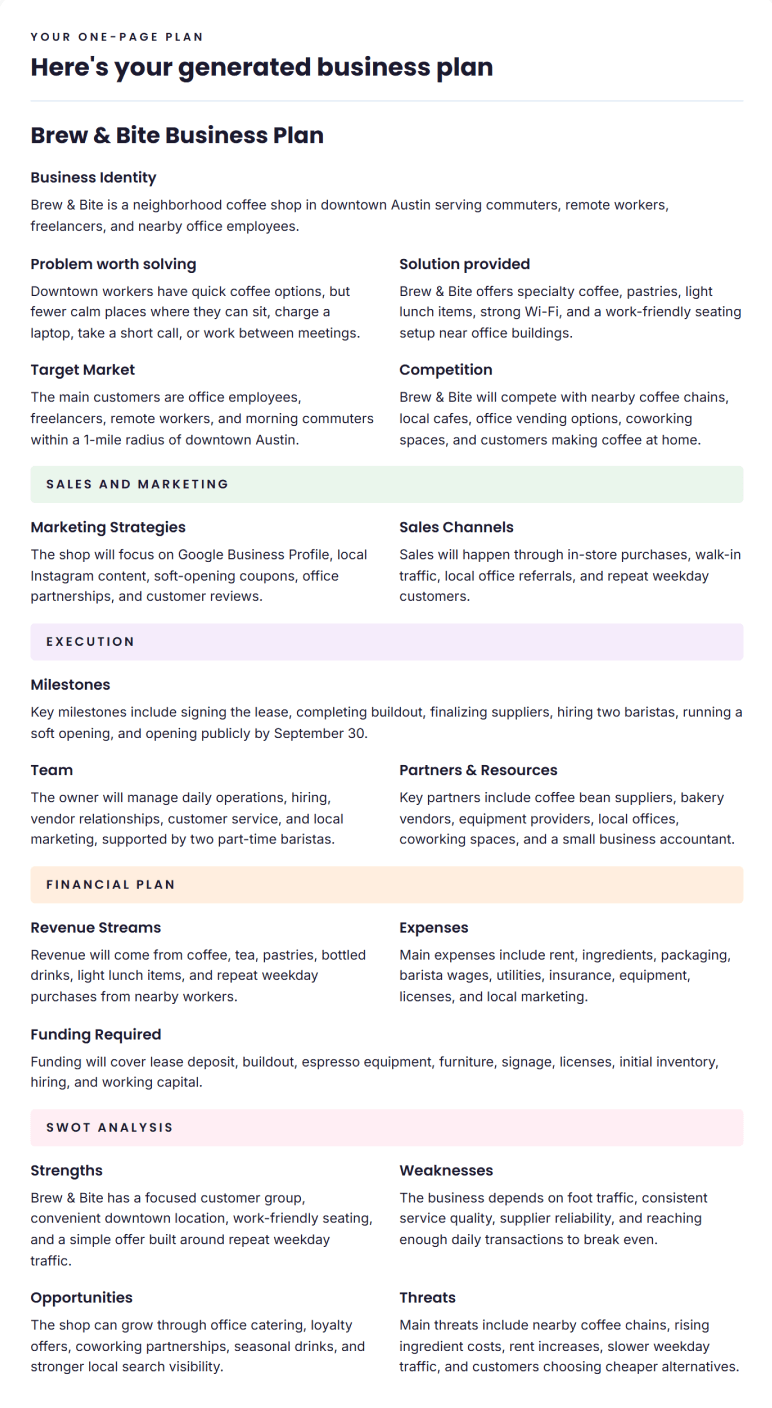
That’s what a finished one-page plan should look like.
How to keep your one-page plan focused and useful (Tips)
Brew & Bite’s plan reads cleanly because of what was left out. A one-page plan is easy to start and easy to overfill. These are a few tips you must follow before calling your own draft done.
- Don’t cram everything onto the page. If one sentence tries to cover the offer, customer, pricing, and marketing plan at once, cut it down to the part that answers the section’s main question.
- Use specific numbers instead of vague claims. A clear Year 1 revenue target, average ticket size, cost estimate, or break-even point gives the plan more weight than broad growth language.
- Cut buzzwords and stiff language. The plan should sound clear, direct, and practical, not like a pitch deck or AI-generated summary.
- Choose one primary marketing channel and one backup. Listing every possible channel makes the plan look scattered instead of focused.
- Make decisions, not descriptions. Each section should clearly show who you serve, what you sell, how you price it, where customers will find you, and what happens next.
If the page feels easier to read after these cuts, you are probably moving in the right direction.
Conclusion
A one-page business plan will not answer every question about your business, and it should not try to. Its job is to make the basics clear enough for you to act: who you serve, what you sell, how the business makes money, and what needs to happen next.
Once you have that on one page, the plan becomes easier to improve. You can update the numbers, adjust the offer, narrow the market, or expand it into a full business plan when a lender, partner, or funding process requires more detail.
For now, start with the version you can finish. Use the template, try the generator, or write directly from the eight sections above and create a plan clear enough to move the business forward.
The Quickest Way to turn a Business Idea into a Business Plan
Fill-in-the-blanks and automatic financials make it easy.

Frequently Asked Questions
Will banks or SBA lenders accept a one-page business plan for a loan?
Should I show investors a one-page business plan or a pitch deck?
What format should my one-page business plan be in: Word, Google Docs, or PDF?
What if my business is too complex to fit on one page?
How often should I update my one-page business plan?

Vinay Kevadia
Vinay Kevadiya is the founder and CEO of Upmetrics, the #1 business planning software. His ultimate goal with Upmetrics is to revolutionize how entrepreneurs create, manage, and execute their business plans. He enjoys sharing his insights on business planning and other relevant topics through his articles and blog posts. Read more