Executive Summary
FrameWorks Production is an LLC-structured, owner-operated video production company based in Austin, Texas. The company’s mission is to deliver high-quality commercial and branded video content customized to the needs of local and regional brands, marketing agencies, and nonprofit organizations.
At FrameWorks, we do not commit to any scripted television, feature film production, talent management, or third-party equipment rental.
Every project is scoped in advance through written contracts that define clear deliverables, timelines, and revision limits. These written contracts and defined milestones protect both client expectations and company cash flow.
The firm is owned by William Worley, who serves as solo operator and creative director. The organizational model is lean and risk-aware, with no full-time employees beyond the founder. All additional production roles, including camera operators, sound technicians, lighting assistants, and editors, are engaged on a per-project basis through freelance contracts.
After analyzing the market, it is proven that the demand for professional video
services continues to grow. This is because modern brands depend more on creative videos to get connected to their audience for marketing, communication, and training.
Approximately 91% of companies use video as part of their marketing strategy. And the U.S. video production market is projected to reach about $90.6 billion by 2030, growing at an estimated 23% annual rate.
Within this marketplace, FrameWorks Production targets local and regional businesses, startups, nonprofits, real estate firms, and marketing agencies. These clients need dependable production execution without carrying the overhead or pricing structure of full-service creative agencies.
Many of these organizations operate with limited internal creative resources. They often rely on external production partners as part of their regular business activities. This includes brand videos, customer testimonials, social media content, internal training materials, and event coverage.
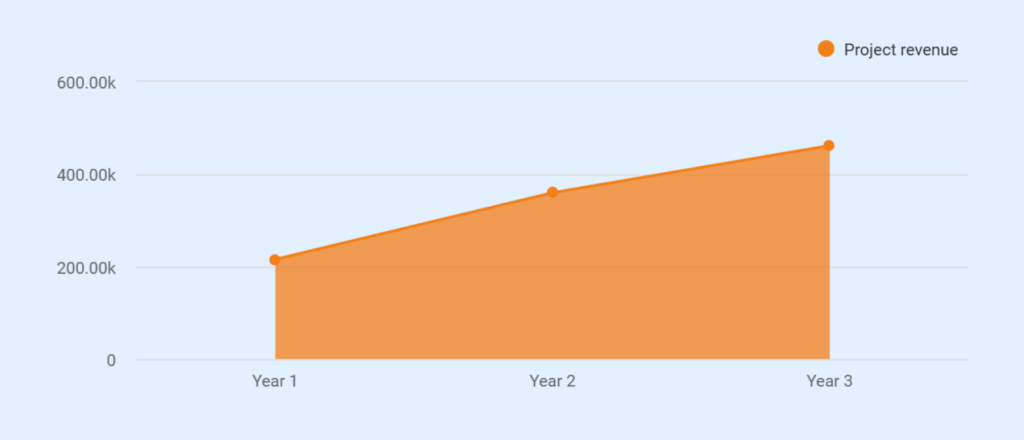
Based on the recurring need for production services, FrameWorks Production expects steady project flow throughout the year. Revenue is driven by per-project pricing. And gradual increases in both project volume and average project value as client relationships mature and repeat work increase.
The table below summarizes expected pricing, project volume, and total project revenue over the first three years of operations.
| Metric | Year 1 | Year 2 | Year 3 |
|---|---|---|---|
| Average Project Price | $4,500 | $5,000 | $5,500 |
| Monthly Project Volume | 4 projects | 6 projects | 7 projects |
| Annual Project Count | 48 projects | 72 projects | 84 projects |
| Project revenue | $216,000 | $360,000 | $462,000 |

Business Overview
FrameWorks Production is established to serve different organizations that need clear, reliable, and professional video content without the complexity of large creative agencies.
Here are the basic structural details of the business:
| Item | Details |
|---|---|
| Legal Name | FrameWorks Production LLC |
| Owner | William Worley (100% ownership; personal guarantor on bank loan) |
| Legal Structure | Single-member limited liability company |
| Business Address | 1840 South Lamar Boulevard, Suite 120, Austin, TX 78704, USA |
| Facility | Small office used for editing, equipment storage, and limited client meetings; no public studio storefront |
| Facility Size | Approximately 900 square feet |
The firm’s goal is to operate as a dependable production partner for businesses that need consistent video output without operating an in-house team. FrameWorks is not built for rapid expansion or high-volume production with a larger team and more resources. The focus is on steady project flow, repeat clients, controlled costs, and clear delivery standards.
Owner Background and Management
FrameWorks Production is owned and operated entirely by William Worley. All management and creative responsibilities are handled directly by him. He holds 100% ownership and serves as the personal guarantor on the company’s bank loan.
William Worley’s role includes:
- Client acquisition and sales
- Creative direction
- Filming and directing
- Post-production oversight
- Project budgeting
In addition to these core responsibilities, William also manages freelancer coordination, equipment maintenance, invoicing & collections, as well as final delivery quality control to ensure projects are completed on time and meet client expectations.
All projects are led by the owner from start to finish, ensuring consistency in execution and communication. There is no separate management staff at launch. It reduces overhead and removes the need for layered approvals that often slow down small creative teams.
William Worley has more than seven years of experience in commercial videography and post-production. He has worked in this field for almost a decade. His experience includes filming, editing, and managing video projects for small businesses and agencies. Most importantly, his portfolio spans promotional videos, testimonials, training content, and event coverage.
This experience guides how FrameWorks Production runs its projects, using familiar workflows and realistic timelines.
Business Model
FrameWorks operates as a service-based production firm that works on a project-by-project system, rather than on open-ended or hourly arrangements.
In the work system, clients are required to pay a deposit before filming begins. The remaining balance is due upon final delivery of approved content. Projects do not move forward without a signed agreement and initial payment, which helps keep cash flow stable.
Other production work per project is handled through freelance contractors. This includes camera operators or second shooters, audio technicians, lighting technicians, freelance editors, and production assistants.
Business Revenue
FrameWorks Production generates revenue through fixed-price video production projects sold directly to clients. Project pricing is based on defined scope, production complexity, shoot duration, crew requirements, and post-production workload.
Each project price covers direct labor, equipment use, editing time, and overhead contribution.
The company generates income through:
- Brand and promotional video projects that are priced per engagement
- Social media video packages delivered as bundled content
- Customer testimonial and corporate training videos commissioned by businesses and nonprofits
- Event highlight videos scoped around filming time and editing requirements
- Post-production-only services for clients supplying their own footage
Every project’s plan is scheduled only after a signed agreement and deposits received from the client’s side. This means revenue generation is secured for confirmed work rather than theoretical leads.
Extra revenue is generated through scoped add-ons such as captions, short-form cutdowns, motion graphics, and licensed music, which are priced separately to avoid scope creep.
The business does not lean on ad revenue, subscriptions, or usage-based billing. All income is earned through direct customer involvement with defined deliverables and payment terms.
Startup Costs Summary
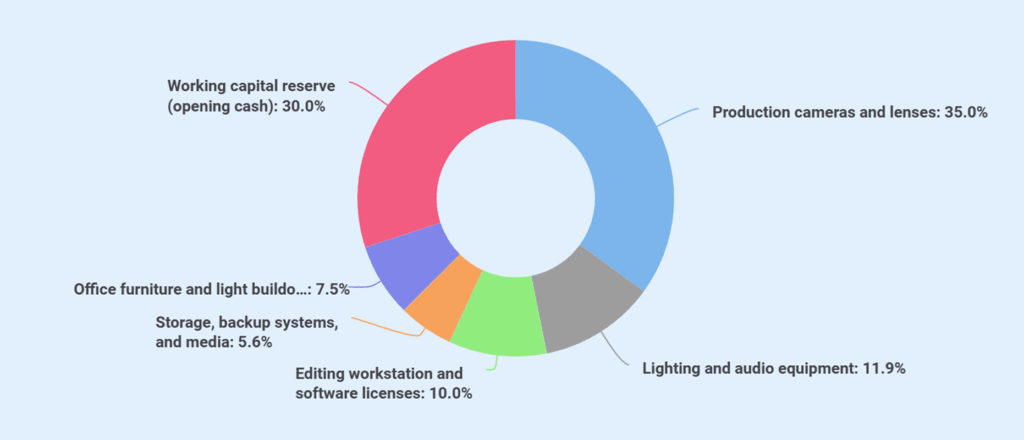
To fund startup operations, FrameWorks Production is seeking a $60,000 term loan from JPMorgan Chase Bank, supported by $20,000 in owner equity. So the total startup capital is $80,000. The loan will be personally guaranteed by the owner.
Here’s the detailed breakdown of the total startup capital:
| Category | Cost (USD) |
|---|---|
| Production cameras and lenses | 28,000 |
| Lighting and audio equipment | 9,500 |
| Editing workstation and software licenses | 8,000 |
| Storage, backup systems, and media | 4,500 |
| Office furniture and light buildout | 6,000 |
| Total Fixed Asset Purchases | 56,000 |
| Working capital reserve (opening cash) | 24,000 |
| Total Startup Costs | 80,000 |
Market Analysis
Austin, Texas, has a strong video production market supported by its growing business and creative industries. By late 2025, more than 225 video production companies were operating in the city, showing steady local demand.
Across Texas, the movie and video production industry is expected to be valued at about $761.8 million in 2026, with solid growth over recent years. Austin also plays a key role in this market, as the city’s creative industries generate around $4.3 billion in annual economic activity, with visual media being a major part of that activity.
Within this market, the United States is the largest contributor, with the promotional video segment alone valued at about $3.62 billion in 2025. That represents roughly 28% market share, and it is expected to be more than double by 2034. The video production revenue is expected to reach $90.64 billion by 2030, as mentioned earlier. And its video production market is set for significant growth, with a projected annual increase of 23% through 2030.
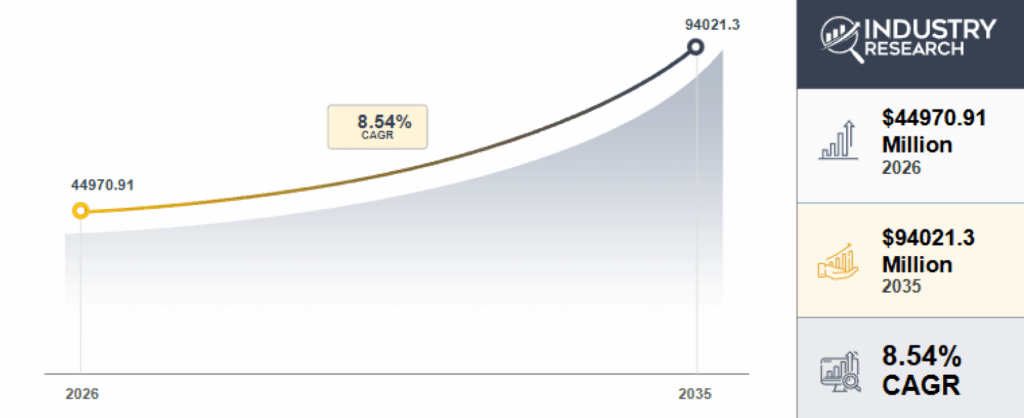
Furthermore, the global video production services market, including corporate, promotional, training, and digital content, is expected to grow from an estimated $44.9 billion in 2026 to $94.02 billion by 2035. This results in a compound annual growth rate (CAGR) of roughly 8.54% over that period.
Client Demand Drivers
Digital video is no longer an optional marketing promotion; it has become a central business strategy nowadays.
Austin has approximately 42,000 small businesses, and these businesses represent the primary customer base for video production services.
However, not all of them invest in professional video. If we estimate that 25% to 35% actively spend on marketing and brand promotion, that means around 10,500 to 14,700 businesses in Austin are realistic potential clients.
With the capacity to serve 40 to 60 businesses per year, FrameWorks would capture well under 1% of this active market, meaning only a small share is needed to sustain operations.
Target Client Profiles
FrameWorks Production focuses on brands that consistently need outsourced professional video services because they don’t have a production team in-house. So, they ended up relying on external support to complete projects professionally at minimal cost.
Here are our primary target client segments that constantly need video services to promote their brands:
- Local and regional small to mid-sized businesses: These client profiles mostly depend on digital videos for website promotions and social media, but usually do not have in-house teams.
- Startups and growth-stage companies: Small businesses need pitch videos, product explainers, and launch content in the early stages, especially in an active startup market like Austin.
- Nonprofit organizations: They use video to connect emotionally with donors, support campaigns, and cover events, often hiring outside producers to meet quality needs.
- Real estate and professional service firms: Use video to present properties, explain services, and build trust, with most production work handled externally.
- Marketing and creative agencies: Sell video as part of client campaigns and outsource filming and editing when internal production resources are limited.
Competitive Market
In Austin, the video production landscape is diversified, with different business scales from small boutique studios to larger-scale agencies.
The table below shows FrameWorks Production’s direct competitors, ranging from two-person teams to mid-size production houses.
| Competitor | Team Size | Strengths | Weaknesses |
|---|---|---|---|
| Sparkhouse | 2–9 | Highly rated for professionalism and quality, strong communication, and responsive project management |
A smaller team size may limit simultaneous larger projects |
| Wienot Films | 10–49 | Specializes in animated explainers & motion graphics; solid creative execution | Focus on animation may not fit all live-action needs |
| Perfect Form | 10–49 | Creative blend of video, motion graphics, animation, and editing; praised for collaboration and delivery |
Not strictly focused on pure video production (mixed services) |
| Door No. 3 | 10–49 | Multi-disciplinary production with strong creative and branding focus | Reviews are more limited, specifically for video work alone |
Other than these direct competitors, which are a well-known production company in Austin, we also compete with some indirect competitors. These include independent videographers, freelance creators, and creative agencies. With higher overhead, they provide services at a very affordable price range.
They are not running any firm, but with a variety of pricing and customization packages, they are giving more flexibility, which appeals to budget-conscious clients.
However, independent freelancers often have limited resources and no formal business structure, which makes it difficult for them to handle larger projects due to capacity constraints. So, this is where our business fills the gap among these indirect competitors.
FrameWorks Positioning
FrameWorks Production positions itself in the marketplace by focusing on commercial, branded, and business-centric digital video services rather than entertainment or speculative media work. Our business competes in this market by targeting the following structures:
- Owner-led creative continuity: Every project is overseen directly by the CEO, ensuring consistent creative decisions and delivery quality.
- Project-based cost transparency: Fixed-price engagements with clear scope and payment milestones reduce risk and complexity for clients.
- Lean operational model: Hiring vetted freelancers only when needed keeps costs low and aligns production capacity with confirmed demand.
In short, FrameWorks Production offers reliable, business-focused video services without extra overhead or complex pricing.
Services and Pricing Structure
FrameWorks Production delivers professional videos and creative concepts for businesses and organizations. We offer a complete solution for brands that want high-end production without the hassle of managing an in-house crew.
Our service structure clearly outlines the project scope, pricing, and timeline. This helps clients understand what will be delivered and when. It also allows the business to understand client expectations before starting the project.
Core Service Categories
FrameWorks focuses on a set of core video services commonly used by brands for marketing, branding, communication, and outreach. Here’s a list of our primary service offerings:
Brand and Promotional Videos
These videos present a business, product, or service clearly and professionally. They are commonly used on websites, landing pages, digital ads, and presentations.
Social Media Content Packages
Short videos are filmed in batches and prepared for different social media platforms. Usually, several clips are recorded in one session and then edited into different formats for each platform.
Customer Testimonial Videos
Interview-based videos featuring real customers or clients’ reviews or experiences. These are used to build trust and credibility. In some testimonial services, clients may provide existing footage or background materials.
Corporate Training and Explainer Videos
These are instructional videos that explain processes, services, or internal workflows in a clear and simple way. The focus is on making the message easy to understand rather than using complex visuals, and they are usually filmed in a controlled setting or based on materials provided by the client.
Event Highlight Reels
Short recap videos filmed at live events such as conferences, fundraisers, or corporate gatherings. These projects focus on capturing key moments and atmosphere rather than full event documentation.
Other than the above core services, we also offer add-on services such as motion graphics, subtitles & captions, short-form cutdowns, and licensed music. This allows clients to extend the value of a project without changing the core structure.
FrameWorks Production does not offer animation-only studio services, live broadcast or streaming services, feature films, or scripted television production, talent management, or equipment rental to third parties. These exclusions help maintain focus on business-oriented video production and allow the company to operate efficiently with controlled risk.
Service Packages and Pricing
The pricing ranges below reflect common project types and are meant as general guidance.
| Service Type | Typical Scope | Approx. Price Range Per Project |
|---|---|---|
| Brand / Promotional Video | 1 filming day, interviews, full edit | $4,000 – $6,000 |
| Social Media Content Package | 6–10 short videos from one shoot | $3,500 – $5,500 |
| Customer Testimonial Video | Single interview setup, edited video | $2,500 – $4,000 |
| Training / Explainer Video | Scripted or guided instructional content | $3,000 – $5,000 |
| Event Highlight Reel | Half or full-day event coverage | $3,500 – $6,500 |
| Post-Production Only | Editing client-supplied footage | $1,500 – $3,000 |
Our services’ actual pricing is finalized after reviewing project details such as scope, location, crew size, filming duration, video quality, editing needs, time duration, project complexity, and delivery requirements.
Project Duration and Turnaround
Most projects follow a predictable timeline, except for the project that requires complex shoots. For example, a model shoot. It requires different sets, models, themes, outfits, etc.
The standard project timeline is structured as follows:
- Pre-production and planning: 3–5 business days
- Filming: Half-day or full-day shoot
- Post-production: 7–14 business days
- Client review and revisions: Based on agreed revision limits
Client Deliverables
To complete projects efficiently, our targeted clients are expected to provide:
- Clear goals for the video and intended usage
- Video format, quality, duration, brand theme, aesthetic, and brand language
- Brand policies or reference material, if available
- Access to filming locations and participants
- Required approvals and feedback within agreed timelines
Marketing and Client Acquisition
Our marketing strategy focuses more on credibility and client relationships rather than high advertising spend.
Primary Channels
Primary marketing channels are selected to attract targeted clients and generate consistent new and repeat projects for the business.
Professional Website and Demo Reel
The company maintains a professional website that serves as the central sales asset. The site features a curated demo video, service descriptions, and contact information. The demo video gets updated in a while after the new project is finished, or something new is added to the portfolio to reflect current capabilities and style.
LinkedIn is used for targeted business development. The company monitors posts from business owners, marketing managers, and local brands announcing product launches, hiring initiatives, or campaign activity. This helps us find organizations that may need promotional, brand, recruitment, or corporate videos. Outreach remains direct and selective.
Referrals
Referrals from past clients and professional contacts are a main source for getting large projects. This often leads to repeat business and introductions to other local business owners and marketing professionals.
Marketing Agencies and Local Business Networks
FrameWorks actively networks with marketing agencies and local businesses. These relationships are built through direct outreach, professional connections, and past collaboration. Agencies often serve as repeat sources of production work when video execution is sold as part of a broader campaign.
Secondary Channels
Secondary channels are used to support visibility and fill the pipeline without heavy spending.
Social Media Showcases
Short video clips and project highlights are shared on social platforms like Instagram, Facebook, and TikTok to demonstrate recent work and maintain an active presence.
Local Business Events
The owner participates in local networking events, industry meetups, and community business gatherings to build relationships and maintain visibility within the Austin market.
Targeted Outbound Outreach
Outbound outreach is used selectively, focusing on agencies and businesses that are likely to require an ongoing video creation outsource service. Outreach is targeted and relationship-driven rather than mass cold marketing.
Client Acquisition Flow
Client acquisition follows a simple and repeatable process:
- Initial client contact through website, referral, or agency connection
- Discovery call to understand project needs
- Proposal and scope definition
- Contract execution and deposit
- Project delivery and follow-up
- Repeat work or referral opportunity
This structure allows the business to focus on qualified leads rather than high-volume inquiries.
Marketing Spend and Allocation
The owner first invests in building its core marketing assets, then maintains a simple monthly marketing budget of about $500. This budget covers website maintenance, sharing portfolio work on social media, attending local networking events, and contacting agencies and potential clients. It does not depend on paid ads or long-term marketing contracts.
Spending Discipline and Strategy
Marketing spend is controlled and reviewed regularly. The business avoids long-term ad contracts, aggressive paid advertising, or speculative campaigns. Instead, spending supports assets and activities that directly contribute to trust and repeat business.
Key principles include:
- Portfolio quality over ad volume
- Repeat clients over one-time projects
- Referrals overpaid for lead generation
- Relationship building over mass outreach
This approach aligns with the company’s project-based revenue model and supports sustainable growth without increasing fixed costs.
Operations Plan
FrameWorks Production operates with a simple and organized setup to ensure steady delivery, protect equipment and data, and maintain quality on every project. Work is managed from a small office studio. The owner directly oversees each project and follows a clear production process.
Studio Layout Structure
The 900-square-foot studio is designed for efficiency, with three distinct areas dedicated to specific tasks, including an editing cabin, equipment storage room, and client meeting area.
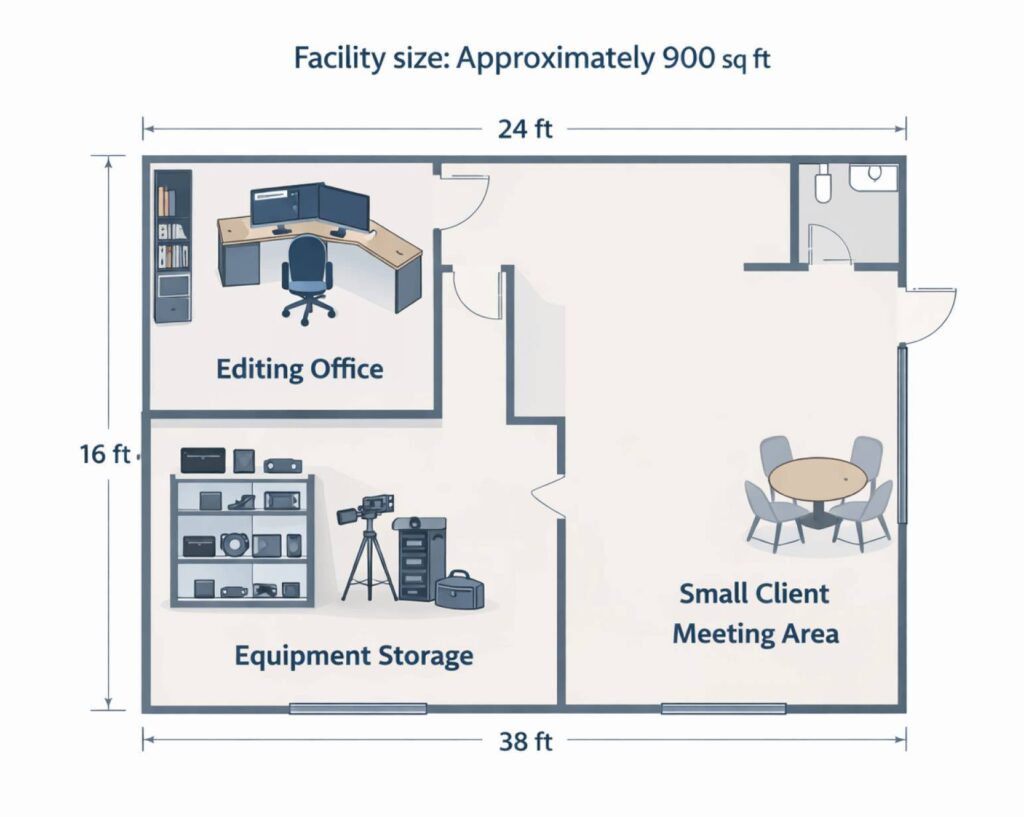
- The editing setup is arranged in a quiet area used for post-video editing work.
- Cameras, lights, and other equipment are stored in a safe corner close by, so they are secure and easy to reach.
- A small meeting area is kept separate, so client talks and reviews do not disturb ongoing work.
Day-to-Day Operating Schedule
The business operates Monday to Friday from 9:00 AM to 6:00 PM. William handles all the admin tasks, client communication, editing, and project planning during these hours.
Daily activities typically include:
- Client handling and proposal discussions
- Pre-production planning and shot list preparation
- Post-production editing and revisions
- Equipment checks and basic maintenance
- File organization, backups, and deliveries
Project Workflow
Every project follows a structured, end-to-end workflow to avoid delays and scope issues. The following visual shows the step-by-step progression of the FrameWorks Production workflow:
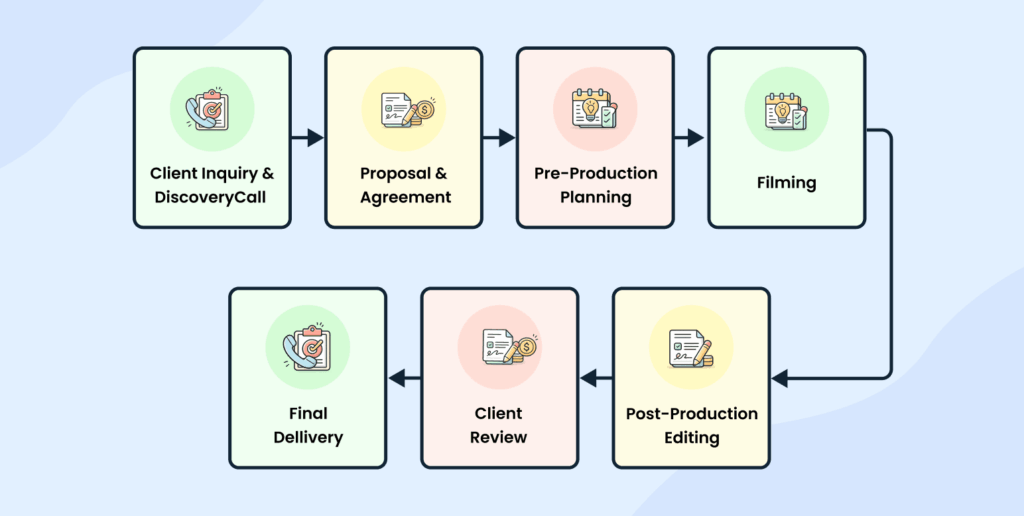
Each phase of this workflow goes through the owner’s involvement, as William Worley is the company’s sole full-time employee.
No filming begins without a signed agreement and deposit, and no final assets are delivered until payment is complete. This structure ensures predictable timelines and keeps the cash flow under control.
Production Controls and Quality Checks
FrameWorks uses simple but effective production controls to maintain quality and reduce rework. Some of the key controls include:
- Shot lists are prepared before filming starts
- Project-specific production checklists
- Standardized folder and file naming conventions
- Review checkpoints during editing before client delivery
Footage is reviewed for audio clarity, framing, exposure, and continuity before post-production begins. Final videos are checked for formatting, resolution, and playback quality before delivery.
Equipment and Technology Infrastructure
The company maintains its own professional production and post-production equipment, avoiding reliance on third-party rentals for standard projects.
Production equipment setup includes:
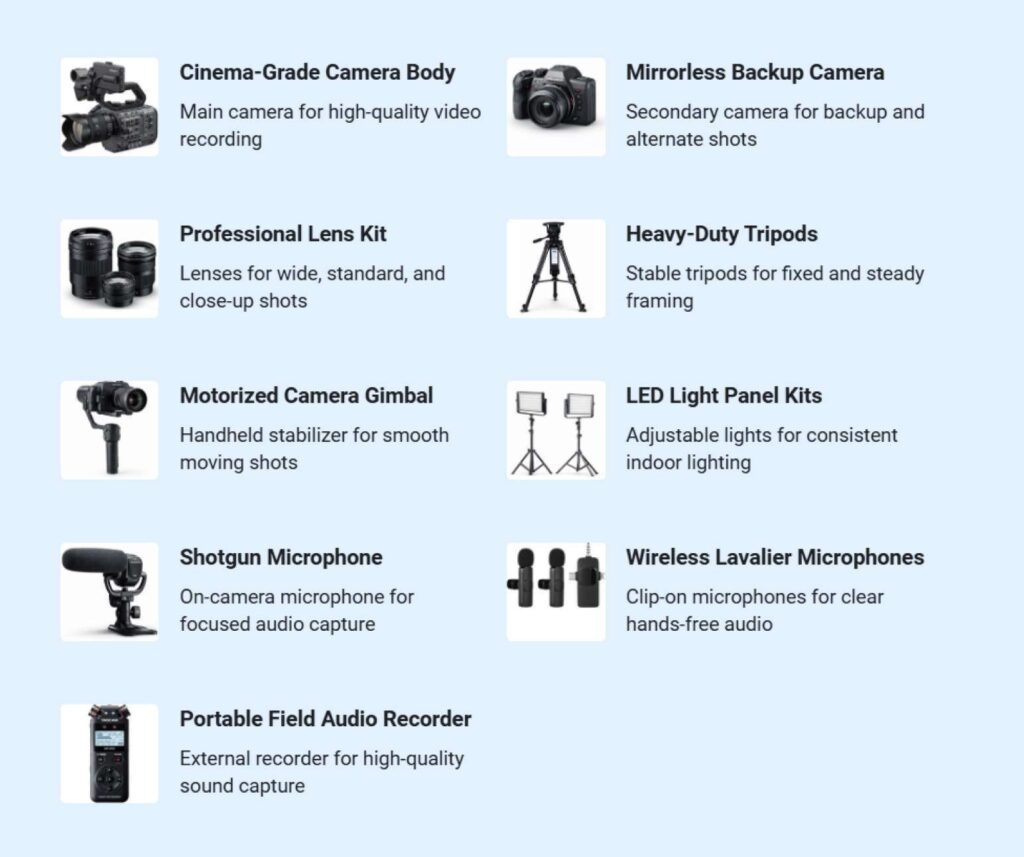
Backup camera gear is maintained to reduce risk in case of equipment failure during shoots. Additionally, drone operations are not included in standard services and are performed only when the required FAA licensing, insurance coverage, and client approvals are in place.
For data storage and backup:
Data protection is a priority due to the size and importance of raw video files. Our data storage and backup practices cover:
- External solid-state drives (SSDs) for active project work
- External hard disk drives (HDDs) for longer-term storage
- Cloud-based backup for redundancy
Raw video footage and edited files are backed up both locally and to the cloud to reduce the risk of any data loss. Files are retained according to project needs and contractual requirements.
Investors hate amateur writing errors
Instantly improve your plan w/ our AI writing assistant
Licensing and Usage Controls
FrameWorks Production follows clear licensing, insurance, and compliance practices to make sure all work is legally approved and safe for commercial use.
Work licenses: The business keeps all required city licenses and state registration, and follows sales tax rules for its services.
Contracts: Each project uses a service agreement. Talent, location, and contractor forms are used when needed. These documents clearly state who owns the final video and how it can be used.
Insurance: The business has general liability, professional liability, and equipment insurance to reduce risk during production.
Compliance: Only licensed music is used, and client footage and data are handled carefully under agreed privacy terms.
Indemnification provisions: Contracts outline responsibility if any claims arise related to content or third-party rights.
Archive and retention: Project files are stored for a limited time after delivery. Long-term storage is only provided if it’s written in agreement.
Staffing Model
FrameWorks Production is fully owned and operated by William Worley, who serves as the Creative Director. At launch, he is the only full-time person who manages each project. From the first client inquiry to final delivery, with occasional support from freelancers hired for specific projects.
William Worley fulfills all the core responsibilities, including:
- Creative direction
- Filming
- Video editing
- Hiring freelancers
- Client communication
- Budgeting and final delivery review
Freelance Crew Structure
The company uses freelance production assistants, professional camera operators, audio technicians, lighting technicians, and image and video editors when a project requires additional support. They get hired only after the client contract and deposit are secured. And they are not retained on an ongoing basis.
These freelance contractors are paid per day or per project and are treated as direct project costs rather than ongoing expenses.
Contractor Risk Controls
FrameWorks Production applies strict controls when engaging freelance crew to reduce financial and operational risk.
Key controls include:
- No freelancer is booked without a signed client contract and deposit
- Crew size is scoped during pre-production and included in client pricing
- Written contractor agreements are in place for all freelance roles
- Freelancers are classified as 1099 independent contractors with no guaranteed working hours and no retainers
- Payment terms are clearly defined on a per-project or per-day basis
The business avoids exposure to unpaid labor costs and ensures cash flow control by hiring freelancers only after client work is confirmed.
Future Hiring Conditions
Hiring costs are not included in the financial projection because FrameWorks Production does not plan to hire any full-time staff at launch. Future hiring will only happen if the workload stays steady over time, not based on expected growth.
Potential future roles may include:
- A full-time editor
- A part-time production coordinator
These roles would be added only if monthly projects stay high enough to support fixed payroll without putting pressure on cash flow. Until those conditions are met, FrameWorks Production will continue operating with an owner-led model and project-based freelance support.
Financial Plan
FrameWorks Production is seeking $80,000 in startup funding to support the initial setup of the business. The funds will be used to purchase production equipment, cover initial setup costs, and provide working capital to maintain stable operations during the early phase.
Source of Funds
| Source | Amount (USD) |
|---|---|
| Bank term loan (JPMorgan Chase) | 60,000 |
| Owner cash contribution | 20,000 |
| Total Sources of Funds | 80,000 |
The business will secure a $60,000 bank term loan at a fixed annual interest rate of 7.75%. The loan will be structured as a five-year amortizing facility, with regular principal and interest payments made over the term of the loan.
Financial Assumption
| Category | Assumption |
|---|---|
| Average Project Pricing | Year 1: $4,500; Year 2: $5,000; Year 3: $5,500 |
| Monthly Project Volume | Year 1: 4 projects/month; Year 2: 6 projects/month; Year 3: 7 projects/month |
| Annual Project Count | Year 1: 48; Year 2: 72; Year 3: 84 |
| Cost of Goods Sold (COGS) | Year 1: 45%; Year 2: 42%; Year 3: 40% |
| Owner Compensation | Year 1: $60,000; Year 2: $70,000; Year 3: $80,000 |
The business does not employ any W-2 employees at launch. The owner’s compensation is treated as an operating expense in the financial statements. Annual fixed overhead (excluding owner salary) totals 44,400. Fixed monthly overhead totals approximately $3,700, which includes rent, insurance, software subscriptions, phone services, marketing, and other recurring expenses.
Profit & Loss Statement
| Item | Year 1 ($) | Year 2 ($) | Year 3 ($) |
|---|---|---|---|
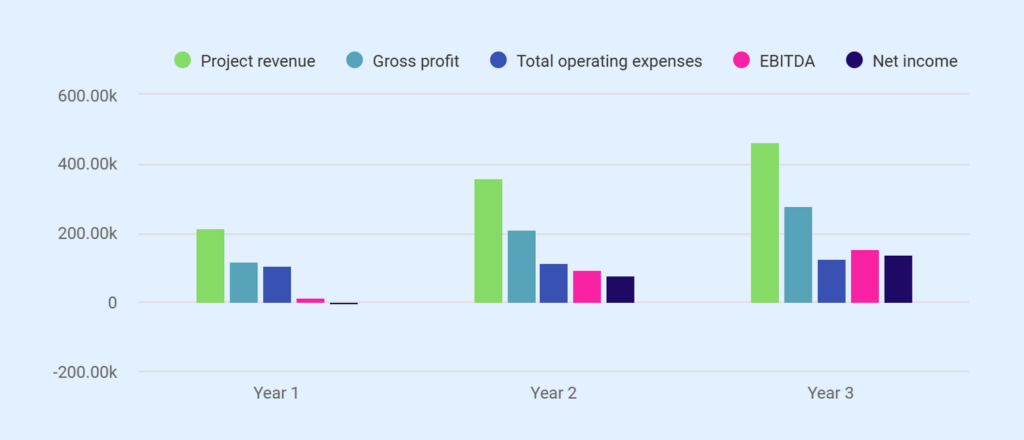
| Project revenue | 216,000 | 360,000 | 462,000 |
| Cost of sales (freelancers, travel, licenses) | (97,200) | (151,200) | (184,800) |
| Gross profit | 118,800 | 208,800 | 277,200 |
| Operating expenses | |||
| Owner salary | (60,000) | (70,000) | (80,000) |
| Office rent & utilities | (26,400) | (26,400) | (26,400) |
| Insurance allocation | (5,040) | (5,040) | (5,040) |
| Software subscriptions | (2,160) | (2,160) | (2,160) |
| Phone & internet | (1,800) | (1,800) | (1,800) |
| Marketing | (6,000) | (6,000) | (6,000) |
| Other operating expenses | (3,000) | (3,000) | (3,000) |
| Total operating expenses | (104,400) | (114,400) | (124,400) |
| EBITDA | 14,400 | 94,400 | 152,800 |
| Depreciation | (11,200) | (11,200) | (11,200) |
| Interest expense | (4,650) | (3,850) | (2,950) |
| Net income (pre-tax) | (1,450) | 79,350 | 138,650 |
Spreadsheets are exhausting & time-consuming
Build accurate financial projections w/ AI-assisted features
Cash Flow Statement
| Item | Year 1 ($) | Year 2 ($) | Year 3 ($) |
|---|---|---|---|
| Net income (pre-tax) | (1,450) | 79,350 | 138,650 |
| Depreciation (non-cash) | 11,200 | 11,200 | 11,200 |
| Change in accounts receivable | (9,000) | (12,000) | (17,000) |
| Change in accounts payable | 7,200 | 10,800 | 12,000 |
| Cash from operations | 7,950 | 89,350 | 144,850 |
| Capital expenditures | — | — | — |
| Cash from investing | — | — | — |
| Loan principal repayment | (12,000) | (12,000) | (12,000) |
| Owner contributions | — | — | — |
| Cash from financing | (12,000) | (12,000) | (12,000) |
| Net change in cash | (4,050) | 77,350 | 132,850 |
| Beginning cash balance | 24,000 | 19,950 | 97,300 |
| Ending cash balance | 19,950 | 97,300 | 230,150 |
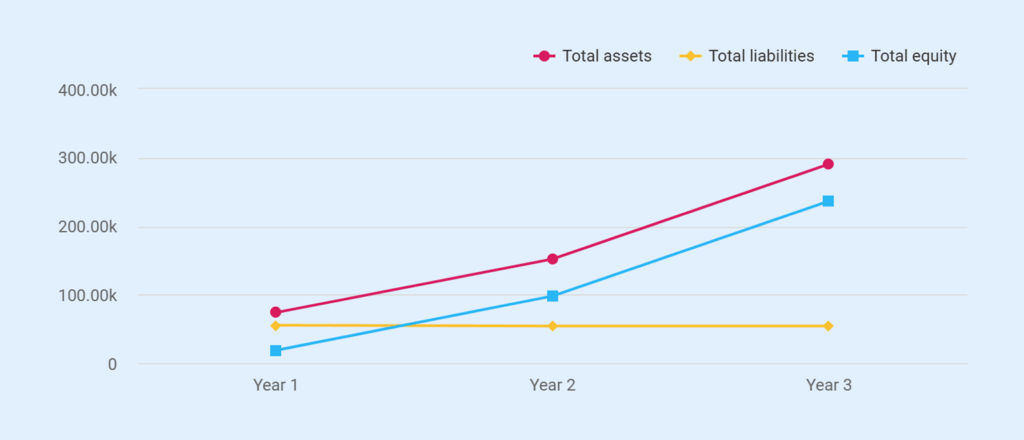
Balance Sheet
| Item | Year 1 ($) | Year 2 ($) | Year 3 ($) |
|---|---|---|---|
| Assets | |||
| Cash | 19,950 | 97,300 | 230,150 |
| Accounts receivable | 9,000 | 21,000 | 38,000 |
| Current assets | 28,950 | 118,300 | 268,150 |
| Fixed assets (gross) | 56,000 | 56,000 | 56,000 |
| Accumulated depreciation | (11,200) | (22,400) | (33,600) |
| Net fixed assets | 44,800 | 33,600 | 22,400 |
| Total assets | 73,750 | 151,900 | 290,550 |
| Liabilities | |||
| Accounts payable | 7,200 | 18,000 | 30,000 |
| Loan payable | 48,000 | 36,000 | 24,000 |
| Total liabilities | 55,200 | 54,000 | 54,000 |
| Equity | |||
| Owner contributed capital | 20,000 | 20,000 | 20,000 |
| Retained earnings | (1,450) | 77,900 | 216,550 |
| Total equity | 18,550 | 97,900 | 236,550 |
| Total liabilities + equity | 73,750 | 151,900 | 290,550 |
Break-Even Analysis
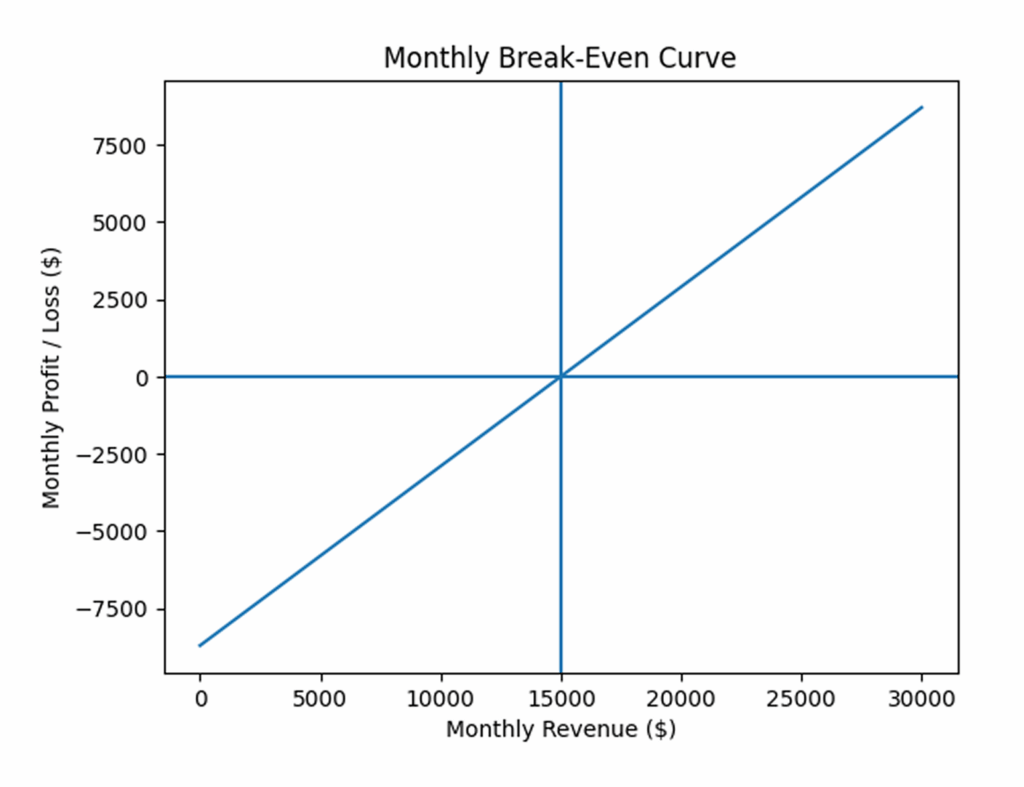
| Item | Value |
|---|---|
| Monthly fixed costs | $8,700 |
| Variable cost ratio (COGS %) | 45% |
| Contribution margin | 55% |
| Monthly break-even revenue | $15,818 |
| Annual break-even revenue | $189,816 |
| Average project value (Year 1) | $4,500 |
| Break-even projects per month | 3.5 |
| Modeled projects per month (Year 1) | 4 |
| Break-even status | Achieved in Year 1 |
The Quickest Way to turn a Business Idea into a Business Plan
Fill-in-the-blanks and automatic financials make it easy.

Upmetrics
Upmetrics is the #1 business planning software that helps entrepreneurs and business owners create investment-ready business plans using AI. We regularly share business planning insights on our blog. Check out the Upmetrics blog for such interesting reads. Read more