




 Download Now: Free Business Plan Template
 The first time I used ChatGPT for a real business task, I typed “Write me a marketing plan” and got back four paragraphs that could apply to any company on earth. Technically correct. Completely useless.
The problem wasn’t the tool. It was what I gave it to work with.
Once I started building my ChatGPT prompts for business with a role, context, a clear task, and a format, the output changed. Cold emails I could actually send. Financial narratives with real numbers. SOPs that my team could follow without asking questions.
I’ve put together what I consider the best ChatGPT prompts for business across eight functions: marketing, sales, customer service, HR, strategy, financial planning, operations, and business planning. Each one has [bracket placeholders] so you can customize without knowing anything about prompt engineering.
Pick the section most relevant to your business right now and start there.
How to write a ChatGPT prompt that actually works?
Most people type one-line questions into ChatGPT and get back generic word salad. The issue is not the tool. It is how you ask.
A request like “Write a sales email” leaves too many gaps. ChatGPT has no idea who you are selling to, what the product does, or what a good outcome looks like. So it defaults to something generic.
Stronger prompts close that gap by including four elements: role, context, task, and format.
| Part | What it does | Example |
|---|---|---|
| Role | Tell ChatGPT who it should act as | You are an experienced B2B sales copywriter |
| Context | Provide the background information | I sell accounting software to independent restaurants |
| Task | Explain what you want it to produce | Write a cold outreach email to book a 20-minute discovery call |
| Format | Specify how the output should look | Keep it under 150 words and include a short P.S. |
Here is the difference in practice.
Weak prompt: “Write me a sales email.”
Structured prompt: “You are a B2B sales copywriter and sell bookkeeping software to independent restaurants with 2-5 locations. Compose a cold outreach mail less than 120 words in an attempt to make a 20-minute discovery call. Write in a conversational manner and a low-friction call to action.”
The difference in output quality is significant. The second prompt gives ChatGPT everything it needs: A role to step into, a specific context, a clear deliverable, and a format to follow. That’s what gets you an output you can actually use.
Every prompt in this guide follows this same structure. You only need to fill in the [brackets] with information about your business.
ChatGPT prompts for marketing & content creation
Marketing is where most small business owners get the most immediate value from ChatGPT. But it is also where they waste the most time on bad prompts. These 7 prompts span the entire marketing stack: ad copy, email, social, and SEO. None requires marketing expertise.
Prompt 1: SEO blog post brief
You are a professional SEO content strategist who assists businesses with less expertise in writing articles that rank well in Google and attract the right traffic.
It is a type of business that provides to [target audience] in [location or market] of business. This aims at developing learning material that draws the prospective customers to the website.
Create a detailed SEO blog post brief targeting the keyword “[primary keyword]”. The brief is supposed to assist a writer in writing a quality article that satisfies search intent and can compete with the search engine top results.
Structure the response with the following sections:
- Search intent explanation
- Suggested H2 and H3 headings
- Key questions the article should answer
- Recommended internal linking opportunities
- Meta title and meta description
- Recommended word count based on competing articles
Prompt 2: Product launch marketing strategy
I am preparing to launch [product or service] for [target audience] in the [industry] market.
Act as a marketing strategist on the launch plan.
Develop a planned campaign that demonstrates how the product is to be launched into the market.
Break the plan into three phases:
1. Pre-Launch
- Awareness building
- Teaser content ideas
- Early interest generation
2. Launch Week
- Messaging focus
- Key promotional activities
- Channels that should carry the launch announcement
3. Post-Launch
- How momentum should be maintained
- Content or promotions that reinforce the value of the product
- Early customer success stories or proof points that should be highlighted
Focus on practical tactics a small business could realistically execute.
Prompt 3: Customer-centered email campaign
I would like to develop an email sequence that will promote [product or service].
The target audience is [target audience], and the major issue that the product addresses is [specific problem].
Draft a 5 email nurture program that will gradually bring a prospect to [demo/purchase/consultation].
Rather than composing generic e-mails, form the series as a story:
Email 1 — Introduce the problem the audience faces
Email 2 — Explain why typical solutions fail
Email 3 — Introduce the product as a practical alternative
Email 4 — Show a real-world use case or scenario
Email 5 — Invite the reader to take the next step
For each email, provide:
- Subject line
- Opening hook
- Main message
- Call-to-action
Prompt 4: Guide to brand voice definitions
You are helping a firm to develop its guidelines on brand voice and tone.
The business is a [type of business] serving [target audience] in the [industry] space.
Develop a guide on brand voice that writers, marketers, and customer support can use as a reference.
Explain:
- The personality the brand should project (e.g., practical, authoritative, conversational)
- How the brand should sound when explaining ideas
- Words or phrases that reflect the brand identity
- Language patterns the brand should avoid
- Three example sentences showing how a typical piece of marketing copy should sound
The goal is to help multiple writers produce content that feels consistent.
Prompt 5: Content repurposing strategy
Recently, I posted a blog post with the name of my blog being [blog title] concerning [topic].
The article is aimed at [target audience] and describes [main idea of the article].
I do not want to leave the article on the blog only, but to make a series of social content pieces.
Analyze the topic and suggest:
- Three LinkedIn post ideas that frame the topic as a professional insight
- Three Twitter/X posts that distill the article into short takeaways
- Two Instagram posts that would be added to a carousel or a short video.
- One short-form video concept explaining the key idea in under 60 seconds
All suggestions must present a different aspect of the same issue and not repeat the same message.
Prompt 6: Search result snippet optimization
I published a blog article targeting the keyword “[primary keyword]”.
The business is a [type of business] serving [target audience].
Act as an SEO specialist, optimizing search snippets.
Generate multiple meta titles and descriptions that could improve click-through rate in Google search results.
Provide:
- Five title options (under 60 characters)
- Five meta description options (under 155 characters)
Make sure each option takes a different angle, such as:
- Problem-focused
- Curiosity-driven
- Benefit-focused
- Guide/tutorial style
- Comparison or decision-making
Prompt 7: Paid social ad concept
A company is running Facebook and Instagram ads to promote [product or service].
The target audience is [target audience], and the campaign goal is [generate leads / drive purchases/book demos].
Instead of writing just one ad, create three different ad concepts.
For each concept, provide:
- Headline
- Primary ad copy
- Supporting description line
- Recommended call-to-action
Each concept should use a different marketing angle, such as:
- Problem-solution framing
- Social proof or success story
- Direct benefit or offer-driven messaging
ChatGPT prompts for sales & business development
The right ChatGPT prompts for sales can help you work through the questions that trip up most founders before you’re ever in a room with a prospect. Who’s your actual buyer? How do you explain what you do without losing them? How do you respond when someone pushes back on price? These prompts walk you through the full sales process, from defining your ideal customer to following up after a demo.
The prompts below will help you go through the entire sales process, define your ICP, and follow up on a demo.
Prompt 8: Ideal customer profile (ICP) definition
I would like to have a better understanding of who a best-fit customer is before I spend more time on outreach.
My business sells [price point] of [product or service]. My existing customers are [describe 2-3 current customers – industry, size, position of the purchaser].
Act as a B2B sales strategist and build a detailed Ideal Customer Profile I can use for both sales and marketing.
Cover:
- Company size
- Industry
- Job titles involved in the buying decision
- Common pain points
- Typical buying triggers
- Red-flag characteristics of a bad-fit customer
Prepare the output in the format of one page internal reference document that I can share with my team.
Prompt 9: Cold outreach email
I need a cold email that is personalized enough to respond to, yet brief enough that it is read in the first place.
I sell [service or product] to [target customer]. My fundamental problem is [state it in a sentence]. I am addressing [type of company] [specific role]. The aim is to reserve a [15/20/30]-minute discovery call.
Compose the e-mail within 120 words. Begin with their problem, and not with my product. Be natural and straightforward, and close with a low-resistance CTA easy to say yes to.
Also include 2 alternative subject lines.
Prompt 10: Sales objection handling
There is one objection that continues to appear in my sales conversations, and I would like to have more effective responses to it without it coming out defensive.
I sell [product or service] at [price point]. The most common objection I have heard is: “[specific objection]”.
Give me three different ways to handle it:
- One response that acknowledges and reframes the concern
- One response that uses a discovery question to surface the real issue
- One response that uses a proof point, comparison, or example to shift perspective
Write them as though they were things I can say to you on a live call. Keep it conversational, not scripted.
Prompt 11: 2-minute sales pitch script
Prepare a 2-minute verbal sales pitch for [product/service].
The [target audience] is the target customer, and the product will assist them in addressing [specific problem].
Prepare the pitch in such a way that it would be presented at a meeting, networking conversation, or introductory call.
The pitch should include:
- A clear statement of the problem
- A simple explanation of the solution
- One or two key differentiators compared to alternatives
- A closing sentence that invites the listener to continue the conversation
Prompt 12: Post-demo follow-up email sequence
A prospect recently attended a product demo for [product/service].
Create a 3-email follow-up sequence designed to move them closer to making a purchase decision.
Each email should serve a different purpose:
Email 1: Thank them for attending and summarize the key benefit of the product.
Email 2: Share a short example or scenario showing how another customer uses the product successfully.
Email 3: Encourage the next step, such as scheduling a follow-up call or starting a trial.
For each email, include:
- Subject line
- Email body
- Clear call-to-action
Prompt 13: Pre-call research brief
I’m preparing for a sales call with [company name], which operates in [industry].
Our product [product/service] helps companies solve [problem].
Create a short pre-call research brief that helps me prepare for the conversation.
Include:
- 5 questions I should ask during the call
- Likely challenges the company may be facing based on its industry
- Possible objections they might raise about buying a solution like ours
- Talking points that connect our product to those challenges
Prompt 14: Partnership or referral outreach email
I want to reach out to a potential referral partner or complementary business to explore a mutual partnership.
My business is [describe what you do]. The business I’m reaching out to is [describe their business]. The reason this partnership makes sense is [explain the overlap or shared customer base].
Write a short outreach email under 150 words that:
Include:
- Opens with a specific reason why their business caught my attention
- Explains who my customers are and why there’s a natural fit
- Proposes one simple, low-commitment next step (a 20-minute call, not a formal pitch)
Keep the tone warm and peer-to-peer. This is not a cold sales email. Write it as one business owner reaching out to another.
Also include 2 alternative subject lines.
ChatGPT prompts for customer service & support
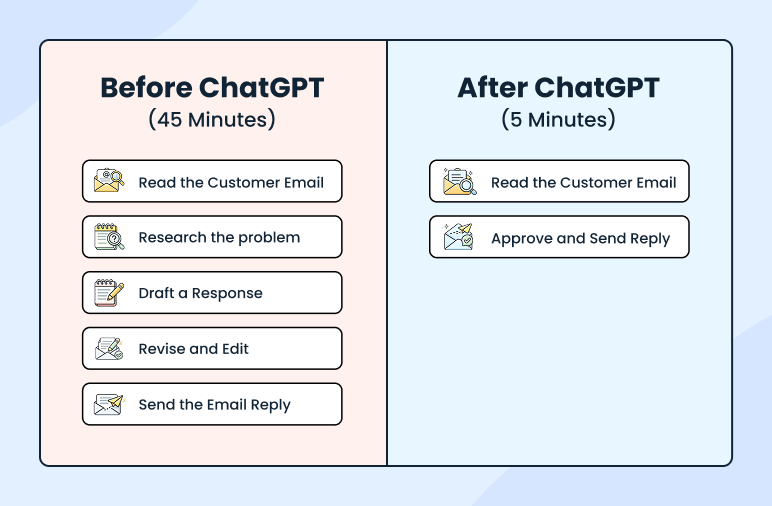
A bad complaint response costs you a client. A thoughtful one can turn a frustrated customer into your most loyal one. The problem is that writing a good customer service email from scratch takes 45 minutes. These 4 prompts cut that to 5 — and the quality goes up.
Prompt 15: Empathetic complaint response
A customer sent the following complaint about our product/service: “[paste complaint message]”.
Write a professional response that recognizes the customer’s frustration and how their concern is being taken seriously. The response should keep a calm and respectful tone, address the issue they raised in a short manner, and explain the following steps the company will take to resolve the situation. The purpose is to assure the customer, yet make the message as brief as possible while maintaining a focus on the solution.
Prompt 16: Returns and refund policy FAQ
Our business offers [product or service], and customers sometimes ask about refund eligibility. Write a clear FAQ response explaining our refund policy in simple language.
The answer should explain under what conditions refunds are available, how customers can request one, and what timeframe they should expect for processing. The tone should be helpful and transparent so customers understand the process without confusion.
Prompt 17: Customer feedback analysis
I collected the following customer feedback from reviews, emails, and surveys:
[paste 10–20 customer comments or reviews]
Analyze this feedback and summarize the insights.
Provide:
- The three most common themes appearing across the feedback
- The main problems or frustrations customers are describing
- Positive patterns that show what customers appreciate about the product
- Specific improvements the business could make based on these insights
Present the analysis as a short internal report.
Prompt 18: Chatbot FAQ script
You are a conversational UX writer.
My company is [explanation of what you do]. The 5 most frequently asked questions by our customers prior to purchase or after purchase are: [list them]. The tone of our communication is [professional/ friendly/ casual].
Write a chatbot question script that addresses these 5 questions. Each: Provide the trigger phrase that the user may type, a 2-3 sentence response in our tone, and a follow-up question that either solves the problem completely or directs the user to a human. Prepare it in such a format that it can be directly copied into a chatbot tool.
ChatGPT prompts for HR and hiring
Writing your first job description takes 3–4 hours and still ends up attracting the wrong candidates. After that comes the interview questions, the offer letter, and eventually performance reviews. Founders figure all of this out from scratch, every single time.
These 4 prompts cover the full hiring cycle: writing the job description, generating interview questions, drafting the offer letter, and running performance reviews.
Prompt 19: Job description writer
You are an HR specialist who writes job descriptions that attract the right candidates and filter out the wrong ones.
I need to hire a [job title] for my [type of business].
The role involves [describe the top 3–5 responsibilities].
Must-have qualifications: [list them]
Nice-to-haves: [list]
Our company culture in 2–3 words: [describe]
Write a full job description.
Include:
- A 2-sentence role summary that sells the opportunity
- A responsibilities section (6–8 bullets)
- A requirements section split into Required and Preferred
- A What We Offer section
Avoid boilerplate filler.
Tone: [direct/welcoming / professional].
Prompt 20: Interview question generator
You are an experienced hiring manager.
I am interviewing candidates for a [job title] role.
The most important skills for success in this role are [list 3–4 skills].
A common failure mode for people in this role is [describe what a weak hire typically does or does not do].
Generate 10 interview questions for this role.
Include:
- 3 behavioral questions (STAR format, tied to the key skills)
- 2 situational questions about scenarios the candidate will actually face
- 2 technical or role-specific questions
- 3 culture-fit questions that reveal how they work and think
For each question, include one sentence explaining what a strong answer typically demonstrates
Prompt 21: Job offer letter
Behave like an HR professional.
I want to extend an offer to a candidate for the role of [job title].
Offer details:
Start date: [date]
Base salary: $[amount] [per year / per hour]
[Bonus or commission structure if applicable]
[Benefits if applicable]
Reports to: [manager name and title]
Write a professional offer letter covering:
- The role and start date
- Compensation details
- Conditions of employment
- At-will employment language
Keep the tone professional but human. This is a small business. Make the candidate feel like they are joining something worth joining.
Prompt 22: Performance review framework
You are an HR consultant specializing in performance management for small businesses.
I need to run performance reviews for a team of [X employees].
Roles include [list roles].
I want reviews to be:
- Specific and evidence-based
- Two-directional (both the manager and employee share feedback)
- Tied to concrete next steps for the following 90 days
Create a performance review framework that includes:
- 8–10 conversation-guiding questions
- A simple 1–5 rating scale with a one-sentence description of what each score means
- A structured section for 90-day goals
- A short written feedback template I can keep on file after each review.
ChatGPT prompts for business strategy & competitive analysis
Most founders use ChatGPT to get answers. The better use is testing your assumptions before you commit to a direction. These prompts are built around structured output formats: tables, quadrant analyses, and numbered frameworks. That’s what separates analysis you can act on from generic advice that fits any business.
Prompt 23: SWOT analysis
You are a business strategy consultant.
My business is [business name], which [describe what you do, your target market, and how you make money]. My main competitors are [list 2–3]. My current biggest challenge is [describe it specifically].
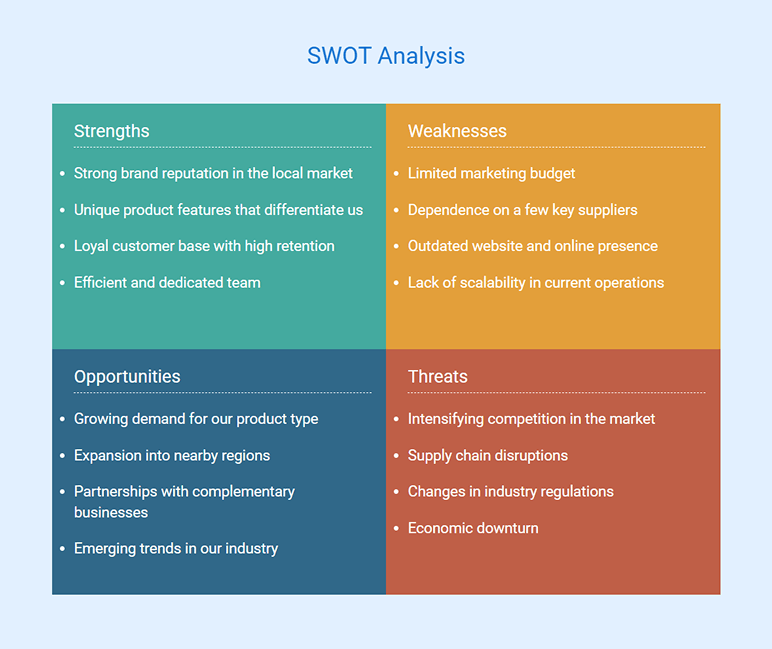
Build a complete SWOT analysis in a 4-quadrant format.
For each quadrant, list 4–5 specific points, not generic ones.
After the table, add one strategic implication per quadrant explaining what I should actually do based on that section.
If the SWOT analysis comes out too broad, iterate by specifying:
Please focus more on [specific strengths, weaknesses, or opportunities] relevant to [specific market conditions or competitors]. Be more specific about external threats and how to use my unique market position in the SWOT.
This gives users a clearer picture of how to narrow down or restructure the prompt to get better outputs. For example, if the initial response is too general, you can focus more on competitive positioning or target customer behavior for a more specific analysis.
Prompt 24: Competitor deep-dive analysis
You are a competitive intelligence analyst.
I need a competitive analysis of [Competitor Name], which offers [describe their product or service]. I compete with them in [market or segment]. My own product is [describe briefly].
Analyze this competitor across five dimensions:
- Product or service offering
- Pricing and packaging
- Messaging and positioning
- Strengths from a customer’s perspective
- Weaknesses or gaps a competitor could exploit
Format the output as a structured table.
Then add one paragraph explaining where I have the most realistic opportunity to win against them.
Prompt 25: Market trend summary
You are a market research analyst.
My business operates in [describe your industry and market segment]. My target customer is [describe]. My main revenue driver is [describe].
Identify the top 5 trends currently shaping this market.
For each trend, explain:
- What is driving it
- How it specifically affects a business like mine
- Whether it represents an opportunity or a threat
- One concrete action I could take in response within the next 6 months
Format the response as a numbered list with a short paragraph for each trend.
If you want to go deeper on this, there is a full guide on how to use ChatGPT for market research that walks through sourcing and validating the data once ChatGPT gives you the framework.
Prompt 26: OKR and quarterly goal setting
You are a business coach specializing in goal-setting frameworks for small businesses.
My main goal for this quarter is [describe it specifically]. My team is [X people]. Key constraints: [time, budget, headcount — whatever is most limiting]. Last quarter, we fell short on [area] because [honest reason].
Build a quarterly OKR plan with:
- 1 company-level Objective (qualitative and motivating)
- 3–4 Key Results with specific, measurable targets
- For each Key Result, 2–3 weekly or bi-weekly actions the team should take
Also, flag the top risk to hitting these OKRs and the warning sign I should watch for around the midpoint.
Prompt 27: Idea stress-test (Red team)
You are a professional devil’s advocate and business critic.
Here is my business idea or strategic decision: [describe it in 2–4 honest sentences].
Your job is to find the flaws before I commit resources.
Give me:
- 5 specific reasons this could fail
- 3 assumptions I might be making that could be wrong
- 2 competitive risks I am probably underestimating
- One question I have not asked myself that I should
Be direct and specific. I do not need encouragement — I need the holes
Prompt 28: Executive summary draft
You are a business writer with experience preparing investor-facing documents.
Here is the core information about my business: [describe your business model, target market, current traction, team, and what you are raising or pitching]. The audience for this summary is [investors / a bank / a strategic partner].
Write a one-page executive summary covering:
- The problem
- The solution
- The target market
- The business model
- Traction to date, or near-term milestones if pre-revenue
- Competitive advantage
- The team
- The ask
Use plain language. No jargon. The goal is for a reader to understand the full picture in under 3 minutes.
ChatGPT prompts for financial planning & forecasting
ChatGPT will not build your financial model. What it will do is help you structure your thinking, spot cash flow risks before they become crises, and understand what your numbers are actually telling you. Think of it as a financial thinking partner, not a calculator.
Prompt 29: Budget allocation plan
My business expects to spend approximately $[total monthly budget] across different operational areas.
The business is a [type of business] that sells [product or service] to [target audience].
Create a suggested monthly budget allocation plan showing how this budget could reasonably be distributed across the most important categories.
Include areas such as marketing, payroll, software and tools, operations, rent or workspace, and contingency funds. Explain the reasoning behind each allocation so it is clear why that portion of the budget should go to that category.
Prompt 30: Cash flow problem analysis
You are a small business financial advisor.
Here is my current cash flow situation:
[Describe it honestly — e.g., “We are profitable on paper but consistently run short on cash in weeks 2–3 of each month. Revenue comes in lumpy, mostly at month-end. Our main expenses are payroll, which is bi-weekly, and rent.”]
Identify the five most common root causes of this type of cash flow problem in small businesses.
For each cause, explain:
- Whether it likely applies to my situation based on what I described
- What the key symptom typically looks like
- One specific action that could help address it
End with a priority-ordered list of the issues I should tackle first to improve cash flow stability.
Prompt 31: 12-month revenue forecast structure
You are a financial modeling advisor.
I’m trying to put together a 12-month revenue forecast for my [type of business].
My revenue model looks like this: [subscription / project-based / product sales / hourly services, etc.]. Right now, I have some basic inputs such as [current monthly revenue, average deal size, churn rate, conversion rate, seasonality, etc.].
I don’t want you to build the forecast. I want help structuring it properly.
Walk me through:
- The key assumptions I should lock in before building anything
- How I should break down revenue (by product, customer type, etc.)
- What a realistic base case vs upside case should look like
- Common mistakes people make with forecasts like this
Focus on getting the setup right so the model actually makes sense.
Prompt 32: Break-even analysis in plain English
You are a small business financial advisor.
I’m trying to understand how much I need to sell each month just to cover my costs.
My business sells [product or service].
Here are the numbers I’m working with:
- Fixed monthly costs: $[amount] (rent, salaries, tools, insurance, etc.)
- Average selling price per unit: $[price]
- Variable cost per unit: $[cost] (materials, delivery, etc.)
Based on this:
- Calculate how many units I need to sell each month to break even
- Show what that translates to in monthly revenue
- Walk me through the math in a simple way
- Then show how this number changes if pricing or costs shift (for example, price drops by 10% or costs increase)
Keep it practical. I want to clearly understand the sales target I need to stay afloat.
Prompt 33: Investor-ready financial narrative
You are a financial storyteller who helps founders communicate numbers to investors clearly.
Here are my key numbers:
[revenue, gross margin, burn rate, runway, growth rate, CAC, LTV, etc.]
I’m raising $[amount], and the funds will go toward [what it will be used for].
Write a short financial narrative I can use in a pitch deck or investor update.
It should:
- Explain what these numbers actually say about the business
- Show how the business is progressing
- Connect the funding ask to clear next steps and growth
Use real numbers from what I’ve shared. Keep it clear and grounded.
ChatGPT prompts for operations & productivity
The highest hidden cost in a small business is not software or overhead. It is the 2 hours a day that founders spend on administrative work that was never planned for. These 4 prompts will not eliminate that time, but they will cut it significantly.
Prompt 34: SOP (Standard Operating Procedure) writer
You are an operations manager who writes clear, numbered SOPs for small business teams.
Here is a description of a task my team performs regularly: [describe the process in your own words — messy notes are fine, stream of consciousness is acceptable].
The person responsible for this task is [role]. The goal is [describe what “done correctly” looks like and why it matters].
Convert this into a clean, structured Standard Operating Procedure that includes: a one-sentence purpose statement, a short list of tools or access required before starting, clear step-by-step numbered instructions with sub-steps where needed, 2-3 common mistakes to avoid, and a simple way to verify the task was completed correctly.
Prompt 35: Meeting summary and action item extractor
You are an executive assistant who specializes in post-meeting documentation.
Here are my raw meeting notes:
[paste notes — messy is fine]
Turn this into something I can actually send or use internally.
Include:
- A short summary of what was discussed
- A clear list of decisions that were made and who made them
- An action item table with: Action Item | Owner | Due Date | Priority
If a deadline isn’t mentioned, mark it as TBD and suggest a reasonable one.
Prompt 36: Weekly project status report
You are a project manager who writes concise updates for busy stakeholders.
Project: [name]
Status: [on track / at risk / delayed]
This week’s progress: [what got done]
Blockers: [what’s slowing things down]
Next steps: [what’s planned next]
Write a concise update that includes:
- A one-line status summary
- Progress made this week
- Current blockers and how we’re handling them
- Priorities for next week
- Any decisions needed from the reader
Keep it short and easy to scan.
Prompt 37: Process improvement analysis
You are a business process improvement consultant.
Here is a workflow our team runs regularly: [describe the process from start to finish, including who performs each step and how long each step typically takes].
The main problems with the process are [describe the issues — for example: too slow, too many handoffs, error-prone, requires constant supervision, etc.].
Identify three specific improvements that could make this workflow more efficient.
For each improvement, explain exactly what should change, how long it would realistically take to implement, the expected time or cost savings, and one practical trade-off or risk to consider.
Focus on practical operational changes rather than recommending new software or systems that would require major implementation.
ChatGPT prompts for business planning (where Upmetrics comes in)
ChatGPT is excellent for thinking through your business concept, drafting narrative sections, and stress-testing your assumptions. What it cannot do is build a financial model, generate professional charts, or produce an investor-ready PDF. Here is how to use both tools together: ChatGPT for ideation, Upmetrics for the finished plan.
Prompt 38: Business concept validation
You are a business strategist who specializes in validating early-stage business concepts.
My idea is: [describe in 2–3 sentences].
Evaluate this concept on four criteria:
- Is there a real problem being solved?
- Is the target customer specific enough to reach?
- Are there paying competitors (market validation)?
- What’s the most likely reason this fails?
Give a 1–5 score on each criterion with a 2-sentence explanation.
Prompt 39: TAM/SAM/SOM market sizing
You’re a market sizing analyst.
My business sells [product/service] to [target customer] in [geographic market].
Help me structure a TAM/SAM/SOM analysis for this opportunity.
For each level (Total Addressable Market, Serviceable Addressable Market, and Serviceable Obtainable Market), explain:
- How to define the boundary for my specific business
- What type of data sources should I use to estimate it (e.g., industry reports, census data, competitor revenue, etc)
- What key assumptions need to be documented for accuracy
Then provide a rough, illustrative estimate using plausible numbers so I can see how the structure works before I gather verified data.
Prompt 40: Executive summary for a business plan
You are an experienced business plan writer.
Here is the core information about my business:
Business name: [name]
What we do: [describe in one sentence]
Target market: [describe]
Revenue model: [describe]
Traction to date: [describe, or note “pre-revenue” if applicable]
Competitive advantage: [describe]
Team: [describe]
Funding ask or plan: [describe]
Write a one-page executive summary in narrative format (not bullet points).
The summary should clearly explain:
- The problem the business addresses
- The solution provided by the product/service
- The market opportunity and why it’s worth pursuing
- Why this team is uniquely positioned to win
- Where the business is headed, including a clear path forward
Keep the tone confident and grounded, avoiding any hype or unsupported claims.
Prompt 41: Business model canvas
You’re a business strategy consultant specializing in the Business Model Canvas framework.
My business is [describe what you do, who you serve, and how you make money].
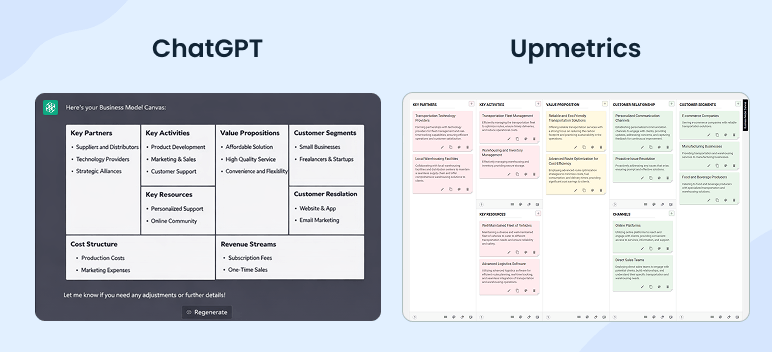
Fill in all 9 boxes of the Business Model Canvas for my business:
- Customer Segments
- Value Propositions
- Channels
- Customer Relationships
- Revenue Streams
- Key Resources
- Key Activities
- Key Partnerships
- Cost Structure
For each box, provide 3–5 specific, realistic entries. After completing the canvas, flag any box where the description suggests a gap or strategic risk that I should address.
Prompt 42: Mission, vision, and values
You’re a brand strategy consultant.
My business is [describe what you do]. My target customer is [describe]. What I care most about in how we operate: [list 2–3 principles]. What I want to be known for in 5 years: [describe your vision of success].
Draft 3 options each for the following:
- Mission statement (why we exist — present tense, under 25 words)
- Vision statement (where we are going — future tense, under 25 words)
- 4–5 core values, with a one-sentence description of what each means in practice at this company
Avoid generic phrases like “integrity” or “excellence” without providing specific context or examples relevant to your business.
Once you have worked through these prompts, you have the raw material for a solid business plan. Getting it into an investor-ready format is where Upmetrics comes in. Upmetrics’ business plan builder structures your content, builds the financial model, generates professional charts, and produces a PDF you can send directly to a bank, investor, or SBA lender.
If you are using ChatGPT specifically for your business plan, that combination gets you from idea to finished document faster than either tool alone. You can read more on ChatGPT business plan or start with the free business plan template.
What ChatGPT isn’t good at (and what to use instead)
ChatGPT is a powerful thinking partner. But treating it like a search engine with perfect, up-to-date knowledge is how you end up with a business plan built on figures the model invented. These are the four areas where I would not rely on it.
| Task | Why ChatGPT falls short | Better alternative |
|---|---|---|
| Real-time market data | Training cutoff means figures can be outdated, estimated, or fabricated entirely | SBA.gov, IBISWorld, Statista, US Census Bureau (census.gov) |
| Final legal documents | Can draft outlines and starting points — not binding or professionally reviewed legal text | A licensed attorney |
| Verified financial models | Structures your thinking well — does not build audit-ready projections with your actual data | Upmetrics, your accountant |
| Current competitor pricing | May reflect outdated pricing or hallucinate figures that sound plausible | Direct research on competitor websites and sales pages |
| Truly original creative strategy | Excellent as a starting point and sounding board — not a substitute for real market insight | Your own research, customer interviews, and iteration |
The practical rule I use: Let ChatGPT help you think, draft, and structure. Verify any statistics, legal content, or financial figures before you act on them or share them with anyone who matters.
For verified small business resources, the SBA’s small business guide is one of the most reliable starting points for U.S.-based founders. For market sizing data, the U.S. Census Bureau is worth bookmarking alongside SBA.gov.
When it comes to business planning specifically, ChatGPT can draft your executive summary and structure your thinking. For the financial model and investor-ready format, dedicated AI business plan tools like Upmetrics close that gap.
For a deeper look at prompt structure, OpenAI’s prompt engineering guide is worth bookmarking.
Conclusion
Every prompt in this article runs on the same principle: give ChatGPT a role, a context, a clear task, and a format. The difference between a generic output and a genuinely useful one almost always comes down to what you put in.
Start with the section most relevant to where your business is right now. Marketing and sales tend to produce the fastest wins. Pick one prompt, swap the [brackets], run it, and iterate.
One thing worth doing that most people skip: save your best outputs in a running doc. Over time, you’ll build a library of prompts tuned to your exact business, your tone, and your customers. That’s worth more than any generic list.
I update this article quarterly as new use cases emerge, so bookmark it and come back.
When those ideas are ready to become a real business plan, here’s where to start. Upmetrics’ free business plan template gives you a structured starting point with guidance built into every section, so you’re not staring at a blank page when it matters most.

