


 Download Now: Free SMART Goal Template
 It’s darn simple to list a few milestones in a business plan, but when you consider all the nuances, you understand how difficult it is to get it right.
The uncertainty is the culprit: (1) what milestones should you include, how many (2) what milestones do investors prefer (3) how to be sure if they aren’t vague or unrealistic (4), and probably a few more.
It ends right here.
In this blog, I’ll help you understand what a milestone is, how they’re different, how and what milestones to include in your plan, and use them to guide your business.
Let me start with my definition of “business milestones”.
What are business milestones?
Business milestones are the key indicators that show real progress in your company’s growth. They connect your strategy to day-to-day activities, show what’s been accomplished, and clarify what needs to happen next.
They even help founders, teams, and investors evaluate whether the business is moving in the right direction.
As a SaaS founder, I see milestones as the moments that prove the business is working. You launch your MVP, get your first paying users, hit a small MRR target, improve activation, or reduce churn.
Setting SMART goals or business milestones is a critical aspect of business planning, and it helps you: (1) map out your goals and track them, (2) adjust your trajectory when needed, and (3) determine when you will reach your goals.
What counts as a good milestone?
New entrepreneurs often confuse milestones with tasks, to-dos, and business goals, but they are all different.
Business milestones vs. goals
Goals describe what you want to achieve, whereas business milestones show clear points that you’re actually getting there.
For instance, growing revenue to $500k is a goal. But hitting $100k in monthly sales by October can be a milestone.
Milestones vs. tasks
A milestone marks a major checkpoint in your progress, while tasks are the smaller actions/steps you take to reach them.
For instance, launching MVP by month 2 is a milestone, whereas finalizing core features, setting up hosting, or internal testing can be considered tasks.
A good milestone is a clear sign that marks real progress, not just another task you finished. It shows you’ve actually moved forward. A solid milestone should be:
- Clear
- Measurable
- Achievable within a realistic timeframe
- Connected to your business model
- Something that moves your business forward
For example,
Not so good milestone: Get sufficient customers in the first year.
Good milestone: Acquire 75 paying customers by Month 6.
How many milestones are expected in a business plan?
For most early-stage business plans, 5-7 milestones are a good number. More than 7 might signal that you don’t know which steps actually matter and feel unfocused. Whereas fewer than 5 usually makes it seem like you haven’t thought through the operational realities of your first year.
The goal isn’t to list everything you might do. It’s to highlight the major checkpoints that show your business is progressing.
7 Essential milestones for your business plan (first year)
I just said you should have at least 5-7 milestones in your plan. And, here are some of the essential ones you might want to consider for the first year.
Why just one year, not 3 or 5? I read a post by Ashley Wright on X that best explains my POV:
“When you’re planning 3, 5, 10-year goals, ask yourself: Why can’t you condense that into one year? The buffer you think you’re creating is actually killing your business.”
Please note: No matter your industry, these milestones apply broadly. Adjust the specifics to match your model, and they’ll fit your plan.
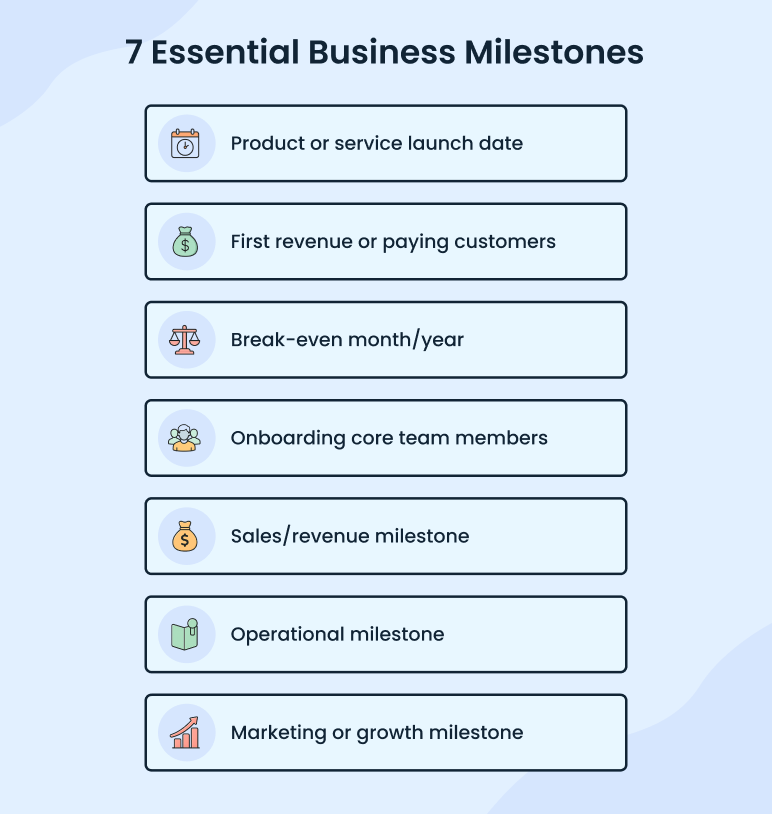
1. Product or service launch date
If you’re an early-stage startup, this has to be your first milestone.
It doesn’t need to be a perfect version of your business offering. For most businesses, this is your MVP, soft launch, trial version, or first batch of services delivered.
Investors often expect clarity on timelines when it comes to product/service launch. (especially software/SaaS products)
“We’re still building the MVP”, “MVP taking 9-12 months to ship.” These are screaming red flags for investors.
Your launch also marks the moment your learning speed increases. Once your product is in the hands of real users, you learn faster, adjust faster, and discover insights you cannot access while planning.
For instance, look at someone like Drew Housten of Dropbox; he didn’t launch with a full product but a short video demo + landing page. This served as their MVP and validated demand before any expensive development.
What if I already have a live product/service?
That’s the best form of validation. If you’re in the early operating stage and have anything like mentioned below to say to investors, you’re the greenest flag as a potential startup to invest in.
- Live product with 50-500 real users (proves demand)
- 30-40% retention rate
- Positive service feedback
- Clear unit economics visible already
2. First revenue or paying customers
Your first paying customers are more than early traction — they’re validation that someone is willing to exchange money for your solution. That’s the real test of your business model.
This milestone doesn’t need big numbers. It needs proof that strangers — not friends or early supporters — find enough value to pay.
Your first revenue is your business model’s “truth moment.”
That first payment is the moment your business stops being a theory and becomes something people actively choose. It also tells you three important things:
- Your offer is priced reasonably
- Your messaging landed
- Your product solves a real problem
This shows investors you’re not guessing anymore — the market has already validated the demand. (even if it’s just a small group)
Let’s say: A local home-cleaning service secured 18 paying customers by Month 2 via direct outreach. It means their offer and pricing matched real customer needs.
In short, you’re not looking at the revenue just yet; you’re looking at the validation and demand.
3. Break-even month/year
Your break-even point is where your revenue covers your monthly costs. You’re not profitable yet, but the business can sustain itself without constant outside support.
This milestone shows you understand your numbers, your pricing, and your operating model well enough to predict when the business stops burning cash.
It’s a founder’s tendency to chase big targets, but investors/lenders pay close attention to when the business stops depending on external cash to function. This also helps investors understand:
- Your pricing makes sense
- Your operations are efficient
- Your growth plan isn’t built solely on a funding cap.
You don’t necessarily need to break even in the first year. Clearly show you understand what needs to be done to stop burning cash, and when it’s likely to happen.
4. Onboarding core team members
Your core team members are the people who shape how your business will operate. This milestone shows you’re building the capability needed to grow, not trying to do everything alone.
The wrong early team slows you down. The right early team expands what the business can do, how quickly it learns and adapts, and how well it executes.
This milestone is necessary because:
- A founder doing everything doesn’t scale
- Bringing in the right talent stabilizes operations
- Execution becomes consistent instead of reactive
- The business becomes transferable (not person-dependent)
- Investors see that you understand which roles truly matter
This milestone isn’t about increasing the headcount, but reducing friction. You’re bringing in the right people to own functions and strengthen the parts of the business that hold everything together.
When written well, this milestone shows that you’ve thought clearly about who you need, why you need them, and when they become essential.
If you already have a core team in place, shift your focus to optimizing the operations.
5. Sales/revenue milestone
After the key early hires, you need one clear revenue target that anchors your growth for the year. This doesn’t have to be a huge number — it just needs to match your business model and operating capacity.
A good sales milestone tells you the rhythm at which your business can grow without overextending itself. It shows whether your current pricing, acquisition channels, and operations can handle real demand.
This milestone helps you understand:
- If your acquisition plan works
- If your funnel is healthy
- If your pricing supports growth
- If your product is delivering enough value
- If customers come back or churn out
Investors look at your first revenue targets to judge how quickly you can turn activity into income and support real growth.
It doesn’t matter whether you choose MRR, total revenue, retained clients, or order volume — what matters is that the milestone reflects traction that you can repeat and improve.
6. Operational milestone
An operational milestone is anything that makes your delivery more reliable, predictable, or scalable. This could be setting up equipment, establishing a workflow, improving onboarding, securing licenses, or automating a part of your process.
Customers might not see these improvements. But they directly affect how quickly they receive their order or service and how reliable the experience feels. Investors pay close attention to this — because operational stability is what keeps a business from collapsing under its own weight.
A solid operational milestone matters because it helps you:
- Deliver consistently
- Reduce errors or delays
- Lower service or production costs
- Improve customer experience
- Handle more volume without burning out
- Build a foundation for expansion
Generally, most founders present revenue milestones. But operational milestones often matter more. If you highlight the operational changes that make the revenue sustainable, you instantly develop credibility.
Let’s take an example:
Suppose a small bakery, during its operational reviews, decides to invest in machinery that would cut prep time by 30%. By implementing this, they’ll free 40 labor hours/month. This not only improved the margin but also increased the number of daily batches they could produce.
It didn’t look like a major milestone or change, but if you look at the impact, massive. That’s something you should be looking for.
7. Marketing or growth milestone
In this milestone, you’ll show how you plan to attract customers consistently. It doesn’t need to be complicated — it just needs to show that you have a real way to reach people.
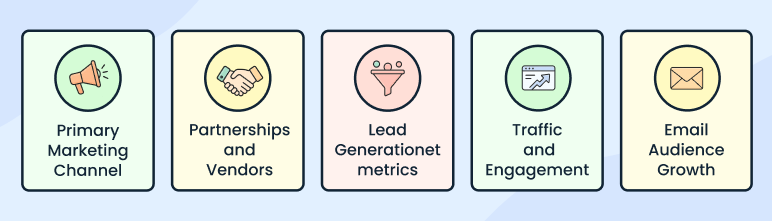
A marketing milestone isn’t about exposure — it’s about proving that customers can find you without manual effort.
Anyone can get a spike in traffic from a one-time push. A real growth milestone shows repeatable traction: something that keeps bringing customers in even when you’re not actively chasing each one.
For example, your growth milestones might look like this:
- Launch the main acquisition channel by Month 2 and generate steady weekly leads.
- Secure a referral partner by Month 3 that sends qualified leads monthly.
- Reach 80–100 qualified leads per month by Month 4.
- Hit 1,000–1,500 monthly visitors by Month 5.
- Grow the email list to 1,000 subscribers by Month 6.
This milestone tells investors you’re not relying on hope or virality. You have a predictable path for demand — something you can scale with time, budget, or resources.
A clear growth milestone proves that once the product is ready, the market can actually reach you without friction or unpredictability.
How do I present these milestones in my business plan?
Fact: Investors just skim the milestone section to judge how well you understand your own execution path. They don’t prefer long explanations. So, keep every milestone simple and to the point.
Here’s a quick and the most practical guide on presenting your milestones in your business plan.
1. Use a table or short bullet list
Each of your milestones should have three components:
- What it is
- When you’ll achieve it
- Why it matter (brief context)
Keep each milestone tight, one sentence per milestone is enough. That’s all the information investors need.
2. Put them in chronological order
List your milestones in chronological order, this shows you understand the sequence in which the business actually grows. For example:
launch → first customers → revenue → operations → team → growth.
3. Match the tone to your audience
Make sure your writing reflects the purpose and audience of your plan:
- Investors want realism and traction indicators
- Banks want stability and repayment logic
- Internal plans want execution detail
Follow these 3 steps, and your milestones are set into your plan, reading for lenders/investors to see.
Where should you include milestones in your business plan?
Business milestones usually belong in the company overview or operations/execution section of your plan. Both of these placements are considered standard, and investors are used to seeing them there.
Business Plan Milestone Examples
I’ve listed a few business plan milestone examples to help you understand what good milestones look like: clear, measurable, and tied to real progress.
We’ve kept diversity in examples, so no matter what industry you belong to, you have something to refer to.
1. Coffee Shop
| Milestone | Timeline | Why it matters |
|---|---|---|
| Sign lease after site approval | Month 1-2 | Accounts for negotiations, permits, and landlord conditions. |
| Complete buildout + equipment setup | Month 3-4 | Prepares the shop for operations |
| Soft launch | Month 4 | First real customer interactions |
| Reach 90–120 daily footfall | Month 6 | Shows steady demand for a neighborhood shop. |
| Break-even | Month 13-14 | Business covers its operating costs |
2. Online Service Business
| Milestone | Timeline | Why it matters |
|---|---|---|
| Launch website + booking system | Week 3-4 | Establishes your digital presence |
| First 10-20 paying clients | Month 2 | Confirms your offer is working |
| Sign 1 referral partner | Month 4 | Creates a recurring lead source |
| Hire part-time support | Month 6 | Expands delivery capacity |
| Reach $6-8k monthly revenue | Month 10-12 | Shows consistent, sustainable income |
3. SaaS Business
| Milestone | Timeline | Why it matters |
|---|---|---|
| MVP ready with core feature set | Month 3-4 | First usable version to test real behavior |
| Onboard 40-50 beta users | Month 4-6 | Collects early feedback and improves UX |
| First 15–20 paying users | Month 6–7 | Validates willingness to pay |
| Full product launch | Month 8–9 | Opens the product to a larger market |
| Hit $5–7k MRR | Month 12 | Shows predictable revenue traction |
4. Retail Business
| Milestone | Timeline | Why it matters |
|---|---|---|
| Sign lease + complete setup | Month 1–2 | Physical space ready for sales |
| Launch store with initial inventory | Month 3–4 | Enables first sales cycle |
| 350–450 monthly visitors | Month 5–6 | Measures footfall and interest |
| $18–22k monthly sales | Month 12–14 | Indicates improving conversions |
| Break-even | Month 14–18 | Store covers monthly costs |
5. E-commerce Business
| Milestone | Timeline | Why it matters |
|---|---|---|
| Launch product line & store | Month 1–2 | Starts the first sales cycle. |
| First 100 orders | Month 3–4 | Confirms early demand. |
| 2.5–3% conversion rate | Month 6 | Shows visitors are buying consistently. |
| Secure fulfillment partner | Month 7–8 | Keeps delivery reliable as orders grow. |
| $20–30k monthly revenue | Month 12 | Reflects steady traffic + repeat buyers. |
Can I reuse (or copy) these examples for my plan?
You should use them as inspiration, but I won’t suggest copying them exactly unless they match your business. Investors can spot template milestones instantly.
What you want instead is to adapt the structure and adjust the numbers so they fit your model, your resources, and your constraints.
Business milestones as a roadmap for your business
Milestones are more than just a small section of your plan; they turn your first year into a structured timeline. They show what happens first, what follows next, and how each step builds toward a stable business.
Use your business milestones to guide your business. If I have to start from square 0, here’s how I’ll use the plan and use my milestones:
- Consider it your first-year checklist
- Review your milestones and targets monthly
- Use them to guide hiring and spending
- Update them as business evolves
- Ensure the team and partners share the same goal
Milestones only work when they’re used, not just written. And, hope this article has provided you with practical insights not just on writing, but using them for your business success.
On a lighter note, if you ever need assistance writing a business plan, consider Upmetrics. A renowned planning platform to help you write your plan, build financial projections, and develop a compelling pitch deck.
Now, list your milestones and complete the plan you started.