


Mess isn’t going out of style. That’s the whole reason cleaning became a $100 billion-plus U.S. market, and why people keep sizing it up as a business worth starting.
But demand was never your problem. The cleaning industry is in a sustained labor shortage. Wages are up, and customers want same-day answers, and the operators winning right now are the ones running recurring residential routes, picking a niche, and letting software do the quoting.
So don’t read the numbers below as trivia. Read them as planning signals: where the money’s growing, what’s making it harder to grow, and what to nail down before you pick a segment, set prices, or make your first hire.
U.S. & global market size
The cleaning industry is bigger than most people assume, and not by a small margin. Here are the headline numbers worth knowing, with a source on every line:
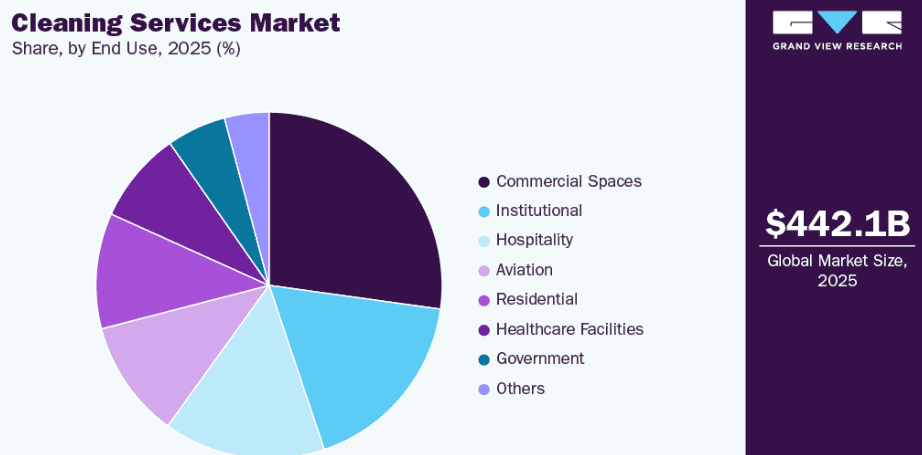
- Global market: ~$442.09 billion in 2025, projected to hit $770.76 billion by 2033 at a 7.3% CAGR. (Grand View Research)
- U.S. janitorial services: ~$112 billion in 2026. (IBISWorld)
- U.S. growth: ~1.8% in 2026, a 2.7% CAGR over the past five years. (IBISWorld)
- North America: the largest region at 31.85% of the global market in 2025. (Grand View Research)
Industry structure
Knowing the market is worth more than $100 billion is useful. Knowing how that money is split is even more useful because the structure is what tells you whether you can actually get in. Here’s how the U.S. cleaning market breaks down:
- There are about 1.25 million janitorial businesses in the U.S. in 2026 (1,254,202), up from 1,227,883 in 2025, a count that has grown 4.2% a year on average over five years but slowed to 2.1% in the most recent year. (IBISWorld)
- No single company controls the market, and even the biggest player holds only a small slice of it. (IBISWorld)
- The average janitorial business employs just 1.9 people. (IBISWorld)
- Commercial work makes up close to 89% of U.S. janitorial revenue. (Grand View Research)
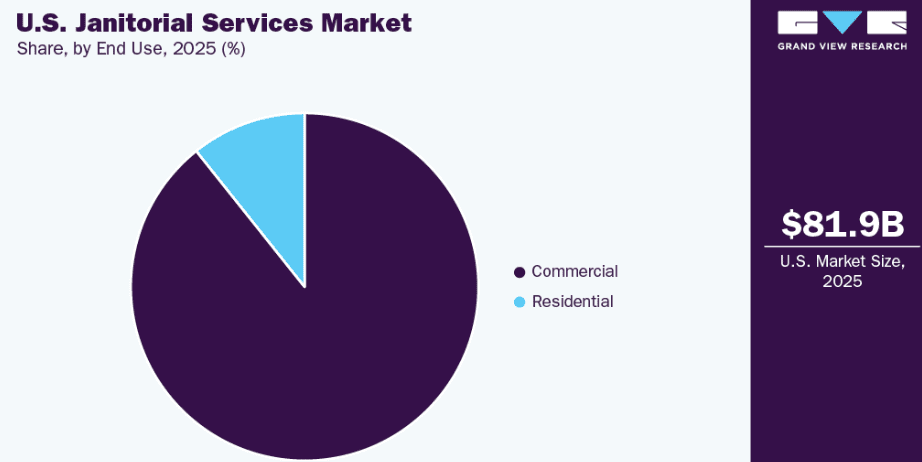
- U.S. janitorial revenue has grown at a 2.7% annual rate over five years, slower than the 4.2% yearly rise in the number of businesses. (IBISWorld)
The same fragmentation shows up at the state level, where even single states hold tens of thousands of competing operators:
- New York alone is a $9.7 billion janitorial market with about 71,014 businesses. (IBISWorld)
- Illinois supports about 46,042 janitorial businesses and 132,811 workers in a $5.8 billion market. (IBISWorld)
That fragmentation creates room to enter, but it also explains why pricing gets messy. When thousands of small operators serve the same local market, some underprice jobs just to stay busy, which makes cleaning look like a low-margin business from the outside.
Labor & workforce
Demand isn’t the hardest part of running a cleaning business in 2026. It’s the staffing. Here’s what the labor side actually looks like:
- About 2.4 million people work as janitors and building cleaners, with a median wage of $17.27 an hour ($35,930 a year) in 2024. (U.S. Bureau of Labor Statistics)
- The most recent 2025 data puts the median a bit higher, at $17.71 an hour. (U.S. Bureau of Labor Statistics, May 2025)
- Employment is projected to grow just 2% through 2034, yet about 351,300 jobs are open every year. (U.S. Bureau of Labor Statistics)
- The lowest-paid 10% earn under $13.26 an hour; the top 10% earn over $23.58. (U.S. Bureau of Labor Statistics)
- With the average cleaning business running on just 1.9 employees, a single departure can wipe out half a crew. (IBISWorld)
- The janitorial industry itself employed about 2.29 million people in 2025, growing 1.8% a year over five years. (IBISWorld)
- The average cleaning business employs more people than it did five years ago, and revenue per employee has risen, too. (IBISWorld)
The owners who pull ahead are the ones who can actually staff the jobs they’ve already won, which is why we would tell anyone to treat hiring, pay, and retention as the real growth plan, not the marketing. A structured hiring process is what makes that possible once you’re staffing more than yourself.
Pricing power & profitability
Cleaning operators have more pricing power than they use. For years, most left rates flat while their costs climbed, and the margin quietly disappeared. The ones making real money in 2026 are simply the ones who finally started charging for it.
- Janitorial service prices have climbed for over a decade and jumped sharply in early 2026. (U.S. Bureau of Labor Statistics, via FRED)
- With industry revenue projected to rise just 1.8% in 2026, growth is too slow to carry you, so margin has to come from pricing and efficiency rather than volume. (IBISWorld)
- The median cleaner wage rose to $17.71 an hour in 2025 from $14.31 in 2021, about 24% in four years. (U.S. Bureau of Labor Statistics, May 2025 OEWS)
- The average cleaning business owner earns about $127,973 a year. (ZipRecruiter)
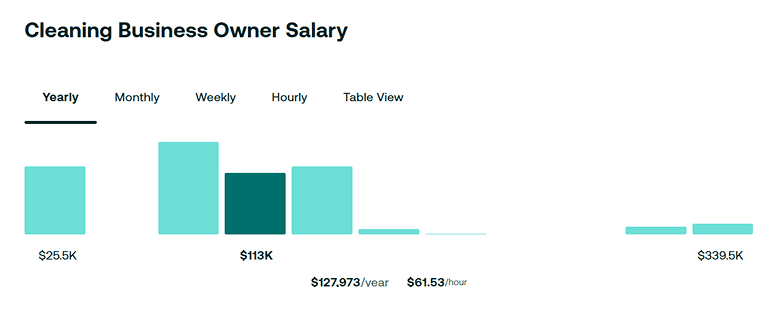
- Most owners make between $92,000 and $145,500. (ZipRecruiter)
- Cleaning and janitorial supervisors earn a $25.64 mean hourly wage, about $53,320 a year, across 178,760 jobs. (U.S. Bureau of Labor Statistics, May 2025)
Residential vs commercial
Commercial is the bigger market, but residential is the faster-growing one and by far the easier place to build cash flow in your first year. The smart move is choosing the one that matches the business you can actually run today, then growing into the other once your expansion plan and systems can carry it.
Here’s how the two really compare, and where we would point you depending on where you’re starting from.
Residential cleaning
Residential is winning the growth race because households have changed how they think about cleaning. It used to be an occasional splurge. Now it’s a standing line in the family budget, closer to lawn care or a streaming subscription than a luxury.
- 41% of U.S. households now use a recurring cleaning service. (Grand View Research)
- 49% of urban consumers hire a cleaner monthly, compared with 22% in rural areas. (Grand View Research)
- 58% of dual-income households regularly outsource cleaning. (Grand View Research)
What we want you to notice is that recurring behavior, not the growth rate, is the real prize. A client on a weekly or biweekly schedule turns a one-time sale into predictable revenue, easier scheduling, and tighter routes, which is what makes a small residential operation actually profitable.
The trade-off is fragility. Residential clients are quick to leave if you miss a clean, reply slowly, or send a different person every visit. You grow fast in this segment, but only if your service is consistent enough to keep the routes you build.
Commercial cleaning
If residential is the faster lane, commercial is the wider one. Most of the money in cleaning still flows through offices, schools, healthcare facilities, and other large buildings that need repeat service at a scale no home ever will.
- The global cleaning services market is worth about $442.09 billion in 2025 and is projected to reach $770.76 billion by 2033, a 7.3% CAGR. (Grand View Research)
- By a narrower definition, the U.S. janitorial services market is about $84 billion in 2026, on track for $105.62 billion by 2033 at 3.3% a year. (Grand View Research)
- In 2026, 68% of consumers will only use a business rated four stars or higher, up sharply from 55% a year earlier. (BrightLocal)
The appeal here is stability. Commercial contracts run longer, smooth out the seasonality that hits home cleaning, and give you fewer, larger accounts to manage instead of dozens of small ones.
The cost of that stability is a higher bar to entry. Before they’ll sign, commercial buyers want insurance, background checks, formal proposals, proof you can cover shifts, and often the capacity to service several sites.
How customers book, rebook, and choose cleaning services
The customer has changed. In both home and commercial cleaning, people now expect to find, book, and pay you online, the same way they handle everything else, and that expectation is reshaping who wins the work.
- 62% of cleaning bookings now happen through mobile apps and online platforms. (Grand View Research)
- In 2026, 68% of consumers will only use a business rated four stars or higher, up sharply from 55% a year earlier. (BrightLocal)
The lesson for a new operator is direct. If booking you is harder than booking the cleaner down the street, you lose the job before you ever quote it, so online scheduling and a fast reply are no longer optional.
And recurring revenue is where the two segments finally agree. A standing client, residential route, or commercial contract is worth far more than a stack of one-time jobs, which makes converting one-offs into recurring schedules the most valuable thing most operators can focus on this year. A few simple customer loyalty strategies go a long way toward keeping those clients on the calendar.
Tech & AI adoption
Cleaning still gets done by people, supplies, and time. That part hasn’t changed. What’s changed is everything around the job: quoting, scheduling, reminders, invoicing, payments, routing, reviews, and follow-ups. That’s where the better-run cleaning businesses are pulling away, and it’s the cheapest edge a new operator can buy.
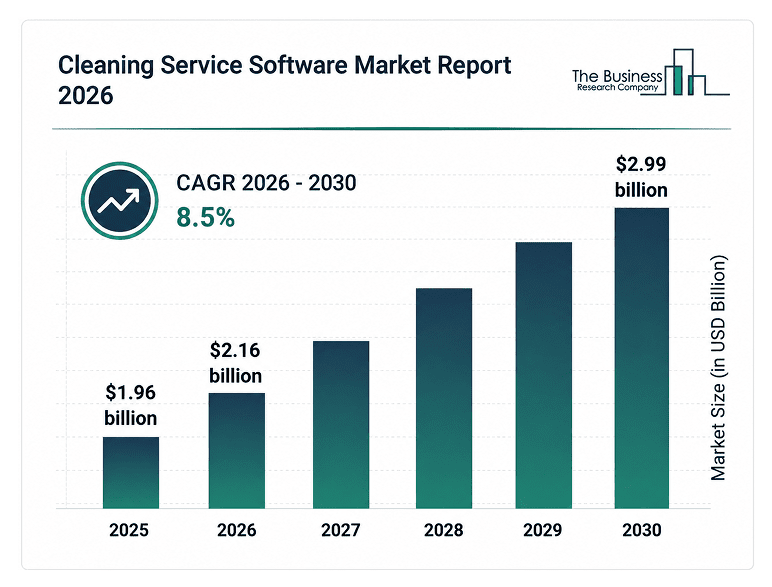
- The global cleaning service software market is growing from $1.96 billion in 2025 to about $2.16 billion in 2026, on track for $2.99 billion by 2030. (The Business Research Company)
- About 52% of home service owners now use AI day-to-day, but cleaning lags at 50% adoption, the lowest alongside lawn care. (Jobber 2026 Home Service Trends Report)
- Among AI users, 54% use it for quoting, 52% for invoicing, and 51% for business writing. (Jobber 2026 Home Service Trends Report)
- Only 12% of cleaning businesses saw major job-size increases last year, the lowest of any trade. (Jobber 2026 Home Service Trends Report)
- Cleaning pros are the fastest lead responders of any trade, with 26% replying within an hour. (Jobber 2026 Home Service Trends Report)
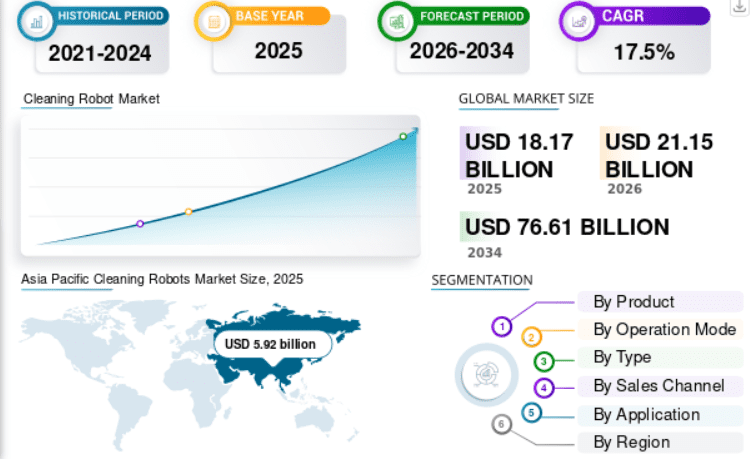
- The global cleaning robot market is projected to grow from $21.15 billion in 2026 to $76.61 billion by 2034, a 17.5% CAGR. (Fortune Business Insights)
Green cleaning & specialty niches
Green cleaning has become something buyers screen for, especially commercial buyers, property managers, schools, and healthcare facilities. And beyond green, the operators making the most per job aren’t generalists. They’ve picked a specialty that pays a premium for training and reliability. Here’s where that’s actually happening.
Green cleaning is now table stakes.
You don’t have to brand yourself “eco-friendly,” but ignoring it closes doors, because customers increasingly treat product safety and chemical use as a deciding factor.
- 78% of consumers globally now prioritize environmentally responsible cleaning. (Grand View Research)
- 41% of consumers actively prefer eco-friendly cleaning products. (Grand View Research)
Our take: for residential, green is a positioning choice that helps you stand out. For commercial, it’s closer to a requirement, and the building data backs that up.
Commercial buyers are tied to green-building standards.
The reason commercial cleaning keeps pulling toward green is that the buildings themselves are certified, and certified buildings want vendors who can document safer products and compliant processes.
- The top 10 U.S. states certified 1,262 LEED projects in 2025. (USGBC, via Green Home Builder)
- Massachusetts led in 2025 with 121 certified projects and 4.24 sq ft per capita. (USGBC, via Green Home Builder)
- Washington, D.C., tops the nation at 49.20 LEED sq ft per capita across 115 projects. (USGBC, via Green Home Builder)
If you want commercial contracts in these markets, being able to show green-certified products and trained crews isn’t a bonus; it’s how you get on the shortlist.
Specialty niches pay a premium.
This is where job value climbs. The same cleaning labor earns far more when it carries compliance, training, and reliability that the average crew can’t offer.
- The healthcare environmental services market is about $58 billion in 2026, growing 7.75% to $84 billion by 2031. (Mordor Intelligence)
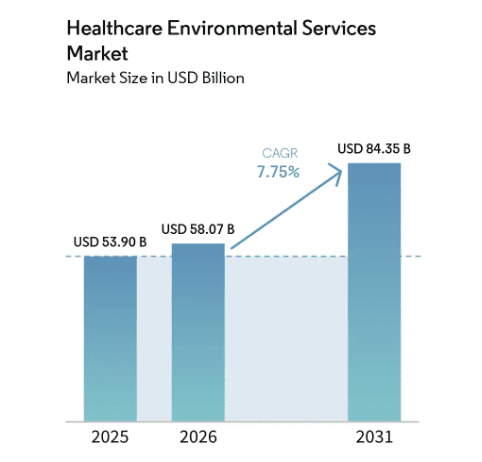
Healthcare is the clearest example of why specializing pays. It demands infection-control training, documentation, and consistency that most general cleaners can’t deliver, which is exactly why it commands higher contract values.
The same logic applies to post-construction and vacation-rental turnover: more skill and reliability are required, so less price competition and better margins.
What these numbers mean for new operators
The stats above point to a promising space to start a cleaning company in. Demand is steady, the market is large, and recurring work is becoming the norm. But before you read all that as a green light, we would look harder at the numbers underneath it, especially the wage data, so you know exactly what you’re walking into.
Cleaner pay has been climbing faster than the prices operators charge, so your single biggest cost keeps rising whether or not you raise your rates. That’s what turns a busy cleaning business into a broken one. You can be fully booked and still lose money if you priced the work two years ago and never adjusted.
So we would plan around that reality from the start. Pick jobs you can repeat, route, and staff without scrambling, rather than chasing whichever segment looks biggest. Start where a missed shift is survivable. You can reschedule a residential clean, but not a daily commercial contract. And judge the business by what each route actually earns you, not by how full the calendar looks.
Here are the first 5 numbers before you write the plan
- $112 billion U.S. janitorial services market in 2026. (IBISWorld)
- 89% of U.S. janitorial revenue is commercial. (Grand View Research)
- 41% of households use a recurring cleaning service. (Grand View Research)
- 2.4 million+ U.S. janitors and cleaners. (U.S. Bureau of Labor Statistics)
- $17.71/hour median cleaner wage. (2025). (U.S. Bureau of Labor Statistics)
Conclusion
The cleaning industry is easy to enter and easy to underestimate. That gap is the whole story.
These numbers look like a green light, but we read them as a reminder that demand was never the hard part. What separates the operators who last is dull on paper: consistent crews, tight routes, prices that cover real costs, and clients who rebook. Less exciting than “$112 billion market”, and exactly what the data is quietly telling you to build.
If you’re still researching, treat every stat here as a planning input, not a reassurance. Let them shape your service mix, hiring, pricing, and cash flow before you take on more than you can deliver. That’s the difference between a business plan and a wish, and between a cleaning business that grows and one that just stays busy.
Build Your Cleaning Business Plan
Turn industry statistics, pricing, staffing, and market insights into a clear business plan.


Upmetrics
Upmetrics is the #1 business planning software that helps entrepreneurs and business owners create investment-ready business plans using AI. We regularly share business planning insights on our blog. Check out the Upmetrics blog for such interesting reads. Read more