


 Download Now: Financial Statements Template
Lounge businesses have different themes, different crowds. But behind the scenes? They all work in similar ways. People show up, stay for a while, spend some money, and hopefully come back again.
But many lounge business plans go wrong because they sound like mood boards. Plenty of talk about vibes, lighting, and atmosphere, but very little about how the place actually runs or pays its bills. Lenders, investors, and landlords usually lose interest right there. Not because the idea is bad, but because the plan doesn’t answer the questions they care about.
This guide exists to fix that problem.
It explains how to write a lounge business plan that focuses on the practical details. How the lounge earns revenue. How seating and capacity are managed. What the numbers look like on slow weekdays. And how to present all of this clearly in a written plan.
If you want to understand what a good plan sounds like and holds up under scrutiny, this is where you start.
How to Use This Guide
This guide isn’t meant to be read once and forgotten. It’s meant to be used while you are actually writing a lounge business plan, section by section.
Start by reading through the full guide to understand how lounge businesses are evaluated. Most lounges fail on paper. Not because the idea is weak. But the plan overlooks how the business actually operates. This guide is structured to keep you focused on the parts reviewers care about most.
Next, decide who the plan is for. If you’re preparing a business plan for a lender or investor, pay close attention to the:
- Revenue logic
- Cost structure
- And break-even explanations
If the plan is for a landlord or leasing agent, focus more on location fit, operating hours, customer behavior, and how the business manages risk inside the space. The underlying numbers should stay the same. Only the emphasis changes.
Use each section of the guide as a checklist.
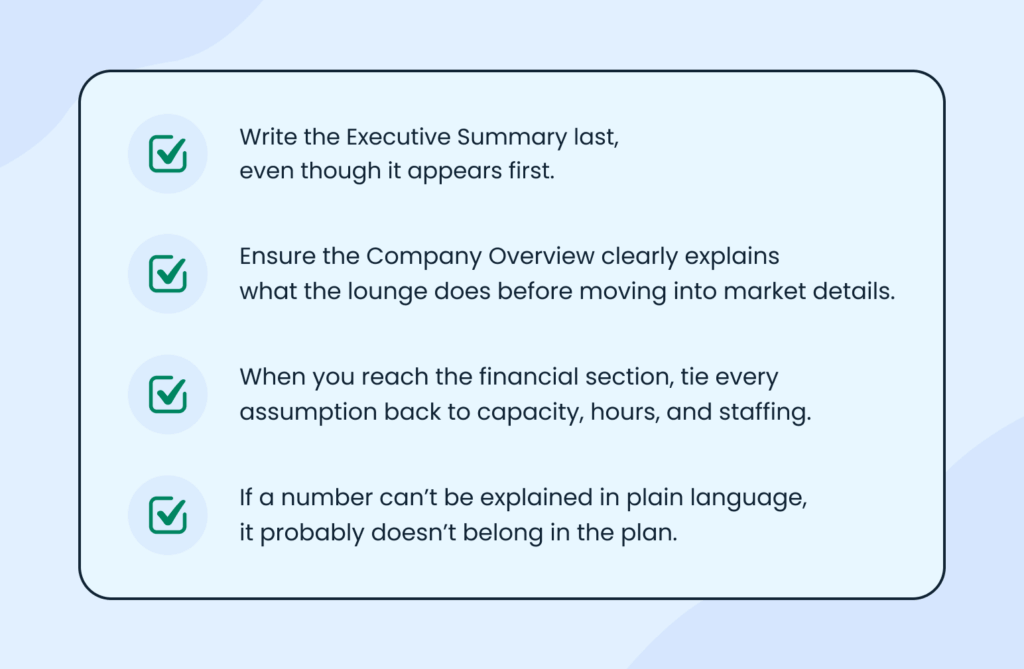
Don’t try to make the plan sound impressive. Reviewers care about believability. Clear explanations, realistic assumptions, and simple math carry more weight than big promises.
Treat this guide as a framework. Not a script. Feel free to adjust examples to fit your lounge concept and local market. As long as the plan shows how the business operates, earns revenue, and covers its obligations, it will be easy for others to take it seriously.
Let’s begin…
Executive Summary
The executive summary carries the most weight in the entire business plan. In many cases, lounge plans are approved or rejected based on this section alone.
It should give a clear picture of the business without forcing the reader to dig through the rest of the document. By the end of this section, it should be clear what the lounge is, who it’s for, how revenue is generated, and why the concept works.
Important: When writing the executive summary, be explicit about what stage the business is in. Most lounge plans are written for a new business preparing to launch, not an existing operation. State this clearly so reviewers understand they are evaluating a startup, not historical performance.
Business Snapshot
Begin with a short overview of the lounge. Explain the concept in simple terms and state the lounge type, such as gaming, hookah, social, or a hybrid model.
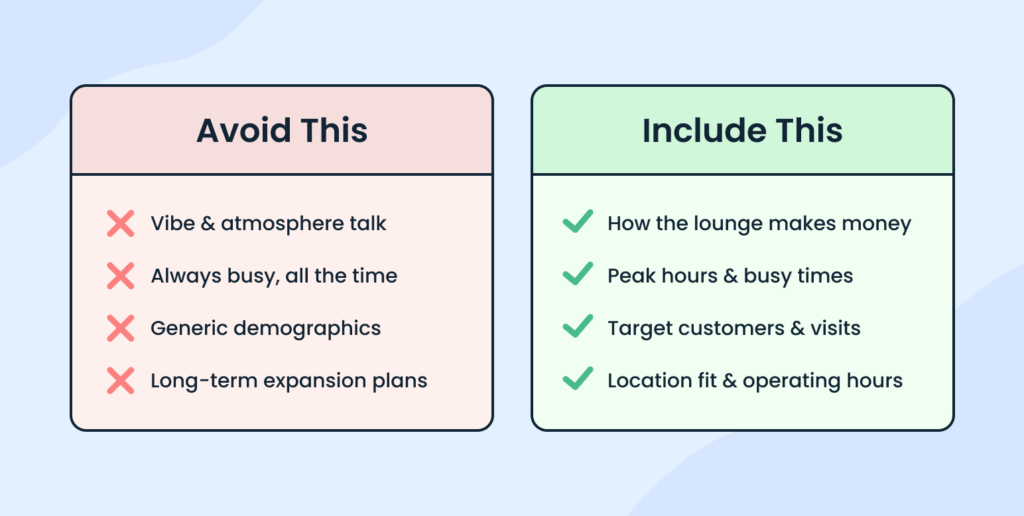
Avoid long descriptions of ambiance or themes. Focus on what the business does and how customers use the space.
How the Lounge Makes Money
Next, clearly state the primary revenue model. This might be time-based usage, session pricing, reservations, or memberships.
Mention supporting revenue streams only briefly. The reader should understand that the business can cover its core costs through its main offering, not extras.
Customers and Demand Timing
Explain who the typical customers are and when they visit. Emphasize evenings and weekends, group visits, and longer stays. Acknowledge that demand is uneven and that the business is designed around peak periods.
Location and Fit
Briefly explain why the location works for a lounge. This is especially important for landlords. Mention operating hours, compatibility with nearby businesses, and basic operational controls.
Purpose of the Plan
End by stating why the plan exists.
If the plan is for a landlord, emphasize lease fit, operating hours, and how the business manages risk inside the space. If the plan is for lenders or investors, emphasize revenue logic, cost control, and break-even clarity.
The numbers don’t change. Only the reviewer lens does.
Lastly, the executive summary should feel grounded, confident, and easy to understand. If this section works, the rest of the plan gets a fair read.
Company Overview
The company overview sets context. It explains what the lounge is at a business level before the reader evaluates the market, operations, or numbers. This section should answer two questions clearly: What kind of business is this? How is it set up to operate?
Business at a Practical Level
Start by explaining what type of lounge this is and what category it falls into. This could be a gaming lounge, hookah lounge, social lounge, or mixed-use concept.
Keep this factual. Avoid storytelling or branding language here. The reader should understand what the business offers and how customers generally use the space.
Business structure
Next, explain the business’s structure. Most lounges operate as single-location businesses, often set up as limited liability entities to manage risk.
If the plan is for a first location, say so. If expansion is a long-term goal, mention it briefly without making it the focus. Reviewers care more about whether the first location works.
Operating Model
Use this part to explain how the lounge functions day to day at a high level. Lounges aren’t high-turnover businesses. They depend on managing capacity, visit length, and peak hours.
This is where you reinforce that the business is built around predictable usage patterns rather than constant foot traffic.
Ownership and Management Involvement
State who owns the business and how involved they are in operations. If the owner is active in daily management, make that clear. This often reduces perceived risk, especially in early-stage lounge businesses.
Avoid listing resumes. Focus on involvement and responsibility.
Readiness and Compliance
This section is especially important for lounges. Licensing and approvals directly affect cost and timing. Confirm that the business is prepared to operate responsibly and within regulations, including:
- Required licenses and permits
- Occupancy and fire code limits
- Proper insurance coverage
Do not list insurance broadly. For alcohol-serving lounges, specify Liquor Liability Insurance. Under U.S. Dram Shop laws, a business can be held responsible if a customer over-consumes and later causes harm. Carrying this coverage shows the business is prepared for legal risk.
Keep the overview clear and grounded. It should make the rest of the plan easier to follow, not repeat it.
Market Analysis
The market analysis proves that the lounge belongs where it plans to operate, not in theory but in real life.
Reviewers read the market analysis to answer one basic question: Will people actually come here, often enough, at the right times? Your job is to make that answer obvious without overloading them with data.
Define the Market Clearly
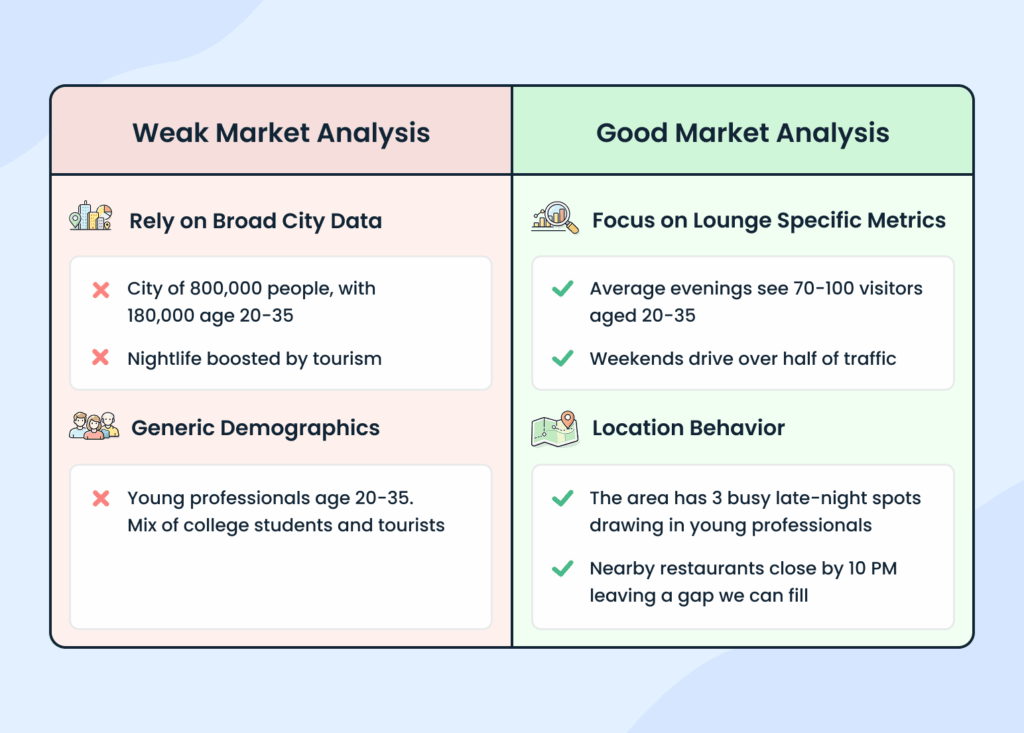
Start by explaining what market the lounge serves. Avoid big, vague areas like an entire city or metro region.
A lounge usually pulls customers from a practical radius. People who live nearby, work nearby, or already spend evenings in the area. Define the market in terms of distance, travel time, or neighborhood clusters rather than population size alone.
This helps reviewers understand that demand is local and repeatable, not theoretical.
Why Demand Exists
Next, explain why people would visit this lounge. Focus on behavior, not trends.
Cover questions like:
- What draws people to this area in the evenings or on weekends?
- What are they already doing nearby?
- Why does a lounge fit naturally into that routine?
Demand drivers might include restaurants, campuses, nightlife zones, dense housing, or limited entertainment alternatives. Keep it practical and tied to how people actually spend their time.
Timing and Visit Patterns
Lounges live and die by timing. This section should clearly state when demand is strongest and when it’s lighter.
Acknowledge that weekdays are usually slower and weekends are stronger. This doesn’t weaken the plan. It strengthens it. Reviewers expect honesty here.
Explain how the business is designed around peak windows rather than assuming steady traffic all day.
Target Customer Description by Behavior
You don’t need deep demographics. Age ranges and income brackets matter less than habits.
Focus on:
- How big is the group size
- Spending behavior during a visit
- How long customers stay
- How often do they return
- What they tend to buy once inside
This helps connect the market analysis directly to the revenue model without jumping ahead to financials.
Location Fit and Constraints
If the plan will be shared with a landlord, this part is critical.
For lounges, the main risks are noise and loitering. Address them clearly. Explain how sound levels will be controlled, including door management, music volume limits, and interior sound treatment where needed.
State how loitering will be prevented. Outline clear closing procedures, staff presence at entry and exit points, and policies that discourage guests from gathering outside.
Specify that staff will walk the building perimeter at least once every hour to monitor noise, check for guests lingering outside, and ensure the sidewalk and surrounding area remain clean.
Also mention parking, crowd flow, and operating hours where relevant.
This shows the business can operate without causing complaints or issues with nearby residents.
Competitive Environment
Competition should be viewed broadly. Other lounges are only part of the picture.
Include your direct competitors, such as other lounges operats nearby your location, and indirect competitors such as bars, cafes, cinemas, or at-home entertainment. The goal isn’t to claim there’s no competition, but to explain why customers would choose this lounge and return regularly.
Avoid attacking competitors. Focus on positioning and fit instead.
What Reviewers Care About
| Reviewer Type | Primary Focus | What they look for in the market section |
|---|---|---|
| Lenders and Investors | Demand and revenue reliability | Evidence that demand is real, repeatable, and based on clear usage patterns; revenue expectations aligned with how customers actually behave in the local market |
| Landlords | Tenant and property fit | Who the customers are, when they visit, how they behave on site, and whether the business complements the property environment |
| All Reviewers | Clarity and relevance | Direct answers tied to location, timing, and customer behavior; avoidance of broad or generic market claims |

Location and Layout Planning
This section explains how the physical space supports the business model. It’s not about design preferences. It’s about whether the lounge can operate smoothly, safely, and predictably inside the chosen location.
Reviewers use this section to sanity-check the plan. If the layout doesn’t align with how the lounge earns revenue, everything else starts to feel shaky.
Type of Space Needed
Begin by explaining which type of commercial space works best for this lounge. Most lounges need open, flexible layouts that support seated or station-based use rather than tightly packed standing crowds.
The goal is visibility and control. Staff should be able to see the floor easily, move between groups, and manage sessions without bottlenecks.
Capacity Support
Next, connect the layout directly to capacity management. Seating, tables, or stations should match expected group sizes and average visit length.
This is where you show that capacity limits are intentional. The space is designed to stay comfortable during peak hours, not to squeeze in as many people as possible. That restraint supports better experiences and more predictable revenue.
Customer Flow
Use this section to walk through what a visit looks like. Explain where people enter, how they check in, where they sit or get assigned, and how they leave. You don’t need a floor plan. You just need to show that you have thought about how people move through the space and that traffic will not feel crowded or confusing during busy times.
Practical Constraints
You’re already aware that lounges come with real-world constraints. This is the place to acknowledge them.
Touch on items like ventilation, noise control, storage, staff work areas, and line-of-sight across the room. These details reassure landlords and lenders that the space is suitable for the intended use.
End the section by reinforcing that the layout is chosen to support operations, not just appearance. A well-planned layout makes staffing easier, capacity easier to manage, and customer behavior easier to predict. That’s what reviewers want to see.
Products and Services
This section explains what the lounge actually offers and how customers interact with it. Reviewers use this section to understand what is being sold, how it’s structured, and whether it makes operational sense.
Core Experience
Begin by clearly stating the main experience the lounge is built around. This should be one primary activity, not a list.
Whether it’s gaming, social seating, hookah service, or something similar, the reader should immediately understand why customers come in and what they’re paying for. A focused core service is easier to price, staff, and scale.
Avoid describing multiple “main” offerings. Remember, if everything is core, nothing really is.
Access Price
Next, explain how customers pay to use the lounge. Most lounges charge by time, session, reservation, or membership.
Here, show that pricing is tied to reality. Mention how pricing connects to seating or station limits, operating hours, and average visit length. You don’t need numbers here, just logic.
Reviewers want to see that pricing reflects how the space is used, especially during peak hours.
Supporting Services
After the main offering, list any supporting services. These might include food and beverages, merchandise, or private bookings.
Keep this short. Supporting services should be presented as ways to increase spend per visit, not as the foundation of the business. If the lounge can’t survive without add-ons, that’s a red flag.
Customer Experience
Briefly describe what a typical visit looks like. How customers check in, how long they stay, and how their time is managed.
This helps reviewers picture how capacity is controlled and how staff interact with customers. Clear rules around time limits, reservations, and behavior signal that the business can handle busy periods without chaos.
Capacity Limits
End the section by acknowledging that all services are limited by physical space. Seats, stations, and tables create a hard ceiling on how many customers can be served at once.
Showing awareness of these limits builds credibility and sets up the financial section that follows.
Operations Plan
The operations plan explains how the lounge runs daily. Here, show that the business isn’t just a good idea. But something that can be managed consistently without problems.
Reviewers look for clarity here. They want to see that you understand peak hours, staffing needs, and the practical realities of running a shared space.
Daily Operating Model
Start by explaining what a normal day looks like. You don’t need to list every task. Focus on when the lounge opens, gets busy, and how the pace changes as the day goes on.
Make it clear that the business plans around peak periods, not constant traffic. Calling out slower times shows realism and good planning.
Operating Hours
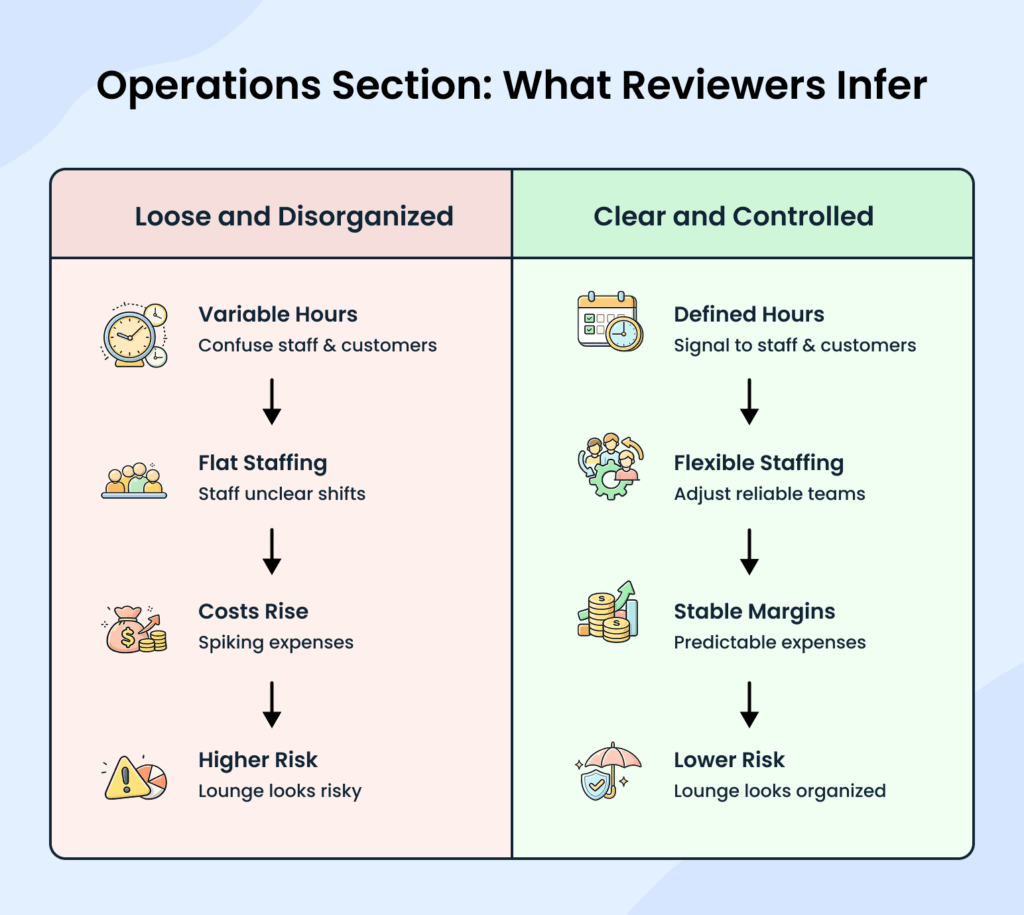
Avoid listing hours without explanation. Instead, explain why the lounge operates during certain times and why hours may vary by day.
Why? Your reviewers want to know that hours are set based on demand, staffing efficiency, and local regulations. Not guesswork. Shorter hours on slow days are often a positive sign.
Staffing Approach
Here, explain how many people are needed to run the lounge and when they are scheduled. Staffing should increase on weekends, late evenings, and event nights, and stay lean during slower times.
Include security staff here. For many lounges, body guard or door staff are necessary. They check IDs, manage entry, control crowd behavior, and reduce risk. Because security affects labor costs and profitability, coverage should be planned based on expected traffic, not guesswork.
Capacity Management
Space drives how a lounge runs. This section should explain how staff track entries, reservations, or session times to avoid crowding. Busy nights need structure.
Mention any limits, booking tools, or staff controls used during peak hours. Show that the lounge stays safe, organized, and calm when demand rises.
Equipment and Maintenance
Keep this practical. Explain how staff check and maintain core equipment on a regular schedule. Focus on prevention, not repairs. This shows planning and reduces concern about downtime or surprise costs.
Security and Compliance
Every lounge must operate within local rules. This section should acknowledge licensing, occupancy limits, ventilation needs, and insurance coverage.
You don’t need legal detail, but you should show awareness and planning. This is especially important for landlords.
Operational Control
Explain how you’ll monitor performance. This will include tracking busy periods, staffing efficiency, or customer feedback.
Your goal should be to show that the business can adapt based on real conditions rather than sticking to rigid assumptions.
Marketing and Customer Attraction
This section explains how customers will discover the lounge and why they will return.
Start how? By clarifying that early marketing strategy focuses on local visibility, not broad advertising. Lounges rely heavily on nearby residents, workers, and existing evening foot traffic. This may include online listings, local partnerships, social platforms, and opening promotions.
Next, explain how repeat visits are encouraged. This could involve clear pricing, consistent service, memberships, or simple loyalty incentives. The emphasis should be on habit-building rather than one-time promotions.
Avoid aggressive growth claims. Reviewers prefer to see a realistic plan that builds a steady customer base over time rather than relying on viral or event-driven traffic.
End by reinforcing that marketing spend and effort scale gradually with demand, not ahead of it.
Management & Organization
Who’s responsible for running the lounge, and how are decisions made? Explain here. Reviewers use it to judge whether you understand the day-to-day operations, not just the concept.
You don’t need a complex organizational chart. You need clarity.
Ownership
Begin by explaining who owns the business and how ownership is structured. In most lounge plans, this is a single owner or an LLC (Limited Liability Company).
If the owner is involved in daily operations, say so. Active ownership is usually viewed as a positive at this stage. If a manager is hired, explain why and how they’re supervised.
Management Role
Mention who’s responsible for daily operations. This includes staffing, scheduling, vendor coordination, compliance, and handling issues on the floor.
Avoid vague language here. Reviewers want to know who’s accountable when something goes wrong. Best practice? Use a flow chart to show the managerial hierarchy.
Team Structure
Most lounges operate best with a small, flexible team. Explain how roles are structured during operating hours, such as a manager or shift lead supported by floor staff.
Don’t list every position. Focus on how coverage changes during peak and off-peak periods. And how responsibilities are handled when the owner isn’t present.
Hiring and Training
- What kind of staff are you planning to hire?
- What training will they receive?
Explain here.
This will show your reader you care about service quality and safety. Your focus? Reliability, customer interaction skills, and the ability to follow procedures.
Training doesn’t need to be extensive, but it should cover customer interaction, equipment use, and rule enforcement.
Decision-making and Oversight
End the section by describing how decisions are made and reviewed. This may include regular check-ins, basic financial reviews, or performance tracking.
The goal is to show that management decisions are based on real data and experience, not gut feeling alone.
Financial Plan
This is the section most reviewers care about, even if they don’t say it out loud. A strong financial plan doesn’t try to impress. It tries to make sense.
The goal here is to show that the lounge can cover its costs, handle slower periods, and still operate responsibly. This means a full financial section must include:
- Projected income statements
- Cash flow statements
- Balance sheets
- Startup cost and use-of-funds tables
- A written assumptions summary tied back to capacity and staffing
Revenue Generation
Start by explaining the main way the lounge makes money. This should match what you described earlier in the Products and Services section.
Don’t jump straight into numbers. First, explain the logic. Revenue should be tied to capacity, operating hours, and how long customers typically stay. If the reader understands the logic, the numbers will feel more believable.
You can also mention supporting revenue streams, but they shouldn’t be positioned as the backbone of the business.
Capacity and Usage Assumptions
Next, describe the physical limits of the space. Seats, stations, or tables create a hard cap on how many customers can be served at one time.
Explain how usage differs between weekdays and weekends. Lounges are rarely busy all day, and pretending otherwise raises red flags. Acknowledge slower periods and explain how peak hours make up for them.
This section builds trust by showing that assumptions are grounded in reality. Tools like Upmetrics financial forecasting can help you model these scenarios without manual spreadsheets.
Cost Structure
After revenue, move to costs. Separate fixed costs from variable costs so reviewers can see what expenses stay the same and which ones change with activity.
| Cost Type | Examples |
|---|---|
| Fixed Costs | Rent, insurance, base utilities, core staffing |
| Variable Costs | Hourly labor, supplies, and payment processing fees |
If the lease is Triple Net (NNN), this must be stated. In many U.S. leases, rent includes base rent plus property taxes, building insurance, and common area maintenance. The financial plan should include an NNN buffer, typically 15 to 25% above base rent, to account for tax increases or adjustments. This prevents unexpected charges from destabilizing cash flow.
Staffing Costs
Staffing often represents the largest controllable expense. Explain how schedules change with demand instead of staying flat. Show that hours increase during busy periods and scale back when traffic slows.
This approach reassures reviewers that payroll stays under control during quiet weeks while still supporting service quality when demand picks up.
Break-even
Don’t hide break-even inside a spreadsheet. Explain it in words.
Show how much monthly revenue you’ll need to cover fixed costs. And how you’ll realistically achieve that revenue through normal operations. Break-even should feel reachable, not theoretical.
Cash Flow and Reserves
Lounges don’t perform evenly every month. This section should acknowledge that reality.
Explain how startup funds are used, how long the business can operate during a slow ramp-up, and whether the owner plans to delay personal compensation early on. This shows financial discipline.
Funding Requirements
If you are looking for any funding for your lounge, add how much you are looking for, from which bank, what the interest rate is, and for how long.
Financial spreadsheets are clunky and boring
Accurately forecast without spreadsheets or historical data
Risks and Mitigation
This section shows that you understand what could go wrong and that you have thought through how to handle it. Reviewers don’t expect a risk-free business. They expect awareness and planning.
A good risk and mitigation section is calm and practical. It names real issues without drama and explains how the business reduces its impact.
License Jeopardy and Staffing Risk
The most serious risk for a lounge that serves alcohol is losing its liquor license. Without it, revenue drops close to zero.
To protect this asset, all employees will complete mandatory TIPS or RAMP certification before serving their first drink. Ongoing training and strict ID checks will be enforced. Management will monitor service practices closely and document compliance.
Clear procedures, shift supervision, and cross-trained staff reduce operational mistakes that could threaten the license.
Demand Risk
Begin by addressing the most common concern. What happens if customer traffic is lower than expected, especially during weekdays?
Acknowledge that lounge demand is uneven by nature. Then explain how the business adjusts. This may include shorter hours on slow days, flexible staffing, or focusing marketing efforts on repeat visits rather than constant new traffic.
The key is to show that the business doesn’t rely on being busy at all times to survive.
Cost and Margin Risk
Next, talk about costs. Rent, staffing, and utilities are usually the largest fixed expenses for a lounge.
Explain how you’ll control the costs through:
- Scheduling
- Limited operating hours during slow periods
- Careful vendor selection
Reviewers want to see that margins are protected by design, not hope.
If the business plans to delay owner compensation early on, this is the place to mention it.
Location and Property Risk
Location-related risks matter, especially for landlords.
Address potential concerns such as noise, parking congestion, or crowd behavior. Then explain the steps taken to prevent issues, such as controlled entry, capacity limits, security presence during peak hours, or clear operating hours.
Regulatory and Compliance Risk
Lounges often operate under specific local rules. Zoning, occupancy limits, ventilation requirements, and permits should be acknowledged here.
You don’t need legal detail. Simply explain that these requirements are understood, monitored, and built into daily operations. Insurance coverage should also be mentioned as part of risk control.
Financial Downside Planning
End the section by explaining what happens if revenue comes in below plan.
This may include:
- Reducing hours
- Tightening labor schedules
- Delaying optional expenses
- Or leaning more heavily on prepaid/repeat-visit offerings.
The goal is to show that the business has room to adjust without immediate financial stress.
Founder Story
This section gives the plan a human anchor. It explains who’s behind the lounge and why they are capable of running it. Not in a dramatic way. Just enough to build trust.
Many plans either skip this section or turn it into a personal essay. The goal is simple: help the reader understand why this person is a reasonable fit for this business.
Practical Background
Begin with a short explanation of the founder’s background as it relates to the lounge. This doesn’t need to be formal experience in the same industry.
Relevant backgrounds might include hospitality, food and beverage, retail, events, customer service, operations, or even running another small business. If the founder has managed people, handled schedules, or dealt with customers face-to-face, that matters.
Avoid listing a full resume. Focus on experience that connects directly to running a space with people, timing, and daily decisions.
Motivation
Next, explain why the founder chose to start this lounge. Keep it grounded.
Good reasons include:
- Seeing a gap in local options
- Wanting to build a social space that fits the area
- Having firsthand exposure to how similar venues operate.
Personal interest is fine, but it shouldn’t be the only reason.
Reviewers want to see intent backed by observation, not just enthusiasm.
Founder Connect to Daily Operations
This is the most important part of the section.
Explain how involved the founder will be in day-to-day operations, especially early on. If the founder plans to manage the lounge, handle scheduling, oversee staff, or be present during peak hours, say that clearly.
Active involvement lowers risk. This is true for lenders, investors, and landlords alike.
Gaps
If the founder lacks experience in certain areas, acknowledge it briefly and explain how it’s handled. This might include hiring experienced staff, working with advisors, or learning through prior hands-on roles.
Trying to hide gaps often raises more concern than admitting them.
End the section by reinforcing that the founder understands what it takes to run a lounge. Long hours, uneven demand, staffing challenges, and customer management all come with the territory.
The founder story should leave the reader thinking, “This person knows what they are getting into,” not “This sounds like a passion project.”
Why Lounge Business Plans Fail During Review
This section exists for one reason. To stop readers from making the same mistakes that quietly kill most lounge business plans.
Rejections are rarely dramatic. Reviewers usually don’t say the idea is bad. They simply say the plan is not clear, not realistic, or not a good fit. The issues below show up again and again.
1. Plan Talks About Vibes Instead of the Business
Many owners spend pages describing the look and feel of the lounge space, but never explain how money is made.
If a reviewer finishes the plan without understanding what customers pay for, how long they stay, or how capacity is managed, the plan usually stops there.
Ambiance matters. It just doesn’t replace business logic.
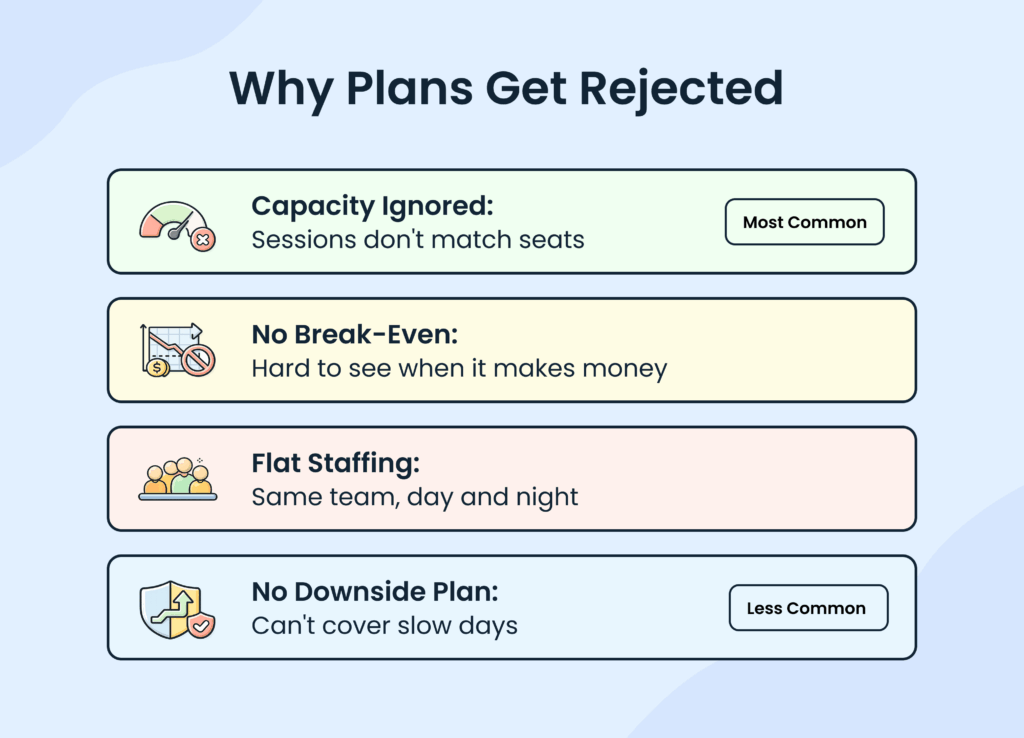
2. Revenue Isn’t Tied to Capacity
Revenue projections must connect directly to seating capacity, operating hours, and realistic usage rates.
When sales targets are presented without showing how many seats or tables exist and how often they can be used, the projections appear inflated. Reviewers expect to see hard limits tied to the space.
3. Assumptions are Too Smooth
Another common issue is assuming steady performance every day of the week.
Lounges don’t perform evenly. Weekdays are softer. Weekends carry more weight. Plans that assume flat demand look disconnected from reality.
Acknowledging uneven demand makes a plan stronger, not weaker.
4. Staffing is Treated as a Fixed Cost
Many plans assume the same staffing level regardless of demand.
In real operations, staffing must flex. When plans don’t show how labor changes between slow and busy periods, reviewers worry about margin pressure and cash flow problems.
5. Break-even is Missing or Hard to Find
In many plans, break-even is buried in spreadsheets or skipped altogether. Reviewers want to see, in plain terms, how much monthly revenue is needed to cover fixed costs. When this isn’t clear, confidence tends to drop fast.
6. Too Many Revenue Streams Too Early
Trying to do everything at once can signal a lack of focus. Plans that depend on events, retail, gaming, food service, memberships, and partnerships from the start often feel scattered. A single, well-defined core business is easier to trust, with add-ons introduced later once the basics are proven.
7. Location Risks are Ignored
Location isn’t just about foot traffic.
Noise, parking, visibility, crowd behavior, and tenant compatibility all matter. Plans that ignore these issues raise concerns for landlords and lenders alike.
8. Compliance is Treated as an Afterthought
Licensing, permits, occupancy limits, and insurance are sometimes mentioned briefly at the end or not at all.
For lounge businesses, these details matter. Ignoring them suggests delays, shutdown risk, or disputes later on.
9. Owner Feels Too Distant
Plans where the owner appears hands-off from the start often face skepticism.
Early-stage lounges usually benefit from active ownership. If the plan doesn’t explain who is present, who makes decisions, and who handles problems, reviewers worry about execution.
10. There’s no downside plan
Perhaps the most common issue of all.
Plans often describe what happens if everything goes right but say nothing about what happens if it doesn’t. Reviewers expect a basic response plan for slower demand or higher costs.
Silence here reads as unpreparedness.
Conclusion
A strong lounge business plan is built on clarity, not hype. Reviewers want to understand how the lounge operates day to day, when people arrive, how long they stay, how capacity drives revenue, and what happens when traffic slows.
Plans that clearly explain these basics tend to move forward more often than those built on big claims. This guide helps you create a plan that works not just on paper, but in real life. Keep each section practical and consistent, then adjust the details to match your lounge and location.
If you are still unsure how to put your lounge business plan together, Upmetrics can help turn this structure into a lender-ready plan with guided sections, financial tools, and clean, professional formatting.
The Quickest Way to turn a Business Idea into a Business Plan
Fill-in-the-blanks and automatic financials make it easy.
Frequently Asked Questions
Do I need a different business plan for lenders and landlords?
How detailed should the financials be in a lounge business plan?
Is it okay if my lounge has slow weekdays?
What is the biggest mistake to avoid when writing this plan?

Vinay Kevadia
Vinay Kevadiya is the founder and CEO of Upmetrics, the #1 business planning software. His ultimate goal with Upmetrics is to revolutionize how entrepreneurs create, manage, and execute their business plans. He enjoys sharing his insights on business planning and other relevant topics through his articles and blog posts. Read more