Selling cupcakes from home is one thing. Running a cupcake shop is different.
You need enough cupcakes for walk-in customers while also handling birthdays, weddings, and large orders booked in advance. The challenge is knowing how much to bake without wasting ingredients or falling behind on orders.
Then there’s rent, staff, equipment, and loan payments to cover, even on slower days. Your plan needs to show how you’ll manage these costs and still make a profit.
That’s what this sample plan for Swirlwick Cupcake Co., a fictional bakery in Clairemont, San Diego, explains. It shows how shop owners plan their pricing, daily baking, custom orders, and finances as they move into a storefront.
Take it as a reference while you write your own cupcake business plan.
Executive Summary
Business Name: Swirlwick Cupcake Co.
Owners: Renata Alvarez & Tessa Kimura
Swirlwick Cupcake Co. is a new cupcake bakery with a takeaway counter in Clairemont, San Diego. It will open on Saturday, April 3, 2027, at Balboa Crest Plaza, 4128 Genesee Avenue, Suite 106, San Diego, CA 92117.
Each morning, the bakery will sell fresh cupcakes at the counter and take advance orders. It will serve four types of buyers:
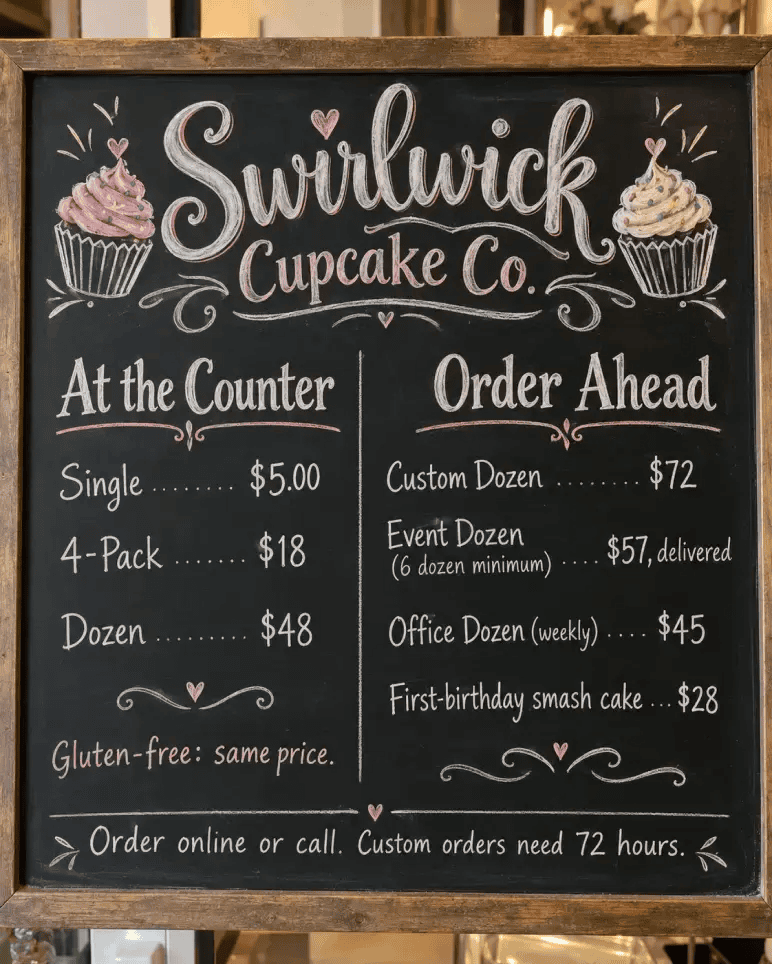
- Walk-in customers, who buy single cupcakes at the counter for $5.00 each
- Families, who order custom dozens for $72 for birthdays and other celebrations
- Hosts of showers and school events, who order event dozens for $57 with delivery
- Offices in nearby Kearny Mesa, which set up weekly standing orders at $45 per dozen
This mix keeps the kitchen busy on weekday mornings, while the counter brings in sales on days with few orders.
Our mission is to bake the cupcakes people order for their best days, and to keep fresh ones on the counter for an ordinary Tuesday.
Owners & Funding
Renata Alvarez, the head baker, has run a home cupcake business since 2019 and owns 60% of the bakery.
Her partner, Tessa Kimura, owns 40% and leads sales and operations. Tessa spent eight years buying catering for a Kearny Mesa office. She knows what office customers need, which helps the bakery win its first standing orders.
We are asking for a $120,000, 10-year SBA 7(a) loan from Calderwood Community Bank at 9.50% interest. Renata and Tessa are adding $60,000 of their own savings. This means total startup capital is $180,000 in all.
The money will be used for:
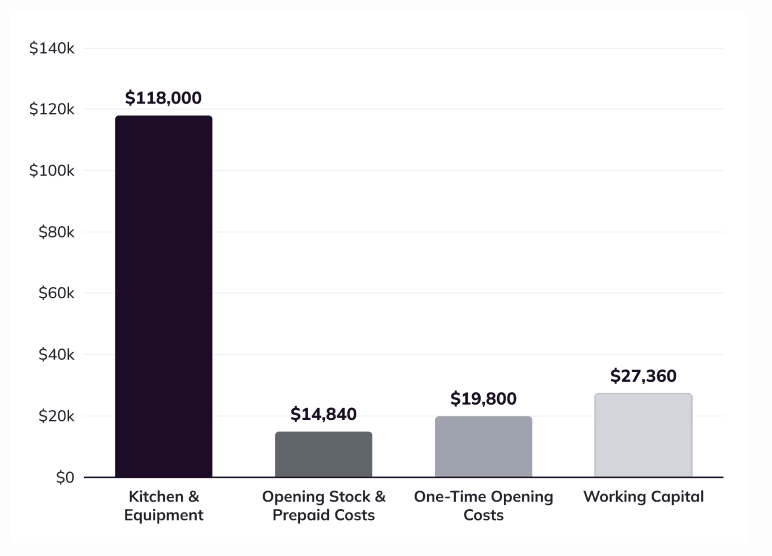
- $52,000 to build the kitchen, including sinks, a grease interceptor, floor drains, and wiring for the oven
- $58,000 for the oven, mixers, refrigerators, and display case
- $22,840 for the point-of-sale system, sign, opening stock, first month’s rent, and insurance
- $19,800 of one-time opening costs, from permits to the opening weekend
- A $27,360 cash reserve for the first year
Swirlwick’s Financials
At Swirlwick, we expect sales to grow as more customers visit the shop and custom and office orders increase.
The chart below shows how each type of order contributes to revenue over the first three years.
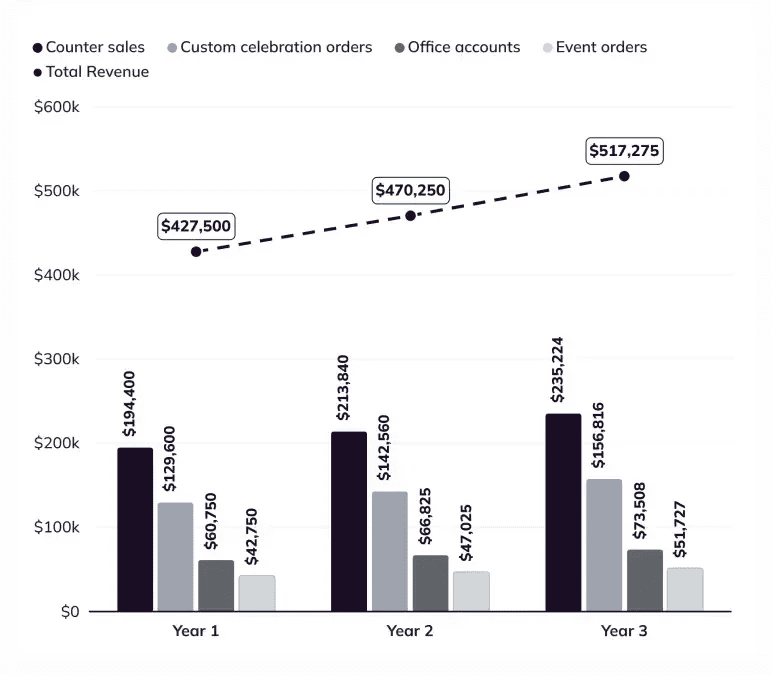
Based on the planned prices and sales mix, Swirlwick expects to sell 90,000 cupcakes in Year 1. Sales grow to 108,900 cupcakes by Year 3 as families come back for each birthday and office accounts build.
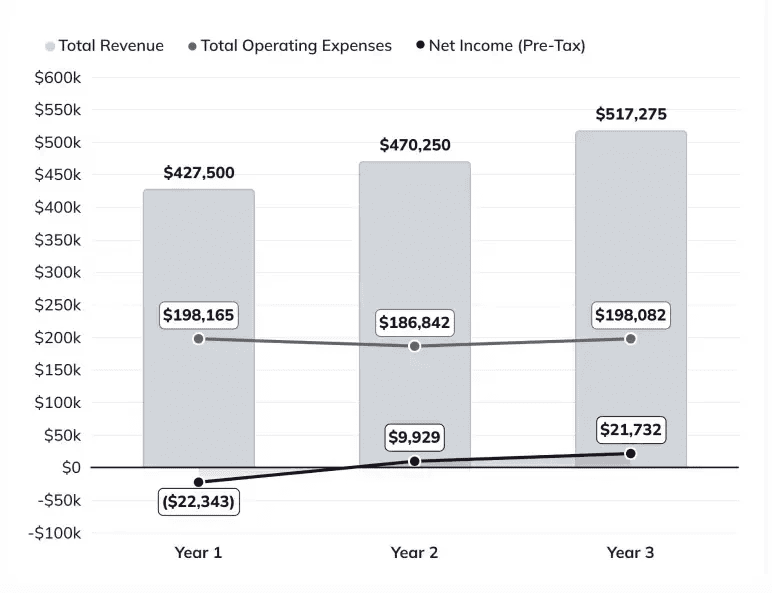
The first year shows a planned loss because of one-time opening costs. The bakery turns a profit in Year 2.
| Category | Year 1 | Year 2 | Year 3 |
|---|---|---|---|
| Cupcakes sold | 90,000 | 99,000 | 108,900 |
| Total Revenue | $427,500 | $470,250 | $517,275 |
| Gross Profit | $201,985 | $222,184 | $244,402 |
| Net Income (Pre-Tax) | ($22,343) | $9,929 | $21,732 |
| Ending Cash | $43,708 | $60,068 | $87,372 |
What Supports the Forecast
More people are buying cupcakes for their celebrations. U.S. cupcake sales are growing 10% year over year, as buyers look for a treat that’s affordable, customizable, and easy to carry.
Swirlwick also opens with customers who already know and trust Renata’s work.
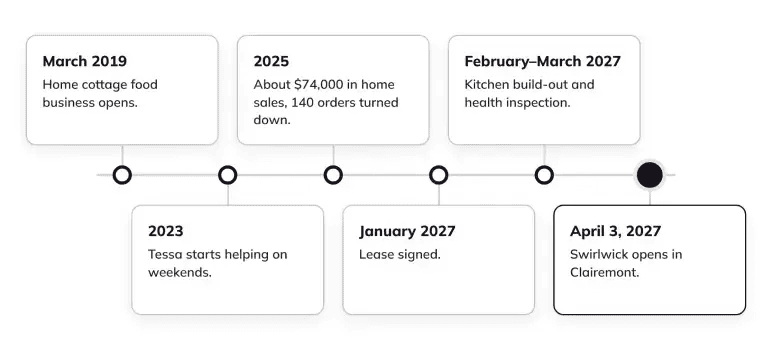
Her home sales reached about $74,000 in 2025, close to California’s yearly limit for a home bakery. That same year, she turned down 140 orders because her calendar or her oven was full.
This means many of the bakery’s first orders will come from families who have ordered from her before.

Business Overview
Renata Alvarez and Tessa Kimura formed Swirlwick Cupcake Co. as a multi-member California limited liability company (LLC) in October 2026.
Their operating agreement sets out each owner’s role and pay, and what happens if one of them leaves. This gives both partners clear roles from the first day.
The LLC signs the lease and the loan, and both owners also sign personal guarantees. This keeps contracts in the business’s name, while the bank still has the owners’ personal backing.
The shop is a 1,100 sq ft end unit at Balboa Crest Plaza, about 10 minutes from the offices of Kearny Mesa. It has a kitchen in back and a counter in front, with no seating, which suits a bakery where most customers pick up a box and go.
For its first three years, Swirlwick will sell only cupcakes and a few cupcake add-ons.
It won’t add seating, a coffee bar, wholesale, or shipping, because each needs more space, staff, or equipment than the shop has. This keeps the team focused on doing one thing well.
Our vision is to be the first call Clairemont families and Kearny Mesa offices make when there’s something to celebrate.
Here is how the business got from a home kitchen to opening day:
Business Background
Renata has been selling cupcakes from her home kitchen since March 2019 under California’s Class A cottage food program. This allows registered home bakers to sell certain foods directly to customers.
In 2025, she completed 612 orders, mostly for birthdays and showers. Most customers found her through Instagram or recommendations from friends.
But her home kitchen has become too small for the business. On a busy Saturday, Renata can bake about 300 cupcakes. She also turned down 140 orders in 2025 because she was fully booked or couldn’t make enough cupcakes in time.
There are other limits to running the business from home. California’s cottage food rules restrict annual sales and the types of products Renata can make.
For example, she cannot sell cupcakes with cream cheese frosting under her current home bakery registration.
Moving into a licensed commercial kitchen will give Renata more room to bake, take larger orders, and offer more flavors. It will also allow Swirlwick to serve walk-in customers instead of relying entirely on advance orders.
Ownership Structure
Renata and Tessa will manage different parts of the bakery based on their experience. Renata will lead baking and production, while Tessa will handle sales and daily business operations.
Their ownership, responsibilities, and planned Year 1 pay are shown below.
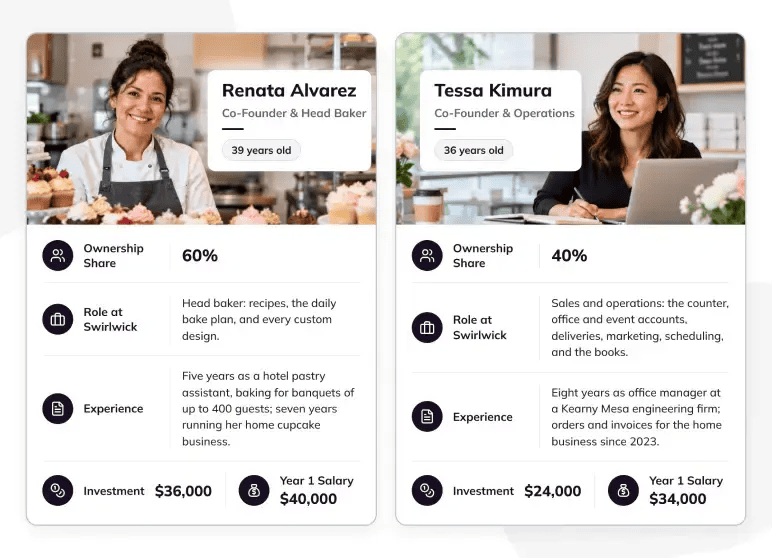
Together, they cover both sides of the bakery. This gives each owner clear responsibilities while keeping both involved in the bakery’s day-to-day work.
Opening and Growth Targets
Swirlwick’s first target is to open on April 3, 2027, with 12 office accounts on weekly standing orders. In its first year, the bakery plans to sell 90,000 cupcakes.
By 2028, Renata and Tessa aim to grow to 14 weekly office accounts. They also want to keep unsold counter cupcakes at or below 8% of the counter bake.
By March 2030, the bakery plans to hold enough cash to buy a second oven without taking on a new loan.
These targets help the owners check their progress each month and plan the next step with confidence.
Industry Analysis & Target Market
Swirlwick’s customers are the families of Clairemont and nearby neighborhoods, and the offices a short drive away in Kearny Mesa. Most of them buy cupcakes for an occasion, so sales follow the calendar.
U.S. cupcake sales increase 18% in the two weeks before graduation season, which runs from May through June.
This is why Swirlwick plans for strong sales in May and June, and will add decorating hours in late May.
Cake and cupcake shops are also a growing business. U.S. patisseries and cake shops will bring in $5.4 billion in 2026. The number of these shops grew by an average of 8.0% a year from 2020 to 2025, reaching 3,180.
This tells a lender that a small cake shop is a familiar kind of business. It also means more shops now compete for the same customers. Swirlwick will stand apart through custom work and office delivery.
Central Clairemont’s ZIP code, 92117, has 20,876 households. The median household income there is $103,661.
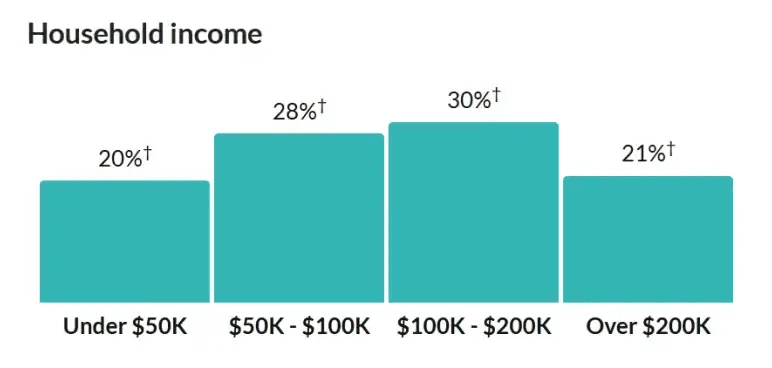
This puts a $72 custom dozen within the party budget of most families near the shop. It also gives Swirlwick thousands of nearby homes to reach through schools, parent groups, and birthday reminders.
Emerging Trends
There are three changes in how people buy celebration treats that shape Swirlwick’s menu:
- More families now host small parties at home, and they want desserts that match the theme. This is why custom dozens are at the heart of the menu.
- Buyers also ask more questions about allergens and ingredients. To make choosing easy, every Swirlwick box carries an allergen label, and the case holds a gluten-free flavor every day.
- Ordering has moved to the phone. Customers expect to order and pay ahead, so custom, event, and office orders all book online, and counter customers can text a pickup order.
Potential Customer Groups
The bakery sells to four groups of customers, and each one buys in a different way.
Families Planning Celebrations
Parents in Clairemont, Bay Park, and Linda Vista order two to four dozen cupcakes for a child’s birthday, a graduation, or a family event.
They want a design that matches the party, a pickup time that fits their day, and a stress-free morning before the guests arrive.
Most of Renata’s home orders came from this group, and they will be Swirlwick’s largest group of order customers.
Event Hosts
People planning baby and bridal showers, small weddings, and school or church events order six dozen or more, a few weeks ahead.
They want delivery and a display that looks good in photos. This is why every event order includes delivery and a cupcake stand.
Kearny Mesa and Clairemont Offices
Office managers and team leads buy for meetings, staff birthdays, and client visits. They need delivery before a morning meeting, one clear invoice, and an order that repeats without a phone call each week.
Tessa did this buying herself for eight years. She knows what these buyers need and how they choose a vendor.
Walk-In Customers
Shoppers at the plaza, parents after school pickup, and neighbors stop in for a treat or a last-minute box. They buy what’s in the case, which has to look full and fresh every afternoon.
Together, these groups keep the kitchen steady through the week. Families and event hosts order for the weekends, offices order for weekday mornings, and walk-ins come in during the afternoons.
Competition
Swirlwick’s direct competitors are other places that sell cupcakes or custom desserts near Clairemont. Its indirect competitors are the other treats families and offices buy for the same parties and meetings.
Here’s how they compare.
| Competitor | What They Offer | Where Swirlwick Can Compete |
|---|---|---|
| Grocery Store Bakeries | Affordable cupcakes and sheet cakes with standard designs | Custom cupcakes in smaller batches and more design choices |
| Cupcake & Dessert Shops | Established brands, loyal customers, and a wide dessert selection | Convenient local pickup, competitive pricing, and smaller custom orders |
| Home Bakers | Custom cupcakes ordered online, often at lower prices | Greater production capacity, walk-in sales, and more frosting options |
| Other Desserts & Caterers | Cakes, cookies, and dessert trays for parties and office events | Individual cupcakes that are easy to serve, customize, and share |
The bakery’s place is between the grocery case and the high-end dessert shop.
Families get custom designs at a neighborhood price, walk-ins find a fresh counter every day, and offices get reliable weekly delivery that most home bakers can’t provide.
Menu & Orders
The bakery sells one product, cupcakes, in four ways that match how people buy them: at the counter, as custom dozens, as event orders, and as weekly office orders.
The menu board above the counter makes every price easy to see:
Counter Cupcakes
Counter cupcakes are for walk-in customers and last-minute boxes.
Customers can also text an order in the morning and pick up a boxed set the same afternoon. This is handy for parents and office workers who want a box on the way home.
The case opens at 9 AM with a short menu, and most flavors sell out by closing:
- Eight everyday flavors: vanilla bean, chocolate fudge, red velvet with cream cheese frosting, lemon, salted caramel, strawberry, cookies and cream, and churro
- One flavor of the month, such as pumpkin spice in October and peppermint in December
- One gluten-free flavor every day, made without gluten ingredients
Custom Celebration Orders
Custom orders are for birthdays, graduations, gender reveals, and any other day a family wants to remember.
The customer picks up to two flavors and a design, such as matching colors, piped details, fondant toppers, or edible photo prints. Orders start at one dozen.
Families can add a mini smash cake for a baby’s first birthday, a gift box with ribbon, or a message plaque that matches the design.
Renata’s home customers already order this way. Moving to a storefront keeps a process they know and trust.
Event Orders
Event orders are for showers, small weddings, and school and church events.
The minimum is six dozen, and the price includes delivery within 10 miles and setup on a cupcake stand. Mini cupcakes count as half a cupcake, which lets hosts mix sizes on one display.
Customers who order 10 dozen or more can book a tasting with Renata before they choose their flavors. This helps hosts feel confident about the display before the big day.
Office Accounts
Office accounts are for businesses in Kearny Mesa and Clairemont.
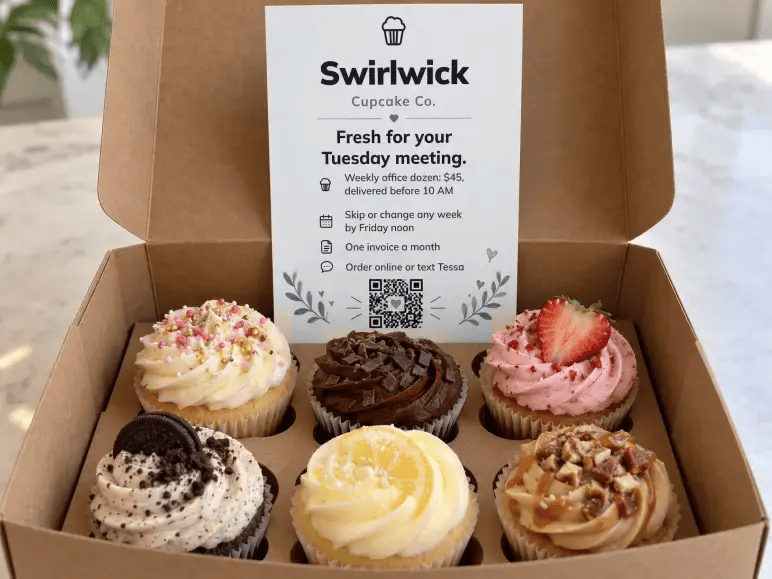
Each office sets a standing weekly order of at least two dozen, delivered boxed and labeled before 10 AM on the day it chooses. Offices that need a one-time meeting order pay the event price.
Each office gets one invoice a month, due in 15 days.
Tessa sells and looks after these accounts herself. This gives every office one friendly person to call.
Marketing & Sales Strategy
Swirlwick’s marketing starts with the people who already order from Renata.
Tessa will add offices through direct visits, while the counter and Instagram bring in the neighborhood.
Pricing Strategy
We set a different price for each way people buy, based on the work each order takes. Prices stay the same for all three years, and the owners will review them each quarter against ingredient costs.
A counter cupcake costs more than a grocery cupcake because Swirlwick bakes it that morning with real butter and cream cheese. It still costs less than most specialty shops charge.
Swirlwick prices custom work by the dozen, not by the cupcake. This keeps quotes simple for families, and it makes sure a small order doesn’t take an hour of Renata’s design time for a few dollars.
Offices pay the lowest price because their orders repeat every week. They also use the quiet weekday mornings, and Tessa can plan their bake days in advance.
We won’t run discount deals on our regular prices. The only offers are the first-order card at launch and the punch card for regular customers.
This keeps prices fair and easy to trust for every customer.
Launch Plan
Renata will announce the opening to her past customers and Instagram followers in February 2027. Each past customer gets a “first order” card for 10% off.
The opening weekend, April 3–4, brings free mini cupcakes for neighbors to enjoy and a sign-up sheet for birthday reminders.
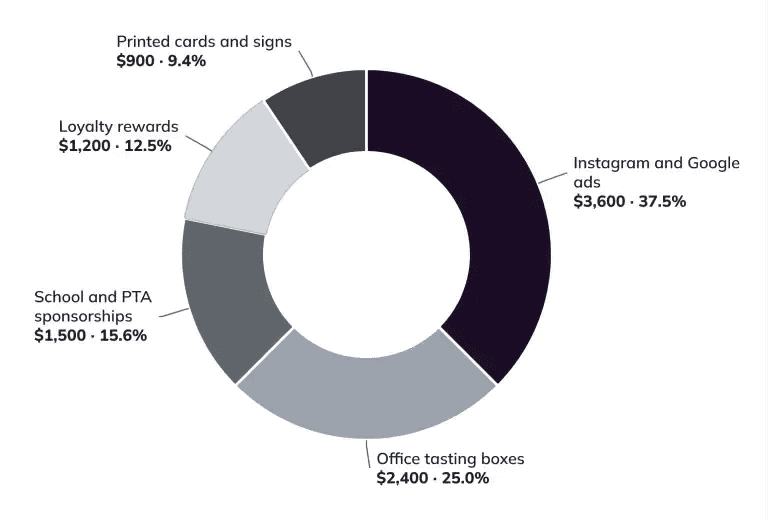
In the first two weeks, Tessa will deliver free tasting boxes to 40 offices in Kearny Mesa and Clairemont.
We have set aside $6,500 for the launch. Another $2,200 goes to our online ordering site and menu photos.
Each office tasting box includes this kind of card:
Marketing Channels
After opening, we will find new customers in five ways.
1. Instagram and Google Business Profile
Renata posts photos of each week’s custom orders, with the customer’s permission. The Google profile shows hours, the menu, and reviews. This helps the shop appear when neighbors search for cupcakes nearby.
2. Office visits
Tessa follows up on every tasting box within a week. She asks each office to try a standing order for two weeks before deciding, which makes it easy to say yes.
3. Schools and parent groups
Swirlwick sponsors PTA events and bakes class-party orders for four nearby elementary schools. This puts the bakery in front of the families most likely to order birthday dozens.
4. Party partners
Two balloon and party rental businesses and a children’s party venue nearby hand out Swirlwick’s referral cards. Swirlwick does the same for them at the pickup shelf.
5. The counter itself
A sidewalk sign goes out on busy days, and a “this week’s flavor” post goes up online every Tuesday morning.
Here is how Swirlwick plans to spend its Year 1 marketing budget:
Customer Retention
Birthdays come back every year, and Swirlwick wants every family to come back with them.
We will keep customers returning in four simple ways:
- Saving the date of every custom order and sending a reminder text five weeks before the next party
- A punch card that gives a free cupcake after ten purchases
- A monthly call from Tessa to each office account, with a new flavor to try each quarter
- A reply from Renata to every online review within a day, good or bad
Repeat birthdays and standing orders also mean Swirlwick needs fewer new customers in Year 2 than in Year 1.
Operations Plan
Our kitchen follows a simple rule: bake the orders first, then bake the counter to a set count.
This keeps cupcakes fresh, keeps waste low, and lets a small team handle a busy Saturday.
Location, Kitchen & Suppliers
The bakery leases a 1,100 sq ft end unit at Balboa Crest Plaza in Clairemont. The front 250 sq ft holds the counter, display case, and pickup shelf.
Behind it is the 700 sq ft kitchen. A 150 sq ft storage room holds supplies and packaging.
The lease runs 10 years, with an option for five more. All-in rent is $3.40 per sq ft per month, and it rises 3% a year.
The landlord gave three months of free base rent during the build-out, which helps the bakery save cash before opening.
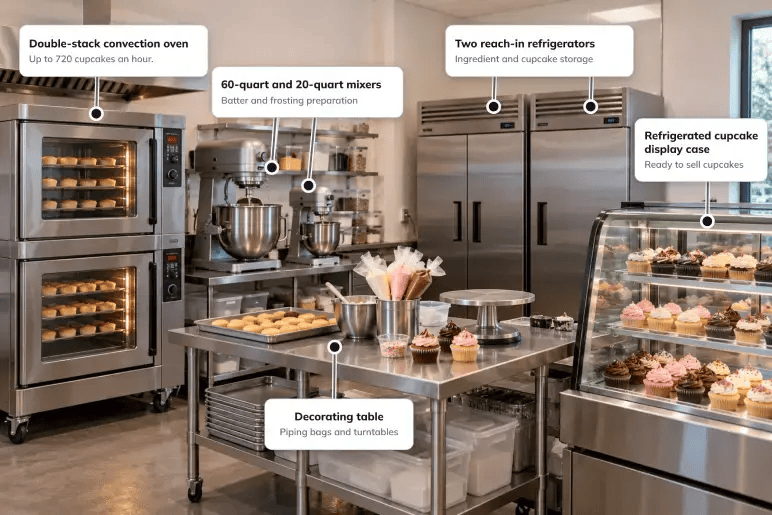
The kitchen’s main equipment decides how many cupcakes Swirlwick can bake, frost, and keep cold each day:
Most ingredients come from Sysco, which delivers twice a week and gives Swirlwick seven days to pay. Butter, cream cheese, and eggs also come from a second, local dairy supplier.
This makes sure one late truck or short order never stops the morning bake.
Boxes, liners, inserts, and labels come from Uline, ordered online about once a month. Renata keeps about 10 days of ingredients and packaging on hand, which covers a busy weekend without tying up too much cash.
Hours & Order Lead Times
The counter is open at the times families and offices usually buy:
- Tuesday to Friday: 9 AM – 6 PM
- Saturday: 9 AM – 5 PM
- Sunday: 10 AM – 3 PM
- Monday: Closed
The kitchen starts at 6 AM. This gives the team time to send office deliveries out between 7:30 and 9 AM.
Each order type has a lead time that gives the kitchen room to plan:
- Custom orders: At least 72 hours ahead, with a 50% deposit
- Event orders: At least two weeks ahead, with a 50% deposit
- Office orders: Changes or skips by Friday noon for the next week
Plans change, and we refund deposits in full up to seven days before the date.
After that, the bakery moves the deposit to a new date, because Renata often makes the toppers ahead. Mondays are for ordering supplies, cleaning, tastings, and design work.
Daily Bake & Unsold Cupcakes
In Swirlwick’s kitchen, decorating takes longer than baking, so it decides how many cupcakes the team can finish each day.
The following two points show how much room the kitchen has and how Swirlwick keeps waste low:
How much the kitchen can make
The oven can bake up to 720 cupcakes an hour, but frosting and decorating take longer. In an hour, one person can finish about 110 cupcakes with a standard swirl, or about 40 custom designs.
With about 11 decorating hours on an average day, the team can finish around 830 cupcakes. Swirlwick plans to sell 293 a day in Year 1 and 355 in Year 3.
This means the same kitchen has room for all of its growth through Year 3.
How the counter is baked
Each morning, the team bakes the counter to a count set from sales on the same weekday the week before. That’s about 153 cupcakes a day in Year 1.
At 1 PM, the team checks the case and bakes a small second batch only when it’s selling fast.
Swirlwick expects about 8% of counter cupcakes, roughly 12 a day, to go unsold. These are never sold the next day; a local food rescue group collects them at closing.
Their ingredient cost is already included in the bakery’s costs. Custom, event, and office orders leave no unsold cupcakes because the team bakes them to order.
Weekly Schedule & Staffing
Tuesdays and Wednesdays are lighter. The team uses them to bake office orders and make decorations ahead, such as fondant toppers and frosting bases. Thursdays and Fridays go to custom and event orders for the weekend.
Saturday is the busiest day, with pickups every 15 minutes and most event deliveries. Sunday is a short counter day with few orders.
Planning the week this way helps a small team handle a busy Saturday without stress.
Here is how the team covers each week:
| Day | Kitchen | Counter & Pickups | Deliveries |
|---|---|---|---|
| Tuesday–Thursday | Renata, assistant baker | Tessa (9 AM–2 PM), counter staff (2–6 PM) | Tessa, 7:30–9 AM |
| Friday | Renata, assistant baker, weekend decorator | Tessa (9 AM–2 PM), counter staff (2–6 PM) | Tessa, 7:30–9 AM |
| Saturday | Renata, assistant baker, weekend decorator | Tessa and one counter staff, all day | Tessa or Renata, event deliveries |
| Sunday | Weekend decorator | Counter staff (10 AM–3 PM) | None |
The assistant baker and decorator work full-time at $22.00 per hour. A weekend decorator works 16 hours a week at $21.00 per hour. Two part-time counter staff share 32 hours a week at $19.50 per hour.
Pay for every role is above San Diego’s minimum wage, which rises to $18.35 per hour on January 1, 2027.
Every team member gets a California Food Handler Card within 30 days of hire, and both owners hold the Food Protection Manager certificate. This helps everyone handle food safely from the first week.
Storefront vs. Shared Kitchen
Before signing the lease, Renata and Tessa priced the usual next step for a home baker: renting hours in a shared commercial kitchen.
Three reasons made the storefront the better choice at Swirlwick’s volume.
1. The hours add up
At Year 1 volume, Swirlwick would need about 45 kitchen hours a week. At about $23 per hour, plus a monthly fee for shelf and fridge space, that comes to about $58,620 per year, with no counter or pickup space.
2. No counter sales
A shared kitchen has no storefront, which means every sale must be ordered ahead. Swirlwick’s counter is expected to bring in $194,400 in Year 1, money a shared kitchen can’t earn.
3. Someone else’s calendar
Shared kitchens book busy days on a first-come, first-served basis. Saturday is Swirlwick’s biggest day, and it’s also the busiest day for the caterers and food trucks that share the same kitchen.
The storefront’s rent is $44,880 in Year 1, about $13,740 less than the shared kitchen at the same volume.
It also gives Swirlwick its own cold storage and a place customers can easily find. A shared kitchen suits a smaller home business, but not one selling 293 cupcakes a day.
Licenses & Food Safety
San Diego County’s Department of Environmental Health and Quality reviews the kitchen plans before the build-out and issues the health permit after a final inspection.
The City of San Diego issues the business tax certificate, and the California Department of Tax and Fee Administration issues the seller’s permit.
Every box carries an allergen label, and cream cheese frostings stay below 41°F in the refrigerators and display case. The team bakes the gluten-free flavor first each morning on cleaned equipment and logs the cleaning.
Swirlwick carries general liability with product coverage, property insurance, and workers’ compensation. This protects customers, the team, and the business.
Risks
Four risks matter most for a small bakery like Swirlwick, and each one has a plan:
Office accounts sign up slowly (about 14% of revenue)
Tessa moves her morning hours to counter sales and school orders, and the assistant baker’s hours follow the orders
Butter, cream cheese, and egg prices rise
Buy from two suppliers, check the cost per cupcake every quarter, and raise counter prices by 25 cents if needed
An owner can’t work for a while
Follow the operating agreement, rely on the assistant baker, who knows every core recipe, and limit custom bookings for a few weeks
Sales come in below plan
Compare sales with the plan each month, and hold back the owners’ Year 2 raises if sales fall short
In Year 1, earnings cover only 0.21 times the loan payments. The main reason is $19,800 of one-time opening costs. The cash reserve pays the gap, and cash never falls below $28,194, its low point in September 2027.
If Year 2 revenue came in 5% below plan, earnings would still cover the loan payments 1.33 times.
Holding back Renata’s and Tessa’s Year 2 raises would keep coverage at 1.25 times, even with sales 7.8% below plan. This gives the bakery room to handle a slower year.
Financial Plan
Swirlwick needs $180,000 to open: a $120,000 SBA 7(a) loan from Calderwood Community Bank and $60,000 from Renata and Tessa. Revenue grows from $427,500 in Year 1 to $517,275 in Year 3, and the bakery turns a profit in Year 2.
Startup Costs
| Category | Amount |
|---|---|
| Kitchen & Equipment | |
| Kitchen build-out (sinks, grease interceptor, drains, wiring, flooring) | $52,000 |
| Oven, mixers, refrigerators, display case, and racks | $58,000 |
| Point-of-sale stations, order tablet, label printer, and sign | $8,000 |
| Opening Stock & Prepaid Costs | |
| Opening ingredients and packaging | $6,500 |
| First month’s rent | $3,740 |
| First-year insurance premium | $4,600 |
| One-Time Opening Costs | |
| Grand opening marketing | $6,500 |
| Licenses and permits | $3,800 |
| Legal and professional setup | $3,500 |
| Online ordering site and menu photos | $2,200 |
| Staff hiring and training | $2,000 |
| SBA guaranty fee | $1,800 |
| Working Capital | |
| Cash reserve | $27,360 |
| Total Startup Costs | $180,000 |
Financial Assumptions
| Assumption | Year 1 | Year 2 | Year 3 |
|---|---|---|---|
| Days open | 307 | 307 | 307 |
| Cupcakes sold | 90,000 | 99,000 | 108,900 |
| Cupcakes sold per open day | 293 | 322 | 355 |
| Counter cupcakes (average $4.50 each) | 43,200 | 47,520 | 52,272 |
| Custom order cupcakes ($6.00 each) | 21,600 | 23,760 | 26,136 |
| Event order cupcakes ($4.75 each) | 9,000 | 9,900 | 10,890 |
| Office account cupcakes ($3.75 each) | 16,200 | 17,820 | 19,602 |
| Average price per cupcake | $4.75 | $4.75 | $4.75 |
| Ingredients and packaging (% of revenue) | 28.0% | 28.0% | 28.0% |
| Unsold counter cupcakes (% of counter bake) | 8% | 8% | 8% |
| Kitchen and counter labor (% of revenue) | 22.4% | 22.4% | 22.4% |
| Payroll tax (% of wages) | 10.5% | 10.5% | 10.5% |
| Rent, all-in | $44,880 | $46,226 | $47,613 |
| Card and online-order fees (% of revenue) | 2.6% | 2.6% | 2.6% |
| Monthly loan payment | $1,552.77 | $1,552.77 | $1,552.77 |
Projected Profit & Loss
| Category | Year 1 | Year 2 | Year 3 |
|---|---|---|---|
| Revenue | |||
| Counter sales | $194,400 | $213,840 | $235,224 |
| Custom celebration orders | $129,600 | $142,560 | $156,816 |
| Office accounts | $60,750 | $66,825 | $73,508 |
| Event orders | $42,750 | $47,025 | $51,727 |
| Total Revenue | $427,500 | $470,250 | $517,275 |
| Cost of Goods Sold | |||
| Ingredients and packaging | $119,700 | $131,670 | $144,837 |
| Kitchen and counter labor | $95,760 | $105,336 | $115,870 |
| Payroll tax on kitchen and counter labor | $10,055 | $11,060 | $12,166 |
| Total Cost of Goods Sold | $225,515 | $248,066 | $272,873 |
| Gross Profit | $201,985 | $222,184 | $244,402 |
| Gross Margin | 47.2% | 47.2% | 47.2% |
| Operating Expenses | |||
| Owner salaries | $74,000 | $78,000 | $84,000 |
| Payroll tax on owner salaries | $7,770 | $8,190 | $8,820 |
| Rent | $44,880 | $46,226 | $47,613 |
| Card and online-order fees | $11,115 | $12,226 | $13,449 |
| Marketing | $9,600 | $9,600 | $10,000 |
| Utilities, phone, and internet | $9,000 | $9,300 | $9,600 |
| Accounting, legal, and permit renewals | $4,800 | $4,900 | $5,000 |
| Insurance | $4,600 | $4,800 | $5,000 |
| Software and online ordering | $3,600 | $3,700 | $3,800 |
| Cleaning and kitchen supplies | $3,600 | $3,800 | $4,000 |
| Delivery mileage | $3,000 | $3,300 | $3,600 |
| Repairs and maintenance | $2,400 | $2,800 | $3,200 |
| One-time opening costs | $19,800 | $0 | $0 |
| Total Operating Expenses | $198,165 | $186,842 | $198,082 |
| EBITDA | $3,820 | $35,342 | $46,320 |
| Depreciation | $15,086 | $15,086 | $15,086 |
| Interest expense | $11,077 | $10,327 | $9,502 |
| Net Income (Pre-Tax) | ($22,343) | $9,929 | $21,732 |
Projected Balance Sheet
| Category | Year 1 | Year 2 | Year 3 |
|---|---|---|---|
| Assets | |||
| Cash | $43,708 | $60,068 | $87,372 |
| Accounts receivable | $2,495 | $2,744 | $3,019 |
| Inventory | $3,279 | $3,607 | $3,968 |
| Equipment and build-out, net | $102,914 | $87,828 | $72,742 |
| Total Assets | $152,396 | $154,247 | $167,101 |
| Liabilities | |||
| Accounts payable | $2,296 | $2,525 | $2,778 |
| SBA 7(a) loan | $112,443 | $104,136 | $95,005 |
| Total Liabilities | $114,739 | $106,661 | $97,783 |
| Equity | |||
| Owners’ capital | $60,000 | $60,000 | $60,000 |
| Retained earnings | ($22,343) | ($12,414) | $9,318 |
| Total Equity | $37,657 | $47,586 | $69,318 |
| Total Liabilities & Equity | $152,396 | $154,247 | $167,101 |
Projected Cash Flow
| Category | Year 1 | Year 2 | Year 3 |
|---|---|---|---|
| Beginning Cash | $47,160 | $43,708 | $60,068 |
| Operating Activities | |||
| Net income (pre-tax) | ($22,343) | $9,929 | $21,732 |
| Depreciation | $15,086 | $15,086 | $15,086 |
| Change in accounts receivable | ($2,495) | ($249) | ($275) |
| Change in inventory | $3,221 | ($328) | ($361) |
| Change in accounts payable | $2,296 | $229 | $253 |
| Prepaid rent and insurance used | $8,340 | $0 | $0 |
| Net Cash from Operations | $4,105 | $24,667 | $36,435 |
| Financing Activities | |||
| Loan principal repaid | ($7,557) | ($8,307) | ($9,131) |
| Net Cash from Financing | ($7,557) | ($8,307) | ($9,131) |
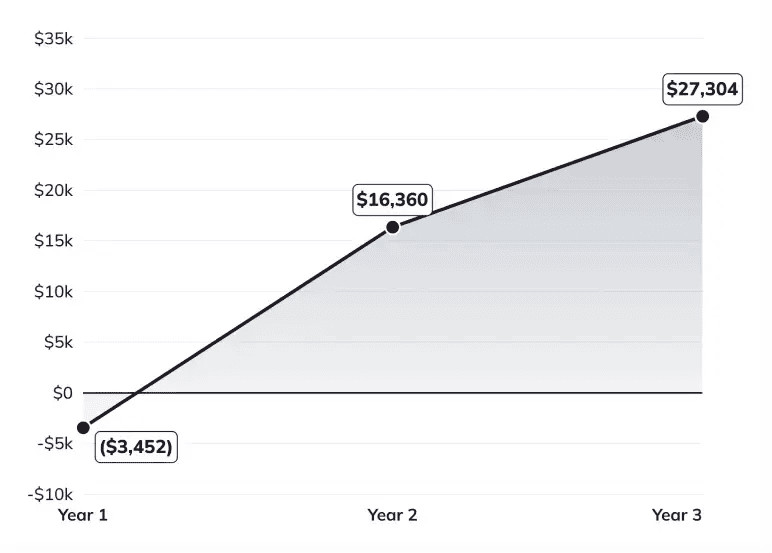
| Net Change in Cash | ($3,452) | $16,360 | $27,304 |
| Ending Cash | $43,708 | $60,068 | $87,372 |
Break-Even Analysis
| Metric | Value |
|---|---|
| Average price per cupcake | $4.75 |
| Ingredients and packaging per cupcake | $1.33 |
| Labor and payroll tax per cupcake | $1.18 |
| Card fees per cupcake | $0.12 |
| Variable cost per cupcake | $2.63 |
| Contribution per cupcake | $2.12 |
| Contribution margin | 44.6% |
| Yearly fixed costs, before depreciation and interest (Year 2) | $174,616 |
| Break-even cupcakes per year (Year 2) | 82,336 |
| Break-even cupcakes per open day (Year 2) | 268 |
| Break-even revenue (Year 2) | $391,096 |
Loan Repayment & Debt Coverage
| Category | Year 1 | Year 2 | Year 3 |
|---|---|---|---|
| Interest | $11,077 | $10,327 | $9,502 |
| Principal | $7,557 | $8,307 | $9,131 |
| Ending loan balance | $112,443 | $104,136 | $95,005 |
| EBITDA | $3,820 | $35,342 | $46,320 |
| Debt coverage | 0.21x | 1.90x | 2.49x |
| Debt coverage before one-time opening costs | 1.27x | 1.90x | 2.49x |
The Quickest Way to turn a Business Idea into a Business Plan
Fill-in-the-blanks and automatic financials make it easy.


Upmetrics
Upmetrics is the #1 business planning software that helps entrepreneurs and business owners create investment-ready business plans using AI. We regularly share business planning insights on our blog. Check out the Upmetrics blog for such interesting reads. Read more