Executive Summary
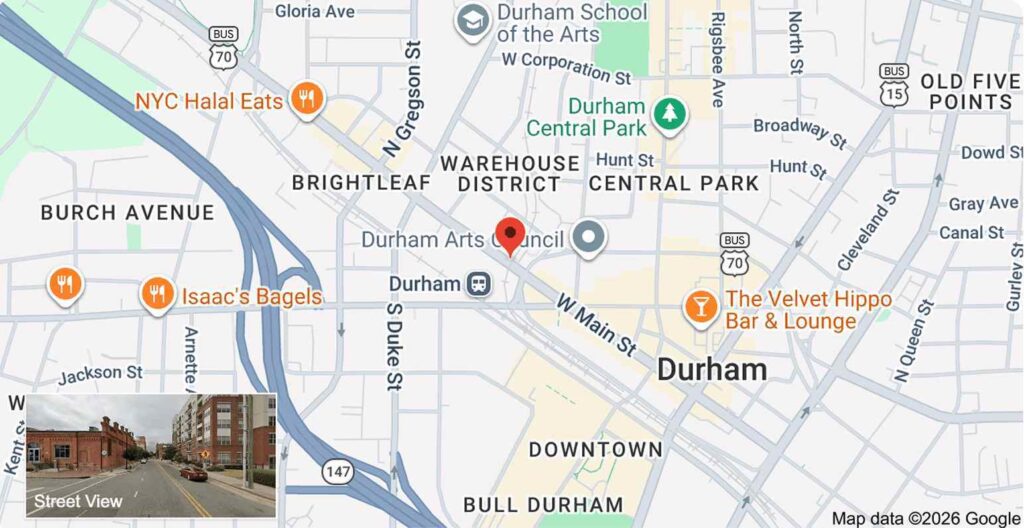
Hearth & Crumb Bakery is a startup neighborhood bakery. Sarah Mitchell owns and operates it. The bakery sits at 512 West Main Street, Unit A, Durham, North Carolina.
It’s organized as a single-member LLC.
The business seeks bank financing of $105,000 for tenant improvements, essential baking equipment, initial inventory, and opening working capital.
The bakery runs walk-in retail only. No seating, delivery, catering, wholesale, or custom cake work. All products are baked on-site and sold the same day.
Operating hours are Tuesday through Sunday, 7:00 AM to 3:00 PM. Mondays stay closed. This schedule supports predictable daily cash flow, controlled labor costs, and consistent execution.
Products
Hearth & Crumb offers fresh-baked goods.
| Menu Items | Details |
|---|---|
| Main Offerings | Breads, breakfast pastries, cookies, bars |
| Seasonal Items | Small selection of seasonal items |
| Menu Strategy | Limited menu to maintain production reliability and manage waste |
Pricing
Pricing sits mid-range. The business doesn’t rely on price increases, expanded hours, additional sales channels, or staffing growth to improve results.
Roles and responsibilities
| Role | Responsibilities |
|---|---|
| Sarah Mitchell (Owner) | Primary baker, oversees daily production, ordering, scheduling, and cost control |
| Assistant Baker | Full-time position supporting baking and production tasks |
| Part-time Counter Staff | 1-2 staff, depending on the day, responsible for customer service and sales |
| Management Structure | No additional management layer, providing direct oversight and hands-on operations |
Financials
Total startup cost is $145,000, where the $105,000 bank term loan covers most of it. Sarah contributes $40,000 in cash. The owner’s investment happens at startup, without additional equity injections.
Financial projections support regular loan repayment from the operating cash flow generated by daily retail sales. Annual principal repayment is modeled at $12,000/year, and scheduled debt service is incorporated directly into the cash flow forecast. All sales are collected at the point of purchase, resulting in immediate cash inflow and no accounts receivable exposure.
The projections assume fixed operating hours, stable pricing, and no new revenue channels. Repayment isn’t dependent on one-time events, catering contracts, or seasonal spikes. Instead, it is supported by consistent daily transactions across 6 operating days/week. Debt service coverage improves over the 3-year projection period as fixed operating costs are absorbed over a growing base of routine neighborhood sales.
Business Description
Hearth & Crumb Bakery is a single-owner retail bakery at 512 West Main Street, Unit A, Durham, North Carolina 27701. Sarah Mitchell owns it outright—structured as a single-member LLC—and runs it herself alongside a small, lean team.
Most foot traffic hits in the morning. People stop on the way to work, on the way back from dropping kids off, or during a break from working at home. The ground-floor entrance faces the street directly, which matters more than people think. If the door isn’t visible from the sidewalk, traffic takes a hit.
Mission and Operating Principles
The mission is simple: fresh-baked goods, every day, for the people who live nearby. Neither tourists nor destination customers, but the neighbors.
We bake 6 days a week. No custom cakes, no catering, no wholesale accounts. Walk-in retail only. Hours are 7:00 AM to 3:00 PM, Tuesday through Sunday—closed on Mondays.
Those hours aren’t arbitrary. They match what the oven schedule actually produces and what two people can staff without burning out in month three. Custom orders would break the model entirely. One wedding cake inquiry can derail an entire morning’s production. The business runs on repetition, and repetition requires protecting the routine.
Facility Layout and Use
The space is about 1,000 square feet. Commercial kitchen in the back, customer counter up front, display shelving, no seating. Customers come in, order, and leave. That’s the whole transaction.
We walked this space four times before signing the lease, and the layout was a big part of the decision—the production-to-retail flow works without wasted square footage.
Production area came first on the floor plan; everything else gets what’s left. That’s the right order of priorities for this kind of operation.
The customer-facing area is compact but functional:
- Display case sized to show the day’s full inventory
- Counter handles transactions quickly
- No seating—recovered roughly 180 square feet, eliminated a whole category of staffing, cleaning, and customer management complexity
Back-of-house covers storage, admin, and cleaning. It’s tight. Dry storage in particular gets uncomfortable during high-production weeks when ingredient orders overlap (the one area we’d change if square footage allowed).
The customer flow works: Walk in, see the case, decide, pay, leave. Under 3 minutes on a normal morning. We walked the path repeatedly during buildout to make sure nothing interrupted that sequence.
Regulatory Compliance
Hearth & Crumb operates in compliance with all relevant local and state food safety regulations. This includes:
- Retail food establishment permit from North Carolina.
- Health department approval from Durham County, with regular inspections to ensure food safety and sanitation standards are met.
- North Carolina Retail Food Establishment Permit issued following health department inspection.
- Durham County Health Department approval, including required pre-opening and routine inspections.
- Food Protection Manager Certification held by the owner, ensuring compliance with food safety handling standards.
- Sales Tax Registration with the North Carolina Department of Revenue for collection and remittance of applicable sales tax.
- Certificate of Occupancy issued after completion of build-out and verification that the premises meet local zoning and safety standards.
- Fire Department Approval, including required inspections of suppression systems and occupancy safety requirements.
- Building Code Compliance Approval confirming that renovations and equipment installation meet local construction standards.
Ongoing compliance includes adherence to food handling protocols, sanitation procedures, temperature control requirements, and regular health inspections. Documentation and permits will be maintained on-site as required by law.
Products & Services
Product Categories
Hearth & Crumb sells 4 categories of baked goods:
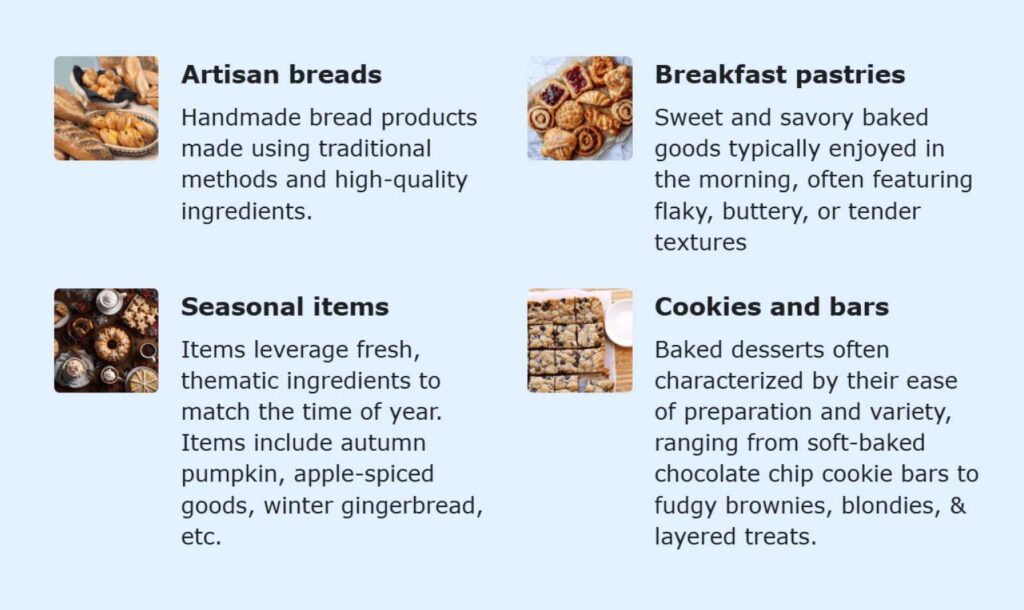
The bakery keeps 20-30 items available daily. A few seasonal items rotate in and out throughout the year, adding another 5 to 8 Stock Keeping Units (SKUs) during active periods.
Each category serves a different customer need.
| Category | Target Customer Need |
|---|---|
| Bread | Weekday dinners and weekend brunches |
| Pastries | Morning customers |
| Cookies & Bars | Snacks or desserts |
Artisan Breads
The bakery produces sourdough, whole wheat, multigrain, and a few other loaves. Loaves are baked fresh each morning. Nothing is par-baked or carried over to the next day.
Bread production happens early. Loaves cool and go into the display case by opening. Most bread sales happen in the morning or late afternoon, so customers can buy on their way home from work.
Pricing sits in the middle range. Customers pay for same-day baking and convenience.
Breakfast Pastries
This category includes croissants, muffins, scones, danishes, and cinnamon rolls. All items are grab-and-go. That means no special requests or customization.
Pastries move fastest in the morning. Some customers buy a pastry and a loaf. Others just want something quick. The bakery keeps variety controlled: 3 or 4 types of muffins, 2 croissant options, and 1-2 scones.
Limited variety reduces waste and keeps production predictable.
Cookies and Bars
Cookies include chocolate chip, oatmeal raisin, peanut butter, and snickerdoodles. Bars include brownies, blondies, and lemon squares. Production happens mid-morning after the bread is done.
These items have a longer display window than pastries. A cookie baked at 10:00 AM still looks fresh at 2:00 PM. That timing flexibility helps smooth out the production schedule. Cookies also work as impulse buys at checkout.
Seasonal Rotation Items
The bakery adds a few seasonal products during holidays and local events.
- Pumpkin bread in the fall
- Gingerbread in winter
- Berry muffins in summer
These stay simple as single-component baked goods only. No tarts or layered desserts. No items that require special equipment or techniques.
Seasonal items usually replace a regular product temporarily. When pumpkin bread comes in, one other bread drops off the menu. Total daily SKU count stays within the 20-30 range most of the time. During peak seasonal periods, it might reach 35.
Rotation decisions depend on what sold well the previous year and what ingredients are available. Customer requests get noted, but don’t automatically trigger new products. Sarah decides what fits the production flow.
What Hearth & Crumb Doesn’t Do
We don’t do custom birthday or wedding cakes. Custom work breaks the production schedule and introduces risk. One custom order can derail an entire morning.
We also don’t do bulk orders for events. The bakery can’t absorb large orders without disrupting retail flow. Catering customers want delivery and setup. But retail-only keeps the model clean.
Pricing Structure
Prices stay consistent throughout the year. We do not apply holiday surcharges or slow-season discounts. Customers know what things cost as they make repeat purchases, and that predictability supports routine buying behavior.
Current pricing falls within the following general ranges:
- Artisan breads: approximately $6 to $9/loaf
- Breakfast pastries: approximately $3 to $5/item
- Cookies and bars: approximately $2 to $4/item
- Seasonal baked goods: generally priced within the same category ranges as comparable core items
These ranges place Hearth & Crumb between grocery store bakeries and specialty destination bakeries. The business does not compete on the lowest price, nor does it position itself as premium. It competes on location, same-day freshness, and consistent execution, with every item baked that morning in the back kitchen.
Freshness Policy
Bakery goods sell the day they’re baked or leave the building at closing. No day-old racks nor markdowns at 2:00 PM. Unsold items get donated to a local food recovery program.
This policy costs a margin, but it also protects the reputation. Customers trust that everything in the case is fresh. Waste is factored into costs as part of normal operations.
Market Analysis
North America’s bakery products market hit $95.2 billion in 2025. Growth continues at 5.8% annually through 2032. This isn’t a fad. Consumers keep buying freshly baked goods. They want clean-label products.
The U.S. bakery market alone reached $78.96 billion by 2023 and is projected to reach $86.93 billion by 2029. Growth stretches across multiple years without sharp spikes or sudden drops—just steady expansion.
Bakery ingredients tell a similar story. The U.S. market sits at $5.5 billion in 2025. Long-term expansion continues as consumers want higher-quality ingredients. They want natural ingredients and are willing to pay for both.
This baseline demand matters for Hearth & Crumb. National trends support a small retail bakery with fixed capacity. The business doesn’t need a massive market share. It needs consistent local customers in an established category. That’s achievable.
Local Context
Durham’s been growing by 0.75% from 2020 to 2026. Young professionals, university employees, families who wanted something between Raleigh’s sprawl and Chapel Hill’s insularity. West Main Street sits in the middle of that story — not the flashy part of it.
512 West Main isn’t downtown, and it’s not the Ninth Street corridor. It’s quieter. The foot traffic here comes from people who actually live nearby, not from people who drove in for brunch. We’re not betting on destination traffic. We’re betting on the person who walks past the window three times a week and eventually comes in.
The median household income in Durham runs around $82,316. Middle-income, not affluent—which in practice means customers aren’t deliberating over a $4 pastry. These are routine purchases for people with regular spending capacity. That’s exactly the customer we’re built for.
Parking is street-only and not abundant. Some customers will walk, some will find a spot. We didn’t plan production capacity as if we were a drive-to destination, because we’re not.
Target Customers
Hearth & Crumb serves people who live or work in the neighborhood (routine purchasers). Not tourists nor destination shoppers.
The core customer might buy bread or pastries once or twice a week. The business model depends on frequency, not large transactions.
Likely customers include professionals working from home, parents managing morning routines, retirees who prefer fresh bread, and people who work nearby. These customers value convenience and want fresh-baked goods without extra travel.
| Customer Segment | Typical Visit Timing | Typical Purchase | Frequency Driver |
|---|---|---|---|
| Nearby Residents (Households) | Morning or early afternoon | One loaf of bread or a small mix of baked goods | Routine household food needs and walking-distance convenience |
| Work-From-Home Professionals | Mid-morning (after early rush) | Pastry with an occasional bread add-on | Flexible schedules and proximity during breaks |
| Commuters Working Nearby | Early morning (7:00–9:00 AM) | Single pastry or pastry plus bread | Grab-and-go breakfast before work |
| Parents with School-Age Children | Morning after drop-off | Bread or pastries for same-day use | Fixed morning routines and repeated weekly needs |
| Retirees and Local Seniors | Late morning to early afternoon | Bread or small baked items | Preference for fresh products over grocery store alternatives |
Purchase Behavior
Transactions are small and frequent. That’s the whole model.
Typical purchase looks like one of these:
- A loaf plus two pastries
- A single pastry on the way to work
- An add-on cookie at the counter
We don’t chase large orders. A customer buying six muffins is fine. Someone wanting 50 cookies for an office event gets pointed elsewhere — that order would disrupt an entire morning’s production for a margin that doesn’t justify it.
Repeat customers develop routines. Tuesday pastry, Friday bread. Those patterns matter more to the revenue picture than any single large transaction ever could. This is the assumption the whole model rests on—if routines don’t form, the projections don’t hold.
New customers try us once and either come back or don’t. No loyalty program, no discount for a second visit, nothing to artificially manufacture a return. In practice, they come back if the location fits their life and the product is worth it. That’s the retention mechanism.
Competitive Landscape
Hearth & Crumb Bakery operates in a competitive but well-defined market, with both direct and indirect competitors. The bakery focuses on freshness, consistency, and product focus as its key differentiators.
Direct Competitors
The most direct competition comes from other independent bakeries within a short drive. There aren’t many on our end of West Main, which is also why this location made sense. The ones that exist are either:
- Further into downtown—where rent is higher, and the customer base skews more destination.
- Or they’re doing custom cake work and catering, which we’ve deliberately walked away from (Different businesses, in practice).
Grocery store bakeries are real competition for the bread customer, specifically. Someone buying a sourdough loaf at the Harris Teeter on Guess Road is a customer as well. We’re not going to win on price against a grocery store, and we’re not trying to. What we can offer is something baked that morning in a kitchen they can see from the counter. That’s a different product because of the different experience it comes with.
Coffee shops selling pastries are worth mentioning, though we think about them differently than most bakery business plans would. They’re not really selling pastries. They’re selling seating, wifi, and an atmosphere to justify 2 hours of laptop time. The pastry is incidental. We’re the opposite. The product is the whole point, and there’s nowhere to sit.
Farmers market bakers show up seasonally, and honestly, some of them are excellent. We don’t lose sleep over them. Their customer is already committed to making a special trip on Saturday morning. Ours is building a Tuesday routine.
Indirect Competitors
These businesses provide alternatives to Hearth & Crumb’s products and compete mainly on price and convenience:
- Grocery and Big-Box Store Baked Goods: Pre-packaged baked goods are available in large retailers such as Costco, Walmart, and Target. They offer low-priced, packaged products but lack the freshness and quality of Hearth & Crumb’s daily-made goods.
- Packaged Snacks: Convenience-based snacks such as granola bars or pre-packaged pastries that are easily available and cost-effective, but don’t provide the same freshness or indulgence as Hearth & Crumb.
- Quick-Service Breakfast Options: Fast food chains offering breakfast options like bagels, muffins, and pastries at competitive prices, focusing on speed and convenience.
- National Chains with Baked Offerings: Chains like Starbucks or Dunkin’ that offer a limited selection of baked goods, often sourced from third-party suppliers, competing on price, convenience, and brand recognition.
These indirect competitors often offer convenience and lower prices, but they do not compete with Hearth & Crumb in terms of freshness, product focus, or the high-quality, local appeal of freshly baked goods.
Why Mid-Range Pricing Works
We don’t compete on price; that’s a deliberate choice.
Low prices require high volume and slim margins. We don’t have the production capacity to make that math work, and honestly, we wouldn’t want to—it’s a race we can’t win against grocery store bakeries anyway.
Premium pricing doesn’t fit either. That model works for destination bakeries with weekend crowds and a reputation built over the years. We’re a neighborhood bakery on a quieter stretch of West Main. Charging destination prices before we’ve earned that trust would be a mistake.
Mid-range is the right position because it lets regular customers keep coming back without thinking about it. A $4 pastry and a $9 loaf don’t require a decision. They just happen. That frequency is worth more to us than squeezing extra margin on any single transaction.
Prices stay the same year-round. No holiday surcharges, no January discounts. Customers know what things cost here—and that predictability is part of what makes a routine possible.
Location Factors
West Main Street gets some foot traffic from nearby residents and pass-through commuters. Morning hours may capture people heading to work or getting coffee.
The location isn’t as high-traffic as downtown Durham. That keeps rent lower and competition lighter. The trade-off is fewer spontaneous customers. The bakery relies on nearby residents building it into their routines rather than depending on heavy walk-by traffic.
Parking exists on the street, but it isn’t abundant. Some customers may walk or bike, while others drive and find street parking. The business doesn’t assume high car traffic.
Market Risks
Durham has room for a neighborhood bakery, but there’s no guarantee customers will adopt it into their routines. The business assumes it can build a base of regular customers from nearby households. That assumption carries risk.
If customers don’t shift existing habits, revenue stays flat. The bakery has limited capacity to offset that through marketing or extended hours. Growth depends on word-of-mouth and consistent execution.
Seasonal patterns exist. December is typically stronger. January slower. Summer weekday traffic may be lighter. The business absorbs these swings rather than trying to eliminate them.
Marketing & Sales Strategy
Customer Acquisition Approach
The acquisition strategy is simple: be good, be consistent, and be easy to find for people who live nearby.
We’re not running paid campaigns or chasing influencer coverage. The customers we need are within half a mile. They’ll find us by walking past, or they’ll hear about us from someone who did. That’s the whole funnel.
In practice, growth here is slow. A new customer tried us once. If the product is good and the location fits their routine, they come back. Eventually, they mention it to a neighbor. That’s word-of-mouth at the neighborhood scale—unglamorous, untrackable, and exactly what a business like this runs on.
We’re not trying to grow fast. Fast growth at this production capacity would just mean selling out earlier and disappointing people. Steady neighborhood adoption is the goal—the kind where 6 months in, a regular customer would notice if we were closed unexpectedly.
Storefront Visibility
The storefront is doing most of the marketing work.
The exterior signage shows the name and hours clearly. Nothing elaborate, just legible from the sidewalk at a normal walking pace. Worth noting: The font size matters. Customers don’t have to slow down to read it.
The window display is the real thing. Every morning before we open, whatever comes out of the oven goes into the case, and the case faces the glass. A person walking past on their way somewhere else can see exactly what’s available without breaking stride. That passive visibility. It’s free, it resets every morning, and it’s honest about what we actually have that day.
We’re deliberately not using the window for promotional signage. No chalkboard specials, limited-time offer boards, or seasonal decorations that block the product view. The product is the display. Anything that competes with that sight line is working against us.
The entrance faces the street directly at ground level. No steps or recessed doorway. People can see in, and getting in is easy. This doesn’t kill casual walk-in traffic before a single customer makes a decision.
Operating Hours as a Marketing Signal
Hearth & Crumb opens at 7:00 AM Tuesday through Sunday, and the doors close at 3:00 PM. These hours match morning and mid-day neighborhood activity. They also stay within staffing and production limits.
Consistency matters more than extended availability. Customers learn the schedule and plan visits accordingly. Hours don’t change seasonally. We also avoid early closures whenever possible.
Closing at 3:00 PM limits revenue upside. It also keeps labor and operating costs controlled.
Local Awareness
Hearth & Crumb maintains informal awareness with nearby businesses. These are casual relationships, not structured partnerships. No joint promotions, co-branded materials, or shared campaigns.
Any cross-traffic that occurs is incidental. It doesn’t require time or expense to maintain.
Social Media Presence
We have an account where we post.
The account exists as a practical tool for people who already know about us—daily photos of what’s in the case, updates if hours change unexpectedly, and a note when a seasonal item comes in. We’re not trying to grow a following or build a content calendar or drive discovery through Instagram. The customers we need are within walking distance. They don’t need to find us through an algorithm.
In practice, posts go up when there’s time to post them. Most mornings that means a quick photo of the case before we open—it takes maybe 4 minutes, and it tells an existing customer whether we have the thing they’re thinking about stopping in for. That’s useful.
No paid posts, promoted content, or engagement campaigns. If the account grows organically because customers share their own photos, that’s fine, and we won’t discourage it. But we’re not building the customer acquisition model around it.
This strategy eliminates the need for costly advertising or engagement-driven campaigns. Instead, social media is a tool for information sharing and customer retention, not a marketing funnel.
Marketing Budget
The marketing budget for Hearth & Crumb is designed to maintain low, predictable costs that don’t fluctuate based on seasonal trends or revenue growth. Our primary focus is on maintaining consistent visibility with minimal outlay, ensuring that customer acquisition and retention remain steady without introducing unnecessary financial risk.
Key elements of the marketing budget include:
| Marketing Element | Description | % of share |
|---|---|---|
| Signage | Clear, straightforward signage outside the bakery to ensure visibility. Displays the bakery’s name, hours, and a simple tagline to reinforce the business identity. |
50 |
| Basic Digital Tools | Low-cost digital tools for social media presence. Used to update customers on daily offerings and changes in hours, without paid ads or promotions. |
30 |
| Occasional Printed Materials | Minimal use of printed materials (e.g., business cards, event flyers) for local distribution to nearby businesses or customers. No ongoing print campaigns. |
20 |
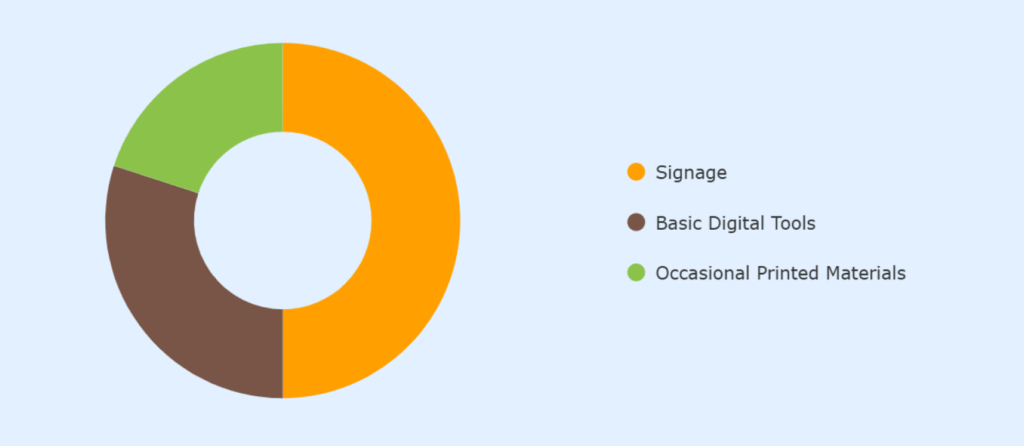
The total marketing spend stays flat year over year and sits alongside other fixed operating costs. It doesn’t go up in December because we’re busy, and it doesn’t go up in January because we’re slow. Consistency matters more than responsiveness here—customers trust a business that behaves the same way every month. This is also easier to manage when you’re doing everything else yourself.
We looked at whether a small paid social budget made sense early on and decided against it. The customers we need are within half a mile. They’ll find us by walking past, or they’ll hear about us from someone who did.
Customer Retention Logic
Retention here means one thing: people building us into their week.
Not a loyalty program. Not punch cards, not a points system, not a discount for your 10th visit. We’re deliberately not doing any of that. For us, a customer who comes in every Tuesday because it’s just what they do on Tuesdays is worth more than a customer chasing a free muffin.
In practice, retention comes down to two things: the product is the same quality every time, and we’re open when we say we’re open. This is the part that actually keeps the model honest—one bad week of product quality or 2 unexpected early closures, and a routine customer just quietly stops coming.
The menu helps. It’s limited enough that regulars know what to expect, but we rotate seasonals often enough that there’s a reason to check in. Someone who comes in every Friday for a sourdough loaf might walk in one October morning and see pumpkin bread and buy that too. That’s the whole retention mechanic right there.
We’re not tracking any of this formally. No CRM, no customer data beyond what the POS captures. We’ll know retention is working when daily transaction counts stabilize and stop requiring explanation. Year 1 is about building the routine. Year 2 is about whether it is held.
By year 3, we’d hope the regulars are the backbone of the revenue picture—but we’ll have a much clearer sense of what that actually looks like around month 18 than we do right now.
Operations Plan
Hearth & Crumb operates as a retail-only neighborhood bakery with a controlled, repeatable daily workflow. All products are baked on-site and sold the same day through walk-in retail. There’s no seating, delivery, or off-site sales.
Operations are built around fixed hours, limited production volume, and direct owner oversight. The business prioritizes consistency and cost control over maximum output. Daily production is planned to fit within existing equipment and staffing limits rather than scaling to meet peak demand.
Hours of Operation
Hearth & Crumb operates with set hours to support reliable customer expectations and predictable staffing.
- Operating Days: Tuesday through Sunday
- Operating Hours: 7:00 AM – 3:00 PM
- Closed: Mondays for recovery and non-production tasks
Monday Closure is specifically reserved for deep cleaning, administrative work, inventory management, and any necessary equipment maintenance. No baking or retail sales take place on Mondays, ensuring the bakery is fully prepared for the week ahead.
These hours remain fixed throughout the year to offer customers the certainty of when to expect fresh products, without the need for seasonal adjustments or shifts in operating times.
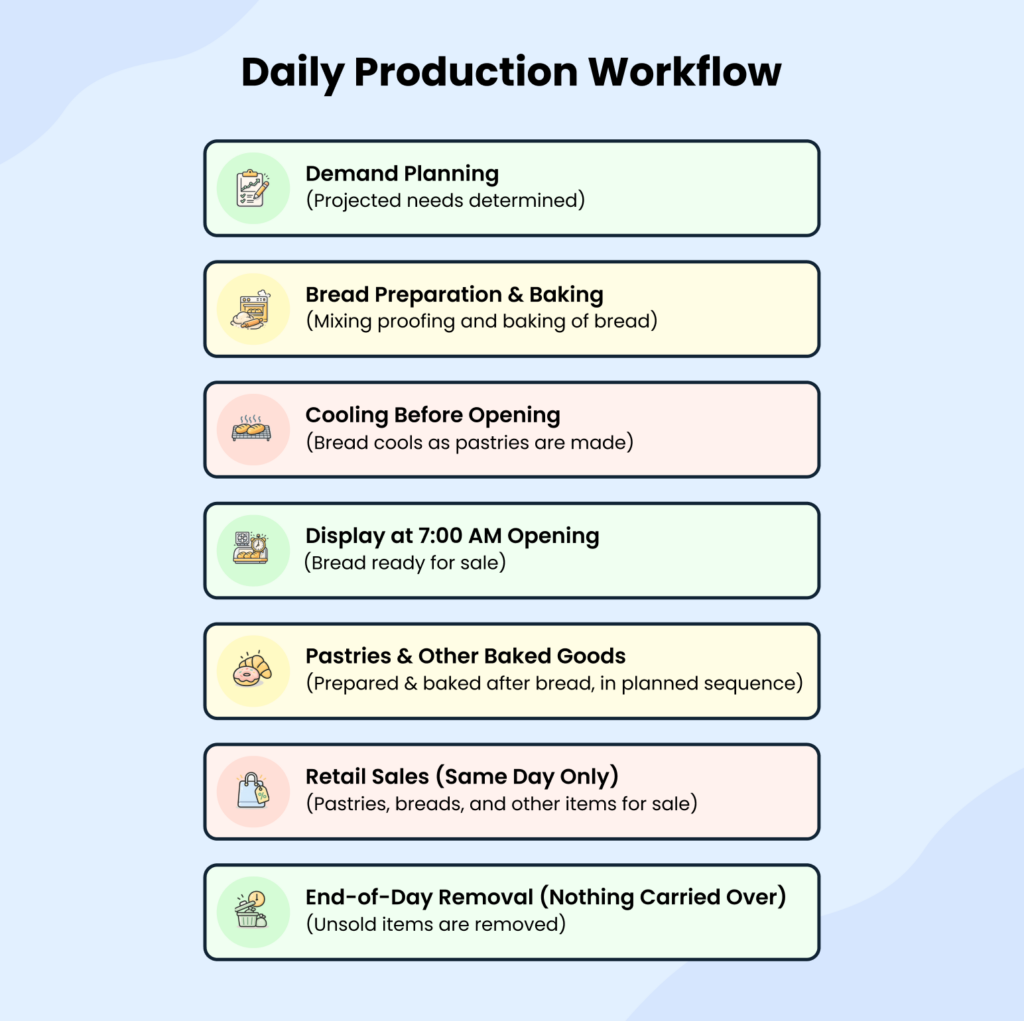
Daily Production Workflow
Production follows a consistent sequence, with careful planning and execution to maintain high product standards and minimize waste.
- Bread preparation & baking are the first steps each morning. Bread items are baked first to ensure they are cooled and ready for display when the store opens at 7:00 AM.
- Pastries & other baked goods follow in a planned order, taking into account oven space and timing. Production is executed in limited batches to prevent overproduction.
- All products placed in the display case are freshly baked that morning. Nothing is carried over to the next day or reheated for resale.
Each day’s production is carefully planned in advance, based on expected demand patterns from previous sales data. The bakery intentionally produces small batches to control waste and ensure that all products are sold fresh on the same day.
Capacity and Constraints
The capacity is limited. That’s intentional, not a gap to fix.
Three things set the ceiling:
- 1 deck oven
- 1 full-time baker plus part-time counter help
- 8 hours from first mix to close
That works out to roughly 180-210 items on a typical day. We mapped actual bake sequences against oven space and cooling time to land on that number — not the other way around.
If demand exceeds what we can produce, we sell out and close that item. No extended hours, no extra shifts. A bakery that sells out by 1:30 PM is telling its neighborhood something useful about itself.
We considered a second oven during buildout and decided against it. The space could fit one—the staffing math doesn’t work yet. We’ll revisit if year 2 looks different.
Mondays are closed. The oven gets cleaned, the week gets planned, and Sarah gets a day that isn’t physically punishing. The model only works if the person running it is still standing in month 6.
Staffing and Daily Coverage
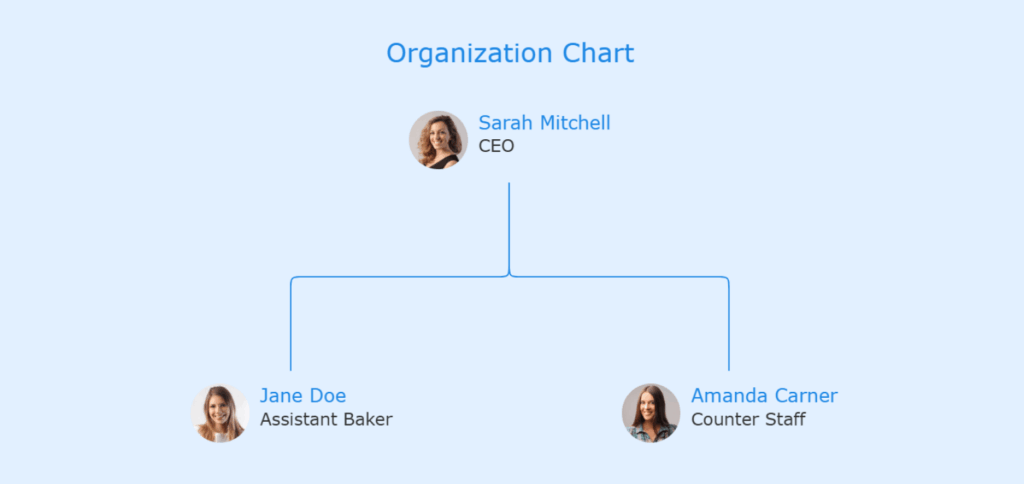
The owner leads daily operations. Sarah serves as the primary baker and oversees production, ordering, and quality control.
A full-time assistant baker supports preparation and baking tasks. One or two part-time counter staff handle customer service. Staffing levels vary by day and expected activity.
Staffing covers opening setup, peak morning periods, and closing tasks. No excess overlap exists. Counter staff focus on transactions and basic display handling. They don’t perform production work.
Inventory and Vendor Management
Hearth & Crumb maintains a simple and controlled sourcing structure designed to support daily production without excess inventory or supplier complexity.
Primary Ingredient Sourcing
The bakery works with a small group of core vendors:
- Regional food distributor: Flour, sugar, baking staples, oils, dairy, yeast, and dry goods.
- Local produce supplier: Seasonal fruits used in muffins or rotation items.
- Packaging supplier: Bags, boxes, parchment paper, and labeling materials.
- Cleaning and sanitation supplier: Approved food-safe cleaning materials.
Consolidating most staple ingredients through a primary distributor simplifies ordering, maintains pricing consistency, and reduces logistical coordination.
Vendor Contingency Planning
If a contracted vendor is temporarily unavailable:
- Shelf-stable staples (flour, sugar, dry goods) can be sourced from approved secondary distributors.
- Seasonal items are adjusted or temporarily removed from rotation rather than forcing emergency sourcing.
- Production quantities may be reduced slightly if necessary to maintain ingredient standards.
The business doesn’t rely on rare or specialty ingredients that would create supply-chain dependency. Menu simplicity reduces sourcing risk.
Inventory Levels and Control
Inventory is intentionally kept tight. The bakery maintains:
- Limited dry goods stock to support near-term production.
- Minimal perishable overstock to reduce spoilage.
- Packaging supplies sufficient for the expected weekly volume.
There’s no warehouse storage or long-term bulk inventory strategy.
Inventory Management System
Hearth & Crumb uses a straightforward inventory tracking approach:
- Daily review of production quantities versus sales.
- Weekly ordering based on recent sales patterns.
- Manual tracking of key ingredient usage.
- POS sales reports used to inform future production planning.
The bakery doesn’t implement complex inventory management software. Given the limited SKU count and retail-only model, a simple tracking system supported by POS sales data is sufficient.
This approach keeps administrative burden low while maintaining control over food cost and spoilage.
Waste Control
Waste is an expected part of bakery operations and is accounted for in production planning. Daily bake quantities are set to balance availability with sell-through.
At the end of the day, unsold items are removed from sale and don’t carry over. Waste is reviewed through daily production and sales comparison, allowing gradual adjustments to future bake levels. The goal is predictable waste, not elimination.
Quality Control
Quality control is managed directly by the owner to maintain high standards of production. The steps include:
- Consistent recipes to ensure uniformity and quality in each batch of baked goods.
- Limited batch sizes to avoid overproduction and ensure freshness.
- Visual inspection of each product before placing it in the display case.
Any items that don’t meet the bakery’s quality standards are discarded, ensuring that only fresh, high-quality products are sold.
By keeping the menu limited, the bakery minimizes the complexity of production, enabling better control over the quality and timing of each product.
Equipment Use and Maintenance
Hearth & Crumb’s production capacity is supported by standard commercial baking equipment sized for a 1,000 sq. ft. retail operation. Core equipment includes:
| Equipment | Purpose |
|---|---|
| Commercial deck oven | Used for bread and pastry baking |
| Commercial planetary mixer | Dough and batter preparation |
| Two-door commercial refrigerator | Dairy, produce, and perishable storage |
| Reach-in freezer | Used for limited frozen ingredient storage |
| Stainless steel prep tables | Dough handling and assembly |
| Glass-front display case | For the customer counter |
| Point-of-sale (POS) system | Transaction processing and sales tracking |
Equipment is used daily during the defined production window. The oven and mixer form the primary production bottlenecks and therefore determine daily batch limits.
Maintenance Protocol
- Daily cleaning of ovens, mixers, prep tables, and display areas after close.
- Weekly deep cleaning of refrigeration units and storage areas.
- Routine inspection of seals, thermostats, and mixer components.
- Preventive servicing scheduled during Monday closure periods.
The bakery does not rely on specialized or custom machinery. Equipment selection prioritizes reliability and service availability over advanced features. No additional equipment purchases are assumed beyond what is included in startup costs, and production planning reflects the limits of current equipment capacity.
Operational Risk Management
The bakery’s operational risks include potential equipment failures, staff availability, and fluctuations in demand. These risks are managed through:
- Simple workflows that minimize complexity and allow for quick adaptation.
- Conservative production planning to match anticipated demand without overproducing.
- Fixed hours and staffing to control costs and avoid overextension.
- Owner oversight to ensure consistent quality and operational reliability.
This risk management strategy is designed to maintain stability, ensuring that the business isn’t dependent on high-volume days or extended operating hours to meet its financial obligations.
Management & Staffing
Management Structure
Hearth & Crumb is owner-operated. Sarah Mitchell owns the business outright. She manages all core aspects, and no separate management layer exists. Decision-making is centralized, which keeps operations simple and consistent.
Sarah leads daily production. She oversees ordering, scheduling, quality control, and overall operations. This structure keeps responsibility clear.
Owner Responsibilities
Sarah serves as the primary baker. She’s regularly involved in daily production activities, including recipe execution, production timing, and product standards.
In addition, she is responsible for:
- Managing ingredient ordering
- Reviewing waste patterns
- Planning future production volumes
Administrative responsibilities include reviewing sales, handling invoices, and managing payroll inputs. Sarah handles financial oversight directly. This maintains cost control and visibility into daily performance.
Staffing Plan
The staffing model is intentionally lean and designed to support fixed hours and limited production volume.
- Owner (Full-Time): Primary baker and operator.
- Assistant Baker (Full-Time): Supports preparation, baking, and cleanup tasks under the owner’s direction.
- Counter Staff (Part-Time): One or two part-time staff members handle customer transactions, basic display restocking, and opening or closing tasks depending on the day.
There are no supervisory or management roles beyond the owner.
Coverage and Scheduling
Staff schedules are set to cover early morning setup, peak morning sales periods, and closing procedures. Counter staff coverage varies by day to match expected customer activity, with additional coverage on busier days and weekends.
The assistant baker works a consistent schedule aligned with production needs. When items sell out, sales stop rather than extending hours or adding labor.
Here are more of our staffing plans:
| Category | Details |
|---|---|
| Labor Cost Control | Labor costs are managed through fixed hours, defined roles, and direct owner involvement. No overtime, split shifts, or temporary labor. Staffing remains consistent year-round. |
| Instruction and Standards | New staff receive basic training in food safety, cleanliness, and customer service. Processes are simple and reinforced through direct supervision. |
| Staffing Risk Considerations | Staff availability is a recognized risk. This is managed by using simple workflows, a limited menu, and careful scheduling. The business does not rely on specialized roles that would disrupt operations if an employee is unavailable. |
Financial Plan
Startup Costs and Use of Funds
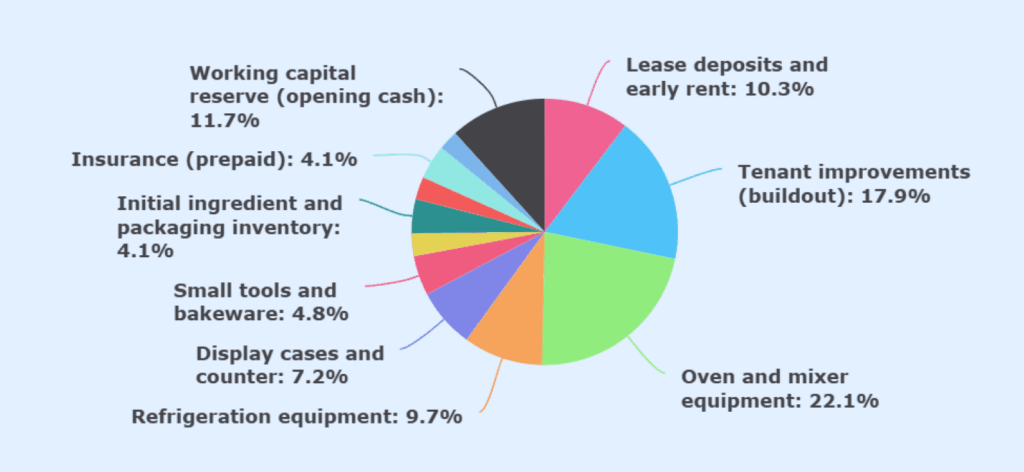
Total startup costs are $145,000. Funds are allocated to prepare the leased space, purchase required equipment, acquire initial ingredient inventory, and provide working capital for early operations.
Uses of funds include:
- Tenant improvements and build-out
- Baking equipment and refrigeration
- Display, counter, and POS hardware
- Tools and smallwares
- Initial inventory
- Opening working capital
No future expansion assets or excess capacity are included. All purchases are limited to what is required for current operations.
| Category | Cost (USD) |
|---|---|
| Lease deposits and early rent | 15,000 |
| Tenant improvements (buildout) | 26,000 |
| Oven and mixer equipment | 32,000 |
| Refrigeration equipment | 14,000 |
| Display cases and counter | 10,500 |
| Small tools and bakeware | 7,000 |
| POS hardware | 4,000 |
| Initial ingredient and packaging inventory | 6,000 |
| Permits and licenses | 4,000 |
| Insurance (prepaid) | 6,000 |
| Pre-opening marketing | 3,500 |
| Working capital reserve (opening cash) | 17,000 |
| Total Startup Costs | 145,000 |
Sources of Funds
Startup costs are funded through a combination of owner investment and bank financing.
| Source | Amount (USD) |
|---|---|
| Bank term loan | 105,000 |
| Owner cash contribution | 40,000 |
| Total Sources of Funds | 145,000 |
The owner’s contribution is provided at startup. No additional equity injections are assumed during the projection period.
Revenue Assumptions
Revenue is generated exclusively through walk-in retail sales. There are no wholesale accounts, catering orders, delivery sales, or custom work included in the projections.
Key assumptions include:
- Fixed operating hours, Tuesday through Sunday
- Stable pricing across the projection period
- Gradual increases in average daily transactions as local awareness develops
- A consistent product mix with limited seasonal rotation
Revenue projections reflect modest volume changes rather than structural changes to the business.
Cost Structure
Cost of goods sold includes ingredients, packaging, and normal production waste. Waste is treated as a routine operating condition and is incorporated into cost assumptions.
Operating expenses include payroll and related taxes, rent, utilities, insurance, marketing, and general administrative costs. Expense levels are modeled to remain relatively stable, with no assumed step-changes in staffing, rent, or marketing spend.
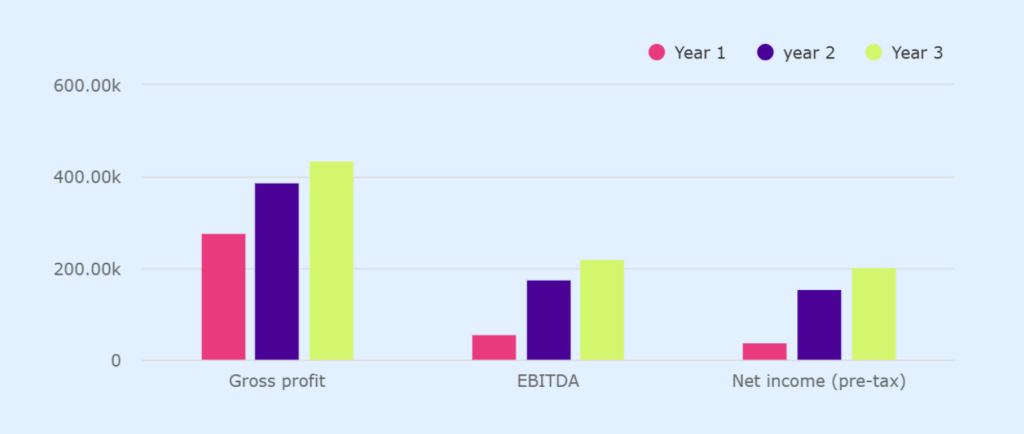
Profit & Loss Statement
| P&L (USD) | Year 1 ($) | Year 2 ($) | Year 3 ($) |
|---|---|---|---|
| Retail sales revenue | 449,280 | 608,400 | 669,240 |
| Cost of goods sold (COGS) | (170,726) | (219,024) | (234,234) |
| Gross profit | 278,554 | 389,376 | 435,006 |
| Owner salary | (55,000) | (55,000) | (55,000) |
| Assistant baker wages | (39,520) | (39,520) | (39,520) |
| Counter staff wages | (32,760) | (32,760) | (32,760) |
| Payroll taxes & benefits (10%) | (12,728) | (12,728) | (12,728) |
| Rent | (38,400) | (38,400) | (38,400) |
| Utilities | (13,200) | (13,200) | (13,200) |
| Marketing | (12,000) | (12,000) | (12,000) |
| Software & POS | (3,600) | (3,600) | (3,600) |
| Repairs & maintenance | (4,000) | (4,000) | (4,000) |
| Other operating expenses | (3,500) | (3,500) | (3,500) |
| Insurance amortization | (6,000) | — | — |
| Total operating expenses | (220,708) | (214,708) | (214,708) |
| EBITDA | 57,846 | 174,668 | 220,298 |
| Depreciation | (11,243) | (11,243) | (11,243) |
| Interest expense | (7,875) | (7,425) | (6,525) |
| Net income (pre-tax) | 38,728 | 156,000 | 202,530 |
Cash Flow Statement
| Cash Flow (USD) | Year 1 ($) | Year 2 ($) | Year 3 ($) |
|---|---|---|---|
| Net income (pre-tax) | 38,728 | 156,000 | 202,530 |
| Depreciation (non-cash) | 11,243 | 11,243 | 11,243 |
| Change in inventory | (566) | (1,858) | (586) |
| Change in accounts payable | 14,227 | 4,025 | 1,267 |
| Cash from operations | 63,632 | 169,410 | 214,454 |
| Capital expenditures | — | — | — |
| Cash from investing | — | — | — |
| Loan principal repayment | (12,000) | (12,000) | (12,000) |
| Owner contributions | — | — | — |
| Cash from financing | (12,000) | (12,000) | (12,000) |
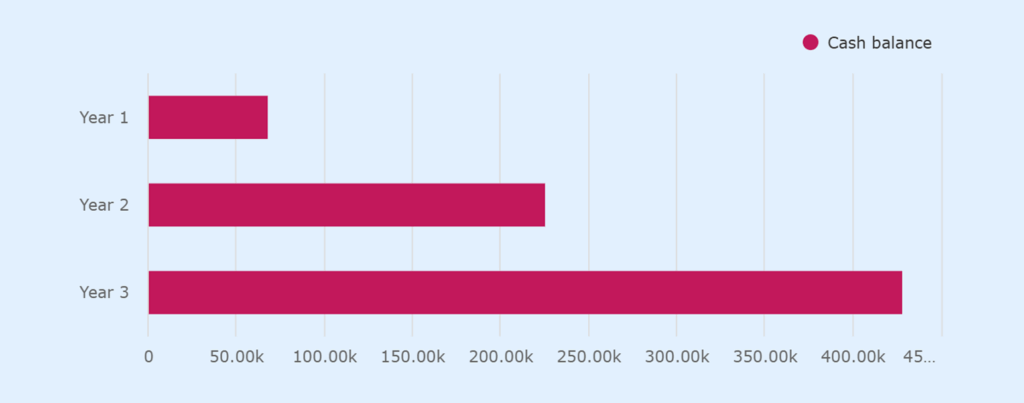
| Net change in cash | 51,632 | 157,410 | 202,454 |
| Beginning cash balance | 17,000 | 68,632 | 226,042 |
| Ending cash balance | 68,632 | 226,042 | 428,496 |
Balance Sheet
| Balance Sheet (USD) | Year 1 ($) | Year 2 ($) | Year 3 ($) |
|---|---|---|---|
| Assets | |||
| Cash | 68,632 | 226,042 | 428,496 |
| Inventory | 5,434 | 7,292 | 7,878 |
| Current assets | 74,066 | 233,334 | 436,374 |
| Fixed assets (gross) | 86,500 | 86,500 | 86,500 |
| Accumulated depreciation | (11,243) | (22,486) | (33,729) |
| Net fixed assets | 75,257 | 64,014 | 52,771 |
| Total assets | 149,323 | 297,348 | 489,145 |
| Liabilities | |||
| Accounts payable | 14,227 | 18,252 | 19,519 |
| Loan payable (long-term) | 93,000 | 81,000 | 69,000 |
| Total liabilities | 107,227 | 99,252 | 88,519 |
| Equity | |||
| Owner contributed capital | 40,000 | 40,000 | 40,000 |
| Retained earnings | 2,096 | 158,096 | 360,626 |
| Total equity | 42,096 | 198,096 | 400,626 |
| Total liabilities + equity | 149,323 | 297,348 | 489,145 |
Spreadsheets are exhausting & time-consuming
Build accurate financial projections w/ AI-assisted features
Loan Terms and Repayment
Hearth & Crumb is seeking a $105,000 bank term loan to fund tenant improvements, equipment purchases, initial inventory, and working capital.
The loan is structured as a standard amortizing term loan with the following modeled terms:
- Loan Amount: $105,000
- Loan Type: Fully amortizing term loan
- Repayment Structure: Principal and interest payments
- Annual Principal Repayment: $12,000/year (as reflected in projections)
- Use of Funds: Build-out, equipment, inventory, working capital
Debt service is incorporated directly into the cash flow projections. Payments are scheduled and don’t rely on interest-only periods, balloon payments, or refinancing assumptions.
Repayment capacity is supported by:
- Immediate point-of-sale cash collection
- 6 operating days/week
- Stable pricing and cost structure
- No dependency on bulk orders, catering, or seasonal revenue spikes
The financial model demonstrates the ability to meet scheduled principal and interest obligations through routine daily retail sales within existing production capacity.
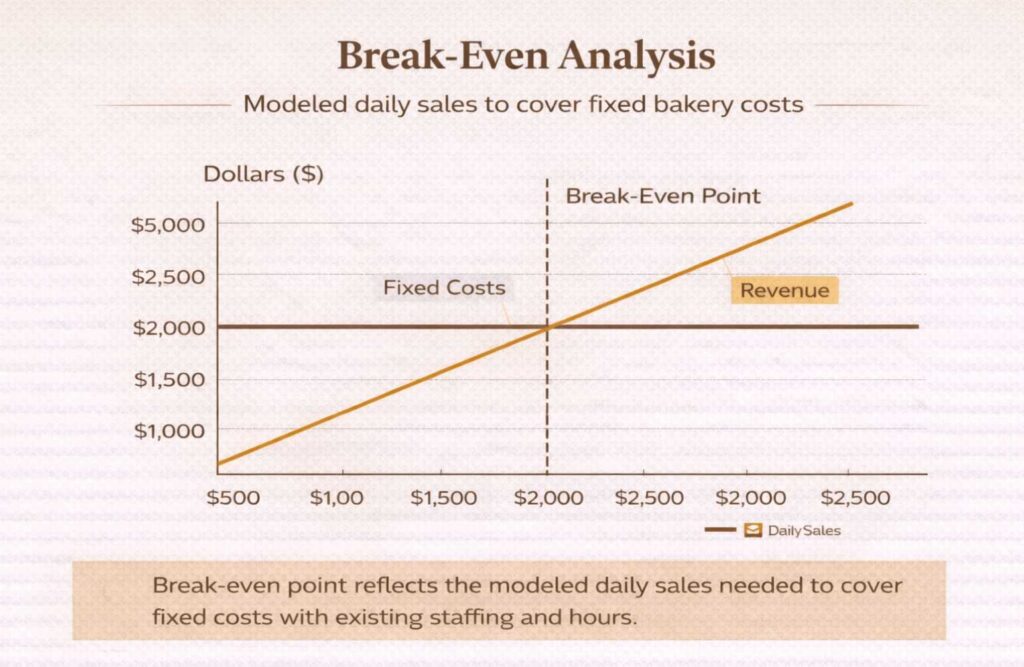
Break-Even Analysis
Break-even analysis identifies the level of sales required to cover fixed operating costs under the current cost structure. The analysis is based on stabilized operating assumptions rather than initial opening conditions.
Break-even results are presented as an analytical reference point rather than a guaranteed outcome.
| Item | Value |
|---|---|
| Monthly fixed costs | $19,692 |
| Variable cost ratio (COGS %) | 36% |
| Contribution margin | 64% |
| Monthly break-even revenue | $30,769 |
| Break-even revenue per day | $1,183 |
| Average transaction value (Year 2) | $13 |
| Break-even transactions per day | ~91 |
| Modeled avg daily transactions (Year 2) | ~150 |
| Break-even status | Achieved in Year 2 |
Financial Risk Considerations
Financial risks include slower-than-expected customer adoption, sales variability, and unplanned maintenance expenses. The financial model reflects conservative assumptions and limited fixed obligations. The business does not rely on aggressive growth or operating changes to meet financial commitments.
The Quickest Way to turn a Business Idea into a Business Plan
Fill-in-the-blanks and automatic financials make it easy.

Vinay Kevadia
Vinay Kevadiya is the founder and CEO of Upmetrics, the #1 business planning software. His ultimate goal with Upmetrics is to revolutionize how entrepreneurs create, manage, and execute their business plans. He enjoys sharing his insights on business planning and other relevant topics through his articles and blog posts. Read more