Starting a dog walking business may seem simple at first. But once you start planning it out, there are several practical decisions to make. You need to figure out:
- what to charge
- how many clients you can realistically handle
- how to keep bookings consistent
- when it makes sense to hire
To help you think through those decisions, I’ve created a complete sample plan for Rover’s Route Dog Walking LLC, a neighborhood dog walking business in Denver, Colorado. It shows how the business approaches its pricing, target customers, daily operations, staffing, and finances.
You can use it as a reference while creating your own plan.
1. Executive Summary
Rover’s Route Dog Walking LLC is an owner-operated dog walking service launching in central Denver, Colorado. The company will initially serve Washington Park, Platt Park, and Baker, focusing primarily on dog owners who need dependable weekday care.
Founder Hannah Brooks will perform all walks during the first year while managing scheduling, onboarding, billing, client communication, marketing, and route planning.
Rather than trying to cover the entire Denver area, Rover’s Route will operate within a compact service zone. Keeping customers close together will reduce unpaid travel time between appointments and allow Hannah to complete more walks during the hours when demand is highest.
Vision
To be the neighborhood’s trusted pet-care provider, known for reliable service, the same walkers each time, and strong client relationships, not for spreading across the city.
Market Opportunity
Rover’s Route is built around recurring demand rather than occasional pet-care bookings. Its main customers will be working professionals and dual-income households who are away from home during the day and need their dogs walked several times each week.
The company does not need to capture a meaningful share of the overall Denver pet-care market. It only needs enough recurring households within its limited service area to create a dense and predictable weekly route.
This makes local customer fit, location, and scheduling needs more important than the size of the national pet-care industry.
Also, app-based platforms serve this area but rotate walkers and churn heavily. Independent walkers exist but often over-extend their routes across the city, which erodes reliability. The gap is a dependable, neighborhood-first walker, and that is the gap Rover’s Route fills.
Services and Business Model
The company’s core service will be private 30-minute recurring weekday walks.
Additional services will include:
- One-time dog walks
- Puppy visits
- Limited weekend walks
Recurring customers will receive standing weekly slots, consistent service, and post-walk updates. One-time appointments will be accepted when capacity allows but will not displace established recurring clients.
Rover’s Route will compete on reliability, convenience, communication, and consistency rather than being the lowest-priced provider.
What Makes the Model Work
The company’s positioning is built around four factors:
- A consistent walker
- Standing weekday appointments
- A tightly defined service area
- Reliable visit tracking and client updates
These features are especially important for customers who are giving a service provider access to both their pet and their home.
Financial Outlook
Rover’s Route expects revenue to increase from $40,600 in Year 1 to $89,900 in Year 3 as the founder builds a recurring route and later adds a part-time walker.
| Financial Highlight | Year 1 | Year 2 | Year 3 |
| Annual walks | 1,400 | 2,200 | 2,900 |
| Revenue | $40,600 | $66,000 | $89,900 |
| Gross profit | $39,900 | $57,580 | $67,727 |
| Net income before tax | ($2,628) | $5,423 | $5,956 |
| Ending cash | $5,302 | $7,339 | $9,967 |
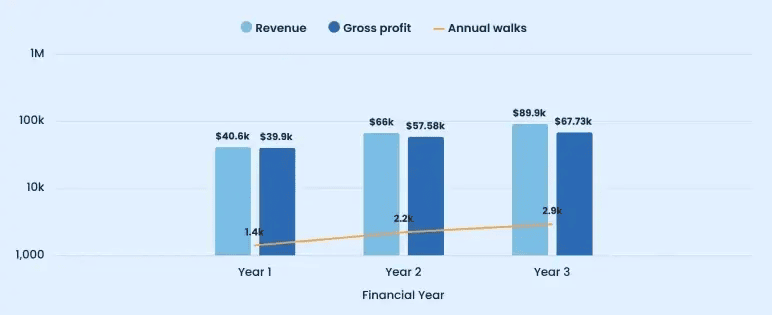
The business breaks even at roughly 145 walks per month. One person reaches full midday capacity at about 150 to 162 walks per month, which is the threshold that triggers the second hire.
Funding Requirement
Rover’s Route requires $12,000 in startup capital.
Hannah will contribute $4,000 of her own funds and plans to finance the remaining $8,000 through a small-business microloan (from the Colorado Enterprise Fund, a local CDFI).
The funding will cover registration, branding, website development, equipment, insurance, scheduling software, launch marketing, and initial working capital.

2. Business Overview
Business name: Rover’s Route Dog Walking, LLC
Location: Central Denver, Colorado
Service area: Washington Park, Platt Park, Baker (about 2.5 sq mi)
Legal structure and Ownership
Rover’s Route is a single-member LLC registered in Colorado, founded and run by Hannah Brooks.
The LLC setup keeps Hannah’s personal money separate from the business, keeps taxes simple (income passes straight through to her), and gives both clients and the lender a registered business to sign with, which matters in a service built on trust and home access.
Hannah has spent several years walking and pet-sitting in central Denver, building the local knowledge, client references, and neighborhood reputation a trust-based service runs on. At launch, she handles every part of the business: walks, scheduling, client messages, billing, and route planning.
Mission Statement
To provide dependable neighborhood dog walking that gives owners confidence their dog is safe and well cared for when they can’t be home.
Business Model
Rover’s Route will earn most of its revenue from customers who reserve recurring weekday appointments.
The business model is built around three operating principles:
- Keep customers geographically close.
- Encourage standing weekly schedules.
- Add labor only when existing capacity is genuinely full.
This approach should make revenue more predictable while reducing the amount of time spent rebuilding schedules and driving between scattered appointments.
Service Area
Rover’s Route will initially serve approximately 2.5 square miles across Washington Park, Platt Park, and Baker.
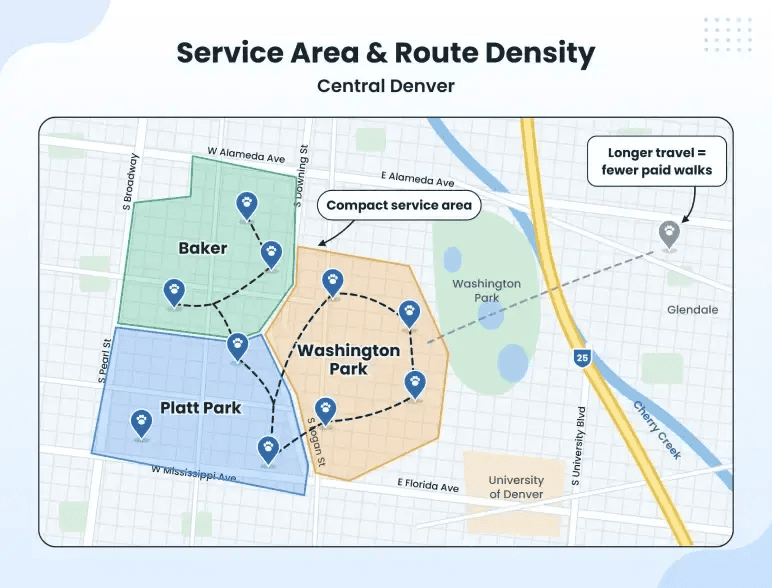
The limited service area is intentional.
The reason is simple: a client a few miles outside the route pays the same per walk as a nearby one but costs far more in unpaid travel time, and that travel is the single biggest drain on a walker’s day. Keeping everyone inside one small zone holds travel between walks to about ten minutes, which is what makes a dense, profitable daily route possible.
So Rover’s Route takes on clients who fit the existing route and turns down work outside the zone, even at a premium, until a second walker is in place.
Business Goals
During its first 18 months, Rover’s Route aims to:
- Establish a strong base of recurring weekday clients,
- Keep most travel between consecutive walks below roughly 10 minutes,
- Approach the practical capacity of a solo walker,
- Create a waiting list for peak-hour appointments,
- Hire the first part-time walker once demand consistently exceeds Hannah’s capacity.
3. Services and Pricing
Rover’s Route keeps its menu short and prices it to steer clients toward the standing weekly schedule that makes routing efficient.
Here’s the overview:
| Service | Duration | Price | Best for |
| Recurring weekday walk (core) | 30 min | $30/visit | Standing weekly schedule, same walker, priority slots |
| One-time walk | 30 min | $32/visit | Occasional need, travel, schedule changes |
| Puppy visit | 20 min | $22/visit | Potty break, water, feeding, short play for young dogs |
| Weekend walk | 30 min | $35/visit | Extra coverage for existing regulars |
Core Service: Recurring Weekday Walks
Recurring weekday walking will be Rover’s Route’s primary service.
Customers may reserve standing appointments two, three, or five days per week depending on their needs and available route capacity.
Recurring clients will receive:
- A regular weekly schedule
- Consistent walker assignment
- Priority scheduling
- Post-walk updates
- Simplified recurring billing
Standing appointments also help Rover’s Route plan routes in advance instead of rebuilding the schedule every day.
Additional Services
(1) One-Time Walks
One-time walks will be available for customers who occasionally need assistance because of appointments, work schedule changes, or other commitments.
These appointments will cost $32 for 30 minutes.
The slightly higher rate reflects the additional scheduling difficulty of fitting irregular bookings around established recurring routes.
(2) Puppy Visits
Twenty-minute puppy visits will cost $22 and may include potty breaks, water, feeding, and brief play.
Where possible, these visits will be scheduled outside the most valuable midday walking slots.
(3) Weekend Walks
Limited weekend walks will be available for $35 per 30-minute visit.
Existing recurring customers will receive priority for weekend availability.
Pricing Strategy
Rover’s Route will not compete primarily on price.
The recurring walk is priced slightly below the one-time service because recurring appointments are easier to schedule and route efficiently.
The price of a walk also has to cover more than the 30 minutes spent walking the dog.
Each appointment includes time required to:
- Travel to the home
- Enter the property
- Prepare the dog
- Complete the walk
- Record the visit
- Send the client an update
- Travel to the next appointment
For this reason, maintaining adequate pricing and tight routes is more important than maximizing the total number of bookings.
4. Market Analysis
Rover’s Route does not need the national pet market to grow. It needs a few hundred dog-owning professional households inside a 2.5-square-mile area to keep using it. So this analysis moves from national context quickly to the only market that actually sizes this business: the three target neighborhoods.
Industry Overview
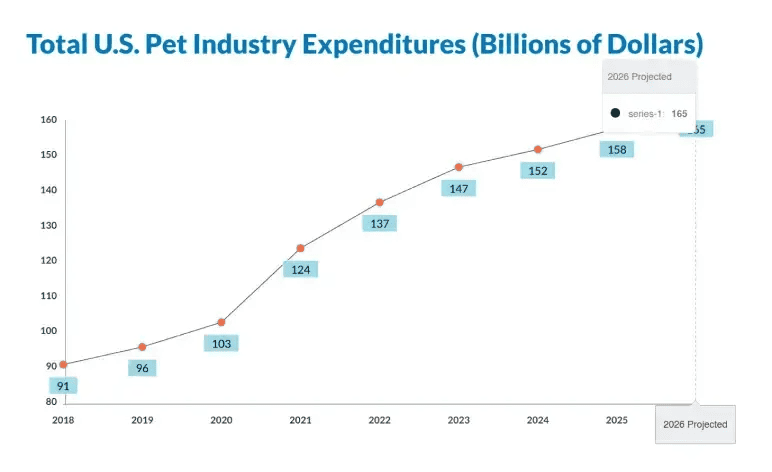
Pet care is a big, steady business. Americans are expected to spend about $165 billion on their pets in 2026. Of that, roughly $14.9 billion goes to “Other Services,” a category that covers dog walking, sitting, boarding, grooming, and training.
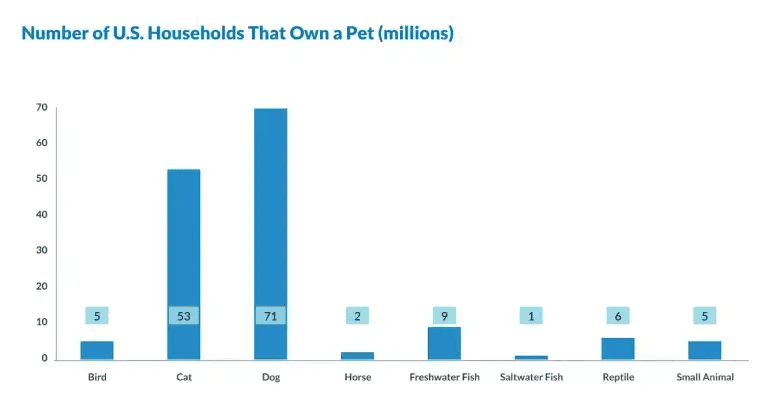
About 95 million U.S. households own a pet. Dogs lead by a wide margin: 71 million households own one, compared with 53 million that own a cat.
More of those owners now pay someone else to help care for their dog instead of doing it all themselves. That shift is what turns dog ownership into a service market.
Dog walking on its own is still small and spread thin. IBISWorld puts it at about $1.5 billion in 2026, split among roughly 35,349 businesses. No single company holds more than 5% of the market. That matters in two ways:
- First, there is no big player to beat. Growing beyond one neighborhood is hard to manage, so most operators stay small and local.
- Second, almost anyone can join. All it takes is a leash and an app. That is why this plan competes on trust and retention instead of price. Those are the two things a new competitor cannot copy quickly.
The job market is growing too. The U.S. Bureau of Labor Statistics expects jobs for animal care and service workers to rise 11% between 2024 and 2034, much faster than the average job. Median pay is about $17.08 an hour, or $35,530 a year.
The signal from the national data is simple: demand for dog care is rising, and that wage sets the market rate Rover’s Route will pay when it adds a second walker.
Local Market Opportunity
This is where the business is won or lost. The three neighborhoods aren’t identical, but each brings the same core customer: a busy, dog-owning household in dense housing with someone out at work all day.
| Neighborhood | Approx. median household income | Profile |
| Washington Park | ~$172,500 | Affluent, highly educated, dense bungalows and townhomes |
| Platt Park | ~$120,000 to $138,000 | Professional dual-income and single-professional households |
| Baker | ~$85,000 to $115,000 | Younger, denser, gentrifying; dual-income renters and condo owners |
Washington Park and Platt Park sit well above Denver’s citywide median household income of $94,718, and Baker is close to it, so this is a market that can comfortably afford a premium service. And households here skew small, near Denver’s citywide average of 2.1 people, mostly working couples and single professionals who are gone all day, the exact profile that pays for a regular midday walk.
Target Customers
Rover’s Route serves a few related types of dog owners, all inside the service area:
- Recurring weekday owners (core): Full-time workers who need the same midday walk several days a week.
- Occasional-need owners: People who book one-off walks around travel, long days, or schedule changes.
- Puppy households: Owners of young dogs that need short daytime potty-and-play visits.
- Weekend-need owners: Mostly existing clients wanting extra coverage on weekends.
The recurring weekday owner is the one the whole business is built around, so that is the persona worked out in detail below, as an example of how to define your own.
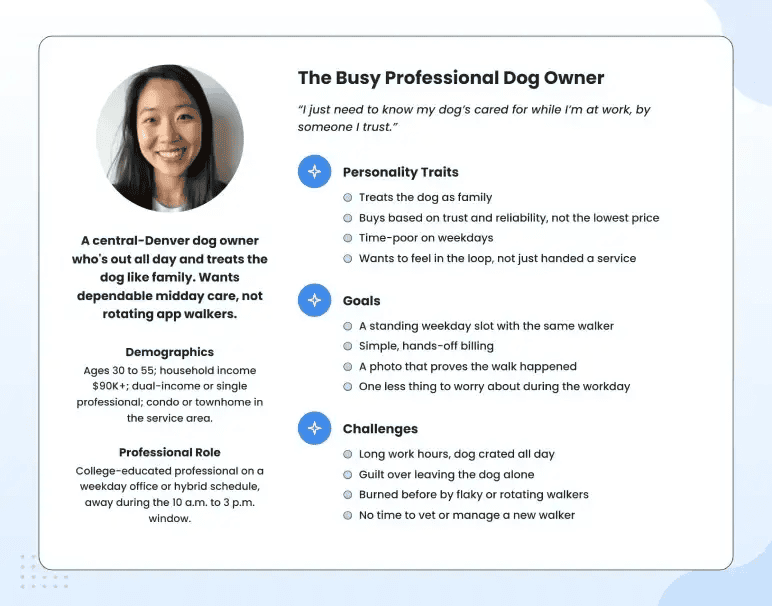
This kind of persona needs help several times a week, and buys on reliability rather than price. That combination of steady need with a willingness to pay for trust is exactly what makes a recurring-walk business work.
Addressable Demand
Rover’s Route will not assume that every dog-owning household in Denver is a realistic customer.
A more useful market consists of households that meet several conditions:
Households inside the service area
× dog ownership
× weekday care need
× willingness to pay for regular service
= realistically addressable customers
The company only needs enough of these households to support approximately 30 to 40 recurring customer relationships and fill its available weekly route.
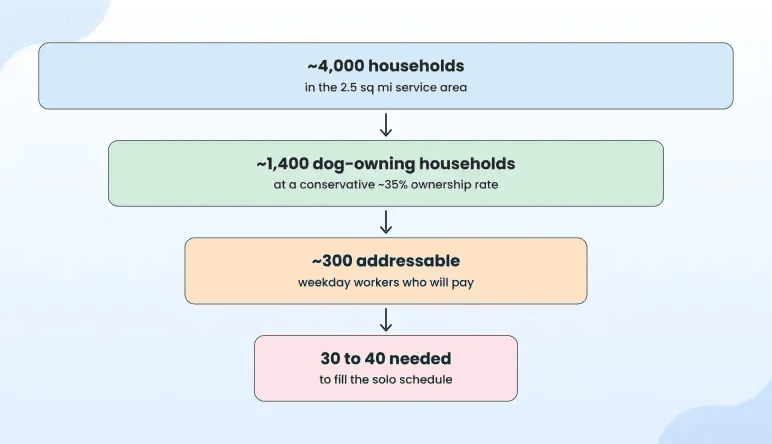
Rover’s Route will therefore evaluate demand using practical indicators such as:
- Recurring-service inquiries
- Leads located near existing customers
- Requests for midday appointments
- Competitor availability
- Number of qualified leads declined because the schedule is full
- Formation of a waiting list for recurring slots
Competitive Analysis
The demand in these neighborhoods isn’t unserved; it’s served unevenly, and that gap is the opening. Rover’s Route competes against three alternatives:
1. App-based booking platforms (national marketplaces)
They have huge walker supply and easy booking, but assign whoever is available, so the dog may get a different stranger each visit. Walkers churn heavily, and owners frequently report inconsistency. This is the main competitor, and the easiest to beat on trust.
2. Other independent local walkers
They offer a personal relationship, but many over-extend, taking clients across the whole city. That stretches routes, creates late or rushed walks, and caps how many standing clients they can reliably serve, which is precisely the discipline Rover’s Route is built around.
3. Doggy daycare and boarding
They solve a different problem (all-day supervision, drop-off required). They don’t give the dog a midday neighborhood walk, or the owner the at-home convenience.
The table below lays the four options against each other.
| Factor | Rover’s Route | App-Based Platform | Independent Walker | Doggy Daycare |
| Same walker regularly | Yes | Varies | Often | Not applicable |
| Standing weekday slot | Yes | Varies | Varies | Yes |
| Home-based service | Yes | Yes | Yes | No |
| Tight neighborhood focus | Yes | No | Varies | No |
| Visit updates | Yes | Varies | Varies | Varies |
None of these options is bad. Each just leaves the same gap: the owner who wants the same trusted walker, same time, every day, in their own neighborhood is poorly served by all three. And that gap is what Rover’s Route is built for.
Keys to Success
Several factors will determine whether Rover’s Route becomes a sustainable business.
Route density over client count
Ten scattered clients are not necessarily better than seven nearby clients. Rover’s Route will prioritize customers who help create efficient clusters of appointments.
Recurring weekday bookings
Standing schedules make both revenue and routing predictable. Recurring clients will receive scheduling priority over occasional bookings.
Protecting the midday window
Most weekday demand will fall between roughly 10 a.m. and 3 p.m. The company will treat those hours as limited inventory rather than accepting every request.
Reliability and communication
A missed walk can damage trust immediately. Rover’s Route will provide clear arrival records, visit updates, and proactive communication when weather or unexpected events affect the schedule.
Consistent pricing
The business will not rely heavily on discounts. Prices must cover both the paid visit and the unpaid time required to reach the next customer.
5. Marketing and Sales Strategy
Marketing is hyperlocal, cheap, and referral-driven, matching the route strategy.
A bootstrapped neighborhood business gains nothing from leads across Denver it cannot serve efficiently, so every channel aims at households close to the existing route. The customer journey runs end to end: acquire, qualify, convert, retain, refer.
Customer Acquisition Strategy
The strategy starts with a filter: only acquire customers who strengthen the route. A lead from across Denver may increase inquiry volume but offer little value if serving that customer creates long gaps between appointments.
For this reason, marketing will focus on attracting dog owners close to the company’s existing routes.
The aim is not simply to generate more leads. It is to generate more qualified nearby leads.
Marketing Channels
| Channel | Role |
| Google Business Profile | Capture local dog walking searches |
| Neighborhood Facebook groups | Build local awareness |
| Nextdoor | Reach nearby homeowners and residents |
| Veterinarians and groomers | Generate trusted local referrals |
| Dog parks and pet businesses | Increase neighborhood visibility |
| Website | Explain services and capture inquiries |
| Customer referrals | Acquire nearby customers efficiently |
Rover’s Route will keep paid advertising limited during the startup phase and focus instead on channels where customers can be targeted geographically.
Referral Strategy
Once a handful of clients are in place, referrals become the main growth channel, and the strongest one.
A neighbor’s referral is free, already sold on trust, and almost always lands inside the existing route, so each one makes the routes denser rather than more scattered.
A small account credit for both the referring client and the new one keeps the loop running. But strong service and consistent communication will remain the main drivers of word-of-mouth growth.
Sales Process
Every new inquiry will follow the same qualification and onboarding process:
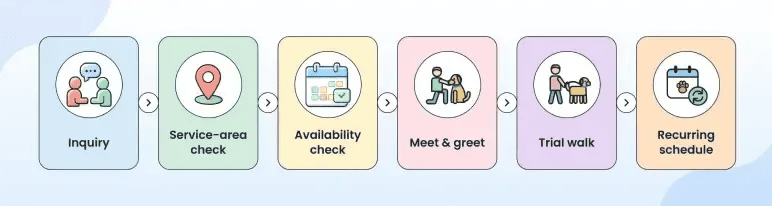
The 2nd and 3rd steps are important.
A potential customer may be willing to pay the standard rate but still be a poor fit if the address is outside the target route or the requested appointment time is already full.
Those leads may be declined rather than accepted at the expense of existing customers.
Recurring Client Conversion
Recurring clients are especially valuable because they create predictable revenue and make routes easier to plan.
For example, a customer booking five $30 walks each week generates:
5 walks × $30 = $150 per week
Assuming approximately 48 active weeks after vacations, holidays, and cancellations:
$150 × 48 = $7,200 in annual revenue
Not every recurring customer will book five walks each week, but the example shows why converting suitable customers into standing schedules can have a large effect on revenue stability.
Recurring appointments also reduce administrative work because the same appointments stay in roughly the same place each week.
Customer Retention
Retention will depend on making the service reliable and easy for customers to trust.
Rover’s Route will support retention through:
- Consistent walker assignment
- Predictable arrival windows
- Post-walk photos and notes
- Fast responses to client questions
- Priority scheduling for established customers
- Advance communication about holidays or weather
- Clear handling of schedule changes
Satisfied recurring customers should also become an important source of referrals, creating a cycle in which nearby customers improve the route and a better route supports more reliable service.
6. Operations Plan
Operations are central to Rover’s Route because available walking hours cannot be expanded indefinitely. The company’s profitability depends on how efficiently those hours are used.
Operating Schedule
Rover’s Route operates Monday through Friday from 8 a.m. to 7 p.m., with limited Saturday availability reserved for existing customers. Sundays are closed.
The 10 a.m. to 3 p.m. period is the core walk window, when most recurring customers need service. Early-morning and late-afternoon appointments are used for customers with more flexible schedules.
A typical day is organized around that demand pattern:
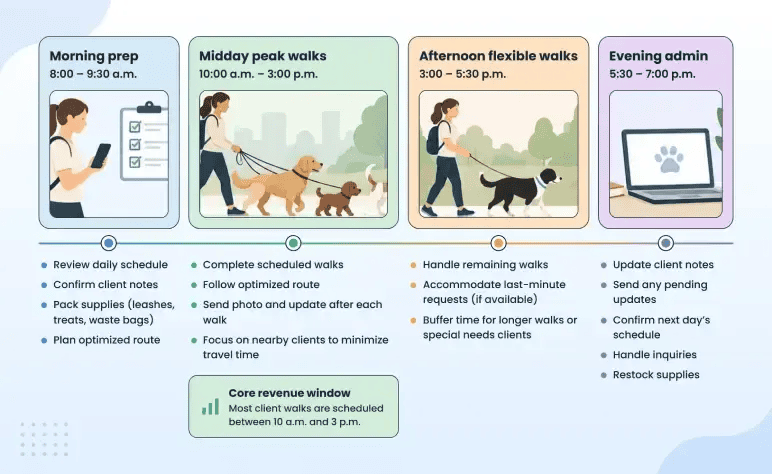
This structure allows Rover’s Route to protect its most valuable hours while still using lower-demand periods productively.
Route Planning and Capacity
Routes will be planned primarily by geography and then by requested appointment window.
Rover’s Route aims to keep travel between nearby customers below approximately 10 minutes whenever possible. Customers significantly outside an existing route may be declined even when an appointment slot appears available.
That’s because a 30-minute walk requires more than 30 minutes of working time.
The walker must travel to the home, gain access, prepare the dog, complete the walk, send an update, and travel to the next customer.
Route Density Economics
A 30-minute dog walk does not require only 30 minutes of working time.
The walker travels to the home, gets access, preps the dog, walks it, sends an update, and drives to the next client. The real cost of each walk depends entirely on how close the next one is.
Take a 5-hour block of appointments:
| Factors | Dense route | Scattered route |
| Walk time | 30 min | 30 min |
| Travel between clients | ~10 min | ~25 min |
| Time per billable walk | ~40 min | ~55 min |
| Walks in 5 hours | ~7 | ~5 |
| Revenue at $30/walk | $210 | $150 |
That is a difference of $60 in revenue during the same five-hour period, before accounting for additional mileage and vehicle costs.
For this reason, Rover’s Route will track:
- Average travel time between appointments
- Walks completed per working hour
- Unfilled gaps in the schedule
- Percentage of customers inside the core service zone
- Revenue generated per route
For Rover’s Route, the more useful productivity measure is therefore not simply clients booked. But paid walks completed per available route hour.
Peak-Hour Capacity
Most weekday demand is expected between approximately 10 a.m. and 3 p.m. Those five hours are the company’s most valuable appointment inventory.
On a dense route, Hannah can reasonably complete around seven to eight walks during a full weekday route. That places practical solo capacity at roughly 150 to 162 walks per month, depending on route quality and customer schedules.
The company will not intentionally fill every available minute. A small scheduling buffer will be maintained for:
- Traffic delays
- Building access delays
- Dogs requiring extra attention
- Weather disruptions
- Unexpected client needs
Customers with flexible schedules may be offered early-morning or later-afternoon appointments to preserve space during the core midday period.
Client Onboarding & Service Delivery
Every new customer must complete a meet-and-greet before the first unsupervised visit.
During onboarding, Rover’s Route will collect:
- Dog-handling instructions
- Veterinary information
- Emergency contacts
- Feeding requirements
- Medication instructions, where applicable
- Behavioral concerns
- Leash and walking routines
- Home-entry procedures
The meet-and-greet also allows Hannah to determine whether the dog can be handled safely and whether the customer’s expectations fit the service.
Home Access
Keys, codes, and other access information will be handled securely.
Physical keys will not be openly labeled with complete customer addresses, and access information will be separated from unnecessary identifying details where practical.
Future employees will be screened and trained before receiving independent access to customer homes.
Visit Tracking and Communication
Customers will receive an update after each completed visit. Updates may include:
- Walk time
- Brief activity summary
- Bathroom notes
- Photo
- Behavioral or health concerns
This provides customers with confirmation that the visit was completed and alerts them quickly if anything unusual occurred.
Scheduling and Technology
Rover’s Route will use pet-care scheduling and invoicing software to keep appointments, customer records, routes, billing, visit logs, and client communication in one place.
Here’s how the system supports the day-to-day work:
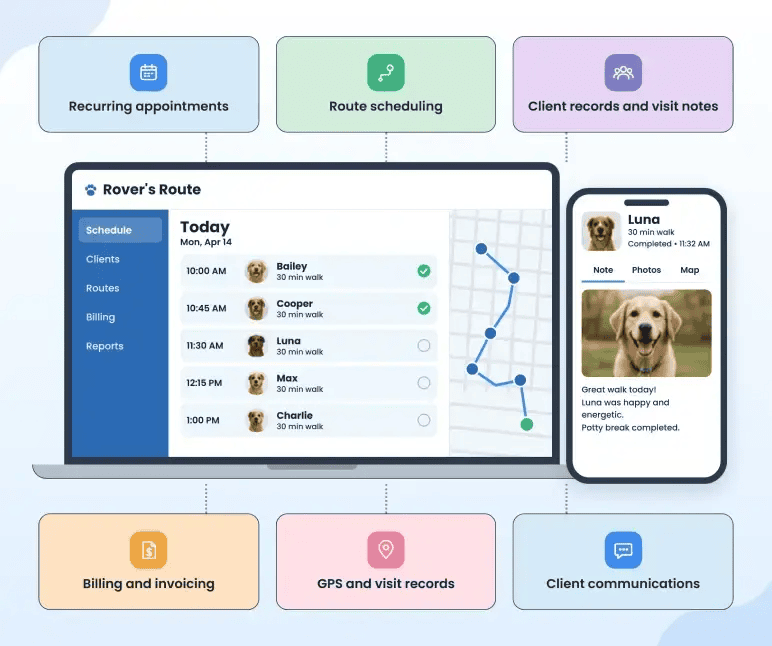
Recurring customers will receive standing weekly slots wherever possible, while routes will be organized around location and appointment timing. After each walk, Hannah can record the visit and send the client an update through the same system.
This helps keep scheduling organized and recurring routes consistent as the client base grows.
Equipment and Transportation
The company will maintain a full set of walking and safety gear: primary and backup leashes, slip leads, waste bags, approved treats, and water, along with pet first-aid supplies and secure key-storage equipment.
Each walk is supported by phone and GPS access, and the walker carries weather-appropriate clothing for Denver conditions. The vehicle is equipped with a phone mount and basic signage.
Hannah will use her existing personal vehicle during the forecast period rather than purchasing a dedicated company vehicle. (Vehicle and mileage costs are included in the financial projections.)
Safety, insurance, and compliance
Rover’s Route will maintain general liability insurance and bonding coverage. The business is registered in Colorado with the required local licensing.
Every client will also keep veterinary and emergency contact details on file.
If weather conditions become unsafe, walks may be shortened, delayed, or rescheduled. Customers will be notified when normal service needs to change.
If a dog requires emergency care, Rover’s Route will follow the owner’s documented instructions and contact the designated veterinarian or emergency contact.
As employees are added, walkers will be screened and trained before working independently with customers’ dogs or accessing their homes.
7. Management and Staffing
Owner and Management
Hannah Brooks will serve as owner and day-to-day manager.
In Year 1, she performs all walks and handles scheduling, client onboarding, communication, billing, route planning, and marketing. The business stays deliberately small and owner-run while the route fills.
Staffing Plan
No employees are planned at launch.
The company will not hire merely because the business feels busy.
Instead, the first hire will be triggered when three conditions occur consistently:
- Monthly walk volume approaches solo capacity.
- Qualified peak-hour customers are regularly being declined.
- A waiting list begins forming for recurring appointments.
These signals indicate that demand is exceeding the available supply of walking hours.
So Rover’s Route considers:
| Year | Staffing | Role |
| Year 1 | Hannah, solo | All walks plus scheduling, billing, onboarding, marketing |
| Year 2 | + 1 part-time walker (mid-year) | Covers midday peak overflow; trained as backup |
| Year 3 | Part-time walker on a regular weekday route | Hannah shifts toward routing and client management |
And yes, the part-timer doubles as coverage if Hannah is ever sick or injured, which removes the single biggest risk in a one-person operation.
Economics of the First Hire
The first walker is expected to earn approximately:
- Year 2: $17 per completed walk
- Year 3: $17.50 per completed walk
That compresses gross margin from about 87% in Year 2 toward about 75% in Year 3. The compression is the point, not a problem: it is the deliberate price of unlocking revenue the owner physically cannot serve alone.
An employee-performed walk earns less contribution than an owner-performed one, but without the employee those walks generate zero revenue.
The hire starts part-time and peak-hours only. Its purpose is to create additional capacity once existing capacity has been sold.
The forecast assumes the part-time walker completes:
| Year | Employee-Completed Walks |
| Year 2 | 400 |
| Year 3 | 1,100 |
The first employee will primarily cover high-demand weekday periods rather than working a full-day schedule with large amounts of idle time.
External Support
Accounting and tax work will be outsourced to a professional rather than staffed internally. Specialized legal, insurance, or technology support will also be brought in as needed.
8. Financial Plan
The financial forecast reflects a deliberately small service business that grows by increasing route utilization before adding labor.
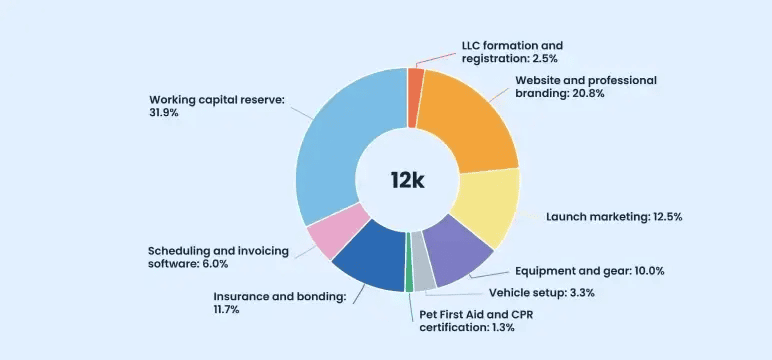
Startup Costs
| Startup Expense | Amount |
| LLC formation and registration | $300 |
| Website and professional branding | $2,500 |
| Launch marketing | $1,500 |
| Equipment and gear | $1,200 |
| Vehicle setup | $400 |
| Pet First Aid and CPR certification | $150 |
| Insurance and bonding | $1,400 |
| Scheduling and invoicing software | $720 |
| Working capital reserve | $3,830 |
| Total startup capital required | $12,000 |
Key Financial Assumptions
| Assumption | Year 1 | Year 2 | Year 3 |
| Average revenue per walk | $29 | $30 | $31 |
| Annual walks | 1,400 | 2,200 | 2,900 |
| Average monthly walks | 117 | 183 | 242 |
| Second-walker walks | 0 | 400 | 1,100 |
| Walker compensation | — | $17/walk | $17.50/walk |
| Direct supplies | $0.50/walk | $0.50/walk | $0.50/walk |
Additional assumptions include:
- Payment processing fees: 2.9% of revenue
- Payroll tax on employee wages: 7.65%
- Owner compensation: $24,000 in Year 1, $36,000 in Year 2, and $42,000 in Year 3
- Accounts receivable and payable: approximately 15 days
- No material depreciable assets during the forecast period
For planning purposes, owner compensation is included in the operating model shown below. Its final accounting and tax treatment should be confirmed with a qualified accountant before the plan is used for tax or lending purposes.
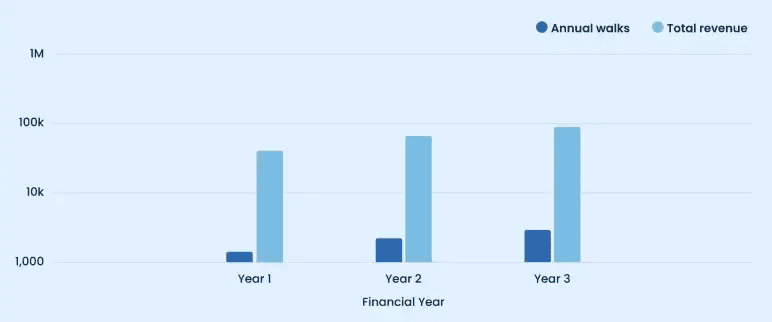
Revenue Forecast
| Item | Year 1 | Year 2 | Year 3 |
| Annual walks | 1,400 | 2,200 | 2,900 |
| Average revenue per walk | $29 | $30 | $31 |
| Revenue | $40,600 | $66,000 | $89,900 |
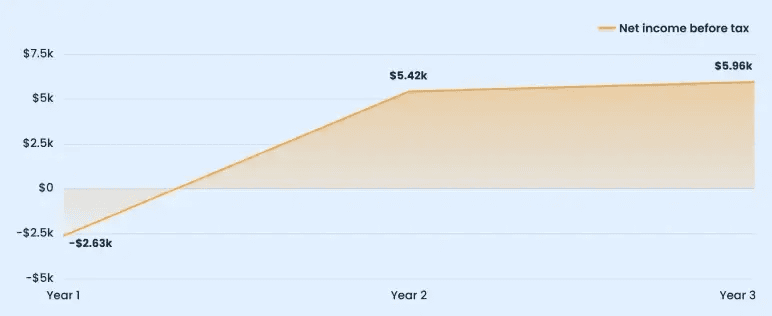
Projected Profit and Loss
| Item | Year 1 | Year 2 | Year 3 |
| Total Revenue | $40,600 | $66,000 | $89,900 |
| COGS | |||
| Direct materials | $700 | $1,100 | $1,450 |
| Second-walker wages | $0 | $6,800 | $19,250 |
| Payroll taxes on walker wages (7.65%) | $0 | $520 | $1,473 |
| Total COGS | $700 | $8,420 | $22,173 |
| Gross profit | $39,900 | $57,580 | $67,727 |
| Gross margin | 98.3% | 87.2% | 75.3% |
| Operating Expenses | |||
| Owner compensation | $24,000 | $36,000 | $42,000 |
| Insurance | $1,400 | $1,500 | $1,600 |
| Scheduling and invoicing software | $720 | $780 | $840 |
| Marketing | $1,800 | $2,400 | $3,000 |
| Vehicle, fuel, and mileage | $3,600 | $5,400 | $7,200 |
| Phone and internet | $960 | $1,020 | $1,080 |
| Accounting and bookkeeping | $1,200 | $1,500 | $1,800 |
| Supplies and gear replacement | $600 | $800 | $1,000 |
| Licenses and continuing education | $400 | $450 | $500 |
| Payment processing | $1,177 | $1,914 | $2,607 |
| One-time startup expenses | $6,050 | — | — |
| Total operating expenses | $41,907 | $51,764 | $61,627 |
| EBITDA | ($2,007) | $5,816 | $6,100 |
| Interest expense | $621 | $393 | $144 |
| Net income before tax | ($2,628) | $5,423 | $5,956 |
Cash Flow Forecast
| Item | Year 1 | Year 2 | Year 3 |
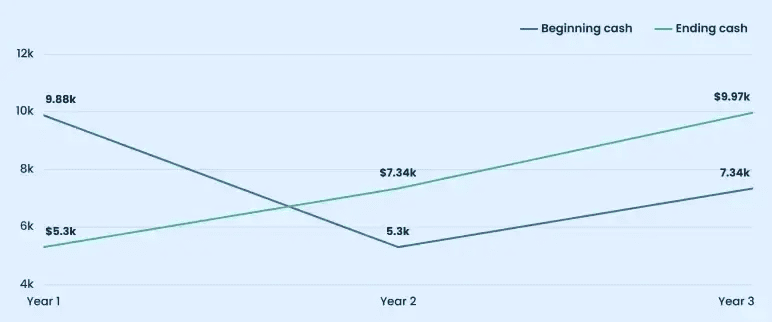
| Beginning cash | $9,880 | $5,302 | $7,339 |
| Operating Activities | |||
| Net income before tax | ($2,628) | $5,423 | $5,956 |
| Depreciation | $0 | $0 | $0 |
| Change in accounts receivable | ($1,668) | ($1,044) | ($983) |
| Change in accounts payable | $29 | $317 | $565 |
| Change in prepaid expenses | $2,120 | $0 | $0 |
| Net cash from operations | ($2,147) | $4,696 | $5,538 |
| Investing Activities | |||
| Capital expenditures | $0 | $0 | $0 |
| Net Cash from Investing | $0 | $0 | $0 |
| Financing Activities | |||
| Loan principal repayment | ($2,431) | ($2,659) | ($2,910) |
| Net Cash from Financing | ($2,431) | ($2,659) | ($2,910) |
| Net change in cash | ($4,578) | $2,037 | $2,628 |
| Ending cash | $5,302 | $7,339 | $9,967 |
Balance Sheet
| Item | Year 1 | Year 2 | Year 3 |
| Cash | $5,302 | $7,339 | $9,967 |
| Accounts receivable | $1,668 | $2,712 | $3,695 |
| Total assets | $6,970 | $10,051 | $13,662 |
| Accounts payable | $29 | $346 | $911 |
| Term loan | $5,569 | $2,910 | $0 |
| Total liabilities | $5,598 | $3,256 | $911 |
| Paid-in capital | $4,000 | $4,000 | $4,000 |
| Retained earnings | ($2,628) | $2,795 | $8,751 |
| Owner’s equity | $1,372 | $6,795 | $12,751 |
| Total liabilities and equity | $6,970 | $10,051 | $13,662 |
Break-Even Analysis
| Item | Value |
| Average revenue per walk | $30.00 |
| Direct materials per walk | $0.50 |
| Payment processing per walk | $0.87 |
| Total variable cost per walk | $1.37 |
| Contribution margin per walk | $28.63 |
| Contribution margin | 95.4% |
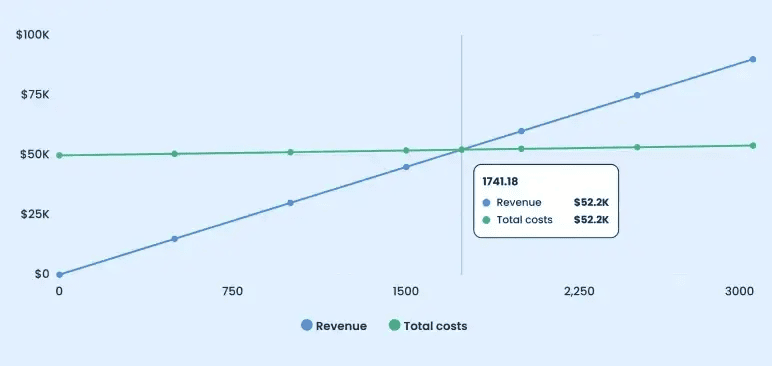
| Annual fixed operating costs | $49,850 |
| Break-even walks per year | 1,741 walks |
| Break-even walks per month | ~145 walks |
| Break-even annual revenue | $52,230 |
Funding Request
Rover’s Route is requesting an $8,000 microloan from the Colorado Enterprise Fund (a Community Development Financial Institution), paired with $4,000 of owner equity for $12,000 in total startup capital.
- Type: CDFI microloan
- Amount: $8,000
- Term: 3 years
- Rate: 9.0% fixed
- Monthly payment: ~$254.34 (annual ≈ $3,052)
- Collateral/guarantee: Personal guarantee from the owner
The loan funds startup gear, prepaid insurance and software, and a working-capital cushion to carry the planned Year 1 loss. It is fully repaid by the end of Year 3 (ending balances: Yr 1 $5,569; Yr 2 $2,910; Yr 3 $0).
The Quickest Way to turn a Business Idea into a Business Plan
Fill-in-the-blanks and automatic financials make it easy.


Upmetrics
Upmetrics is the #1 business planning software that helps entrepreneurs and business owners create investment-ready business plans using AI. We regularly share business planning insights on our blog. Check out the Upmetrics blog for such interesting reads. Read more