Executive Summary
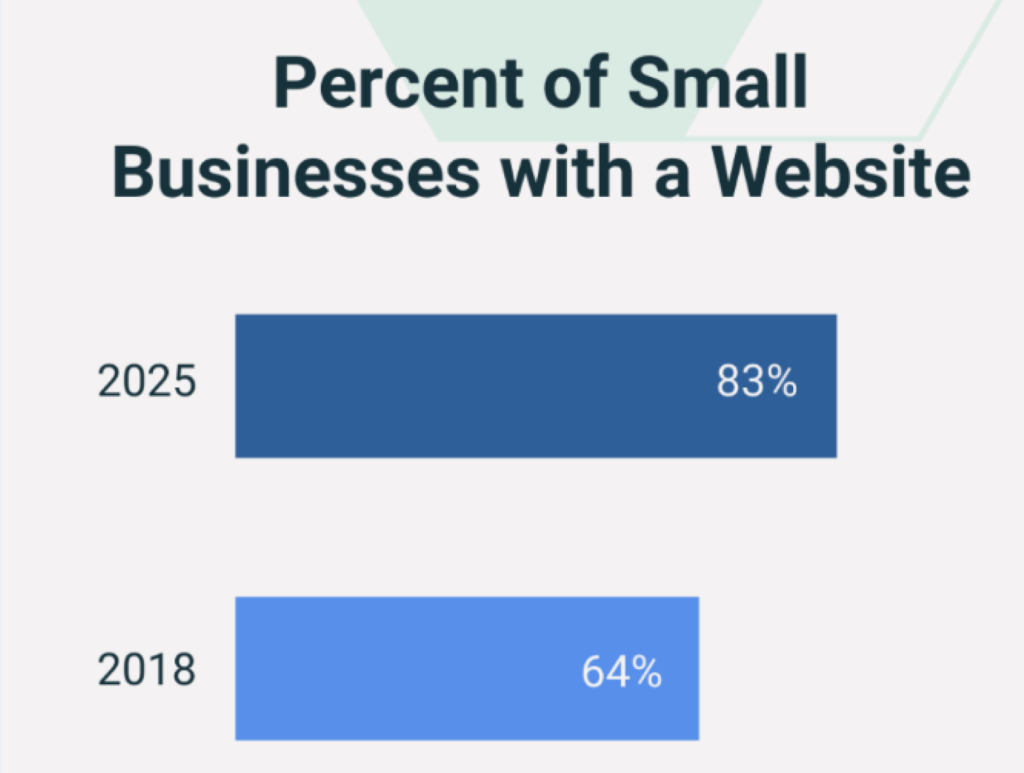
In 2025, 83% of U.S. small businesses operate with a business website, and 12% launched one within the past year. This shows that basic online presence has become a standard part of running a small business.
PixelCraft Web Design LLC exists to serve this ongoing need. The company operates as a single-member limited liability company owned and managed by Alex Morgan, who performs all revenue-generating project work directly. The business provides fixed-rate website design, redesign, and landing page services to small businesses and independent professionals. All operations are home-based and focused on clearly defined, short-cycle projects delivered under written scope agreements.
The company limits its services to fixed-scope website design projects and does not provide enterprise software development or ongoing managed services. These exclusions allow the business to remain focused on short-cycle, fixed-scope projects with predictable delivery and cash flow.
PixelCraft works on clearly defined projects. Each client signs a written scope agreement that outlines deliverables and limits revisions. Customers make a 50% down payment at the commencement of a project and a 50% payment upon actual delivery, thereby removing exposure to accounts receivable. Fixed pricing and short project timelines keep cash inflows steady and reduce delivery risk. The company has no employees, rented premises, or other fixed liabilities.
PixelCraft Web Design is requesting a $4,500 equipment term loan from Wells Fargo Bank, N.A. to purchase a business-only desktop computer and the required professional software used for client project delivery. The owner will contribute $500 in cash toward startup costs that do not qualify for loan funding. The business will use loan proceeds only for equipment and professional software. The financed equipment will serve as collateral, and the owner will provide a personal guarantee.
| Funding Source | Type | Amount ($) | Purpose |
|---|---|---|---|
| Owner Cash Contribution | Equity | 500 | Business registration, domain, and setup costs |
| Bank Equipment Term Loan (Wells Fargo) | Debt | 4,500 | Desktop computer and professional software |
| Total Funding | 5,000 |
In the first year, the business expects to complete an average of two projects per month. Monthly operating costs average approximately $390, excluding loan payments. With prepaid billing, low overhead, and direct owner execution, the business generates enough operating cash flow to cover estimated monthly loan payments with room to spare throughout the loan term.

Don’t waste time using spreadsheets
Simplify financial forecasting & reporting w/ Upmetrics
Company Overview
Legal Structure and Business Location
PixelCraft Web Design is a Texas-based single-member limited liability firm that operates in a registered home office at 221 East 5th Street, Austin, Texas 78701. It does not rent an office or a retail space.
The entire client communication, project coordination, and service delivery occur remotely. This home-based setup maintains low fixed operating costs, eliminates lease requirements, and allows the firm to remain adaptable to changes in project volumes.
Ownership and Management
Alex Morgan is a 100 % owner and the sole operator of PixelCraft Web Design. All of the core business operations, such as client intake, project scope, web design, development, testing, and delivery, are handled by him.
The company has no employees. PixelCraft uses freelance support on a temporary, project-specific basis when specialized assistance is required. This structure supports clear accountability, consistent quality control, and predictable project schedules.
Mission and Vision
The mission of PixelCraft is to provide small businesses and independent professionals with functional websites using fixed-price projects, predictable schedules, and direct owner engagement.
The company wants to be a sustainable, owner-managed web design firm with a reputation for delivering reliably, controlling scope, and offering a rational solution instead of growing fast.
Business Model
PixelCraft earns income through fixed-price web projects, such as a new site, site redesign, and landing pages. Every project begins with a written scope agreement outlining the deliverables, timelines, and limits to revision before any work is done. Customers make 50% advance payment and 50% payment before final delivery, which removes accounts receivable and allows a predictable cash flow.
The business does not rely on subscriptions, retainers, hosting services, or ongoing marketing contracts. This project-based model keeps revenue simple and operating risk low.
Business Objectives
Within the first two years, PixelCraft aims to establish a stable base of small business clients in the Austin market while maintaining a controlled workload and positive cash flow. Specifically, the business intends to:
- Complete at least 24 fixed-scope website projects in Year 1 and increase to 48 projects in Year 2, consistent with defined capacity limits.
- Maintain an average of 2 projects per month in Year 1, scaling to 4–5 projects per month by Year 3, without hiring employees.
- Achieve projected revenue of $50,446 in Year 1, $100,893 in Year 2, and $126,116 in Year 3, while maintaining strong gross margins due to low fixed overhead.
- Generate a growing share of business from referrals and repeat clients by the end of Year 2 to reduce reliance on outreach-based acquisition.
- Maintain on-time delivery for all projects within defined scope and revision limits.
Data Security and Backup Practices
PixelCraft handles limited client data related to website content, login credentials, and contact forms. The business follows basic data security practices appropriate for small business web projects, including the use of secure passwords, restricted access to client credentials, and encrypted cloud-based storage for project files.
Project data is backed up regularly using cloud storage and local backups to reduce the risk of data loss. PixelCraft does not store payment information or sensitive personal data beyond what is required for project delivery.
Market Analysis
Local Market
PixelCraft Web Design LLC operates in Austin, Texas. USA Today Blueprint shows Austin as the top U.S. city for starting a business in 2024, based on new business filings, employment trends, and local economic conditions.
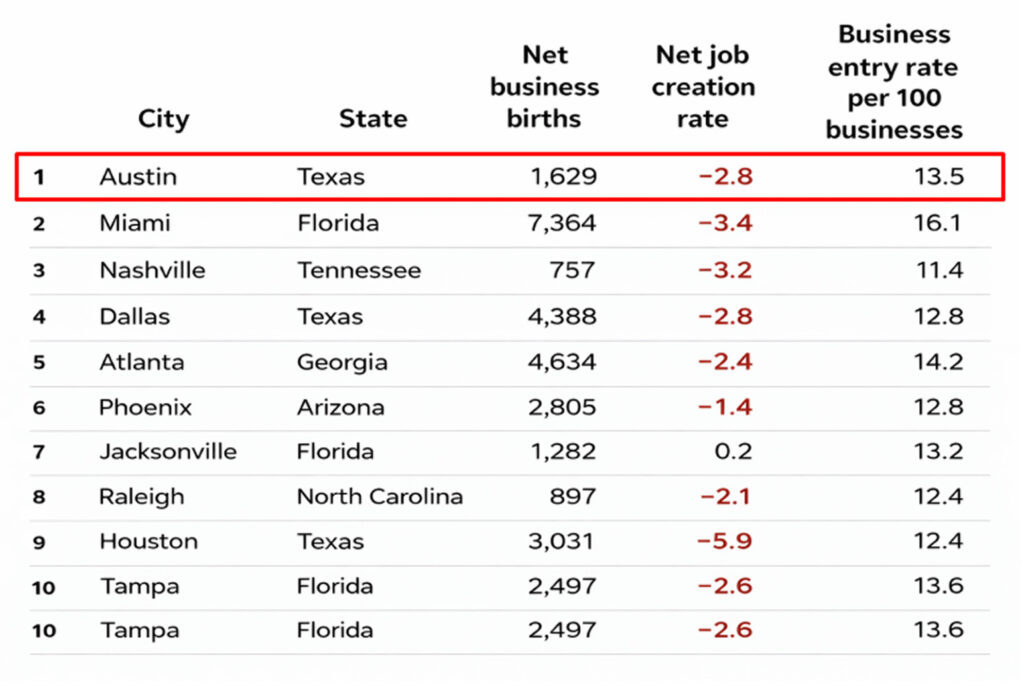
This generates a significant number of new and young businesses. After launch, most owners require a professional site that displays their services, develops trust, and provides a proper means to allow customers to get in touch. Most do not need complex systems or ongoing digital programs. They want a simple website that works, fits their budget, and can be delivered quickly.
PixelCraft structures its services around this. It provides fixed-price, clearly defined web projects that align with the way small service businesses and freelancers deal in Austin. Being a low-cost, home-based, and owner-run business, PixelCraft helps local clients quickly without needing many projects or big growth.
U.S. Market Context
At the national level, most website work for small businesses does not come from first-time adoption. It comes from replacement and upkeep as businesses outgrow early DIY sites, update branding, or replace outdated designs. In 2025, 12% of U.S. small businesses reported launching a new website within the past year, which shows ongoing site replacement rather than initial adoption.
This is reinforced by the habits of consumers. More than 81% of customers browse an online business before making a purchase, and hence, a broken or aged site is a direct blow to customer interest.
Due to this fact, many owners prefer small, practical website projects that address specific issues (old design, lack of information, or bad usage on mobile) rather than long-term digital strategies. PixelCraft addresses this demand with fixed-price website builds and redesigns, without long-term commitments or additional advertising costs.
Current Small Business Environment
Recent news also adds that small business owners are continuing to operate consistently despite increased expenses and financial pressure. According to Business Insider, a 2025 poll by FreshBooks says that 76% of U.S. small business owners claim their finances are either stable or improving despite inflation, tariffs, and customer-acquisition issues.
This indicates that a large number of small businesses continue to purchase the necessary tools rather than reducing entirely. In practice, owners tend to prioritize practical, limited-scope expenses that support visibility and customer access.
A professional website often falls into this category, as it directly supports inquiries and credibility without creating long-term financial commitments. PixelCraft’s project-based model aligns with this behavior by offering defined outcomes and predictable costs.
Target Customer Profile
PixelCraft’s target customer is a small business owner or independent professional who needs a clear, workable website but prefers a simple, fixed-scope project over long-term digital services or ongoing commitments.
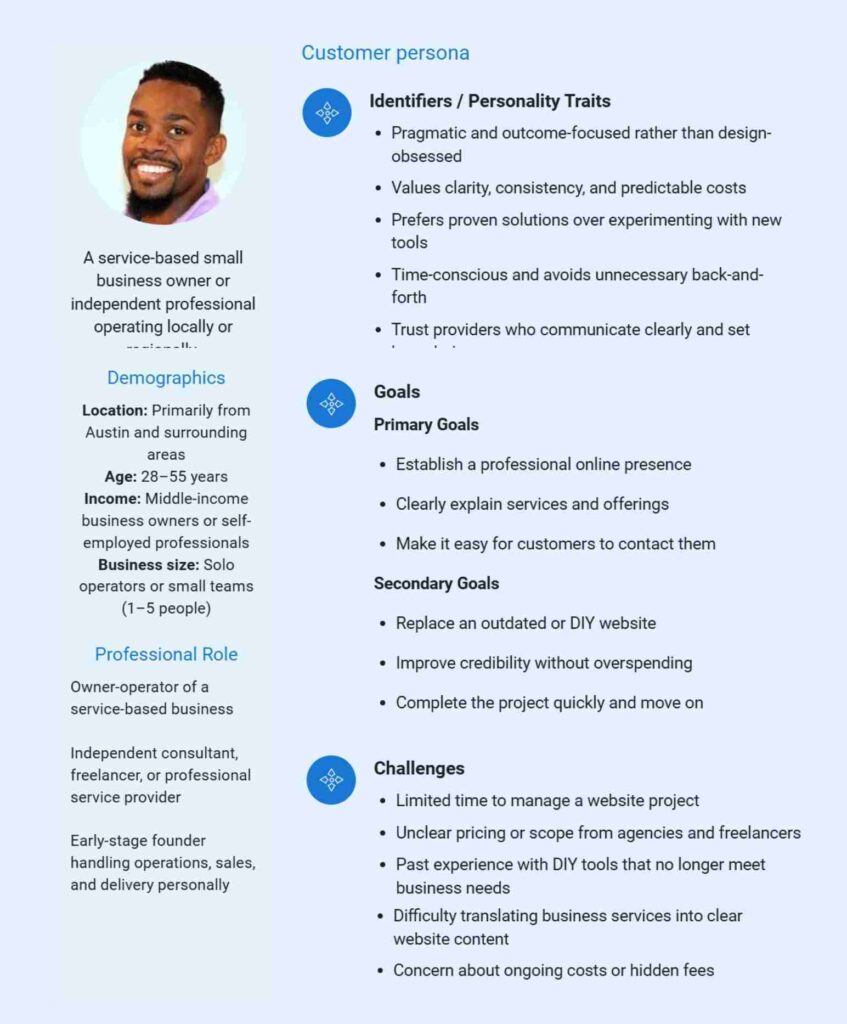
PixelCraft provides fixed-priced site projects completed by the owner. This suits customers who need simple, predictable, and professional outputs without continuous commitments or unnecessary complexity.
Competitor Analysis
Competition in the small business web design market does not center on large national firms or enterprise providers. Instead, it operates at the local and individual level, where business owners choose between freelancers, small studios, or do-it-yourself platforms based on cost, speed, and simplicity. Most purchasing decisions favor providers who can deliver a professional website quickly, at a fixed price, without long-term commitments or unnecessary services.
PixelCraft competes within this practical decision set by offering clearly scoped, fixed-price projects delivered directly by the owner.
Direct Competitors
Direct competitors include local freelance designers and small web design studios in the Austin area that offer similar small business website services.
| Name | Type | Typical Offering | Competitive Gap |
|---|---|---|---|
| Austin Web Design | Small local agency | Custom small business websites | Higher pricing driven by agency overhead |
| Owl Digital Marketing | Local design studio | Website + bundled marketing services | Bundled services exceed the needs of small projects |
| Freelance designers (Upwork / local networks) | Independent freelancers | Low-cost website builds | Inconsistent availability and scope control |
| 512 Web Design | Small studio | Website design for local businesses | Longer timelines for small projects |
PixelCraft competes by offering direct owner involvement, fixed pricing, and defined scope without agency overhead or variable freelancer availability. This appeals to small businesses seeking professional results with predictable cost and delivery.
Indirect Competitors
Indirect competitors include DIY wdebsite builders and bundled service providers that offer alternatives to hiring a dedicated web designer.
| Name | Type | Typical Offering | Competitive Gap |
|---|---|---|---|
| Wix | DIY website builder | Template-based self-built websites | Limited customization and time burden on owners |
| Squarespace | DIY website builder | Design templates with subscriptions | Requires ongoing self-management |
| GoDaddy Website Builder | DIY platform | Low-cost website setup | Limited design flexibility |
| Full-service marketing agencies | Digital agencies | Websites bundled with retainers | Higher cost and long-term contracts |
PixelCraft serves businesses that outgrow DIY tools or do not need bundled marketing services. The company provides a one-time, professional website solution without subscriptions, retainers, or ongoing management requirements.
Competitive Positioning
PixelCraft positions itself between low-cost DIY platforms and higher-cost agencies. The business focuses on clients who want:
- A professional website built for them, not by them
- Fixed, upfront pricing
- Short delivery timelines
- Direct communication with the person doing the work
This position allows PixelCraft to compete effectively without relying on volume-based pricing, bundled services, or long-term client commitments.
Service Offerings
PixelCraft Web Design provides website services to small businesses and independent professionals who want simple, functional ones without long-term service contracts.
PixelCraft operates under short-term projects that have clear objectives, consistent deadlines, and fixed prices. It doesn’t offer open-ended services and long-term contracts.
Core Services
PixelCraft offers the following primary services:
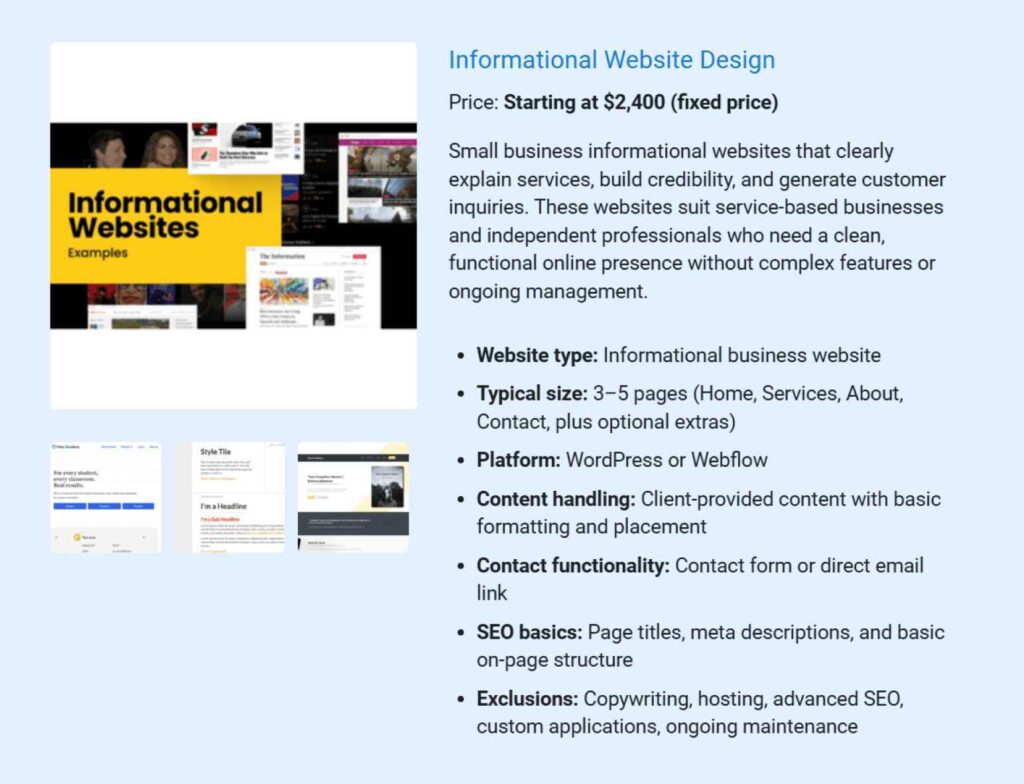
1) Informational Website Design
A typical small business site contains three to five pages. They describe services, develop trust, and gather queries.
2) Website Redesigns
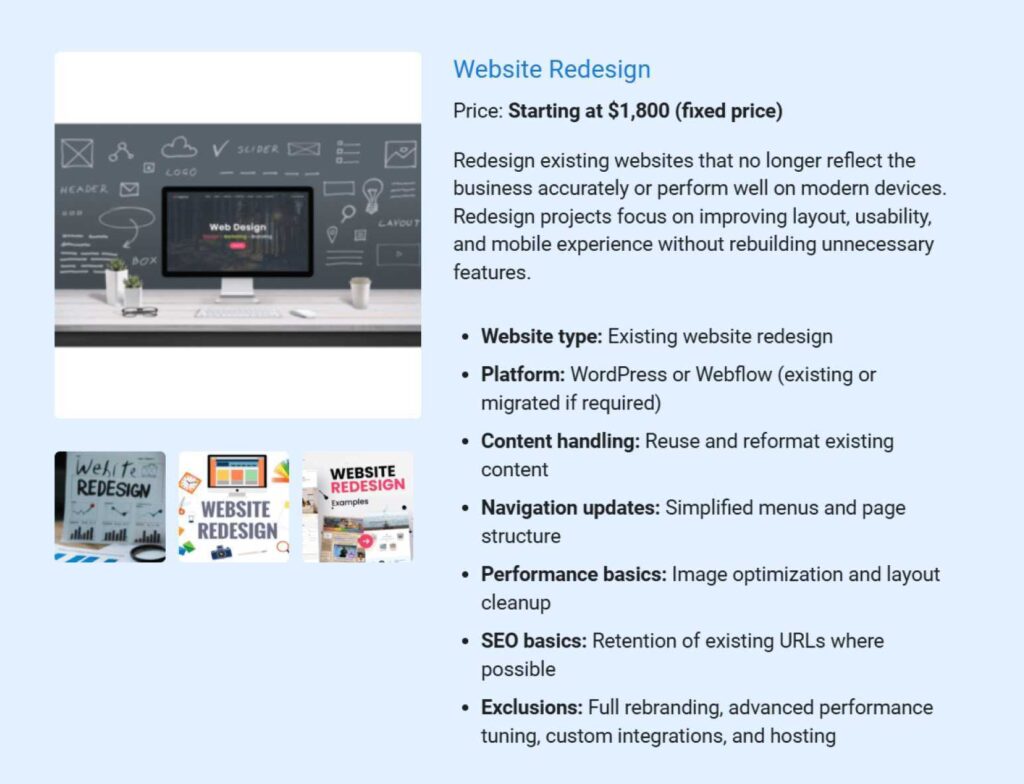
A website that appears to be old, is hard to use on a phone, or is confusing often needs an update. Redesigns make the sites more convenient and appealing, but the company doesn’t redesign the features that are not required.
3) Landing Pages
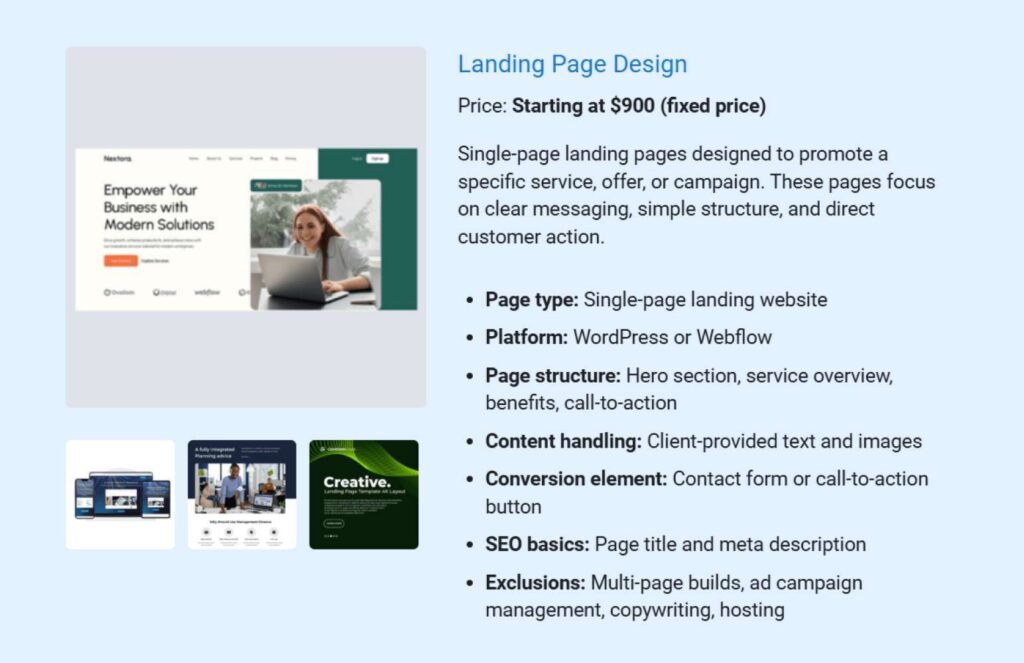
A single-page site is created to represent one service, sale, or campaign. Such sites help customers request additional information and make convenient choices.
All services are scoped and do not include developing custom software, large-scale systems, or complicated connections.
Tools and Platform Context
PixelCraft has tested website platforms and design tools that maintain services over a period of time. WordPress and Webflow are systems that operate millions of websites all over the world and are operating in stable, well-maintained environments.
Since these platforms are industrial, posing no risky experiments, PixelCraft does not depend on the passing trends or the untested technologies. This stability reduces operational risk and allows the business to deliver projects predictably, using workflows that remain consistent across clients and over time.
Pricing Structure
PixelCraft uses fixed project pricing. Fees are determined by the type of website and the defined scope of work, and are agreed upon before the project begins. Typical pricing includes:
- Informational websites ($2,400 average): Fixed project pricing based on page count and defined scope.
- Website redesigns ($1,800 average): Pricing based on the current condition of the site and the required updates.
- Landing pages ($900 average): Fixed pricing for single-page promotional or campaign-focused sites.
This structure eliminates hourly billing disputes and allows clients to understand total project costs upfront.
Add-On Services
Some projects include optional add-on services, such as:
- Basic content updates or page revisions
- CMS setup or configuration
- Simple on-page SEO setup
Add-ons are added only when they are specified in the project and charged separately as part of the fixed price. Typical add-ons average $250 per item, depending on the task.
Billing Terms
PixelCraft follows consistent billing terms for all projects:
- 50% deposit collected before work begins
- 50% balance collected before final delivery or launch
These terms eliminate accounts receivable exposure and support predictable cash inflows. The business does not extend credit or offer post-delivery payment terms.
Scope Control and Revisions
Every project operates under a written scope agreement that defines:
- Deliverables
- Timeline
- Number of included revision rounds
Requests outside the agreed scope require written approval and additional pricing. This approach protects project timelines and prevents scope creep.
Marketing and Sales Strategy
PixelCraft Web Design follows a simple, low-cost marketing approach to keep project flow steady without creating capacity pressure. Because the business operates as an owner-led service with fixed project limits, the goal is not to generate high lead volume but to attract the right type of projects that fit the defined scope and pricing.
Most clients come from channels where small business owners actively look for website help rather than from broad advertising. This keeps acquisition costs low and improves lead quality.
Primary Marketing Channels
PixelCraft concentrates on a small number of practical marketing channels that support predictable demand without requiring high marketing spend.
| Marketing Channel | How It Is Used | Role in Lead Generation |
|---|---|---|
| Portfolio Website | Showcases completed work, outlines services, and allows prospective clients to request quotes or consultations | Serves as the primary credibility and inquiry channel |
| Referrals and Word of Mouth | Past clients refer new customers based on completed project experience | Produces high-quality leads with minimal ongoing cost |
| Direct Outreach and Listings | Targeted outreach to local businesses with outdated websites and selective use of freelance platforms or business directories | Supplements demand, especially during the early operating stages |
As part of targeted outreach, PixelCraft will also offer a free 15-minute website audit for businesses with outdated or underperforming sites. This audit reviews visible usability issues, mobile responsiveness, page structure clarity, and basic performance concerns. It is structured, time-limited, and focused on identifying whether a defined redesign project is appropriate.
The audit does not include implementation guidance or extended consulting. Its purpose is to qualify prospects and transition suitable businesses into fixed-scope website projects.
Sales Process
PixelCraft uses a simple sales flow that emphasizes early qualification and scope clarity:
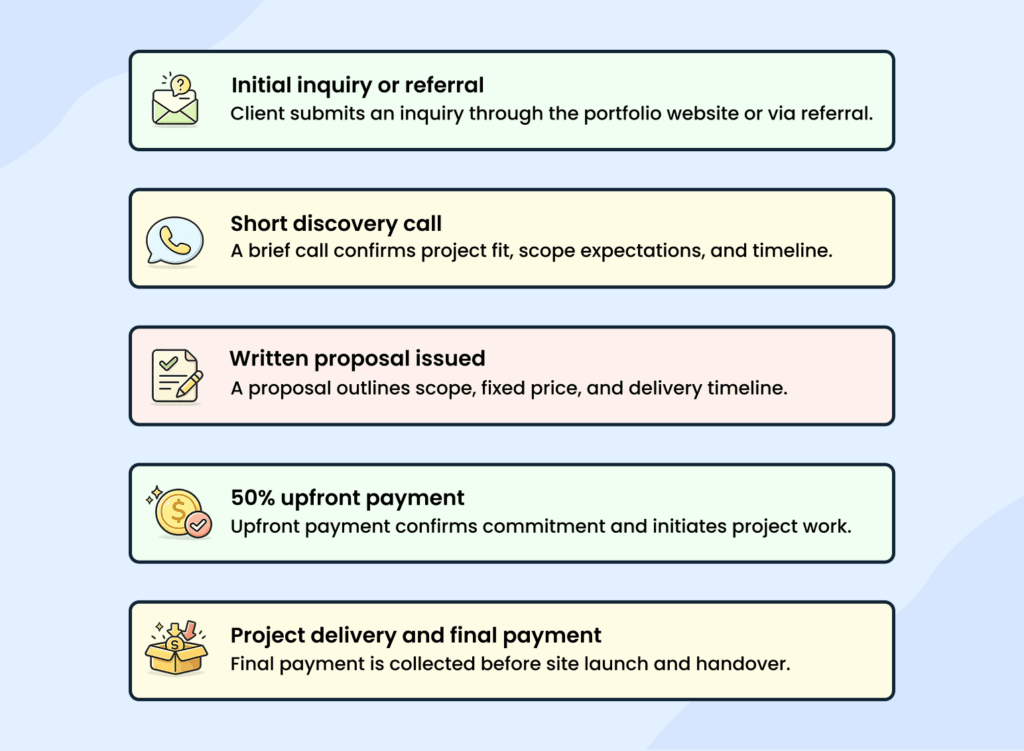
This process reduces time spent on unsuitable projects and supports consistent cash collection.
Pricing and Scope Control
PixelCraft uses fixed pricing for all services and defines scope in writing before work begins. The business does not rely on hourly billing or open-ended project terms.
Scope discipline protects delivery timelines and prevents margin erosion. Requests outside the agreed scope require written approval and additional pricing, which keeps projects aligned with available capacity.
Marketing Budget
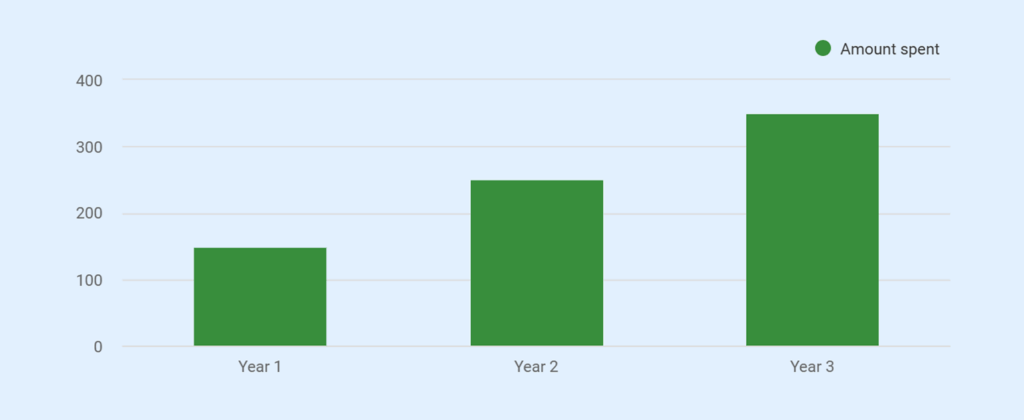
PixelCraft maintains a controlled marketing budget that scales gradually with business activity. In Year 1, marketing spend averages approximately $150 per month, covering portfolio website hosting, basic tools, and limited visibility through directories or listings. As project volume stabilizes, the budget increases to around $250 per month in Year 2 and approximately $350 per month in Year 3 to support modest outreach and visibility.
The business does not rely on high-volume advertising campaigns, long-term agreements, or ongoing paid promotions. Instead, marketing spend focuses on essential tools and limited promotion that directly support inquiries and project intake.
This approach keeps customer acquisition costs low and ensures marketing activity remains aligned with available capacity and project demand.
Operating Plan
PixelCraft Web Design runs as a single-owner, project-based business with a consistent delivery process. Every project follows the same steps from initial inquiry through completion, which helps keep timelines predictable and workload manageable. Because the owner handles all project work directly, clarity at the start of each project is a priority rather than something addressed later.
Most issues in web design projects do not come from the design itself. They usually stem from unclear expectations, open-ended scope, or work beginning before key decisions are made. PixelCraft’s process avoids these problems by setting clear boundaries upfront and keeping each project focused on a defined set of tasks.
Operating Structure and Responsibilities
All projects begin with a request or a referral. The owner will determine whether the ask suits the jobs we do before discussing design. This involves considering the type of site, the number of pages, and the possibility of a fixed-price job.
A short discovery call follows. The purpose of this call is not to sell but to confirm fit. If the project requires ongoing support, undefined features, or an open-ended build, it is declined. This early filtering keeps later stages of the workflow stable and prevents projects from expanding beyond what one person can realistically deliver.
Project Intake and Qualification Process
Operations begin before any design work takes place. PixelCraft validates every request to ensure that it corresponds to the services, price, and delivery capabilities.
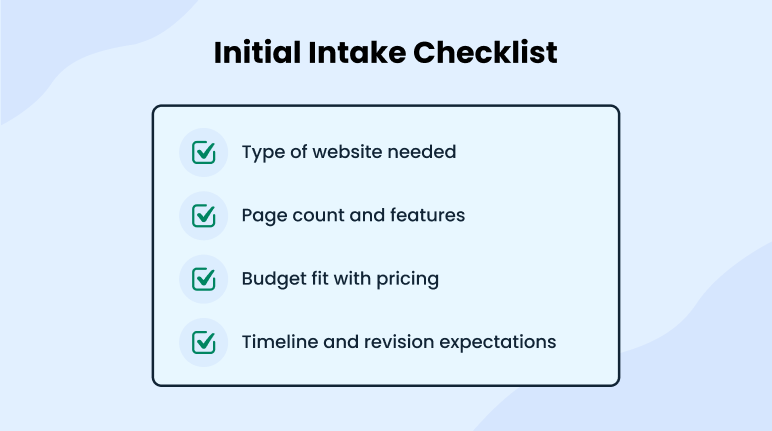
Then it takes a short call to explain the goals and risks. Unlimited work projects, continued support, or undefined plans are refused. This qualification step protects delivery capacity and prevents scope-related delays later in the project.
Design, Build, and Execution
After the project starts, work moves in a practical sequence. Structure comes first. Page layout, navigation, and content placement are decided before visual styling is finalized. This allows the clients to concentrate on how the site works rather than getting bogged down in the little things.
After the plan is finalized, the site is created on established platforms such as WordPress or Webflow. These tools are stable, highly supported, and suitable for small websites that do not require 24/7 tech support.
The owner reviews each site before sharing it with the client to confirm that pages load correctly, links function as expected, and all items listed in the approved project scope have been completed.
Internal Review and Quality Control
Before client review, PixelCraft conducts an internal quality check to confirm:
- Pages load and display correctly
- Navigation works as intended
- Forms and links function properly
- Content aligns with the approved scope
This step ensures the client reviews a near-final product, thus reducing confusion and the unnecessary rigmarole of feedback.
Client Review, Revisions, and Project Closure
Within the revision limits defined in the proposal, clients review the nearly complete site and provide feedback. Any requests outside the approved scope are reviewed separately and require written approval before additional work begins.
Once revisions are complete, the remaining project balance is collected before final delivery or launch. The site is then delivered or published, and the project is closed. Each project concludes with no unpaid balances, unfinished tasks, or ongoing obligations.
Capacity and Risk Control
PixelCraft limits the number of active projects at any given time, and staggers start dates to avoid overlapping deadlines. This keeps delivery consistent without adding staff or fixed costs.
Operational risk stays controlled through a small set of practical safeguards:
| Risk Area | How It Is Managed |
|---|---|
| Scope creep | Written proposals and revision limits |
| Payment delays | Upfront and pre-delivery payments |
| Delivery overruns | Limited concurrent projects |
| Quality variance | Direct owner execution |
| Fixed overhead | No employees or leased facilities |
By keeping scope narrow, intake controlled, and responsibility centralized, the business delivers projects consistently while maintaining predictable timelines and cash flow.
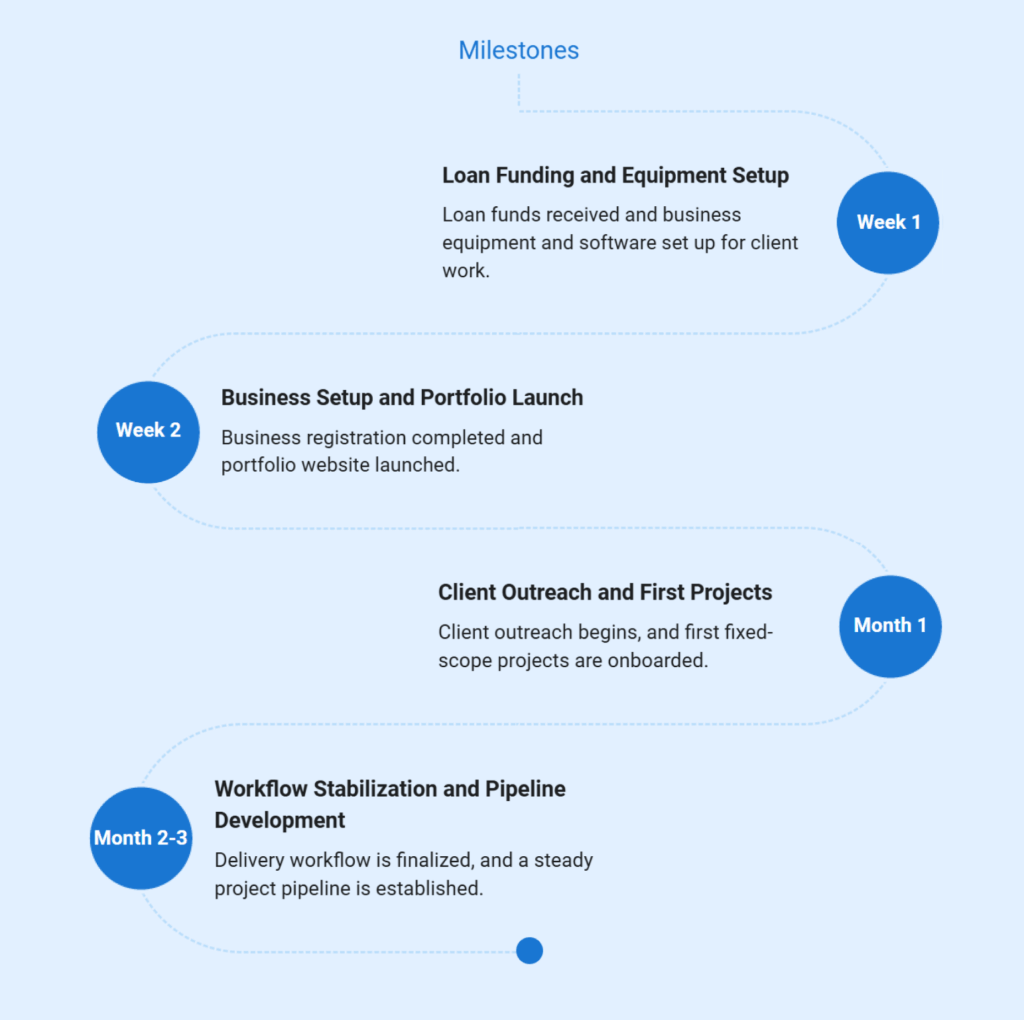
Milestones & Timeline
PixelCraft’s launch plan follows a short, practical timeline focused on getting tools in place, activating operations, and building a steady project pipeline. Because the business operates with low overhead and no facility setup, milestones concentrate on readiness and early client acquisition rather than long buildout phases.
Financial Plan
PixelCraft’s financial plan reflects a low-overhead, project-based service business operated by a single owner. The projections align with the company’s fixed pricing structure, prepaid billing model, and controlled project volume. Because the business does not carry payroll, rent, or inventory, financial performance depends primarily on steady project intake rather than scale.
Startup Costs
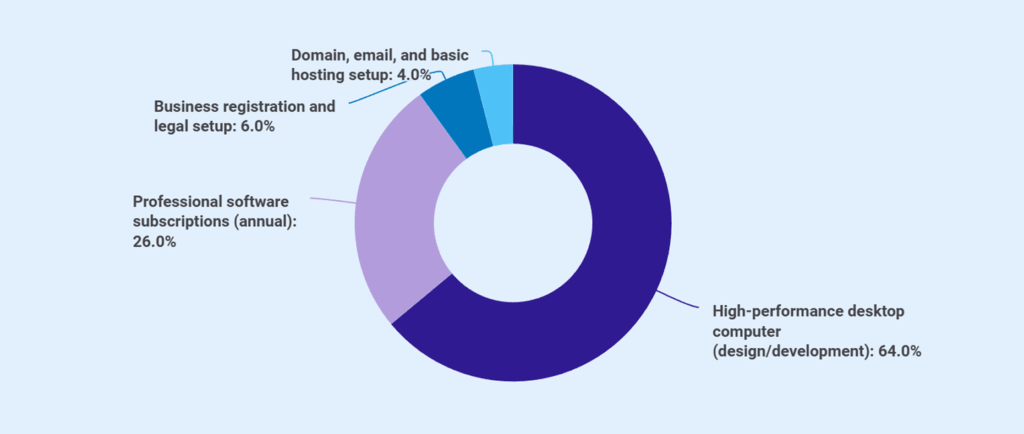
PixelCraft’s startup costs are limited to essential equipment, software, and basic business setup. No facility buildout, inventory purchases, or staffing costs are required.
| Category | Cost (USD) |
|---|---|
| High-performance desktop computer (design/development) | 3,200 |
| Professional software subscriptions (annual) | 1,300 |
| Business registration and legal setup | 300 |
| Domain, email, and basic hosting setup | 200 |
| Working capital buffer (opening cash) | 0 |
| Total Startup Costs | 5,000 |
Key Financial Assumptions
The projections below rely on conservative, clearly defined operating assumptions tied directly to capacity.
| Factor | Details |
|---|---|
| Business Model | Fixed-price, project-based services |
| Billing Structure | 50% upfront, 50% before delivery |
| Average Projects Per Month | Year 1: 2 · Year 2: 4 · Year 3: 5 |
| Average Project Value | Based on the service mix |
| Monthly Fixed Operating Costs | ~$390 |
| Payroll | None |
| Rent | None |
These assumptions intentionally limit volume to protect delivery quality and avoid overextension.
Profit & Loss Statement
| P&L Line Item | Year 1 (in $) | Year 2 (in $) | Year 3 (in $) |
|---|---|---|---|
| Revenue | |||
| Informational websites | 34,560 | 69,120 | 86,400 |
| Website redesigns | 10,800 | 21,600 | 27,000 |
| Landing pages | 3,240 | 6,480 | 8,100 |
| Add-on services | 2,100 | 4,200 | 5,250 |
| Gross Revenue | 50,700 | 101,400 | 126,750 |
| Refunds / bad debt (0.5%) | (254) | (507) | (634) |
| Net Revenue | 50,446 | 100,893 | 126,116 |
| Cost of Sales (COGS) | |||
| Freelance overflow support | 1,260 | 2,520 | 3,150 |
| Software delivery allocation | 1,200 | 1,200 | 1,200 |
| Total COGS | 2,460 | 3,720 | 4,350 |
| Gross Profit | 47,986 | 97,173 | 121,766 |
| Gross Margin | 95.1% | 96.3% | 96.6% |
| Operating Expenses | |||
| Software (non-delivery) | 240 | 240 | 240 |
| Hosting and email | 360 | 360 | 360 |
| Internet allocation | 600 | 600 | 600 |
| Miscellaneous | 480 | 480 | 480 |
| Marketing | 1,800 | 3,000 | 4,200 |
| Insurance | 600 | 600 | 600 |
| Bookkeeping and tax prep | 600 | 600 | 600 |
| Total Operating Expenses | 4,680 | 5,880 | 7,080 |
| EBITDA | 43,306 | 91,293 | 114,686 |
| Depreciation | 1,067 | 1,067 | 1,067 |
| EBIT | 42,239 | 90,226 | 113,619 |
| Interest expense (9.5%) | 314 | 171 | 36 |
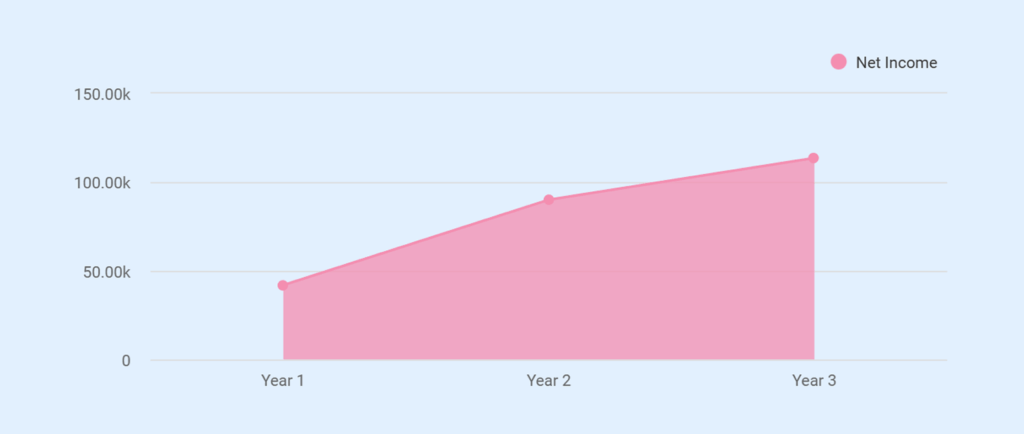
| Net Income | 41,925 | 90,055 | 113,583 |
Here’s one thing to note: Income taxes are not reflected in the projections because the business is taxed as a pass-through entity. Net income shown represents pre-tax business earnings. The owner will report business profit on their individual tax return and pay applicable income and self-employment taxes regardless of whether funds are withdrawn from the business.
Cash Flow Statement
| Cash Flow Item | Year 1 (in $) | Year 2 (in $) | Year 3 (in $) |
|---|---|---|---|
| Operating Activities | |||
| Net income | 41,925 | 90,055 | 113,583 |
| Depreciation add-back | 1,067 | 1,067 | 1,067 |
| Working capital changes | 0 | 0 | 0 |
| Net Cash from Operations | 42,992 | 91,122 | 114,650 |
| Investing Activities | |||
| Equipment purchase | (3,200) | 0 | 0 |
| Net Cash from Investing | (3,200) | 0 | 0 |
| Financing Activities | |||
| Loan proceeds | 4,500 | 0 | 0 |
| Owner contribution | 500 | 0 | 0 |
| Loan principal repayment | (1,200) | (1,500) | (1,800) |
| Net Cash from Financing | 3,800 | (1,500) | (1,800) |
| Net Change in Cash | 43,592 | 89,622 | 112,850 |
| Beginning cash | 0 | 43,592 | 133,214 |
| Ending Cash | 43,592 | 133,214 | 246,064 |
Balance Sheet
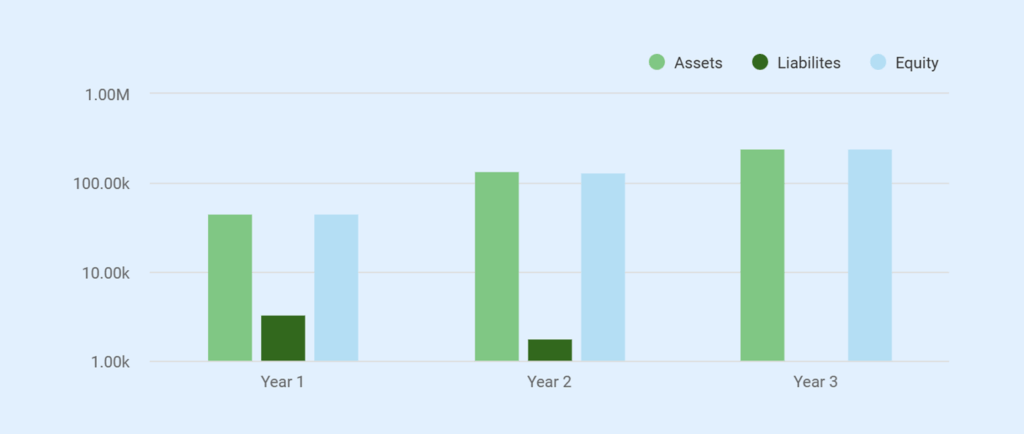
| Balance Sheet Item | Year 1 | Year 2 | Year 3 |
|---|---|---|---|
| Assets | |||
| Cash | 43,592 | 133,214 | 246,064 |
| Accounts receivable | 0 | 0 | 0 |
| Fixed Assets | |||
| Equipment (cost) | 3,200 | 3,200 | 3,200 |
| Accumulated depreciation | (1,067) | (2,134) | (3,200) |
| Net fixed assets | 2,133 | 1,066 | 0 |
| Total Assets | 45,725 | 134,280 | 246,064 |
| Liabilities | |||
| Loan payable – current | 1,500 | 1,800 | 0 |
| Loan payable – long-term | 1,800 | 0 | 0 |
| Total Liabilities | 3,300 | 1,800 | 0 |
| Equity | |||
| Owner capital | 500 | 500 | 500 |
| Retained earnings | 41,925 | 131,980 | 245,564 |
| Total Equity | 42,425 | 132,480 | 246,064 |
| Total Liabilities + Equity | 45,725 | 134,280 | 246,064 |
Break-Even Analysis
| Item | Value |
|---|---|
| Monthly fixed operating costs | $390 |
| Variable cost ratio | 3.0% of revenue |
| Contribution margin | 97.0% |
| Monthly break-even revenue | $402 |
| Weighted average revenue per project | $2,110 |
| Break-even projects per month | 0.19 |
| Practical break-even point | 1 small project every 4-5 months |
| Year business clearly surpasses break-even | Year 1 |
Notes:
- Fixed costs reflect an owner-only, home-based structure.
- Variable costs are limited to freelance overflow and refunds.
- Break-even occurs at an extremely low volume due to minimal overhead and prepaid project billing.
- Year 1 represents stable, sustained break-even rather than one-off profitability.
Don’t waste time figuring out Excel
Simplify financial forecasting & reporting w/ Upmetrics
Funding Requirements
PixelCraft funds startup costs through a combination of owner cash and a small equipment term loan.
| Source | Amount (USD) |
|---|---|
| Small Business Equipment Term Loan (Wells Fargo Bank, N.A.) | 4,500 |
| Owner cash contribution | 500 |
| Total Sources | 5,000 |
The business does not require working capital financing, inventory funding, or facility-related investment due to its home-based, owner-managed operating model.
Use of Loan Funds
A $4,500 equipment term loan will be used exclusively for equipment and software required for professional website design and development work. This includes a dedicated business desktop computer and the activation of professional design and development software used for website builds and redesigns. No proceeds are allocated to payroll, marketing campaigns, or ongoing operating expenses.
| Category | Amount ($) | Purpose |
|---|---|---|
| Desktop Computer | 3,200 | Primary production equipment |
| Professional Software | 1,300 | Design and development tools |
| Total | 4,500 |
Repayment Capacity
Loan repayment is supported by predictable operating cash flow generated through fixed-price projects billed 50% upfront and 50% before delivery. The business operates with low monthly overhead and no payroll or lease obligations. Break-even occurs at minimal monthly revenue, which provides a margin of safety for debt service.
| Item | Details |
|---|---|
| Loan amount | $4,500 |
| Bank | Wells Fargo Bank, N.A. |
| Loan type | Small business equipment term loan |
| Estimated term | 3 years (36 months) |
| Estimated interest rate | 9.5% fixed (assumed standard small business equipment rate) |
| Collateral | Financed equipment |
| Personal Guarantee | Owner |
| Estimated monthly payment | $144.59 = ~$145 |
| Annual debt service | $1,735 per year = ~$1,740 |
| Repayment source | Operating cash flow from client projects |
Note: Final repayment terms will reflect lender-issued loan documents.
Owner Investment
The owner provides a direct cash contribution toward startup costs and a full personal guarantee for the equipment loan. The owner’s investment reduces lender exposure and demonstrates a direct financial stake in the business. Ongoing loan repayment is supported by operating cash flow generated through fixed-price client projects.
The Quickest Way to turn a Business Idea into a Business Plan
Fill-in-the-blanks and automatic financials make it easy.

Upmetrics
Upmetrics is the #1 business planning software that helps entrepreneurs and business owners create investment-ready business plans using AI. We regularly share business planning insights on our blog. Check out the Upmetrics blog for such interesting reads. Read more