


It’s darn simple to approve a big purchase when your bank balance looks healthy. But when you factor in payroll, rent, quarterly taxes, and a slow season around the corner, you realize how easy it is to get the timing completely wrong.
The uncertainty is the culprit: when is the right time to buy? Should you pay cash or finance? What if you drain your reserves and something breaks next month? How do you know the purchase will actually pay off?
It ends right here.
In this article, I’ll walk you through a step-by-step process for purchase planning, whether you’re buying equipment, office space, or a company vehicle. I’ll cover how to calculate the real cost, how to check your cash flow before committing, how to pick the right payment structure, and the mistakes that quietly drain small business bank accounts.
Let me start with what purchase planning actually means.
Why should you always plan a large business purchase?
Purchase planning is the process of deciding what your business needs to buy, when to buy it, and how to pay for it before the money leaves your account.
You may also see this referred to as capital expenditure planning or CapEx budgeting. Same idea, just the formal term used when businesses evaluate and budget for major long-term investments.
It sounds simple. Most owners think they’re already doing it. But there’s a difference between checking your balance and actually planning a purchase.
The concept of purchase planning
Most owners think about purchases in two steps: do I need it, and can I afford it? Purchase planning adds a third: Is right now the right time?
That third question is the one that saves you. Not every purchase that’s needed and affordable is timed correctly. And a poorly timed purchase can create the same cash flow problem as one you couldn’t afford at all.
A good purchase plan answers all three questions before any money moves. That’s the whole concept. Nothing more complicated than that.
Why plan for every major purchase?
Not every expense needs this treatment. But some do. A commercial oven for a bakery, a delivery van for a landscaping company, a CNC machine for a small manufacturer, an office buildout, a POS system overhaul.
In accounting terms, these are capital expenses, major purchases that benefit your business for more than one year. Building a capex plan around them, even a simple one, is how you avoid the cash flow surprises that catch most owners off guard.
These purchases don’t just cost money. They move money. And that’s where things get tricky.
Planning matters for three reasons beyond just timing. First, it forces you to check whether the purchase will actually pay for itself. If the equipment, software, or space won’t generate enough return to cover its cost within a reasonable timeframe, that’s worth knowing before you buy, not six months after.
Second, it gives you leverage. When you know your numbers, you negotiate better, choose smarter financing, and avoid buying at the wrong point in your cash flow cycle.
Third, it keeps your reserves intact. An unplanned purchase at the wrong time doesn’t just cost money. It can leave you scrambling to cover basics when something unexpected hits.
When you plan it out first, you sidestep all of that. You catch the bad timing before it becomes your problem, find better financing options, and walk into vendor negotiations knowing your numbers cold.
Check your cash flow forecast, 90 days out
Your balance right now means almost nothing without context.
What matters is what that number looks like after everything already committed gets pulled out—payroll next Friday. Rent on the first. The supplier invoice you approved two weeks ago. The quarterly tax payment is due in six weeks.
Here’s a real example. A retail store owner has $18,000 in the account and wants to buy $14,000 worth of new shelving. Looks comfortable. But she’s got $7,000 in payroll, $4,500 in rent, and a $2,000 supplier payment all hitting in the next 30 days. Her real available number is $4,500. The purchase would have wiped her out.
Run the numbers out 30, 60, 90 days. Map what’s coming in against what’s already going out. Whatever’s left after that is what you actually have to work with.
While you’re at it, run a quick payback check. Divide the total cost of the purchase by the monthly revenue or savings it’s expected to generate. If it won’t pay for itself within 18-24 months, that’s worth a hard second look before you commit.
Our cash flow forecasting guide walks through exactly how to build this if you need a place to start.
5 Steps to plan a major business purchase
Before you sign that purchase order, work through these five steps. They’ll take an afternoon and could save you thousands.
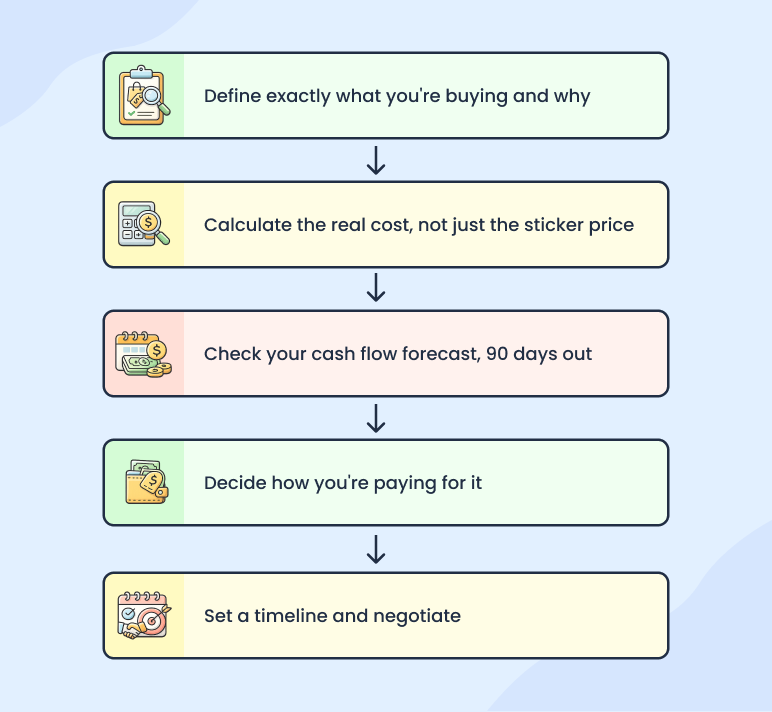
1) Define exactly what you’re buying and why
Most owners start vague. “We need a new oven.” “The delivery van is getting old.” That’s fine as a starting thought, but it’s a terrible place to make a $10,000 decision from.
The “what” is just half of it. The “why” is where most owners skip the real work.
Defining why a purchase is necessary is how you justify it, to yourself, to your team, and to any lender or investor who asks. It forces you to connect the purchase to a specific business outcome. Not “we need better equipment” but “this equipment lets us take on two new delivery routes starting next quarter, which adds $6,000 in monthly revenue.”
If you can’t draw that line between the purchase and the outcome, you’re not ready to buy yet.
One of those is a purchase. The other is just an idea. The difference isn’t the item. It’s the justification behind it.
2) Calculate the real cost, not just the sticker price
Whatever number is on the listing, add to it. That’s the real starting point.
Delivery fees, installation, and staff training on new equipment. A maintenance contract for year one. An insurance rider. And taxes on top of everything else. Nobody puts all of that on the product page, but all of it shows up on your bill.
Two costs that almost nobody accounts for: downtime and the learning curve. When new equipment arrives, there’s usually a period where production slows or stops entirely during setup and testing. And once it’s running, staff need time to get comfortable with it, which means slower output and more errors before things normalize.
For a busy bakery, two days of reduced production while a new oven is installed and tested could mean $1,500 in lost output. That’s a real cost. It just doesn’t show up on any invoice.
A $15,000 oven becomes $18,500 once the listed costs land. Factor in downtime and the learning curve, and you’re closer to $20,000. That’s the number worth planning around.
| Cost Item | Example Amount |
| Sticker price | $15,000 |
| Delivery & installation | $800 |
| Staff training | $400 |
| First-year maintenance | $600 |
| Insurance rider | $300 |
| Taxes & fees | $1,400 |
| Downtime & lost output | ~$500-$1,500 |
| Total actual cost | ~$18,500-$20,000 |
Build this list before you approve anything. The final number is always higher than the first one.
3) Check your cash flow forecast, 90 days out
Your balance right now means almost nothing without context.
What matters is what that number looks like after everything already committed gets pulled out of payroll next Friday. Rent on the first. The supplier invoice you approved two weeks ago. The quarterly tax payment is due in six weeks.
Here’s a real example. A retail store owner has $18,000 in the account and wants to buy $14,000 worth of new shelving. Looks comfortable. But she’s got $7,000 in payroll, $4,500 in rent, and a $2,000 supplier payment all hitting in the next 30 days. Her real available number is $4,500. The purchase would have wiped her out.
Run the numbers out 30, 60, 90 days. Map what’s coming in against what’s already going out. Whatever’s left after that is what you actually have to work with.
Our cash flow forecasting guide walks through exactly how to build this if you need a place to start.
4) Decide how you’re paying for it
Having the money available doesn’t settle the question of how to pay.
Most owners treat this as a simple yes or no. Do I have the money? Yes. Then I’ll pay cash. But that logic ignores what happens to the business after the purchase clears.
A restaurant owner pays $20,000 upfront for a full kitchen equipment upgrade because she has the cash sitting there. Two months later, a supplier invoice comes in early, a slow week hits harder than expected, and payroll is due Friday. She’s cash-strapped, not because the upgrade was wrong, but because she paid for it the wrong way.
Cash pulls from your reserves all at once. Financing spreads the cost, keeps cash in the business, and the interest is usually tax-deductible. Leasing keeps the monthly number low, but you hand everything back when the term ends.
Now that you have your timeline and negotiation plan, one decision remains: how to pay.
5) Set a timeline and negotiate
Start with your timeline. Work backward from when you actually need the equipment running. If it’s for a Q3 catering push, you don’t need it delivered in Q3; you need it installed, tested, and staff trained by then. That might mean ordering in April, not July.
Getting your timing right also gives you negotiating power. A flexible delivery window is one of the easiest discounts to get. Vendors manage production schedules and storage costs. If you can take delivery 30 days later, that’s worth something to them, sometimes 5-8% off the total.
Beyond delivery, ask about payment terms. Net-60 or net-90 terms cost you nothing to request and can make a real difference to your cash flow that month.
Have the conversation before you sign. The worst they can say is no.
How to pay for a major purchase: cash vs. loan vs. lease
It’s one of the most common questions I get: Should I just pay cash, or is financing the smarter move? The answer depends on three things: your reserves, your tax situation, and how long the equipment stays useful.
1) Paying cash
No interest, no lender, no monthly commitment. Zero total cost beyond the purchase price itself. Clean and simple.
The catch is what it does to your reserves. Pulling $25,000 out in one shot sounds smart until a client pays late, something breaks, or a slow month hits harder than expected. That cushion you just spent was the thing standing between you and a real problem.
Cash makes sense when you have more than 6 months of operating expenses saved and the purchase won’t move you below that threshold. If you’re anywhere near that line, keep reading.
2) Taking out a loan
Borrowing spreads the cost out over time and keeps cash in the business where it’s needed most. There are three main routes depending on your situation.
A business term loan is the most straightforward. At around 8% interest over 5 years, a $25,000 purchase runs roughly $507 a month with a total cost of around $30,400. The interest is tax-deductible, which softens the real cost more than most owners realize.
If you want the equipment itself to secure the loan, equipment financing is the cleaner option. At 9-10% over 5 years, expect payments around $520 a month on a $25,000 purchase. Faster approval, and the lender cares about the asset, not just your credit history.
The SBA loan route gets you the best rates of any option here. SBA 7(a) rates currently run between 7.25-9.75%, putting monthly payments around $350 over 7 years on a $25,000 purchase. If you want to understand how SBA loans work and whether you qualify, our SBA loan guide and SBA loan requirements cover both in detail. The tradeoff is approval time, minimum 60-90 days, so plan if this is the route.
3) Leasing
On a 5-year lease, $25,000 worth of equipment runs around $280 a month. The full payment is tax-deductible. But at the end of the term, you hand it back with nothing to show for it.
That’s fine when the equipment will be outdated in 3-5 years anyway. Technology, vehicles, and specialized machinery often fall into this category.
So how do you choose?
Cash reserves above 6 months of operating expenses? Paying outright might work. Below that, financing keeps your buffer intact. Leasing makes sense when the equipment has a short useful life and ownership isn’t the point.
Don’t wipe out your emergency fund just to dodge a loan. That 3-6 month reserve is what keeps the business standing when something unexpected hits.
How a big purchase affects your cash flow
Here’s what happens to your cash flow when you spend $20,000 on new equipment, month by month.
Take a landscaping company bringing in $15,000 a month with $8,000 in fixed costs. That’s a $7,000 monthly cushion before the purchase. Comfortable, not lavish.
They buy a $20,000 mower. The new equipment opens up $3,000 in additional jobs per month, roughly 2 extra jobs a week at $375 each, based on their current pricing. But how that purchase gets paid for changes everything.
| Month | Revenue | Fixed Costs | Purchase Cost | Net Cash Flow |
| Before purchase | $15,000 | $8,000 | $0 | $7,000 |
| Month 1 (cash) | $18,000 | $8,000 | $20,000 | -$10,000 |
| Month 2 (cash) | $18,000 | $8,000 | $0 | $10,000 |
| Month 1 (financed) | $18,000 | $8,000 | $450 | $9,550 |
| Month 2 (financed) | $18,000 | $8,000 | $450 | $9,550 |
Pay cash, and month one puts you $10,000 in the hole. The business recovers, but that first month is genuinely painful depending on what else is due.
Finance it at $450 a month, and you’re cash flow positive from day one. The equipment pays for itself in two months from the new revenue alone.
Break-even on the financed option hits around the month 8, factoring in interest. Still a solid return on a single piece of equipment.
This is exactly why cash flow forecasting matters before a big purchase, not after. Map it out 90 days ahead, and you can see which payment structure actually works for your situation.
Before your next big purchase, build this same table with your actual revenue and fixed costs. Plug in both scenarios. The right call usually becomes obvious in about five minutes.
5 Purchase planning mistakes that cost small businesses money
These five mistakes drain small business bank accounts every year. Most owners don’t realize they’re making them until the damage is done.
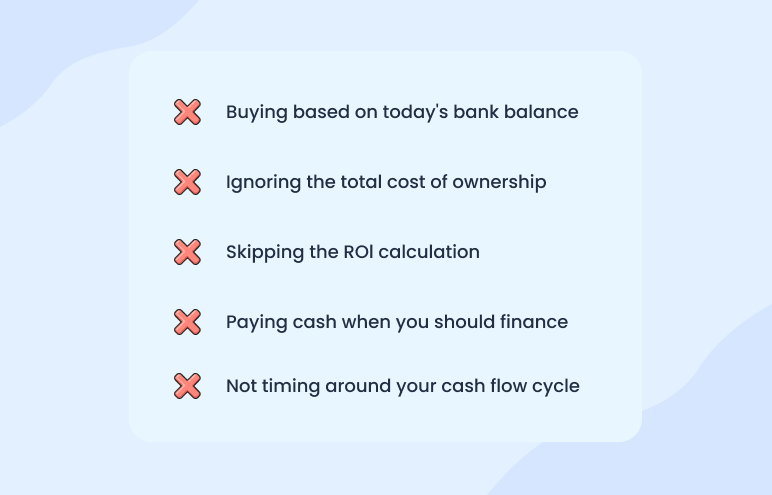
1) Buying based on today’s bank balance
Your bank balance is a snapshot. It shows what’s sitting in the account at this exact moment. It doesn’t show what’s already spoken for.
The problem isn’t that owners don’t know this; most do. The problem is that in the moment, a healthy balance feels like permission. It’s a psychological trap, not a math problem.
The balance you see is almost never the balance you actually have. And making a $20,000 decision based on the wrong number is how a perfectly good purchase turns into a cash flow crisis.
2) Ignoring the total cost of ownership
Total cost of ownership is the full amount a purchase actually costs you over its useful life, not just what you paid on day one.
A $12,000 printer is a good example. Sounds manageable. Then the toner starts running out every six weeks. The maintenance contract kicks in at year two. A repair shows up in year three. Five years later, you’ve spent $27,000 on that printer, and nobody budgeted for any of it.
The number on the listing is just where the costs begin. Everything after that is what the purchase actually costs you.
3) Skipping the payback calculation
The payback period is how long it takes a purchase to pay for itself through the revenue or savings it generates. It’s different from ROI, which measures the percentage return on what you spent. For most small business owners, the payback period is the more useful number.
Most owners skip this entirely. They buy the equipment because they need it, not because they’ve mapped out when it starts paying back. A landscaping company buys a $20,000 mower without checking how many additional jobs it needs to generate before it breaks even. Six months later, it’s still just a cost sitting on the balance sheet.
The math is simple. Divide the total cost by the monthly revenue or savings the purchase generates. That gives you the payback period in months.
Every major purchase should clear that calculation before you approve it. If the equipment, software, or space won’t pay for itself within 18-24 months, that’s worth a hard second look. No payback estimate means no real justification—just hope.
4) Paying cash when you should finance
This one feels counterintuitive. If you have the money, why wouldn’t you just pay?
Here’s why. A cleaning business owner has $40,000 in the bank and needs a $25,000 vehicle. She pays cash to avoid the loan. Two months later, a piece of equipment breaks, a client cancels a contract, and her slow season starts early. She’s now running the business on $15,000 with no cushion and no credit line.
Having the money available doesn’t mean spending it all makes sense. That reserve exists for a reason. Financing the vehicle at $450 a month would have kept $25,000 in the business where it was needed most.
5) Not timing around your cash flow cycle
Cash flow timing is the practice of matching big spending decisions to the months when your business actually has money to absorb them. This connects directly to Step 3 above. Checking your 90-day forecast is exactly how you avoid this mistake.
Most owners don’t think about this at all. They decide to buy, they buy. But a restaurant owner who drops $15,000 on a new POS system in January, historically their slowest month, is going to feel that in a way they wouldn’t have in October.
Look at your last 12 months before you commit to anything. The seasonal patterns are already there. Sometimes waiting six weeks is the whole difference between a smooth transition and a month you spend scrambling to cover basics.
Make purchase planning a part of your business plan
A one-time purchase plan is useful. But it’s still reactive. You do the work when a big buy comes up, then forget about it until the next one.
Building it into your ongoing business plan changes that entirely. When your financials are already mapped out, purchase planning stops being a separate exercise. It’s just part of how you run the business.
A simple way to start: add a “planned purchases” line item to your annual budget. List every major buy you’re considering, the estimated cost, and the quarter you’re targeting. That one habit alone forces better timing decisions before the pressure hits.
Take the $20,000 mower example. Build two scenarios in your cash flow forecast, one where you pay cash, one where you finance it. You’ll see immediately which month works and when the equipment breaks evenly.
Your profit and loss statement shows how the purchase affects profitability over time. Not just the upfront cost, but what it does to your margins month after month.
And scenario planning is where it gets really useful. Instead of gut-feeling your way through “should I buy now or wait six months,” you run both. Two scenarios, side by side, with actual numbers. The right call usually becomes obvious pretty fast.
Upmetrics handles all of this in one place. Build your cash flow forecast, run scenario comparisons, and use the AI assistant to stress-test your assumptions. For example, ask it what happens to your cash flow if the purchase costs 20% more than expected or if revenue dips the month after you buy.
If you’re already running your financial forecasts there, adding a purchase scenario takes maybe 10 minutes. And if you’re applying for financing, lenders love seeing that kind of scenario analysis in your plan. It shows you’ve actually thought it through.
Conclusion
Purchase planning isn’t some complicated finance process. It’s just being intentional about what you’re buying, when you’re buying it, and how you’re paying for it before the money leaves your account.
Here’s what you now have:
- A process for defining exactly what you’re buying and why
- A checklist for calculating the real cost beyond the sticker price
- A framework for checking your cash flow 90 days out
- A clear comparison of cash, loan, and lease options
- A way to time purchases around your cash flow cycle
None of this is complicated. It just requires doing it before you buy, not after.
So before you approve that next big purchase, run through the steps. Check the forecast. Pick the right payment structure. You have everything you need to make a smart call.
And if you want to build this into how you run the business permanently, Upmetrics’ free business plan template and financial forecasting tool make it a lot easier. Build your forecast, run purchase scenarios, and walk into every major purchase knowing exactly where you stand.
Now go plan that purchase you’ve been putting off.
The Quickest Way to turn a Business Idea into a Business Plan
Fill-in-the-blanks and automatic financials make it easy.

