



 Download Now: Free Market Analysis Kit
 Most founders do some form of market research before starting their business. The issue is never effort. It is knowing which type to use and when.
Someone validating a new idea needs a different approach than someone expanding a product line or entering a new market. Someone writing a business plan for investors needs different inputs than someone trying to understand why sales have slowed.
That mismatch is where most research efforts fall short. The work happens, but it does not answer the right question for the stage the business is actually in.
To clear up all the confusion, I have divided the main types of market research into a format that is easier to act on, so you can match the right method to the decision you are actually trying to make.
What is market research?
Market research is all about gathering information about your customers, competitors, and market before making key business decisions.
CB Insights found that 43% of failed startups cited “no market need” as a top reason for shutting down. They built something the market didn’t actually want, not because they weren’t smart or didn’t work hard. The real reason is that they never tested whether the demand was real before committing to it.
That is what market research is actually for. It is how you pressure-test assumptions about who your customer is, what problem you are solving, and what people will pay before those assumptions cost you. The earlier you do it, the more it shapes what you build, who you target, and how you price it.
In a business plan, this is where your market analysis comes from. Your target customer, market size, pricing, and positioning should all be backed by some form of research.
At the broadest level, there are two types of market research: primary and secondary. Beyond that, qualitative and quantitative describe what kind of data you collect. All of it feeds into the same place, which is your market analysis.
1) Primary research
Primary research means going directly to your target market to collect information yourself. You decide what to ask, who to ask, and how to interpret the answers. Nothing is filtered through a third party or aggregated across an industry.
It is useful because of that directness. The information is business-specific, as well as the precise question you are attempting to respond to. I find it most useful for justifying an idea, figuring out exactly what is annoying customers, or experimenting with pricing to be sure it is worth the real investment.
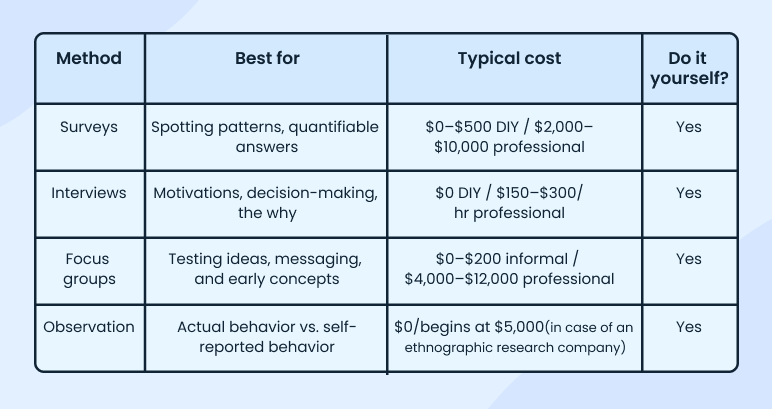
Primary research methods are mainly four, namely, surveys, interviews, focus groups, and observation.
Surveys
Surveys are the most accessible way to collect primary data at scale. The main types of market research surveys include online surveys, telephone surveys, and in-person questionnaires, each suited to a different audience and budget.
Google Forms or the free version of SurveyMonkey should be sufficient to start with small businesses. A DIY survey costs nothing. A typical survey design and analysis costs $2,000 to $10,000, though.
Interviews
One-on-one conversations with potential customers are where you get the real texture behind buying decisions. Most founders can run these themselves by speaking with 5 to 10 people in their target market. The cost is mostly time.
When you hire a professional moderator, you will have to pay between $150 and $300 an hour. At the initial level of validation, I would suggest that you do these on your own and then avoid using a moderator.
Focus groups
The focus groups involve a small group of participants to discuss a product, idea, or concept. They are effective in testing messaging, reactions, or early concept testing where group dynamics bring out things that are not available in one-on-one interviews.
Focus groups conducted professionally are usually between $4,000 and $12,000 in one session. You can run informal versions with target users below $200, and that is the correct place to start with most small businesses.
This does not need a huge budget for most small businesses. The trick is to choose the correct approach to whatever you are learning.
Observation
Observation involves the act of monitoring the actual behavior of people as opposed to asking them to explain their actions. This may be as simple as visiting a physical place to observe how customers use a product or service, or watching session recordings and heatmaps to observe how people use a site.
You can use it when you’re aware that there is a discrepancy between what people claim to do and what they actually do. Interview and survey data are based on self-reporting, which is not necessarily true. Observation eliminates such a filter.
This is free in the case of small businesses. You can observe customer behavior in your store, in a competitor store, or using free tools such as Google Analytics or Microsoft Clarity. You can also hire an ethnographic research company to do some structured observation studies, where the cost starts from $5,000.
2) Secondary research
You don’t always need to collect data from scratch. Secondary research is based on data that has been previously developed by governments, research agencies, and industry associations. It is normally the most economical and quickest method to know a market.
This is the first place that I would suggest beginning before conducting any surveys or interviews. Within minutes, you can get demographic information, industry trends, and competitor benchmarks. It also narrows down your main research, meaning that you are left with only gathering information that is not available in the existing sources.
Some of the most useful free sources:
| Source | What you’ll find | Best for |
| Census.gov | Population data, household income, and business demographics by region | Sizing a local market, understanding customer demographics |
| Data.gov | Thousands of public datasets across industries | Finding niche data you wouldn’t expect to be publicly available |
| SBA.gov | Small business guides and market research resources | Foundational market research for first-time founders |
| Bls.gov | Employment trends, wage data, industry outlooks | Workforce planning, understanding industry health |
| Pew Research Center | Consumer behavior trends, demographic shifts, and survey methodology insights | Understanding how target audiences think and what drives their decisions |
Paid sources like Statista and IBISWorld offer more structured insights but come at a cost. For most early-stage businesses, the free sources above cover the basics.
For a broader overview of what’s available, this guide to market research tools covers both free and paid options worth considering.
There are two broad types of secondary market research: internal sources like your own sales data, customer records, and past reports, and external sources like government databases, industry studies, and published research. Most early-stage founders focus on external sources since they don’t yet have internal data to draw from.
The main limitation is that none of this data is tailored to your business. It can be outdated, too broad, or not specific enough to your niche. You will need to interpret and adapt it rather than use it directly.
I’d suggest starting every research project with 30 minutes of secondary research. It costs nothing and tells you what questions are already answered, so your time and budget go toward filling the gaps.
Primary and secondary describe where your data comes from. Qualitative and quantitative describe what kind of data you collect. Let’s discuss.
3) Qualitative research
Qualitative research focuses on non-numerical insights:
- How people think
- What they care about
- Why they make certain decisions
This method involves looking for patterns in behavior, language, and intent.
I find it most valuable early in the process, before you know exactly what to measure. The main types of qualitative market research include in-depth interviews, focus groups, open-ended surveys, ethnographic observation, and online community listening. Each is designed to surface the reasoning behind behavior rather than measure it.
Here is a simple example. A coffee shop notices a drop in morning sales. Transaction data shows fewer orders, but it’s not the reason. The owner speaks with a few regular customers and finds that wait times have increased and nearby offices have shifted to hybrid schedules. That context shifts the entire response.
Instead of discounting prices, the focus moves to faster service and targeting afternoon foot traffic. That is qualitative research in practice. It does not give you numbers. It provides you with a context for them.
The correct place to start is qualitative research when you are venturing into a new concept, attempting to comprehend what is motivating an action, or enhancing your message. Quantitative research can be used to scale up on what you know you are looking at once you have it.
4) Quantitative research
Quantitative research presents you with figures that can be directly used in a business plan: market size, demographics of customers, price sensitivity, and frequency of purchase.
Qualitative research tells you that pricing confuses customers. Quantitative research tells you that 68 out of 100 surveyed customers will pay $20–$30, but only 40 will pay $35.
Some of the quantitative research methods include:
- Structured survey: closed-ended questions that have quantifiable answers.
- Polls: single-question, quick directional data.
- Data analytics: traffic, conversion, frequency of purchase.
- A/B tests: where two variations are compared to find out which one works better.
- Market sizing computations: TAM, SAM, and SOM estimation based on available data.
I think that the market sizing section is the area I find the most lacking in most of the business plans at the early stages.
Based on industry reports and census data, you can approximate your total addressable market (TAM), the entire size of the market you are entering, your serviceable addressable market (SAM), the portion you can practically serve, and your serviceable obtainable market (SOM), the portion you can capture in the short term.
These numbers go directly into your market analysis section and are among the first things investors look at.
One thing founders often overlook is response rates. SurveyMonkey benchmarks show that online surveys typically get a 10% to 30% response rate. So if you need 100 responses, plan to reach out to at least 300 to 400 people.
For most small businesses, that is a realistic target without needing a large budget or a research firm. You can also use AI-powered research tools to help analyze responses once you have them.
5) Exploratory research
Exploratory research focuses on why you are doing the research in the first place. It is a type of research that you carry out in advance of what you are going to ask.
Common methods include:
- Informal conversations: casual discussions with people in your target market to understand their frustrations and habits.
- Online community observation: read threads on Reddit, Facebook groups, or forums where your target audience discusses freely.
- Competitor browsing: checking the product features, prices, and customer reviews in order to identify gaps.
- Literature review: reading industry reports, articles, and already available research to learn what is already known.
The good news is that exploratory research costs almost nothing. Most of these methods require time rather than budget, which makes it the most accessible starting point for any founder.
At this stage, you can use AI for market research to scan communities, summarize reviews, and identify common themes across sources to cover more ground faster.
What you find here directly shapes the early sections of your business plan. The problem you identify, the customer frustrations you uncover, and the gaps you spot in existing solutions all feed into your problem statement and customer analysis sections.
I worked with a founder who spent a week doing exactly this before building anything. They went through forum discussions and customer reviews in their category and kept seeing the same complaints come up: a specific workflow nobody had solved cleanly, workarounds people had stitched together themselves.
That week of reading shaped their entire product direction and saved them months of building the wrong thing.
Specialized research types
The specialized forms of market research help you answer specific questions about your brand, competitors, products, and customers.
You don’t need all of them. The businesses that I have worked with mostly use two or three of them at various stages, depending on the kind of decision that they are attempting to make.
The following is a list of the five most applicable to small businesses and startups.
1) Brand research
Brand research gauges your business perception in terms of awareness, recognition, and customer descriptions of your positioning versus the competition.
I consider it most helpful before a rebrand, entering a new market, or when sales falter without a definite cause. For example, a local café discovers customers see it as a grab-and-go spot, not a place to work; that insight alone can reset its entire positioning.
A basic brand perception survey using Google Forms costs nothing. Professional brand tracking studies typically run $5,000 to $15,000.
2) Customer research
Customer research helps you know who your customers are, their demographics, behaviours, level of satisfaction, and what keeps them coming back. It comes in handy, especially when creating customer personas to be followed in a business plan, retention, or product line expansion.
A SaaS product may discover that its customers who pay are predominantly in a particular industry, and this changes its targeting and communication strategies towards new clients.
Customer interviews and satisfaction surveys cost little to nothing. A professional customer research study runs $3,000 to $10,000, depending on scope. Most founders can build solid personas from 10 to 15 conversations.
3) Competitive research
Competitive research refers to the study of other firms within your market: their price, positioning, strengths, and weaknesses. Before entering a market, when the growth is slow or when you are developing the competitive analysis section of your business plan, it is necessary to take this into account.
I recommend using a structured tool like Upmetrics’ competitor analysis generator to organize findings, especially if you are tracking multiple competitors at once.
This is a fully DIY research type wherein you can use competitor websites, pricing pages, and customer reviews free of cost. Paid tools like SEMrush or SimilarWeb add depth for $100 to $400 per month. The timeline is typically one week for a basic analysis.
4) Product research
Product research focuses on testing what you are building before or after launch: features, pricing, packaging, and overall experience. It is best applied prior to development, a significant update, or when justifying a price adjustment. You can test two prices with a limited group of users, e.g., before committing to either.
This involves DIY product testing with a small user group, and costs start from zero to a few hundred dollars in incentives. Professional usability testing typically runs $5,000 to $20,000. For early-stage validation, a simple 5-question survey or 5 user interviews is usually enough.
5) Market segmentation research
The market segmentation research breaks up your larger market into smaller segments, where the segments are classified based on demographics, behavior, geography, or psychographics. It helps you narrow down your messaging rather than attempting to reach all people simultaneously.
A fitness brand, say, could divide its audience into beginners, weight-loss-oriented users, and performance athletes and tailor its strategy towards each of these audiences.
DIY segmentation using free census data and customer survey responses costs nothing. Professional segmentation studies run $5,000 to $25,000. For most small businesses, combining secondary demographic data with 10 to 15 customer interviews is enough to identify two or three meaningful segments.
How to choose the right type of market research
With all these types available, how do you decide which one your business actually needs?
The plain truth is that two or three well-selected methods will bring 80% of the value to most founders. You don’t need a research program that covers every method. You must have the right kind of type to your circumstance, and that is reduced to three things:
- Business stage: Early-stage ideas benefit more from exploratory and qualitative research. You are still figuring out what to build. Later stages rely more on quantitative and competitive data to validate and defend decisions.
- Budget: Secondary research and basic interviews cost little to nothing. Surveys and structured studies increase in cost depending on scale and whether you bring in outside help.
- Research question: If you need to understand behavior or motivation, qualitative methods work better. If you need numbers for projections or a business plan, quantitative methods are what you need.
I’d suggest thinking in scenarios rather than abstract frameworks. Here are three situations I see most often:
- Validating a new idea: Start with exploratory research, then run 5 to 10 interviews. Understand the problem before you try to measure anything. You can use Upmetrics’ AI for market research to structure and speed up this process.
- Writing a business plan for investors: Combine secondary research for market size and industry trends with a short survey to support your demand and pricing assumptions. These two inputs cover most of what the market analysis section of your business plan requires.
- Improving an existing product: Use customer research and product testing to understand what is working and what needs adjustment. This is where competitive research also becomes useful, since you need to know how your product stacks up against current alternatives.
How to use market research in your business plan
Your market research findings are not just for you. They are the evidence that makes investors and lenders believe your business can actually succeed.
Collecting data is only half the job. The real value comes from translating that data into clear inputs for your business plan. Oftentimes, founders do solid research and then present raw numbers without context.
Investors are not looking for data dumps. They want to know what the research means for your business, who your customers are, how large the opportunity is, and how you compare to alternatives.
Different types of research feed into different parts of your plan:
| Research type | Business plan section | What it provides |
| Primary + Qualitative | Customer analysis | Pain points, needs, buying behavior, customer personas |
| Secondary + Quantitative | Market analysis | Market size (TAM/SAM/SOM), growth trends, demand estimates |
| Competitive Research | Competitive analysis | Competitor positioning, pricing, strengths, gaps |
| Product Research | Product/service section | Feature validation, pricing inputs, and user feedback |
The market analysis section of your business plan is where all of this comes together. Customer interviews define your target audience and their problems. Industry data from Census.gov or Statista estimates how large the market is.
Competitive research shows how your offering fits alongside existing alternatives. If you want to speed up the process, an AI business plan generator can help you structure these findings into a complete plan faster. You can also write a business plan with AI if you prefer to build it section by section as your research develops.
The Quickest Way to turn a Business Idea into a Business Plan
Fill-in-the-blanks and automatic financials make it easy.

