Executive Summary
Sunny Scoops is a locally operated ice cream truck business based in Orlando, Florida. This business is a solo operator, with Aaron Feldman, the owner, personally managing all daily operations.
For the first 3 years, the business will focus on a single-truck operation to keep costs within budget and keep management under control.
- Product Range: Sell a variety of frozen treats, like ice cream bars & candies, cones, packed ice cream sandwiches, and flavored popsicles.
- Operational Efficiency: Because all items are pre-packaged and frozen, no food preparation is required. This makes the truck easier to clean and maintain, as well as ensures we meet all food safety standards with lower spoilage risk or unsold goods.
- Supply of Goods: All inventory is purchased from reliable national distributors to ensure high quality and brand recognition.
- Payment Methods: Accept cash and cards on the spot at the time of the sale. This provides immediate payment and removes the risk of unpaid bills.
Market Outlook
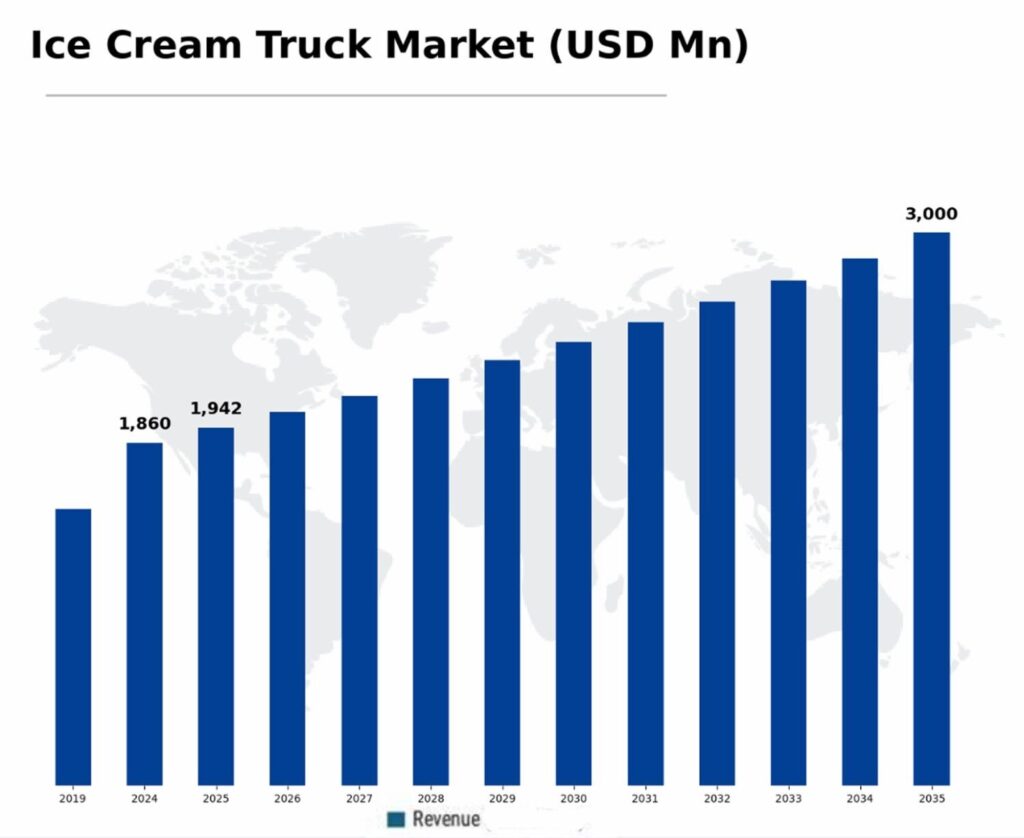
The ice cream industry is wide and always growing. People around the world spent almost $80.9 billion in 2025. And the specific ice cream truck business is also becoming more popular, with a market value of $1,860 million in 2024, and is expected to grow to $3,000 million by 2035.
Target Market
The truck does not stay in the same spot all day. Sunny Scoops brings the frozen dessert directly to where people gather in places where demand is very high.
This avoids the high cost of renting a shop, high parking fees, and lets the owner move the truck to wherever the most customers are, with proper location permission and licensing.
- Neighborhood and local parks
- Authorized schools and institutes
- Community events, funfairs, and festivals
The target customers of this business are mostly families with children, couples hanging out in gardens, school or college students, and people enjoying outdoor activities in the local area of Orlando.
Operating Structure
The owner manages all daily activities alone, which benefits the business for direct control over costs and operations.
Working days and hours vary with seasonal changes. The business runs more frequently during warmer months, basically in the time period of March to September, and reduces activity during colder periods in winter, especially from November to February. The selling schedule is also adjusted based on foot traffic and community event schedules.
Inventory is restocked weekly, four times a month, due to limited freezer space. Preventive maintenance is planned regularly to reduce the risk of breakdowns, especially given the use of a pre-owned vehicle.
Funding Request
Sunny Scoops is funded through a combination of owner cash investment and a bank term loan. The funding plan is conservative and focused on covering essential startup needs.
| Source | Amount |
|---|---|
| Bank Term Loan (Regions Bank) | $32,000 |
| Owner Cash Contribution | $7,000 |
| Total Funding | $39,000 |
The money will be used to buy and set up the truck, pay for permits, and purchase the first round of stock. Some funds will also be kept as a backup to cover bills while the business gets started.
Financials
The table below shows Sunny Scoops’ projected revenue and net income over the first three years of operation, reflecting steady growth and improving profitability under a single-truck, owner-operated model.
| Year 1 | Year 2 | Year 3 | |
|---|---|---|---|
| Revenue | $90,000 | $124,000 | $163,000 |
| Net Income (Pre-Tax) | $14,100 | $15,300 | $31,300 |
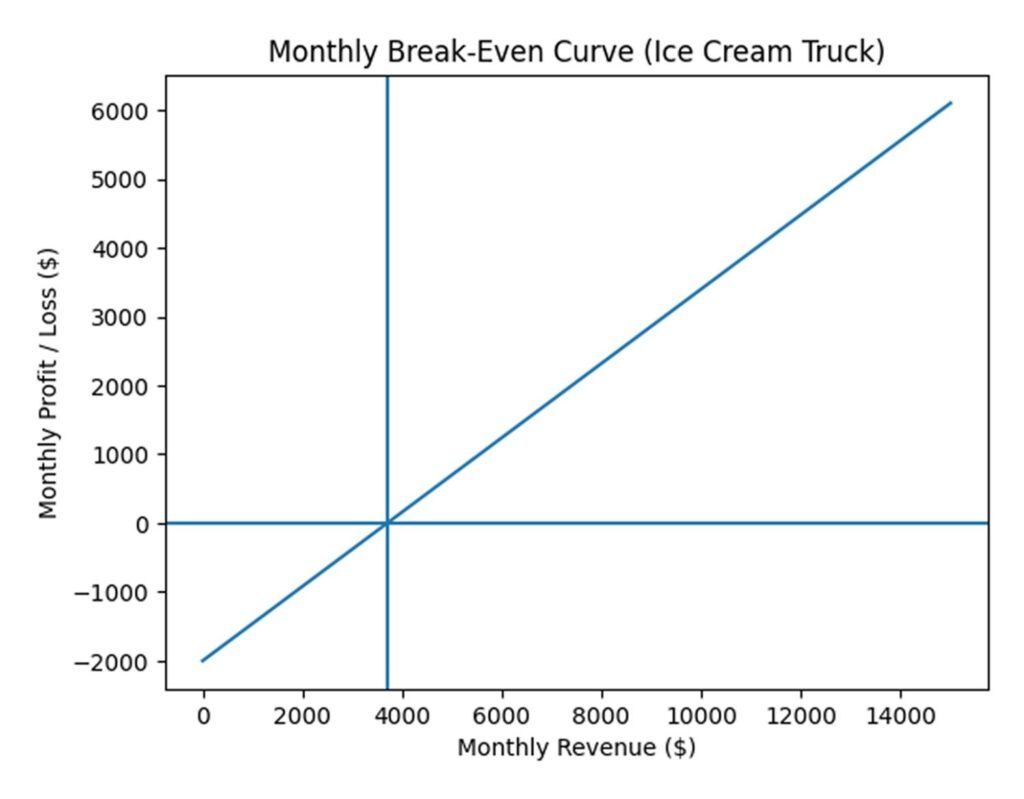
Sunny Scoops breaks even when monthly sales reach about $3,600 to $3,900. This amount covers regular monthly costs of around $2,000, including fuel, insurance, permits, freezer storage, basic truck maintenance, and phone and POS expenses. Product-related costs, such as inventory, packaging, spoilage, and card fees, make up about 45–47% of sales, leaving enough margin to cover fixed costs.
Since the business is expected to earn about $7,500 per month in Year 1, $10,300 in Year 2, and $13,600 in Year 3, it stays well above break-even in most months. This helps the business remain stable even during slower periods.

Don’t spend weeks on your first draft
Complete your business plan in less than an hour
Business Overview
Sunny Scoops Ice Cream Truck is registered as a single-member limited liability company. This structure supports personal liability protection while keeping business administration straightforward.
| Legal name | Sunny Scoops Ice Cream Truck LLC |
| Business type | Owner-operated mobile food business |
| Business Stage | Startup |
| Business address | 905 Maple Ridge Drive, Orlando, FL 32803 |
Ownership and Management
Since the owner, Aaron Feldman, is the only employee working for the business, he will handle every part to keep things operating as planned. These are the key duties:
- Driving and operating the truck daily
- Serving customers and handling payments
- Controlling inventory and restocking
- Coordinating vehicle and equipment maintenance
- Maintaining permits and compliance requirements
Handling these duties directly helps keep operating costs low, improves day-to-day efficiency, and ensures the business stays aligned with its operating plan.
Business Goals
The primary goals of Sunny Scoops are practical and stability-focused rather than instant or aggressive growth-driven by unplanned investment.
- Operate a profitable single-truck business with consistent cash flow
- Maintain low operating expenses and manageable daily operations
- Serve local neighborhoods and community areas reliably
- Achieve stable performance without adding staff or additional vehicles during the first 3 years
Business Model
Sunny Scoops follows a focused business model built around a single vehicle and generates revenue through direct customer sales.
| Area | Description |
|---|---|
| Operating setup | 1 ice cream truck |
| Sales method | In-person sales only |
| Products sold | Pre-packaged frozen treats |
| Online or delivery sales | Not offered |
| Catering services | Not offered |
| Employees | None for at least 3 years of the business |
| Expansion plans | No additional trucks planned |
This defined scope keeps operations manageable and aligned with the owner-operated nature of the business.
Market Research
On a national level in the USA, the street food market, which includes food trucks, carts, and other mobile food sellers, is a massive industry worth approximately $4 billion. Within that space, food trucks specifically account for $2.8 billion in total sales. These show that modern customers, such as Gen Z and Millennials, are very comfortable purchasing snacks and desserts from mobile vendors rather than at an expensive restaurant or cafe.
They appreciate the fair pricing and the convenience of being able to grab the high-quality snack while they are performing any outdoor activities or just hanging out with loved ones.
Florida visitor data of 2025 reported 33.1 million visitors in Q4 2024, supporting year-round visitor volume even outside peak summer months. This is a major demand driver for impulse food purchases in parks, public spaces, and event corridors. This city ranked high as a top staycation and tourism destination, with large numbers of parks, attractions, family events, and entertainment options.
Local Demand Characteristics
Orlando remains the most visited destination in the U.S., reporting 75.3 million visitors in 2024. It is quite smart to operate a mobile frozen dessert business in an environment like Orlando. People regularly congregate outside due to the region’s year-round milder weather, which generates a steady and dependable demand for ice cream and other icy treats. This setting offers a solid basis for the success of a new ice cream truck venture.
The City of Orlando reports 148+ parks, gardens, recreation areas, neighborhood centers, and playgrounds, which support recurring routes and park-based selling where people especially come for ice creams and treats.
Other than tourist places like parks and playgrounds, Orange County Public Schools reports show Orlando serves 214 schools in the 2025–26 school year, which supports permitted school-zone selling where allowed.
Seasonal Sales Patterns
Orlando’s climate and tourism patterns influence when people buy frozen treats:
- Peak Season (March through September): Warm weather encourages outdoor activity and higher impulse purchases.
- Shoulder Season (October and November): Reduces slightly but remains active due to mild weather.
- Lower Season (Between December and February): During the peak winter temperatures, though it is rare and usually short-lived in Orlando, the sales numbers are reduced slightly because there are fewer outdoor activities during this time of year.
These patterns are also affected by local tourism cycles and school breaks, meaning higher sales on weekends, holidays, and community festival dates.
Customer Profile and Buying Behavior
Orlando’s estimated population is 334,854 in 2024, with steady growth from prior years. According to the U.S. Census Bureau, about 21.4% of Orlando’s population is under 18 years, and 11.1% is 65 and over.
Age Distribution on the city level:
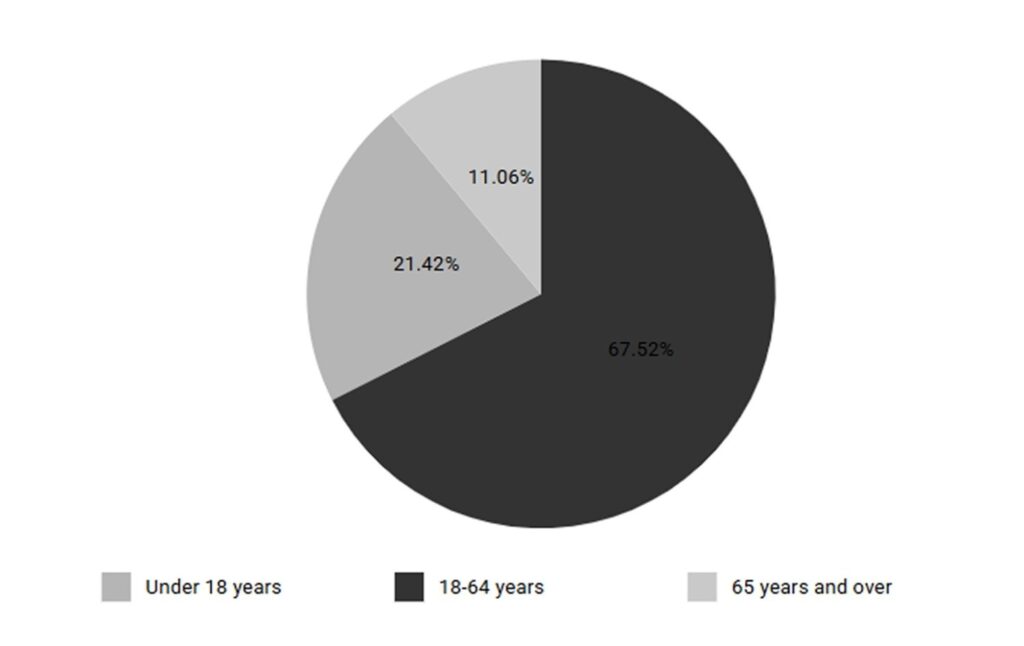
This age spread reflects a large working-age and family population with a meaningful share of children and teens, which is the core group for frequent ice cream purchases.
Children (5–12 years)
Common decision influencers when present with family, purchase intent strengthens on warm afternoons and weekends.
Teens (13–18 years)
Likely to make group purchases at events, parks, and busy routes.
Young Adults (25–34 years)
A significant share of Orlando’s adult population and key purchasers for family units.
Adults (35–64 years)
A large cohort within the working-age population with disposable income for discretionary purchases.
Older Adults (65+ years)
A smaller portion of the population may purchase occasionally during leisure outings.
The table below will show our business’s primary target customer groups:
| Target Customer | Typical Behavior | Why It Matters |
|---|---|---|
| Families with children | Visit parks, schools, and community events | Frequent impulse purchases of frozen treats |
| Park visitors | Stay several hours, especially on weekends | High foot traffic near shaded seating or playground areas |
| Event attendees | Attend festivals, markets, and food truck parks | Bulk or repeat purchases during peak hours |
| Tourists/visitors | Explore attractions, theme parks, and public spaces | Additional transient demand throughout the year |
These groups form the backbone of demand for mobile ice cream vending. Families and park visitors make up a large share of impulse purchases, especially when combined with outdoor time. Event days tend to boost group purchases and overall daily sales volume.
Competitive Analysis
Orlando’s mobile dessert market has several established ice-cream truck vendors that regularly serve neighborhoods, parks, and community events across the city, creating a competitive but active local market.
- Mr. Freeze Ice Cream Trucks: Offers soft serve, Italian ice, sundaes, and other frozen treats across Orlando and nearby areas.
- J’s Cone Zone: An Ice cream truck provides classic soft-serve flavors with paid event service options.
- Ice Cream on Wheels: Mobile ice cream and cart vendor active at events and public spaces.
- Other Local Trucks: Listings include various trucks and carts serving ice cream and desserts at community events (at least 20+ vehicles).
Here is the competitor positioning comparison about their strengths and what type of service they are offering:
| Competitor | Service Type | Strengths |
|---|---|---|
| Mr. Freeze Ice Cream Trucks | Mobile truck | Known brand, varied menu |
| J’s Cone Zone | Mobile truck | Soft serve specialty |
| Ice Cream on Wheels | Mobile truck/cart | Event and walk-up focus |
| Local food trucks (others) | Mixed mobile food + ice cream | Network effect at food truck parks |
Positioning of Sunny Scoops
Sunny Scoops is positioned as a neighborhood-focused ice cream truck that puts more focus on consistency, familiarity, and everyday access rather than premium or event-only offerings.
- Focuses on consistent neighborhood routes, parks, and selected community events rather than primarily event or catering-first models.
- Emphasizes a simple, easy-to-access product range of pre-packaged frozen items, which supports higher turnover in everyday locations.
- Competes by offering a predictable presence and local familiarity rather than rare or premium custom treats.
Products & Pricing Model
Sunny Scoops offers a controlled selection of pre-packaged frozen treats that are easy to serve and familiar to customers. Our menu is designed to appeal to children, families, and casual park or event visitors who prefer recognizable products and quick service.
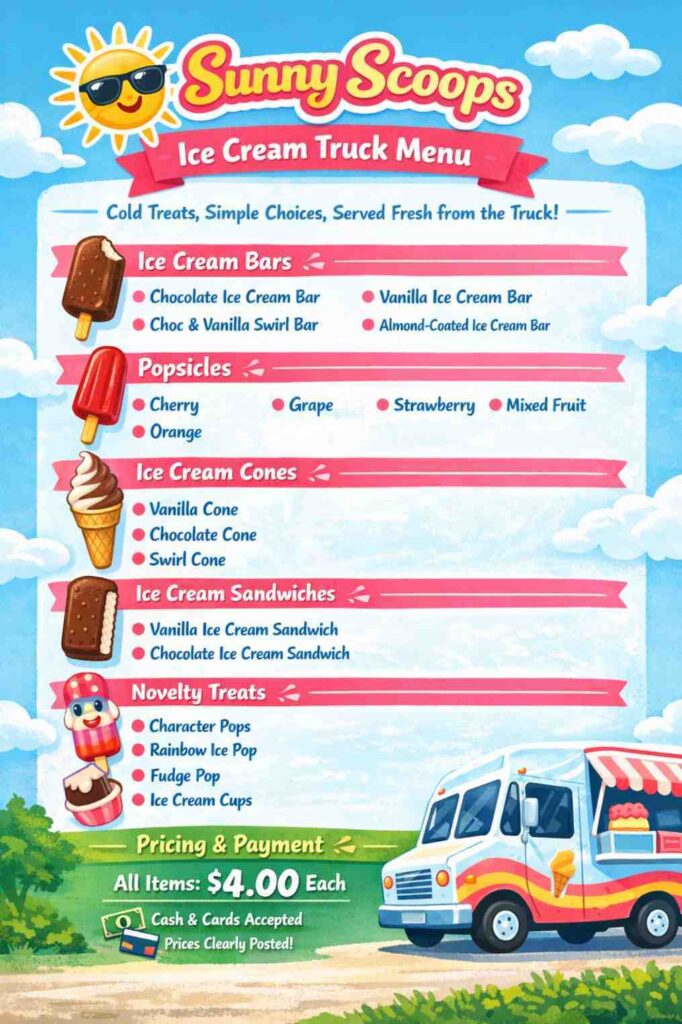
The main product lineup includes:
- Ice cream bars
- Ice cream cones
- Popsicles
- Ice cream sandwiches
- Novelty frozen treats
All products are sourced from national and regional frozen treats suppliers and wholesalers, which helps ensure consistent quality, dependable availability, and customer trust in well-known brands. At any given time, the truck carries approximately 25 to 30 SKUs, a range that provides variety without overloading freezer capability.
The most beneficial thing about this menu is that all the product offerings are pre-packaged, so there will be no food preparation required. This keeps service fast, reduces handling risks, and supports clean and compliant operations.
Pricing Strategy
Pricing is set to remain in line with local ice cream truck pricing rather than positioning the business as a premium or specialty brand with a higher price tag. Because the buying audience is mostly teens or school kids, the pricing is decided accordingly. The goal is to encourage frequent, impulse purchases while covering all variable and operating costs.
Average pricing is structured over 3 years as follows:
- Year 1: Every item in the menu is priced at approximately $4.00 each
- Year 2: When businesses secure a more regular audience, prices increase slightly to about $4.25 per item
- Year 3: At the peak stage of business, prices rise modestly to around $4.50 per item
These small price increases do not change the business’s market position. Even as prices rise gradually due to inflation and supplier costs, they remain simple and easy to understand, with most items staying within a clear, narrow price range. This helps customers make quick decisions, especially when buying multiple items for families, friends, or group outings.
Operating Model
Sunny Scoops has a flexible business approach that allows us to sell products according to local demand and the weather. We maintain flexibility and minimal expense by avoiding set schedules and a huge staff. This setup allows the owner to control costs closely and make quick changes when needed.
All day-to-day activities, including transportation, customer service, inventory management, permit and licensing, are individually managed by Aaron. This hands-on approach guarantees that every aspect of the organization meets high standards and eliminates the need for workers. This business prioritizes long-term dependability and financial stability by keeping operations straightforward and concentrated.
This structure is a deliberate part of a conservative financial plan for the business. The primary goal is to maintain a stable and profitable business rather than pursue rapid growth. By keeping overhead low and operations simple, Sunny Scoops is positioned for long-term reliability and stability, with good financial health.
Route Strategy and Daily Operations
Sunny Scoops follows a route-based selling model, operating in residential neighborhoods, public parks, permitted school zones, and a limited number of local events.
Operating schedules are adjusted based on:
- Weather conditions
- Seasonal demand
- Local activity levels
- Event availability
The business does not operate on a fixed daily route year-round. Instead, routes are adjusted regularly to match demand patterns and reduce unproductive operating hours.
The operating schedule of Sunny Scoops for the 3 years is as follows:
| Metric | Year 1 | Year 2 | Year 3 |
|---|---|---|---|
| Average operating days per month | ~20 days | ~22 days | ~23 days |
| Daily route hours | ~4–6 hours | ~4–6 hours | ~4–6 hours |
Sales activity is mainly focused on afternoons and early evenings, and sometimes even on nights when demand gets higher. The truck makes stops in areas with visible foot traffic, typically staying for 10 to 30 minutes, depending on customer activity. Stops are adjusted throughout the day to avoid low-demand areas and reduce idle time.
At the end of each day, Aaron closes out sales by reconciling cash and card payments, reviewing inventory levels, cleaning the service area, and securing the truck in an appropriate parking location for the next operating day.
Equipment and Layout
The business is operating a used ice cream truck equipped for mobile frozen dessert sales. This choice balances upfront cost with operational capability.
Core equipment of Sunny Scoops:
| Equipment | Purpose |
|---|---|
| Used ice cream truck (with freezer) | Primary sales and storage unit |
| Freezer servicing and upgrades | Maintain consistent freezing temperatures |
| Generator and electrical servicing | Power freezers and POS equipment |
| POS system and card reader | Process cashless payments |
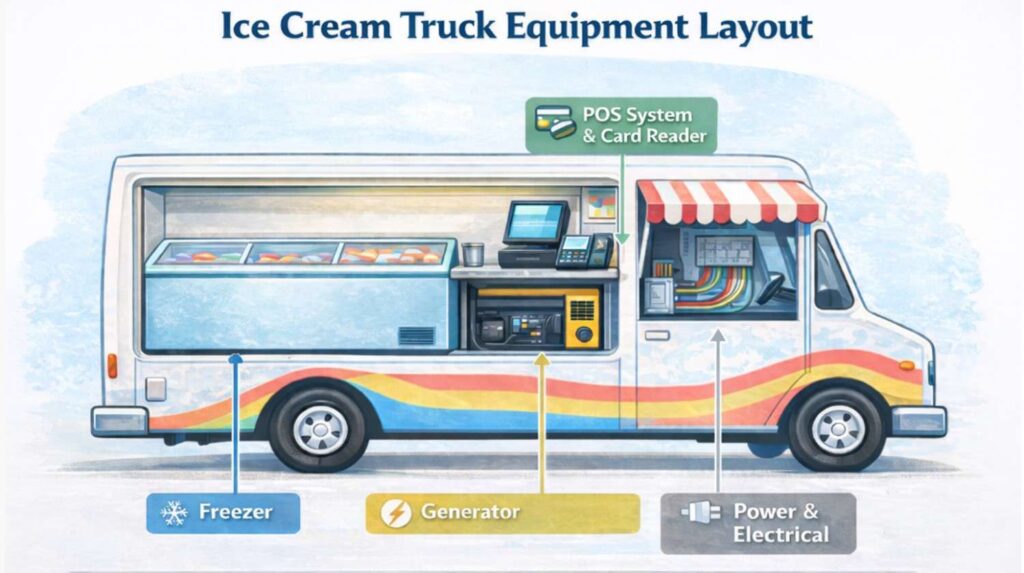
The ice cream truck is the main operating asset, and its condition directly affects daily operations. Because the truck is used, higher maintenance and repair costs are expected in Year 1, so a regular maintenance plan is followed, with routine inspections and timely repairs to reduce breakdown risk.
And the fuel is treated as an operating expense, which will depend on how much the truck is moving from location to location, not the cost of goods sold, since it supports route activity rather than individual item sales.
Inventory Storage and Restocking
This business only provides pre-packaged frozen products, which allows inventory to be handled safely, quickly, and with minimal complexity and risks. All products are stored inside the truck’s onboard freezers, which serve as the primary storage location during daily operations.
When needed, limited off-truck freezer or commissary storage is used to support short-term inventory holding, but the business does not rely on large external storage facilities.
Inventory planning is closely linked to real sales activity due to the truck’s limited freezer space. Weekly product purchases allow the owner to modify orders depending on current demand instead of long-term projections. This strategy lowers the possibility of spoiling, prevents overstocking, and minimizes the amount of money invested in unsold goods.
Stock levels are intentionally kept low. Rather than carrying excess stock, Sunny Scoops focuses on high-turnover items that sell consistently across routes, parks, and events. Normal levels of spoilage and shrinkage are expected in frozen food operations and are already accounted for in the cost structure, allowing the business to plan realistically rather than assume zero waste.
Inventory Cost Components
Inventory-related costs are treated as part of the cost of goods sold and increase directly with sales volume. These include:
- Ice cream and frozen product purchases
- Spoilage and shrinkage, estimated at 2–3% of sales equivalent
- Packaging and consumable supplies
Together, these costs represent approximately 45–47% of total sales, reflecting a balanced cost structure that accounts for product cost, handling losses, and transaction fees.
Inventory Management Priorities
Inventory management follows a low-risk, cash-conscious model. All frozen products are purchased on a weekly basis, which matches freezer capacity and helps limit spoilage.
Key inventory practices include:
- Maintaining intentionally low inventory levels
- Expecting and accounting for normal spoilage and shrinkage
- Rotating products based on sales performance
- Removing slow-moving items to protect cash flow
Sunny Scoops maintains inventory control by monitoring which ice creams sell consistently and restocking them in small, frequent quantities. This keeps the business adaptable and secures money from being misused on unsold goods. The business can better control expenses and maximize the use of the truck’s limited freezer space by making small and smart purchases of goods.
Regulatory Compliance
There are certain regulations for the comfort and safety of the general population. Sunny Scoops operates in full compliance with Florida state, Orange County, and the City of Orlando regulations for running a mobile food truck.
Mobile vending in Florida is regulated by state agencies such as the DBPR, and sometimes FDACS or the Department of Health, depending on the type of food being sold. Sunny Scoops follows the rules that apply to its business model and maintains access to approved commissary or freezer facilities for proper storage and cleanliness.
At the local level, city and county rules control where food trucks can operate. These rules limit vending in areas such as parks, school zones, and event locations, and also set how long a truck can stop in one place. Sunny Scoops is registered to collect and pay sales tax and follows these local rules so daily routes run smoothly and the business avoids fines or shutdowns.
From a cost standpoint, these requirements are planned and built into our operating expenses. Permits and licenses are treated as annual operating costs and allocated monthly to avoid large one-time expenses.
Insurance coverage, including commercial auto and general liability, is also included in monthly operating expenses to protect the business, customers, and the public. The business avoids surprises, maintains complete compliance, and can confidently concentrate on day-to-day operations by budgeting these compliance expenditures as part of regular operating expenses.
Seasonality & Revenue
Every year, Orlando’s environment allows for vast periods of mild weather and outdoor recreation rather than cold or cozy weather. For the majority of the spring, summer, and fall seasons, average monthly temperatures are high, resulting in long periods of increased demand for cold foods and snacks.
| Month | Avg High (°F) | Avg Low (°F) |
|---|---|---|
| Jan | 71 | 52 |
| Feb | 74 | 54 |
| Mar | 78 | 58 |
| Apr | 83 | 63 |
| May | 88 | 69 |
| Jun | 91 | 74 |
| Jul | 92 | 75 |
| Aug | 92 | 75 |
| Sep | 90 | 73 |
| Oct | 85 | 68 |
| Nov | 78 | 60 |
| Dec | 73 | 55 |
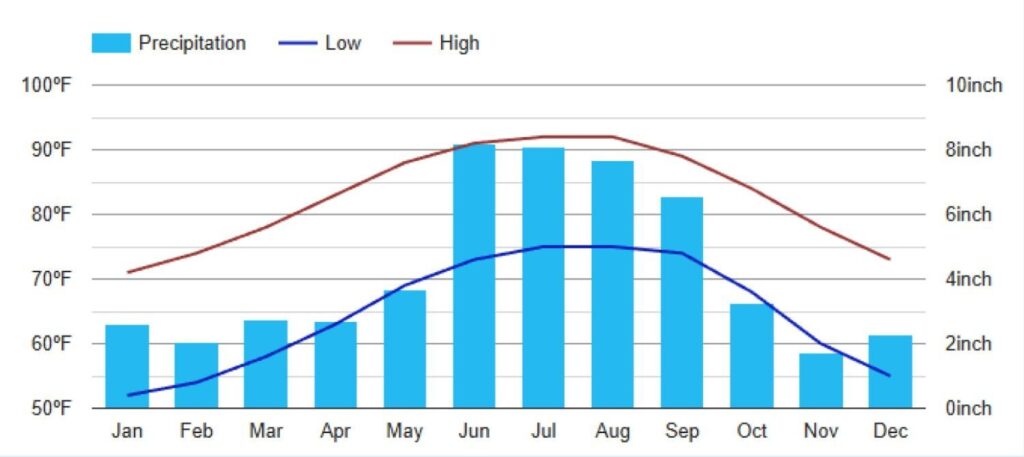
Seasonal Planning
Sunny Scoops plans operating days and route intensity around these patterns.
| Climate | Months | Temperature | Expected Demand |
|---|---|---|---|
| Warm Season |
April – October | 83°F to 92°F | Strong, steady demand for frozen treats. |
| Peak Summer |
May – August | Over 88°F | Highest sales volume of the year. |
| Shoulder Months |
March – November | Mild | Steady sales from outdoor foot traffic. |
| Cooler Months |
December – February | Milder | Slower sales; mostly occasional purchases. |
During warmer months, the truck plans to be on the road more frequently and for longer hours. In cooler months, the focus shifts to targeted high-traffic areas and events rather than full seasonal routes.
Event-Based Sales
Special events boost revenue beyond typical route sales. Access to events is gained by applying directly to event organizers or local authorities in advance. Most events require proof of permits and insurance, and some charge a small participation fee, depending on the size and type of the event. Event sales help balance slower months by adding short periods of higher demand.
These events can include:
| Event Category | Event Type | Description | Why It Works for an Ice Cream Truck |
|---|---|---|---|
| Community Festivals |
City festivals | Annual or seasonal events organized by the city or local groups | High foot traffic, family attendance, and long event hours |
| Cultural festivals | Events celebrating local or cultural communities | Diverse crowds, repeat purchases, daytime activity | |
| Food and craft festivals | Markets featuring food trucks and vendors | Customers expect mobile food options | |
| Park Concerts | Free outdoor concerts | Evening concerts held in public parks | Strong demand during warm evenings |
| Summer music series | Weekly or monthly park concert programs | Predictable scheduling and repeat attendance | |
| Couples movie nights | Outdoor movie screenings in parks | High young public turnout and snack purchases | |
| Holiday Parades |
Independence Day (July 4) parades | Large public celebrations with daytime crowds | Peak summer temperatures increase cold-treat demand |
| Holiday light parades | Seasonal parades during the winter months | Shorter selling windows, but high crowd density | |
| Local Fairs | County or neighborhood fairs | Multi-day events with rides and vendors | High volume sales over several days |
| School fairs | Fundraisers and seasonal school events | Strong family presence | |
| Community markets | Weekend fairs or pop-up markets | Consistent local attendance | |
| School & Neighborhood Events |
School open houses | Parent and student gatherings | Afternoon and early evening demand |
| Sports days and tournaments | Youth and school sports events | Group purchases after games | |
| HOA or block events | Neighborhood gatherings | Local repeat customers and route visibility |
Event days usually generate higher sales volumes than regular route days because crowds gather in concentrated areas.
- Event days can deliver 1.3× to 1.7× typical daily sales volume
- Events are treated as supplemental revenue, not base volume
- Participation requires permitted setups and pre-planning
Event sales also help smooth out slower seasonal months by adding concentrated spikes in demand.
Marketing & Visibility Strategy
Sunny Scoops prioritizes a visibility-based marketing strategy that focuses on local presence rather than on paid advertising. The business raises awareness by regularly operating in busy locations where people gather, like public parks and residential neighborhoods. By direct interaction and regular community exposure, this strategy enables the business to grow its reputation.
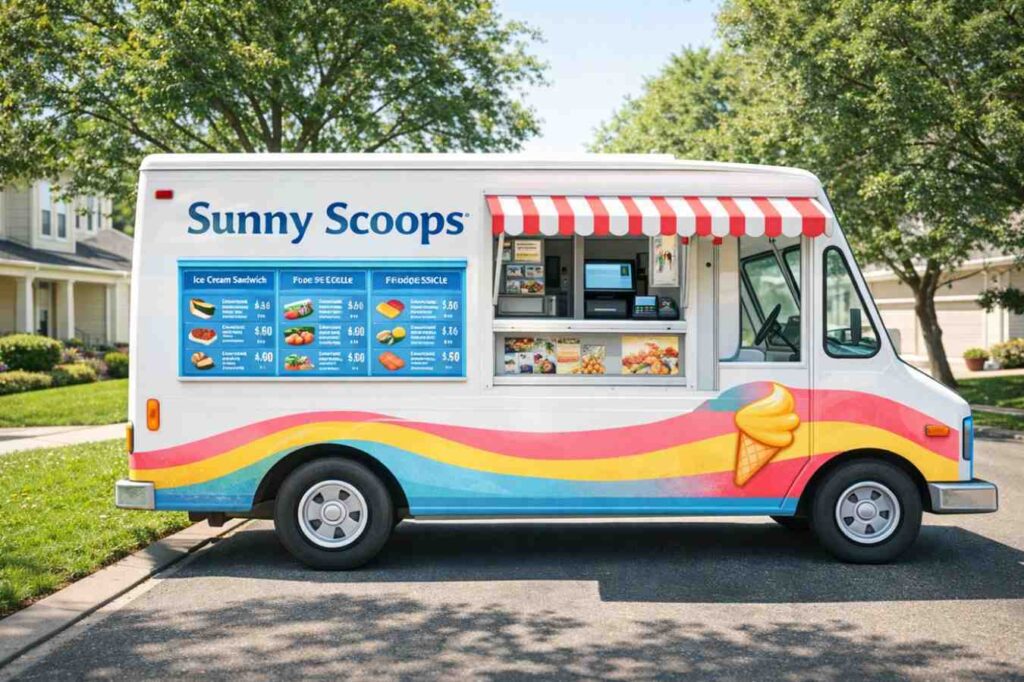
The ice cream truck itself is the main marketing tool. Its design, sound, and consistency help customers recognize the brand and know when and where it is operating.
Visibility-First Approach
The Sunny Scoops ice cream truck is branded to be bright, clean, and easy to identify. The business name is displayed clearly on the exterior, supported by simple and colorful graphics that appeal to families and children.
The menu boards are placed on the service side of the truck with large text and clear pricing, so the customer will make a quick decision. This strategy generates sales quickly and will open more opportunities to handle large numbers of customers.
A traditional ice cream truck bell or chime is used during routes. This sound alerts nearby residents before the truck is visible and helps draw customers outside. Over time, this becomes a familiar signal associated with Sunny Scoops.
Key visibility elements:
- The vehicle is clearly marked with the brand name “Sunny Scoops”
- Big, readable menu boards
- Easy, colorful, kid-friendly visuals
- During routes, the ice cream truck bell or chime is utilized
Local Engagement Tactics
Instead of using expensive one-time advertisements or branding, Sunny Scoops builds recognition by showing up consistently and becoming a well-known ice cream truck in the area. The truck makes frequent trips back to the same parks and communities to increase local involvement and familiarize families with the brand presence and awareness.
Other than the daily routes, when operating in parks or at neighborhood events, the truck is positioned near areas with natural foot traffic, such as playgrounds, walking paths, and seating areas of the location.
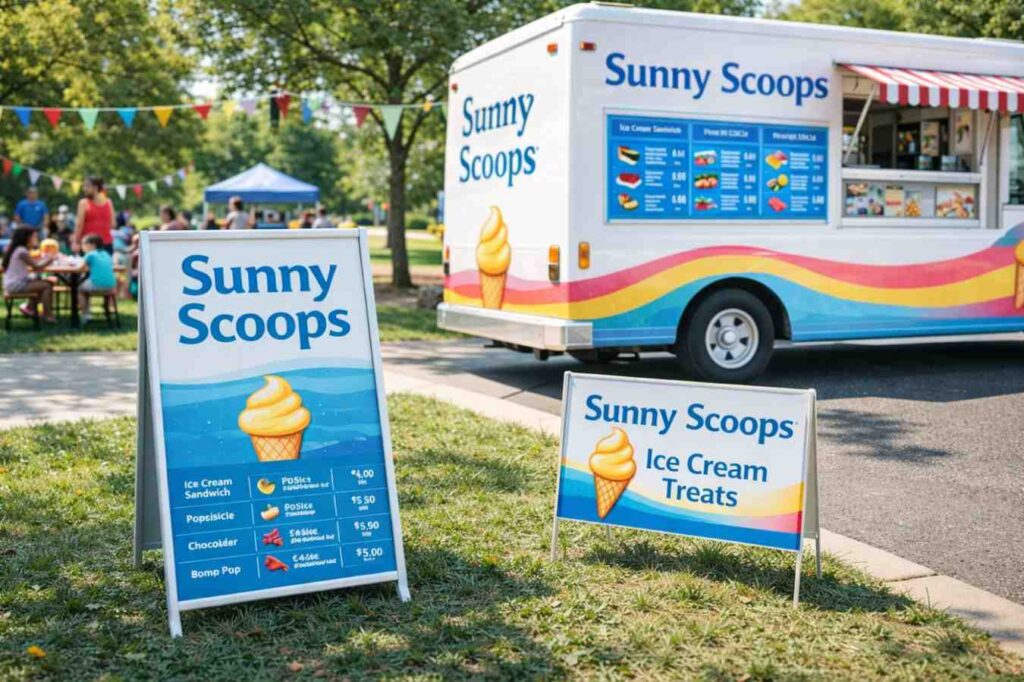
During community events, Sunny Scoops uses simple participation setups to introduce the brand to larger groups at once. Small banners or posters with the business name and menu are displayed near the truck so customers can easily identify the product without creating visual clutter.
Word-of-Mouth and Repeat Sales
Ice cream trucks rely heavily on informal word-of-mouth, especially among families and children. When the truck appears regularly in the same areas, customers often share its schedule with neighbors or bring friends when they hear the bell.
Repeat sales are encouraged through:
- Familiar menu items that customers already know
- Predictable pricing that avoids surprises
- Friendly, consistent service
No formal loyalty programs are used, as repeat business is driven by convenience and routine rather than discounts.
Marketing Spend Controls
Marketing expenses are intentionally low and are focused only on tools that directly support visibility and sales. There is no ongoing spend on digital ads, print advertising, or promotional campaigns.
| Marketing Element | Purpose | Cost Control |
|---|---|---|
| Truck branding and decals | Brand recognition | One-time setup |
| Menu boards | Product and price clarity | Reusable |
| Bell or chime | Daily route awareness | Built into operations |
| Event signage | Visibility at gatherings | Low cost, reusable |
| Paid advertising | Not used | No recurring cost |
Financial Plan
The financial plan for Sunny Scoops is built on a practical and cautious approach. Instead of chasing fast growth, the focus is on maintaining steady cash flow and keeping costs under tight control. All projections are based on a simple model: one truck, no employees, and a straightforward product list.
This plan uses realistic sales goals that change with the weather and local demand. Startup costs and monthly bills are spread out whenever possible to avoid financial stress. By keeping expenses predictable, the business stays stable and profitable throughout both the busy summer months and the slower winter season.
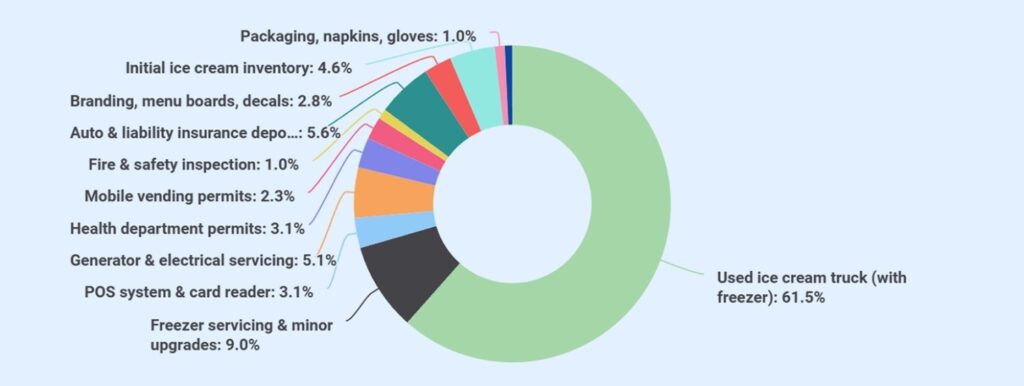
Startup Costs & Use of Funds
| Category | Cost |
|---|---|
| Vehicle & Core Equipment (Capitalized) | |
| Used ice cream truck (with freezer) | $24,000 |
| Freezer servicing & minor upgrades | $3,500 |
| POS system & card reader | $1,200 |
| Generator & electrical servicing | $2,000 |
| Subtotal — Vehicle & Equipment | $30,700 |
| Licensing, Permits & Compliance | |
| Health department permits | $1,200 |
| Mobile vending permits | $900 |
| Fire & safety inspection | $400 |
| Subtotal — Permits & Compliance | $2,500 |
| Insurance & Pre-Launch Setup | |
| Auto & liability insurance deposits | $2,200 |
| Branding, menu boards, decals | $1,100 |
| Subtotal — Insurance & Setup | $3,300 |
| Opening Inventory & Supplies | |
| Initial ice cream inventory | $1,800 |
| Packaging, napkins, gloves | $400 |
| Subtotal — Inventory & Supplies | $2,200 |
| Working Capital (Opening Cash) | $300 |
| Total Startup Costs | $39,000 |
| Source | Amount |
|---|---|
| Bank Term Loan (Regions Bank) | $32,000 |
| Owner Cash Contribution | $7,000 |
| Total Funding | $39,000 |
Income Statement
| Year 1 | Year 2 | Year 3 | Total | |
|---|---|---|---|---|
| Revenue | ||||
| Route Sales (Street & Parks) | $82,000 | $112,000 | $145,000 | $339,000 |
| Event Sales | $8,000 | $12,000 | $18,000 | $38,000 |
| Total Revenue | $90,000 | $124,000 | $163,000 | $377,000 |
| Cost of Goods Sold (COGS) (ice cream inventory, spoilage/shrinkage, packaging, card processing fees) |
||||
| Ice Cream Inventory (incl. spoilage) | $38,500 | $50,800 | $65,200 | $154,500 |
| Packaging & Consumables | $1,600 | $2,000 | $2,600 | $6,200 |
| Card Processing Fees | $2,400 | $3,200 | $4,300 | $9,900 |
| Total COGS | $42,500 | $56,000 | $72,100 | $170,600 |
| Gross Profit | $47,500 | $68,000 | $90,900 | $206,400 |
| Gross Margin | 52.8% | 54.8% | 55.8% | 54.7% |
| Operating Expenses (OPEX) | ||||
| Fuel (route driving) | $8,500 | $10,000 | $10,500 | $28,500 |
| Truck Maintenance & Repairs | $6,000 | $5,500 | $5,500 | $16,500 |
| Insurance (auto + liability) | $3,600 | $3,800 | $4,000 | $11,400 |
| Permits & Licenses | $2,000 | $2,100 | $2,200 | $6,300 |
| Commissary / Freezer Storage | $1,800 | $1,900 | $2,000 | $5,700 |
| Marketing & Promotions | $1,500 | $1,800 | $2,200 | $5,500 |
| Phone, Software & POS Fees | $1,200 | $1,300 | $1,400 | $3,900 |
| Owner Compensation | 0 | $18,000 | $24,000 | $42,000 |
| Total Operating Expenses | $24,600 | $44,400 | $51,800 | $120,800 |
| EBITDA | $22,900 | $23,600 | $39,100 | $85,600 |
| EBITDA Margin | 25.4% | 19.0% | 24.0% | 22.7% |
| Depreciation | $6,100 | $6,100 | $6,100 | $18,300 |
| EBIT | $16,800 | $17,500 | $33,000 | $67,300 |
| Interest Expense | $2,700 | $2,200 | $1,700 | $6,600 |
| Net Income (Pre-Tax) | $14,100 | $15,300 | $31,300 | $60,700 |
Don’t waste time using spreadsheets
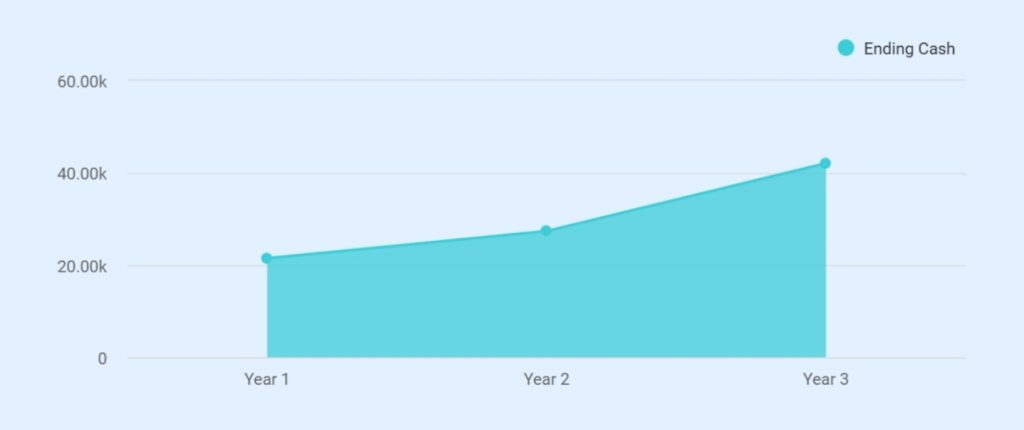
Cash Flow Statement
| Year 1 | Year 2 | Year 3 | |
|---|---|---|---|
| Operating Activities | |||
| Net Income (Pre-Tax) | $14,100 | $15,300 | $31,300 |
| Add: Depreciation (non-cash) | $6,100 | $6,100 | $6,100 |
| Change in Inventory & Consumables | ($1,200) | ($1,500) | ($1,800) |
| Change in Accrued Expenses | $300 | $400 | $500 |
| Net Cash from Operations | $19,300 | $20,300 | $36,100 |
| Investing Activities | |||
| Initial Truck & Equipment Purchase | ($30,700) | 0 | 0 |
| Net Cash from Investing | ($30,700) | 0 | 0 |
| Financing Activities | |||
| Bank Loan Proceeds | $32,000 | 0 | 0 |
| Owner Cash Contribution | $7,000 | 0 | 0 |
| Loan Principal Repayment | ($6,400) | ($6,400) | ($6,400) |
| Owner Distributions | 0 | ($8,000) | ($15,000) |
| Net Cash from Financing | $32,600 | ($14,400) | ($21,400) |
| Net Change in Cash | $21,200 | $5,900 | $14,700 |
| Beginning Cash | $300 | $21,500 | $27,400 |
| Ending Cash | $21,500 | $27,400 | $42,100 |
Balance Sheet
| Year 1 | Year 2 | Year 3 | |
|---|---|---|---|
| ASSETS | |||
| Cash | $21,500 | $27,400 | $42,100 |
| Inventory & Consumables | $1,600 | $3,100 | $4,900 |
| Prepaid Permits & Insurance | $900 | $1,000 | $1,100 |
| Total Current Assets | $24,000 | $31,500 | $48,100 |
| Truck & Equipment (Gross) | $30,700 | $30,700 | $30,700 |
| Accumulated Depreciation | ($6,100) | ($12,200) | ($18,300) |
| Net Fixed Assets | $24,600 | $18,500 | $12,400 |
| TOTAL ASSETS | $48,600 | $50,000 | $60,500 |
| LIABILITIES | |||
| Accounts Payable & Accruals | $700 | $1,100 | $1,600 |
| Current Portion of Term Loan | $6,400 | $6,400 | $6,400 |
| Long-Term Term Loan | $19,200 | $12,800 | $6,400 |
| Total Liabilities | $26,300 | $20,300 | $14,400 |
| EQUITY | |||
| Owner Capital Contribution (Initial + Adjustments) | $8,200 | $8,300 | $8,400 |
| Retained Earnings | $14,100 | $21,400 | $37,700 |
| Total Equity | $22,300 | $29,700 | $46,100 |
| LIABILITIES + EQUITY | $48,600 | $50,000 | $60,500 |
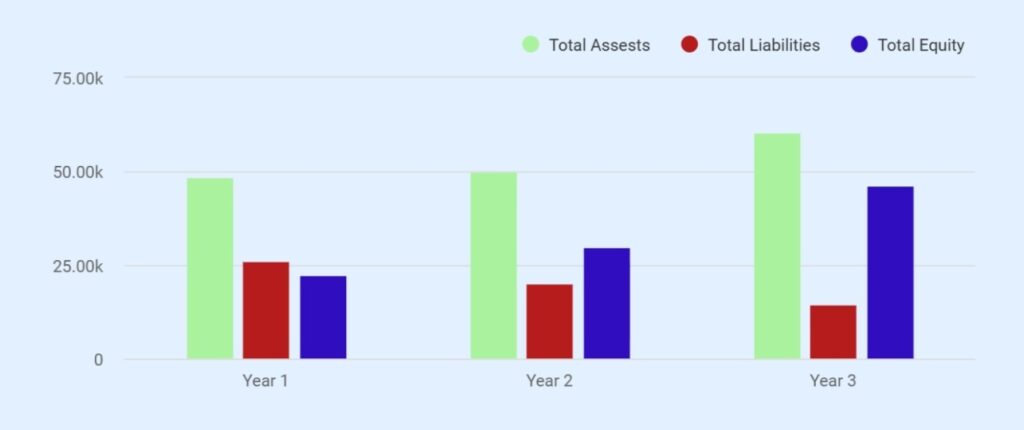
Note: Owner Capital Contribution reflects the initial $7,000 startup investment. The small year-to-year increases are not additional cash contributions, but accounting adjustments made to reconcile retained earnings with total equity and keep the balance sheet consistent, without affecting overall financial projections.
Break-Even Analysis
| Metric | Value / Range |
|---|---|
| Monthly Fixed Operating Costs (OPEX) | $1,900 – $2,100 |
| Fuel (baseline, non-event) | ~$700 |
| Insurance (auto + liability) | ~$300 |
| Permits & licenses (monthly equivalent) | ~$170 |
| Commissary/freezer storage | ~$150 |
| Marketing & promotions | ~$125 |
| Phone, software, POS | ~$100 |
| Truck maintenance (baseline) | ~$250 |
| Fixed Cost Base Used | ~$2,000 / month |
| Variable Cost Ratio (COGS % of Revenue) | ~45–47% |
| Ice cream inventory (incl. spoilage) | ~42–44% |
| Packaging & consumables | ~2–3% |
| Card processing fees | ~2.5–3.0% |
| Contribution Margin | ~53–55% |
| Base Monthly Break-Even Revenue | ~$3,600 – $3,900 |
| Conservative break-even point | ~$3,900 |
| Lower-bound (good weather month) | ~$3,600 |
| Annualized break-even revenue | $43,200 – $46,800 |
| Avg. Monthly Revenue – Year 1 | ~$7,500 |
| Avg. Monthly Revenue – Year 2 | ~$10,300 |
| Avg. Monthly Revenue – Year 3 | ~$13,600 |
The Quickest Way to turn a Business Idea into a Business Plan
Fill-in-the-blanks and automatic financials make it easy.

Upmetrics
Upmetrics is the #1 business planning software that helps entrepreneurs and business owners create investment-ready business plans using AI. We regularly share business planning insights on our blog. Check out the Upmetrics blog for such interesting reads. Read more