Executive Summary
LoneStar Heritage Cattle Farm, LLC is a newly established, family-operated ranch at 12874 Ranch Road 317 in Gatesville, Texas. It will adopt proven rotational grazing and sustainable land practices learned through Texas A&M AgriLife and local ranching mentors.
The business is a small-scale cow-calf and beef startup aiming to expand gradually over three years. This plan is to help us with the request to the USDA Farm Ownership Loan to purchase land, increase the herd, and improve equipment and fencing.
The mission is to create a financially secure, sustainable ranch, which provides Central Texas with beef of high quality that was raised by grazing in the pasture. We adopt a strategy of animal care, land restoration, and direct connection with local restaurants, butcheries, and families that can appreciate traceable meat without any hormones.
Market Opportunity
Texas boasts of more than 4.08 million beef cows, which is the highest cattle-producing state in the country. Nevertheless, the majority of beef available locally is produced in large commercial feedlots, which leaves opportunities to smaller farms that sell natural and grass-fed meat. The Coryell County and surrounding areas are demanding an increasing number of locally grown beef that has no hormones.
LoneStar Heritage Cattle Farm will target restaurants, butcher shops, and a family in central Texas that appreciates traceable beef, which is pasture-raised. The location of the farm is convenient for delivering the farm and accessing local markets along the Waco-Austin route. The increasing interest of consumers in sustainable and regenerative farms is an advantage to the consistent growth of this kind of business.
Target Market
The main customers of LoneStar Heritage Cattle Farm will include:
- Local butcheries and restaurants in Central Texas that purchase premium, grass-fed beef.
- Direct consumers via the monthly beef boxes from the farm.
- Austin and Waco have regional farmers’ markets, as well as small groceries specializing in sustainable food.
This combination will guarantee consistency in sales, both wholesale and retail, as well as the development of a local brand that is recognizable, with a quality reputation, transparency, and responsible ranching operations.
Ownership
LoneStar Heritage Cattle Farm, LLC, is owned and operated by the husband-wife team of Robert and Emily Hayes, with years of practical experience in ranching along with financial and operational expertise.
They jointly operate the ranch not only with priorities on animal health, but also on long-term financial sustainability and sustainable land use.
Financial Outlook
The LoneStar Heritage Cattle Farm will begin with a herd of 70 cattle, where their main business operations will be the cow-calf production and direct-sell beef boxes. As a new operation, LoneStar expects modest early revenue as herd and brand awareness build during the startup phase.
The ranch will be operating with a small set-up phase loss of approximately 40,000 during the first year, where some infrastructure and expansion of the herd are to be done, with an overall projected revenue of around 285,000.
By this time, the herd has grown to approximately 95 head, and monthly beef box sales have increased to 100; the revenue should be about 475,000, resulting in a positive EBITDA of approximately 12%. The Year 3, when the number of head of cattle and full market reach 125, the total revenue is expected to increase to a range of about 710,00,0, and the EBITDA is expected to increase to about 22 per cent.
The startup investment is estimated to be 775,000, with 175,000 owner funds and 625,000 USDA Farm Ownership Loan. The large expenses are the cost of purchasing land (500,000 dollars), equipment (125,000 dollars), and livestock growth (80,000 dollars).
The cost of goods is approximately 45 percent, and the fixed annual cost is almost $140,000, so the ranch will break even in about $32,000 per month, which is approximately 80 boxes of beef or 20 sales of steers.
LoneStar aims to reach profitability by Year 2 as herd maturity and local market relationships strengthen.
Spending days structuring a business plan?
Let Upmetrics handle the first draft so you can focus on details

Business Overview
Legal Structure
LoneStar Heritage Cattle Farm, LLC is a family-operated cattle ranch that is found at 12874 Ranch Road 317, Gatesville, Texas. The business entity will be in the form of a Texas Limited Liability Company (LLC), which includes the liability protection, flexible taxation, and an explicitly family-managed business entity. The ranch is constructed on 200 acres of land in the Central Texas hill country, and is surrounded by mid-sized farms, reachable through TX-36 and I-35.
Operations will begin once LoneStar Heritage secures the USDA Farm Service Agency (FSA) loan, completes land purchase, and meets all required compliance approvals. The ranch complies with Beef Quality Assurance (BQA), has animal traceability as per USDA Premises ID, and has a rainwater harvesting license with the Texas Water Development Board.
Mission Statement
To raise high-quality, grass-fed beef by responsible ranching that is based on animal welfare, soil health, and local community confidence.
Vision Statement
To be developed into one of the most reputable, family-owned cattle farms of Central Texas, with sustainable grazing practices, transparent sourcing, and high-quality beef that promotes the main local demand and the food system in the region.
Ownership & Management
| Owner | Ownership % | Title | Primary Responsibilities |
|---|---|---|---|
| Robert Hayes | 80% | Managing Member / Ranch Operations Director | Oversees herd care, grazing rotation, maintenance, equipment, and supplier coordination. |
| Emily Hayes | 20% | Managing Member / Finance & Compliance Director | Manages finances, payroll, USDA reporting, and lender communication. |
Robert Hayes grew up around cattle operations and has several years of hands-on experience assisting family ranches. He has completed ranch management training through Texas A&M AgriLife Extension.
Emily Hayes has a background in business administration and accounting, and is responsible for financial management and USDA reporting as she gains experience in agricultural finance.
Both owners qualify as beginning farmers under USDA guidelines, with under 10 years of direct ranch ownership experience.
Land and Property Details
LoneStar Heritage Cattle Farm is a 200-acre ranch that is situated in the Central Texas Hill Country, 12874 Ranch Road 317, Gatesville, Texas. The property was the land with a mixture of owned acreage and the USDA Farm Ownership Loan.
It is zoned for agricultural use and includes established fencing, cross-paddock divisions, and natural water features suitable for rotational grazing.
The property includes:
- A 6-paddock rotational grazing system with cross-fencing for soil recovery and managed herd movement.
- Two ponds and three solar-powered waterers for sustainable water access.
- A large barn and feed storage equipment shed.
- Hay baling and storage area with Vermeer 504R baler.
- Livestock security Perimeter fencing with 5-strand barbed wire.
The property is also connected to the utilities, has farm insurance with the Texas Farm Bureau, and is a part of the collateral package of the USDA loan appraisal.
Advisory & Support Resources
As new ranch operators, LoneStar partners with experienced local providers and mentors to ensure herd health and regulatory compliance.
- Purina Animal Nutrition (Temple, TX): Feed and Minerals supply on a fixed-price delivery contract.
- Dr. Henry Walker, Gatesville Large Animal Vet: In charge of vaccinations, herd wellness, and compliance with BQA.
- H&M Meat Processing (Hamilton, TX): Slaughtering, packaging, and tracing of a beef box.
- Helena Agri-Enterprises: Sells pasture seed, soil management inputs, and fertilizer
- Agricultural CPA (Contracted): Responsible for FSA/USDA financial reporting and loan compliance.
Such alliances make LoneStar efficient, compliant, and well supported in its day-to-day operations
Business Goals
These objectives will assist LoneStar Heritage to be a profitable, community-based business that markets high-quality, pasture-raised Texas beef and is a responsible steward of the land as well as livestock.
- In three years, we aim to grow to 120 cows and 4 bulls to meet the demand for grass-fed beef.
- Prepare the direct-to-consumer beef box program, reaching 200 monthly subscriptions and frequent restaurant contacts in Central Texas.
- Cold storage and on-site packing plant to improve efficiency and reduce wastage, as well as to provide 100 per cent quality control.
- Achieve financial stability by achieving break-even by Q3 2027 and remaining profitable over 20% EBITDA by Year 3.
- Become more sustainable through regenerative grazing, solar water source, and rain collection to reduce the cost of operation and environmental impact.
- Offer support to the local ranching community through training, tours on farms, and 4H/FFA internships, which promote sustainable agriculture education.
These objectives will assist LoneStar Heritage to be a profitable, community-based business that markets high-quality, pasture-raised Texas beef and is a responsible steward of the land as well as livestock.
Market Research
The world cattle farming market is still growing since cattle production is adjusting to increased protein demand. The increased income, modified diets, and the demand to know about the origin of their food have reinforced the whole beef supply chain, starting with the breeding and grazing process to the retail outlets.
The global beef market is currently worth USD 450.5 billion and will increase to USD 645.6 billion by 2024 and 2033, respectively. To a large extent, this expansion can be attributed to the consumption of high-quality and naturally raised beef in North America and Asia.
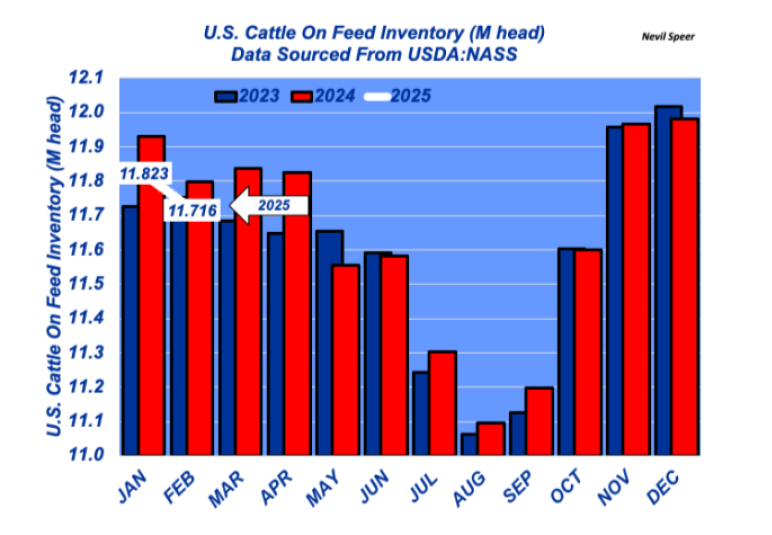
A large part of this expansion is fuelled by the need to have high-quality protein and grass-fed, especially in North America and Asia.
U.S. Beef Market Overview
The US is the largest beef producer globally, and it produces approximately 20 percent of the global production (USDA, 2025). The domestic consumers are more willing to buy beef that is raised on farms that focus on animal welfare, traceability, and environmental sustainability, which LoneStar Heritage’s grass-fed, regenerative strategy aligns well.
Texas, which is the largest cattle state in the country (nationwide), generated almost half of all cash receipts in the U.S. cattle and calves.
Texas & Central Texas Region
The state of Texas is the largest producer of cattle, with an estimated 4.08 million cattle as beef cows as of January 2025, as per the USDA National Agricultural Statistics Service and Texas Farm Bureau.
Coryell County is an area in Central Texas that is one of the most active areas in ranching in the state. It has several benefits to a sustainable beef enterprise, such as LoneStar Heritage.
- Strategic location: Approximately 75 miles northwest of Austin and near Waco and Temple, with access to regional farmers’ markets, butcheries, and distributors.
- Ideal climate: Winters are mild, and grazing seasons are long, which makes the pasture rotated year-round and lowers the cost of feeding.
- Infrastructure access: The livestock auctions, such as the vet and feed suppliers, are nearby, which facilitates operations.
- Skilled labor: The area benefits from Texas A&M AgriLife programs, 4H, and FFA training that build agricultural expertise.
LoneStar Heritage Cattle Farm will focus on grass-fed, regenerative ranching, emphasizing quality and sustainability over scale. By combining efficient local operations with transparent, pasture-to-table beef production, the ranch is positioned to serve Central Texas consumers who value locally raised, traceable meat.
Target Customers
LoneStar Heritage Cattle Farm focuses on three main customer groups within Central Texas and the surrounding regions.
1. Local Butcheries and Restaurants
Independent butcher shops and farm-to-table restaurants in Austin, Waco, and Temple are key customers. They require a steady supply of traceable, grass-fed beef and value consistent quality, humane animal treatment, and local sourcing. Supplying these buyers provides LoneStar with reliable wholesale income and community recognition.
2. Direct-to-Consumer Buyers
Local families and individuals who prefer pasture-raised, hormone-free beef represent the farm’s fastest-growing market. Through monthly beef box subscriptions, LoneStar offers curated meat selections delivered directly to customers, emphasizing freshness, transparency, and connection to the ranch.
3. Farmers’ Markets and Food Cooperatives
Regional markets in Central Texas attract consumers seeking local and sustainable food options. Selling directly at these venues helps build brand visibility, engage with loyal repeat customers, and capture higher margins compared to bulk sales.
These customer segments bring a balance of stability and growth potential — wholesale buyers ensure steady volume, while direct and farmers’ market sales strengthen brand identity and community trust.
Competitive Landscape
The beef market of Texas comprises three main categories of producers, which serve various sections of the supply chain:
1. Large Commercial Ranches (e.g., King Ranch, 44 Farms)
These activities raise thousands of head of cattle and deliver beef to great processors or distributors. Their benefit is in scale and set deals, yet their huge overheads, complicated logistics, and low capability of receiving customized or trackable products are likely to be crucial.
2. Cooperative and Commodity Producers
These ranchers engage in local auctions or cooperatives where they market cattle at market rates. Although this model is very liquid and accessible in the market, it has limited control of the price and little or no branding potential, hence difficult to distinguish their beef products.
3. Mid-Scale Independent Ranches (like LoneStar Heritage)
Family-run ranches are smaller, and even more adaptable, and are nearer to the markets. They will be able to embrace regenerative grazing, direct sales to consumers, and on-label, which are treasured attributes to the current environmentally conscious customers.
The negative is the reduced number of herd and a short production volume that needs efficiency, good marketing, and intelligent partnerships.
Direct-to-consumer beef subscriptions with restaurant and butcher contracts are the way to bridge the two worlds that LoneStar Heritage Cattle Farm can reach. This model offers a consistent revenue stream, flexibility, and customer base loyalty with an appreciation of quality, sustainability, and authenticity of Texas-raised beef.
4. Indirect Competitors
LoneStar also competes indirectly with plant-based protein brands (e.g., Beyond Meat, Impossible Foods) and imported grass-fed beef from countries like Australia and New Zealand, which are marketed as sustainable alternatives. While these products attract health- and eco-conscious buyers, LoneStar’s local, pasture-raised identity and transparency offer a strong counterpoint.
LoneStar Heritage’s Competitive Advantages
| Factor | LoneStar Advantage |
|---|---|
| Animal Welfare | Beef Quality Assurance (BQA)–certified herd management with low-stress handling and rotational grazing. |
| Sustainability | Regenerative grazing practices that improve soil health and conserve water; solar-powered waterers and rainwater harvesting. |
| Market Access | Dual-channel model combining direct-to-consumer beef boxes with wholesale restaurant and butcher contracts. |
| Product Quality | 100% grass-fed, hormone-free Angus–Hereford beef finished on-site for full traceability and flavor consistency. |
| Brand Identity | Texas-based family ranch known for transparency, heritage values, and “Pasture-Raised Texas Beef—From Our Family to Yours.” |
By using modern technology, eco-friendly methods, and a strong local brand, LoneStar is set to stand out, build customer loyalty, and grow steadily over the next few years.
Market Trends
Several strong trends support LoneStar Heritage Cattle Farm’s growth and positioning in the Texas beef industry:
- Rising demand for grass-fed beef: Consumers and restaurants increasingly prefer pasture-raised, hormone-free, and traceable meat.
- Local sourcing preference: Programs like Go Texan have boosted sales of locally raised beef since 2020.
- Shift toward regenerative ranching: State and private initiatives reward soil health, water conservation, and sustainable grazing.
- Stronger supply chains: Distributors and butcheries now favor nearby suppliers to reduce transport costs and spoilage.
- Consumer trust in transparency: LoneStar’s family-run, pasture-to-table model builds authenticity and customer loyalty.
Together, these trends make Central Texas an ideal region for a grass-fed, sustainable, and locally focused beef operation like LoneStar Heritage Cattle Farm.
Stop searching the internet for industry & market data
Get AI to bring curated insights to your workspace
Production & Products
Herd Structure and Growth
LoneStar Heritage Cattle Farm raises Angus–Hereford crossbreeds, known for strong genetics, efficient feed conversion, and quality marbling. The herd will expand carefully to maintain pasture balance and ensure consistent beef quality.
| Year | Breeding Cows | Bulls | Calves & Yearlings | Estimated Beef Output (lbs hanging weight) |
|---|---|---|---|---|
| Year 1 | 70 | 3 | 98 | 60,000 |
| Year 2 | 95 | 3 | 138 | 110,000 |
| Year 3 | 125 | 4 | 179 | 160,000 |
Each finished steer will yield approximately 500–550 lbs of hanging weight, sold through a mix of direct-to-consumer beef boxes and restaurant or butcher contracts.
Production System & Suppliers
LoneStar Heritage Cattle Farm runs a 200-acre rotational grazing operation following Texas A&M AgriLife Extension guidelines for mid-sized ranches. The herd grazes across six paddocks equipped with solar-powered water troughs and shaded rest zones to reduce heat stress.
1. Grazing and Feeding System
Feed and minerals come from Purina Animal Nutrition (Temple, TX). The ration follows the Texas A&M Cow–Calf Nutrition Guidelines:
- 80% pasture forage and hay
- 15% protein and energy supplements (Purina Wind & Rain mix, range cubes)
- 5% salt and trace minerals
During dry spells, hay and feed are supplemented via Helena Agri-Enterprises or local balers.
2. Animal Health and Welfare
Care follows Beef Quality Assurance (BQA) and USDA Premises ID standards under Dr. Henry Walker, Gatesville, TX. Routine measures include:
- Biweekly herd checks, vaccination, and hoof trimming
- Annual deworming and calf acclimation
- Digital record-keeping of health and breeding
A $5,000 annual vet retainer ensures round-the-clock coverage. The ranch targets Certified Grassfed by AGW by Year 3.
3. Processing and Supply Chain
Processing is handled by USDA-approved H&M Meat Processing (Hamilton, TX) with 10–14 day dry aging, vacuum-sealed packaging, and labeling compliant with USDA FSIS standards. Finished beef is stored in a 10,000-lb cooler and distributed weekly across the Austin–Waco–Temple corridor via a small refrigerated trailer.
Packaging supplies (vacuum bags and insulated boxes) are sourced from EcoEnclose and Uline, verified U.S. packaging vendors suitable for perishable products.
4. Sustainability and Resource Management
LoneStar incorporates several environmentally responsible systems:
- Solar-powered water pumps (average 15% energy cost savings, based on USDA NRCS case studies).
- A rainwater harvesting system permitted by the Texas Water Development Board, used for irrigation and cleaning.
- Manure composting to enhance soil fertility and reduce chemical fertilizer use.
Products & Experiences
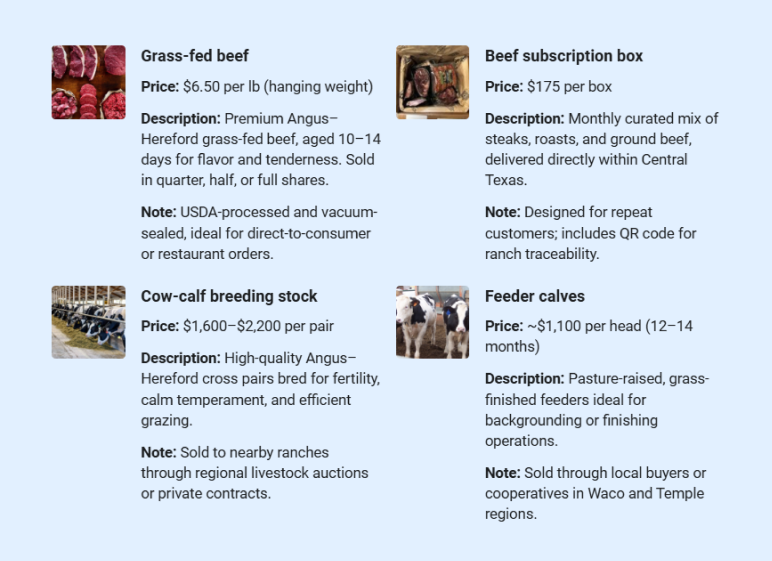
LoneStar Heritage Cattle Farm sells premium grass-fed beef, breeding stock, and hay while offering on-site ranch experiences. Every product reflects quality, traceability, and sustainable Texas ranching practices.
Additional Offerings:
- Hay and Forage Sales
- Compost (organic fertilizer)
- Ranch tours and workshops
Sustainability Systems
LoneStar Heritage Cattle Farm works under the principle of regenerative and resource-effective actions to defend land, water, and energy, and enhance profitability and long-term soil condition.
- Manure composting and renewal of soil: The manure is collected and composted and reused in pastures, leading to savings of 20 percent in fertilizer expenses and improving the soil organic matter.
- Solar-driven water systems: 3 solar-powered pumps will be used to service the entire paddock with drinking water, thereby saving about 15 percent of electricity cost according to USDA NRCS solar water system guidelines.
- Rainwater harvesting and reuse: Rainwater collected on the roofs of the barns is gathered in a 20,000-gallon cistern, where it is purified and reused in irrigation according to the conservation regulations of the Texas Water Development Board.
- Rotational grazing: The pastures are given time to rest between grazing processes, and the native grass grows and absorbs carbon, which has already been proven by the Texas A&M AgriLife Extension to increase the forage yields.
- Carbon efficiency and biodiversity: By Year 3, the farm expects to have a carbon offset pilot with the NRCS Conservation Stewardship Program (CSP) on grass-fed operations in Texas.
Such systems help LoneStar to cut down the cost, also improve the land productivity, and keep a continuous and closed beef operation that will be sustainable and promote the local economy.
Production Costs (per lb of beef sold)
| Expense | % of Total | Cost ($/lb hanging weight) |
|---|---|---|
| Feed & Forage | 42% | $2.73 |
| Labor | 22% | $1.43 |
| Veterinary & Breeding | 6% | $0.39 |
| Utilities & Fuel | 5% | $0.33 |
| Maintenance & Equipment | 4% | $0.26 |
| Overhead (insurance, admin, marketing) | 21% | $1.36 |
| Total | 100% | $6.5/lb |
Using USDA AMS National Monthly Grass Fed Beef Report data and Texas direct‑to‑consumer price sheets as benchmarks, current grass‑fed beef retail prices equivalent to roughly $9.50–$11.00/lb are reasonable for modeling LoneStar’s margins (USDA AMS, 2024; Texas Ridge Grass Fed Beef, 2024).
Operations & Staffing
LoneStar Heritage Cattle farm works between 6:00 am to 6:00 pm, and during calving, hay, and finishing season, staggered shifts are given to ensure that the cattle are taken care of and the customer is satisfied.
- Evening: 12:00 PM to 6:00 PM
- Morning: 6:00 AM to 12:00 PM
Staffing Plan
LoneStar Heritage Cattle Farm has a small, family-run team managing daily ranch work. Family labor and seasonal help will cover most early operations until herd size justifies full-time hires.
| Role | Staff Needed | Job | Pay |
|---|---|---|---|
| Owner/Operator (Robert Hayes) | 1 | Oversees herd management, land use, breeding, and vendor relations | $48,000/year (owner draw) |
| Operations & Finance Manager (Emily Hayes) | 1 | Handles bookkeeping, FSA compliance, logistics, and customer invoicing | $36,000/year (owner draw) |
| Ranch Hand | 1 | Daily feeding, fencing, calving, hay baling, and upkeep | $38,000/year |
| Seasonal Workers | 2 (April–Sept) | Assist with hay harvest, branding, and general maintenance | $18/hour (~$12,000 each) |
| Veterinarian (Contract) | — | Routine herd health, pregnancy checks, and emergency calls | $6,000/year retainer |
| Equipment Mechanic (Part-Time) | 1 (as-needed) | Handles tractor, baler, and chute repairs | $25/hour (~$5,000/year) |
Rotational grazing and solar-powered systems cut labor needs by about 25%. Each ranch hand manages 40–50 cattle and is trained to handle feeding, calving, and maintenance to keep operations smooth.
Vendor & Partner Network
Vendor agreements are reviewed annually by Emily Hayes to maintain cost control, consistency, and USDA compliance across all operations.
| Vendor / Partner | Service | Contract Terms |
|---|---|---|
| Purina Animal Nutrition (Temple, TX) | Feed and mineral supply | Quarterly delivery with a price cap on bulk feed |
| H&M Meat Processing (Hamilton, TX) | USDA beef processing and packaging | $0.85/lb processing rate, reviewed annually |
| Helena Agri-Enterprises | Seed, fertilizer, and soil inputs | Seasonal purchase contracts |
| Gatesville Large Animal Vet (Dr. Henry Walker) | Veterinary and herd health services | Monthly retainer + emergency visits |
| Farm Bureau Insurance | Liability, livestock, and equipment coverage | Annual policy renewal (~$6,000/year) |
| Helena Equipment Services | Tractor and baler maintenance | As-needed service contract |
| CPA Firm – Central Texas Ag Accounting | Financial reporting and FSA/USDA compliance | Quarterly reviews and lender reporting |
These partnerships provide reliability in supply, cost stability, and consistent quality assurance, allowing LoneStar to focus on production and customer relationships rather than daily operational risks.
Compliance & Regulatory Management
LoneStar Heritage Cattle Farm adheres to state, federal, and USDA standards of beef production and direct sales to be safe, traceable, and environmentally safe:
- USDA Premises ID & Animal Traceability Program: Records and keeps track of livestock movement in terms of disease prevention.
- Beef Quality Assurance (BQA) Certification: Certifies human care, feed management, and food safety.
- Texas Department of Agriculture License: This is a license necessary to sell beef directly in the state.
- EPA Livestock Wastewater Management Permit: It covers the runoff, waste management, and protection of grazing land.
- Farm Bureau Liability/ Safety Compliance: This is to provide compliance with OSHA farm safety and equipment regulations.
All certifications, inspections, and renewals are recorded in an internal compliance log maintained by Emily Hayes. She reviews it quarterly to ensure the ranch meets all regulatory requirements.
Daily Workflow
The LoneStar Heritage Cattle Farm starts by feeding and monitoring the well-being of the herds at 6:00 AM. Cattle are transferred to new grazing fields at 8.00 AM. Fences, water troughs, and equipment check and maintenance are done between 10:00 AM and 12:00 PM. At approximately 1:30 PM, Robert and Emily go through records, take care of vendor orders, and USDA or financial documents.
At 4:00 PM, the crew feeds and attends to calves and pregnant cows. At 6:00 PM, livestock are settled at night, equipment is washed, and CattleMax data is updated to prepare for the next day’s operations.
Technology Integration
LoneStar uses simple, dependable tools to manage operations and reporting:
- CattleMax: Tracks herd records and health data.
- FarmLogs: Monitors grazing rotation and soil health.
- QuickBooks + USDA FSA Portal: Handles accounting and loan compliance.
- Solar Sensors: Automate water and fence systems for reduced labor.
These systems help the ranch stay productive, compliant, and financially transparent.
Milestones & Timeline
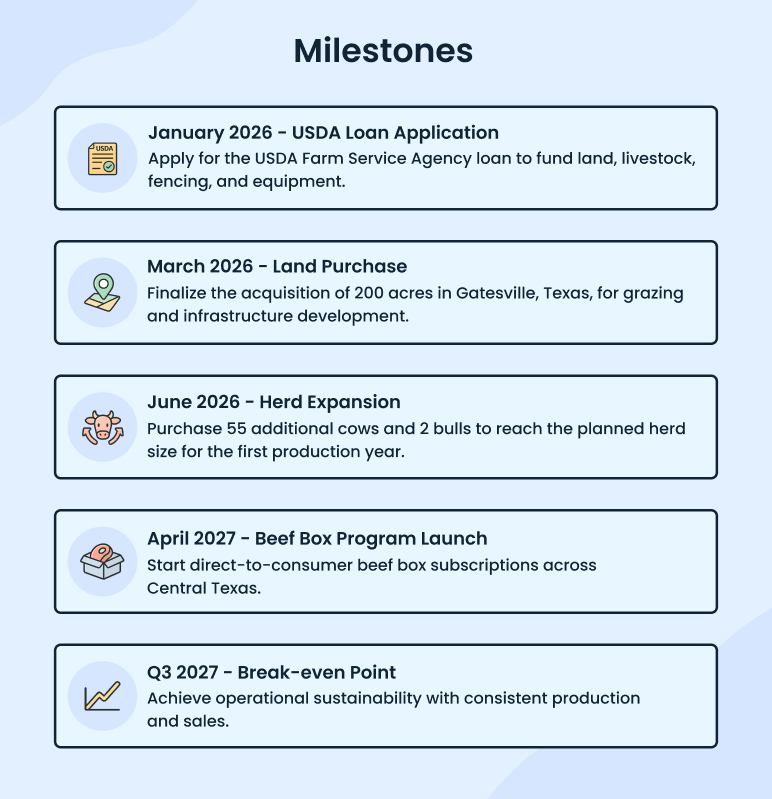
LoneStar Heritage Cattle Farm has a step-by-step plan to guide its growth from setup to steady operations and long-term profitability.
Sales & Marketing Strategy
Strategic Objective
LoneStar Heritage Cattle Farm’s goal is to build a reliable and balanced sales structure, combining stable wholesale beef supply contracts with a growing direct-to-consumer presence. During the first two years, the focus will be on restaurant and butcher partnerships to create a steady cash flow. From Year 3 onward, LoneStar will expand its “LoneStar Heritage Beef” brand through local farmers’ markets, subscription boxes, and small grocery outlets across Central Texas.
Sales Channels
To reach the customers, the ranch relies on a combination of stable wholesale agreements and increasing retail sales, which guarantees the prospective revenue and consolidates its position on the market. The sales channels are structured in the following way:
- Sales of Restaurant and Butcher (50% total revenue)
LoneStar will target the local restaurants, butcher shops, and specialty meat stores within Waco, Temple, and Austin. These partners appreciate the quality, traceability, and beef produced in Texas. The ranch will deliver premium cuts and ground beef in the form of fixed-weight orders every quarter to maintain a regular flow of income.
- Direct-to-Consumer Subscription Boxes (30% of total revenue)
The “LoneStar Heritage Beef Box” program delivers 20-pound monthly packages directly to customers. Each box includes a mix of steaks, roasts, and ground beef with full pasture-to-plate traceability via QR code. This channel supports recurring income and helps build brand loyalty with eco-conscious households.
- Farmers’ Markets and Co-op Distribution (15% of total revenue)
LoneStar will attend regional farmers’ markets in Austin and Waco and partner with Central Texas Food Co-ops for bulk orders. These stores offer an opportunity to create brand awareness, increase margins, and inform consumers about regenerative ranching.
- Livestock Auctions (5% of total revenue)
The surplus feeder calves and cull stock will be auctioned at Gatesville and Temple livestock auctions to ensure good turnover and liquidity of herds.
Marketing Channels
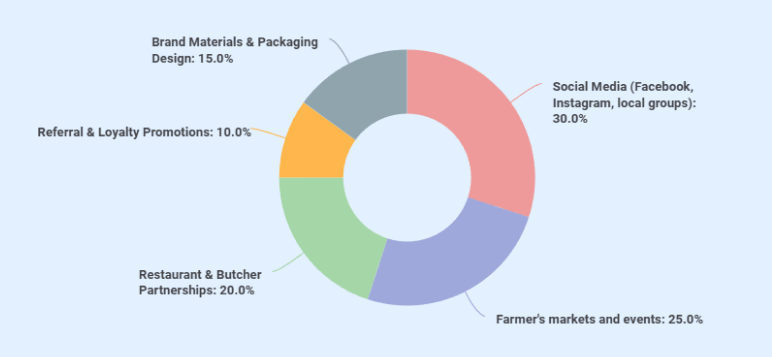
Marketing projections will increase to 2,000/month in the first year and 3,500/month in the third year, and the money will be used as follows:
| Marketing Activity | Percentage | Budget ($) | Description |
|---|---|---|---|
| Social media marketing (Facebook, Instagram, YouTube) | 35% | $420 | Share ranch updates, animal care stories, and product availability to build transparency and loyalty. |
| Farmers’ markets and local events | 25% | $300 | Sell directly to customers at Austin and Waco markets, and promote beef boxes through sampling events. |
| Restaurant and butcher partnerships | 20% | $240 | Collaborate with local chefs and butchers for menu listings and co-branded signage. |
| Customer referral and subscription promotions | 10% | $120 | Offer referral discounts and loyalty perks for beef box subscribers. |
| Brand packaging and content materials | 10% | $120 | Create brochures, product labels, and QR codes that tell the story behind each cut of beef. |
| Total | 100% | $1200 | — |
Promotions & Community Activities
To connect with customers, LoneStar will use simple, friendly promotions:
- Meet the Rancher Days: Every month, there is an open ranch day where people are educated about grass-fed beef and environmentally-friendly grazing.
- Local Butcher and Restaurant Co-branding: Co-branding promotions with major purchasers in Austin and Waco.
- Social Media Outreach: Posts regularly on the life of the ranch, animal life, and regenerative practices in order to attract direct-to-consumer customers.
- Community Involvement: 4-H, FFA, and Texas Beef Council education will be sponsored to improve the community relationship and brand loyalty.
- Community Involvement: Sponsorship of 4-H, FFA, and Texas Beef Council education programs to enhance the community connection and brand loyalty.
Sales Targets & Customer Acquisition Plan
| Year | Key Focus | Customer Acquisition Goals | Total Revenue ($) | Wholesale Volume (% of Total) | Direct-to-Consumer Revenue ($) |
|---|---|---|---|---|---|
| Year 1 | Build the Base | Secure 3 restaurant and 2 butcher partnerships | $285,000 | 90% | $28,000 |
| Year 2 | Expand Reach | Double restaurant clients and 100 beef box subscribers | $475,000 | 70% | $142,000 |
| Year 3 | Grow the Brand | 200 beef box subscribers + 10 retail accounts | $710,000 | 60% | $284,000 |
By Year 3, LoneStar expects direct-to-consumer and retail channels to contribute 40% of total revenue, improving margins and customer loyalty beyond wholesale sales.
Financial Plan
In Year 1, most resources will go toward setup and herd expansion. From Year 2 onward, revenue growth and margin improvement will result from higher beef box sales and steady wholesale partnerships.
Startup Costs
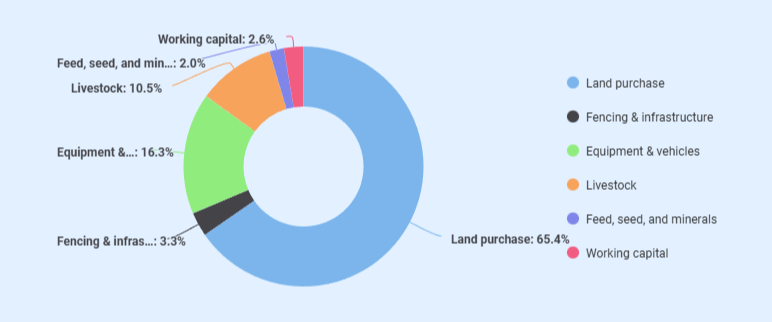
The farm will require about $765,000 to start operations. This includes land, equipment, animals, and working capital.
| Category | Description | Amount (USD) |
|---|---|---|
| Land purchase | 200 acres @ $2,500/acre | $500,000 |
| Fencing & infrastructure | Corrals, water systems, and grazing setup | $25,000 |
| Equipment & vehicles | Tractor, baler, UTV, chute | $125,000 |
| Livestock | Additional 55 cows + 2 bulls | $80,000 |
| Feed, seed, and minerals | Initial inventory | $15,000 |
| Working capital | 4-month operating buffer | $20,000 |
| Total Required Capital | ≈ $765,000 ($625,000 USDA loan + $140,000 owner equity [land + herd + cash]) |
Important Assumptions
- Herd expansion: 70 → 125 head by Year 3
- Mean production of beef: 525 lbs hanging weight/finished animal.
- Increase in the price of beef: $6.25 to $6.75 per pound in 3 years.
- Term of debt: 20 years with a fixed interest of 4.75% (USDA FSA loan)
- Coverage working capital: 3 months of expenses.
- Production efficiency: Increases by 5-7 per cent/per year due to increased grazing and feed management.
- EBITDA margin: Increases from negative in Year 1 (set up phase) to around 23% in Year 3.
Revenue Forecasts
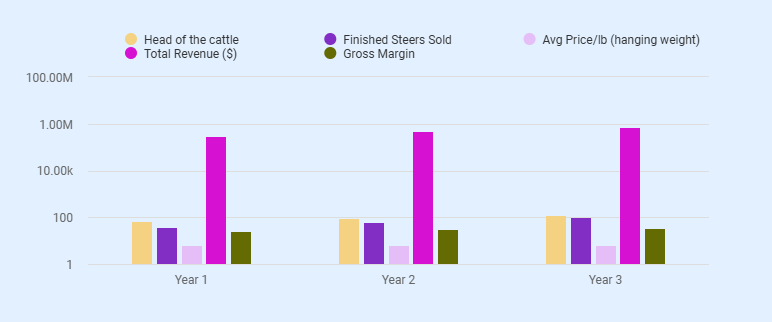
| Year | Head of Cattle | Finished Steers Sold | Avg Price/lb (hanging weight) | Total Revenue ($) | Gross Margin |
|---|---|---|---|---|---|
| 1 | 70 | 40 | $6.25 | $285,000 | 25% |
| 2 | 95 | 65 | $6.50 | $475,000 | 30% |
| 3 | 125 | 100 | $6.75 | $710,000 | 35% |
Monthly Projections (Year 1)
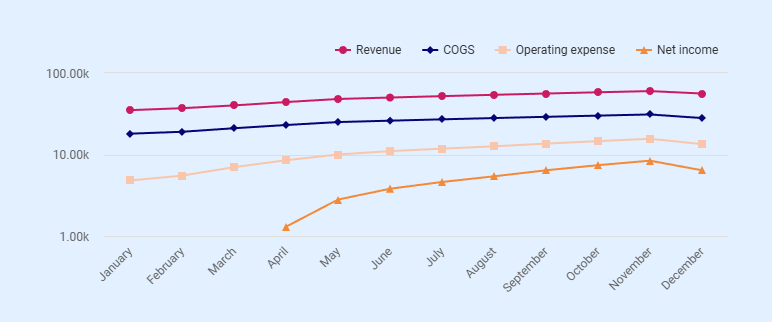
| Month | Revenue ($) | COGS ($) | Operating Expenses ($) | Net Income ($) |
|---|---|---|---|---|
| Jan | 17,000 | 13,200 | $7,200 | -2,400 |
| Feb | 18,000 | 13,500 | $7,200 | -1,700 |
| Mar | 19,000 | 14,000 | $7,200 | -200 |
| Apr | 21,000 | 14,500 | $7,200 | +1,300 |
| May | 23,000 | 15,000 | $7,200 | +2,800 |
| Jun | 24,000 | 15,000 | $7,200 | +3,800 |
| Jul | 25,000 | 15,200 | $7,200 | +4,600 |
| Aug | 26,000 | 15,400 | $7,200 | +5,400 |
| Sep | 27,000 | 15,400 | $7,200 | +6,400 |
| Oct | 28,000 | 15,400 | $7,200 | +7,400 |
| Nov | 29,000 | 15,400 | $7,200 | +8,400 |
| Dec | 28,000 | 14,600 | $7,000 | +6,400 |
| Total | $285,000 | $176,000 | $86,600 | +$42,400 |
Projected Profit & Loss Statement (3 Years)
| Category | Year 1 | Year 2 | Year 3 |
|---|---|---|---|
| Head of Cattle | 70 | 95 | 125 |
| Beef Sold (lbs hanging weight) | 21,000 | 34,000 | 50,000 |
| Average Price ($/lb) | $6.25 | $6.50 | $6.75 |
| Total Revenue | $285,000 | $475,000 | $710,000 |
| COGS (feed, vet, processing) | $176,000 | $250,000 | $355,000 |
| Gross Profit | $114,000 | $225,000 | $355,000 |
| Gross Margin | 40% | 47% | 50% |
| Operating Expenses (labor, insurance, fuel, admin) | $100,000 | $125,000 | $145,000 |
| EBITDA | + $14,000 | $100,000 | $210,000 |
| Debt Service (loan payments) | $45,000 | $45,000 | $45,000 |
| Net Income Before Tax | – $31,000 | $55,000 | $165,000 |
| Net Margin | -11% | 12% | 23% |
Projected Balance Sheet (3 Years)
| Category | Year 1 | Year 2 | Year 3 |
|---|---|---|---|
| ASSETS | |||
| Current Assets | |||
| Cash & Working Capital | $25,000 | $40,000 | $55,000 |
| Feed & Supply Inventory | $12,000 | $15,000 | $18,000 |
| Accounts Receivable | $8,000 | $10,000 | $12,000 |
| Total Current Assets | $45,000 | $65,000 | $85,000 |
| Fixed Assets | |||
| Land & Buildings (net of depreciation) | $500,000 | $500,000 | $500,000 |
| Equipment & Vehicles | $125,000 | $120,000 | $115,000 |
| Livestock (biological assets) | $80,000 | $125,000 | $165,000 |
| Infrastructure & Improvements | $25,000 | $28,000 | $32,000 |
| Total Fixed Assets | $730,000 | $773,000 | $812,000 |
| TOTAL ASSETS | $775,000 | $838,000 | $897,000 |
| LIABILITIES & EQUITY | |||
| Current Liabilities | |||
| Accounts Payable | $18,000 | $20,000 | $22,000 |
| Short-Term Portion of Loan | $30,000 | $30,000 | $30,000 |
| Total Current Liabilities | $48,000 | $50,000 | $52,000 |
| Long-Term Liabilities | |||
| USDA/FSA Loan (20 yrs @ 4.75%) | $625,000 | $595,000 | $565,000 |
| Total Liabilities | $673,000 | $645,000 | $617,000 |
| Owner’s Equity | |||
| Owner Capital (initial equity) | $175,000 | $175,000 | $175,000 |
| Retained Earnings | -$73,000 | $18,000 | $105,000 |
| Total Owner’s Equity | $102,000 | $193,000 | $280,000 |
| TOTAL LIABILITIES & EQUITY | $775,000 | $838,000 | $897,000 |
Spreadsheets are exhausting & time-consuming
Build accurate financial projections w/ AI-assisted features
Break-Even Analysis
| Item | Details |
|---|---|
| Average Selling Price (per lb of beef) | $6.50 |
| Variable Cost (per lb) | $3.95 (≈63% of selling price, based on COGS structure) |
| Contribution Margin (per lb) | $2.30 |
| Break-Even Volume (lbs of beef) | ~13,900 lbs |
| Break-Even Revenue | 13,900 × $6.25 = $86,875 |
| Current Year 1 Output | 21,000 lbs (≈151% of break-even point) |
Business Ratios
| Ratio | Formula / Definition | Year 1 | Year 2 | Year 3 |
|---|---|---|---|---|
| Gross Margin | Gross Profit ÷ Revenue | 40% | 47% | 50% |
| Net Profit Margin | Net Income ÷ Revenue | −11% | 12% | 23% |
| Current Ratio | Current Assets ÷ Current Liabilities | 1.6 | 1.9 | 2.3 |
| Debt-to-Equity Ratio | Total Liabilities ÷ Owner’s Equity | 1.7 | 1.3 | 1.0 |
| Return on Assets (ROA) | Net Income ÷ Total Assets | −4% | 6% | 11% |
| Return on Equity (ROE) | Net Income ÷ Owner’s Equity | −8% | 10% | 19% |
| Operating Expense Ratio | Operating Expenses ÷ Revenue | 45% | 38% | 33% |
| Break-Even Coverage Ratio | Actual Sales ÷ Break-Even Sales | 1.21 | 1.38 | 1.55 |
Funding Requirements
Loan Overview
LoneStar Heritage Cattle Farm is applying for financing through the USDA Farm Service Agency (FSA) under the Farm Ownership Loan program, along with a small equipment loan.
The total funding request is $625,000 at a fixed interest rate of 4.75% for 20 years. The USDA’s Texas State Office will oversee the loan. Funds will be used for purchasing 200 acres of land, expanding the herd, building fences and water systems, buying essential equipment, and covering early operating expenses.
Purpose of the Loan
The loan will be used for:
- Acquisition of 200 acres of grazing land and development of fencing and water systems.
- Increasing herd size of 55 cows and 2 bulls.
- Purchasing important machinery (tractor, baler, chute, and fencing equipment)
- Installation of solar-powered waterers and rotating paddocks.
- Funds operating costs and initial supplies of feed, supplies, and initial working capital.
This framework will help LoneStar to grow responsibly and have a positive cash position until it reaches its first production cycles.
Collateral Summary
The following assets will be secured by the loan:
- Land and improvements: $500,000
- Livestock and machinery: $275,000
Collateral value of $775,000, which is above the amount of the loan itself and minimizes the risk to the lender.
Repayment Plan & DSCR
The payment of the loan is to be made in a 20-year period with payments annually. LoneStar anticipates:
Year 1: Negative (setup phase, initial loss of ~$31,000)
Year 2: ~1.05× (near breakeven)
Year 3: ~1.45× (comfortable repayment capacity)
Debt service will stay flat with an estimated cost of approximately $45,000 annually, which is achieved through beef box subscriptions and regular restaurant contracts.
Owner equity contribution: $175,000 (cash, livestock equity, and family-owned land value).
Risk & Mitigation
As new ranchers, LoneStar relies on mentorship and FSA technical assistance to manage operational risks. There are also threats associated with operating a cattle farm, such as droughts, increased feed prices, epidemics, or even a shortage of labor.
LoneStar Heritage Cattle Farm handles these by its careful planning, setting supply contracts, and experienced local partners. The measures enable the stability of operations, the health of the herd, and a stable cash flow, in accordance with the lending standards of the USDA-FSA.
| Risk Area | Impact | Mitigation Measures |
|---|---|---|
| Feed Price Volatility | Feed is ~45% of total costs. Increases could affect margins. | Multi-year feed contract with Purina Nutrition; partial on-site hay production (25% of feed volume); bulk seasonal purchases to stabilize costs. |
| Market Price Fluctuations | Beef prices may vary by up to 15%. | Dual-channel model (DTC + processor contracts) cushions price swings; beef box pricing is set quarterly to offset volatility. |
| Herd Health Risks | Disease or low fertility reduces herd growth. | Regular vet inspections by Gatesville Large Animal Vet; vaccination schedule, quarantine protocol; livestock insurance. |
| Labor Shortage | Skilled ranch labor scarcity affects consistency. | Cross-training of staff, partnership with local FFA programs; use of part-time interns and family members during peak months. |
| Drought or Resource Scarcity | Affects grazing and water availability. | Rainwater harvesting system + two ponds + drought feed reserve maintained for 90 days. |
The Quickest Way to turn a Business Idea into a Business Plan
Fill-in-the-blanks and automatic financials make it easy.

Upmetrics
Upmetrics is the #1 business planning software that helps entrepreneurs and business owners create investment-ready business plans using AI. We regularly share business planning insights on our blog. Check out the Upmetrics blog for such interesting reads. Read more