You may know how to handle hiring, employee relations, compliance, and human resources operations. But building an HR consulting business around that experience requires a different kind of planning.
You need to decide which services are worth offering, how to price them, who to target, and how to turn occasional projects into steady revenue.
To help you plan that out, I’ve created a complete sample for Cardinal HR Advisors, a fictional Austin-based HR consulting business. It gives you a clearer look at how a small consulting firm can structure its services, attract clients, manage delivery, and project its financials.
Use it as a reference when you build your own plan.
Executive Summary
Cardinal HR Advisors LLC is an Austin, Texas-based HR consulting firm that helps small and growing businesses manage their people operations without building a full in-house HR department. It is a multi-member LLC owned 50/50 by Rachel Donnelly and Marcus Reyes.
The Opportunity
For a 30-, 40-, or 50-person company in Austin has real HR problems and no HR department. Someone has to write the handbook, classify new hires correctly, run the review cycle, and handle the complaint that lands in the owner’s inbox on a Friday. That work falls to an office manager and gets done badly or not at all.
A full-time HR manager solves it but costs over $180,000 a year once payroll taxes and benefits are added. Cardinal HR sells the middle option: senior HR judgment, bought by the project or by the month. It’s built for companies past the point where HR can run off the side of someone’s desk, but not yet big enough to justify a full-time hire.
Services and Revenue Model
Cardinal HR earns revenue in three ways, and the three are built to feed each other:
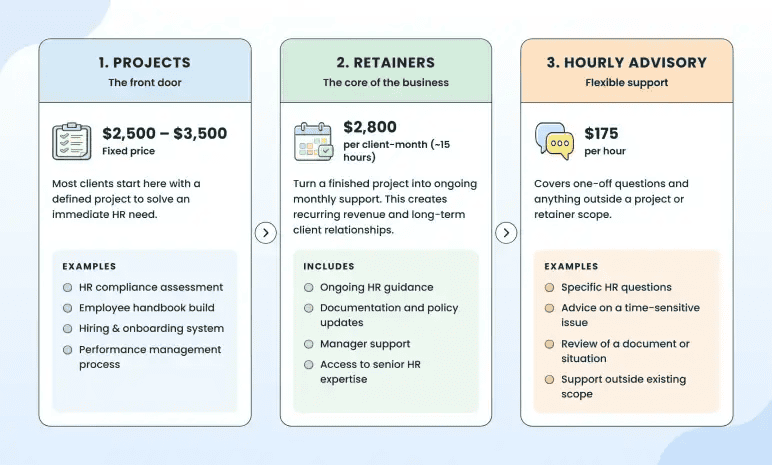
Every service is defined and priced up front, not open-ended “HR help.” The firm deliberately does not offer staffing or recruiting placement, payroll processing, benefits brokerage, PEO co-employment, or HR software at launch.
Target Market
Cardinal HR targets privately held employers with 10 to 100 employees across the Austin metro and remote Texas, concentrated in three sectors: professional services, technology and SaaS, and healthcare and wellness. These businesses hire steadily, carry recurring compliance obligations, and are large enough to pay for judgment but too small to employ it full-time.
Financial Highlights
The business is expected to be profitable in its first year while paying both founders’ salaries and gradually adding delivery capacity. By Year 3, Cardinal HR is projected to generate $501,900 in revenue while maintaining a lean operating structure.
| Metric | Year 1 | Year 2 | Year 3 |
| Billable hours | 1,780 | 2,270 | 2,760 |
| Total revenue | $322,000 | $411,950 | $501,900 |
| Gross margin | 82.3% | 78.6% | 76.7% |
| Net income, pre-tax | $24,798 | $43,721 | $54,521 |
| Ending cash | $84,091 | $120,193 | $166,250 |
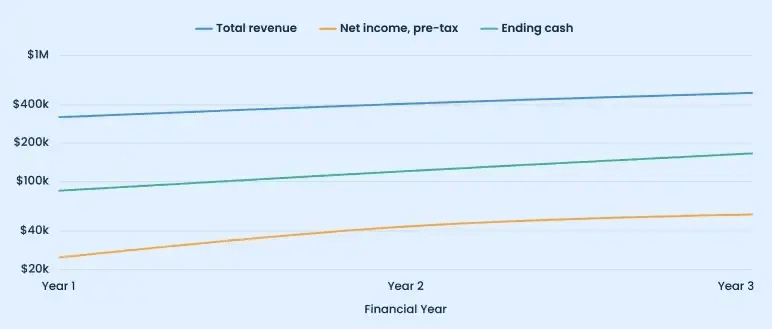
Margins run at 77–82% because the firm sells expertise rather than goods. Break-even sits at 1,952 billable hours a year. That’s about 19 billable hours per partner per week.
Funding Requirement
Cardinal HR is requesting a $50,000 SBA microloan from PeopleFund, an SBA microlender in Austin, at 10.0% fixed over 72 months, alongside $50,000 in combined owner equity. Of the $100,000 total, $65,000 is a working capital reserve and only $19,300 is capitalized equipment.
Company Overview
Cardinal HR Advisors LLC is a Texas multi-member limited liability company, formed in November 2026, trading from January 2027. It works from a shared office in central Austin and delivers on-site and remotely across Texas. Shared space holds occupancy at $9,600 in Year 1, roughly 3% of revenue, instead of committing to a lease early.
The partners plan an S-corp election for the first tax year. That is why owner pay appears in the financials as salary with employer payroll taxes rather than as owner draws.
Why Cardinal HR Exists
Rachel and Marcus spent years inside HR functions before starting Cardinal HR, and they kept running into the same problem from the other side of the desk: small employers with real HR exposure and no good way to fix it.
A 40-person company can’t justify a $180,000 HR manager, and a template pack can’t classify a worker or coach a manager through a termination. So the work fell to whoever had time, and got done badly or not at all.
That gap is structural. Large HR firms are built for enterprise clients, and the small employers who most need judgment are the least profitable for them to serve.
Cardinal HR is built specifically for that middle: senior HR help, bought by the project or the month. Between Rachel’s compliance and strategy background and Marcus’s hiring and systems experience, the firm covers what a small employer needs without either partner working outside their depth.
Ownership
The firm is owned by its two founders:
(1) Rachel Donnelly — Managing Principal (50%)
15 years in HR, SHRM-SCP. Leads compliance, employee relations, and HR strategy.
(2) Marcus Reyes — Principal Consultant (50%)
12 years in talent and HR operations, PHR. Leads hiring systems, HRIS, and manager training.
A partnership operating agreement defines each partner’s scope, the equal profit split, decision rights, and a dispute-resolution process. Both partners work full-time from day one and draw equal salaries.
Mission
Cardinal HR’s mission is to help growing businesses build practical, compliant HR systems without the cost and complexity of maintaining a full internal HR department.
Business Goals
During its first year, Cardinal HR intends to:
- Reach 5–7 active retainer clients by month 12 (60 billable client-months across Year 1).
- Deliver 34 fixed-fee projects and 200 advisory hours.
- Hit $322,000 in revenue with positive pre-tax net income.
- Bring on the part-time HR Coordinator by month 5.
- Hold each partner’s billable week near 20 hours, capped at 25.
Industry & Market Research
Cardinal HR’s model only works if enough of the right employers exist nearby. They do. This section starts with the industry for context, then narrows to the Austin employers the firm can actually reach.
Global & US Market
The global HR consulting market is expected to grow from $84.58 billion in 2026 to $118.76 billion by 2031, a 7.02% CAGR.
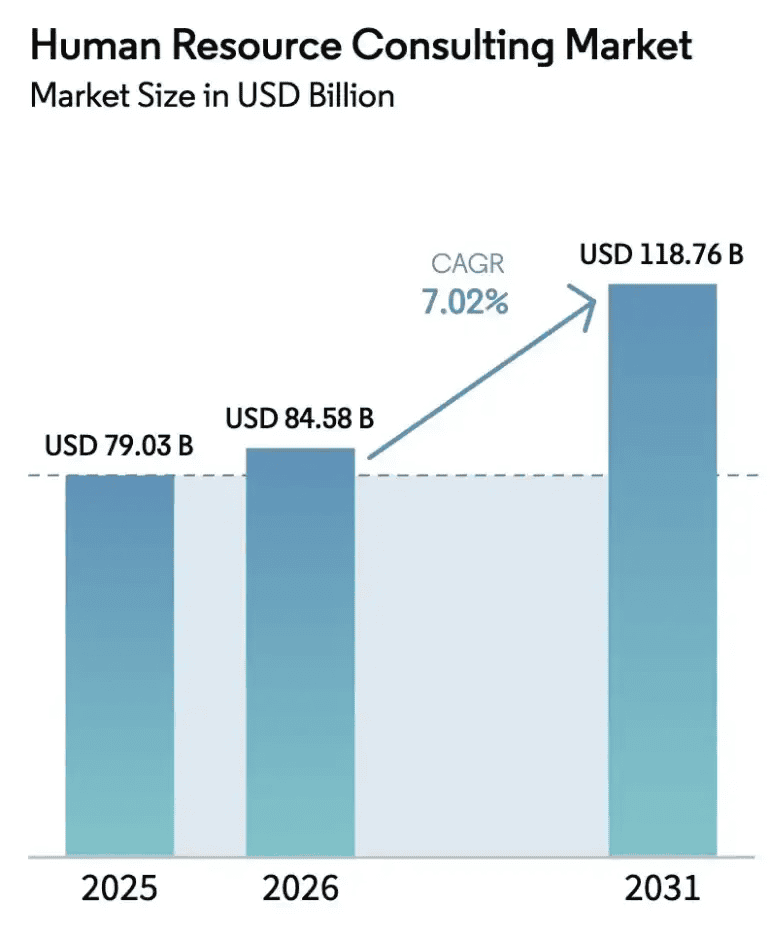
The US HR consulting industry reached about $29.0 billion in 2026, growing 1.4% year over year. The slow growth is the point.
Cardinal HR is not counting on a fast-expanding market. It is targeting a structural gap inside a mature one: small employers that have real HR needs but are too small to justify a full-time senior HR hire.
Why does that gap exist? The cost of bringing HR in-house creates most of that opening. The median annual wage for HR managers was $149,280 in May 2025, and $75,940 for HR specialists. Once payroll taxes, benefits, and other employment costs are added, a senior HR hire costs well above that base salary.
For a company of 30 to 50 people, that is hard to justify when the workload does not fill a full-time role. But relying on a junior generalist rarely solves the harder problems that trigger outside help: employee relations issues, policy gaps, classification questions, terminations, and manager coaching.
That is where Cardinal HR fits. A client can buy senior HR expertise through a defined project, a monthly retainer, or limited hourly support, instead of committing to a permanent senior hire.
The Austin Employer Base
Austin fits this model because its labor market is unusually concentrated in professional and management roles, the kind of workforce that generates steady HR complexity as companies grow.
Management occupations made up 10.4% of Austin-area employment in May 2025, one of the metro’s three largest occupational groups and well above the national share.
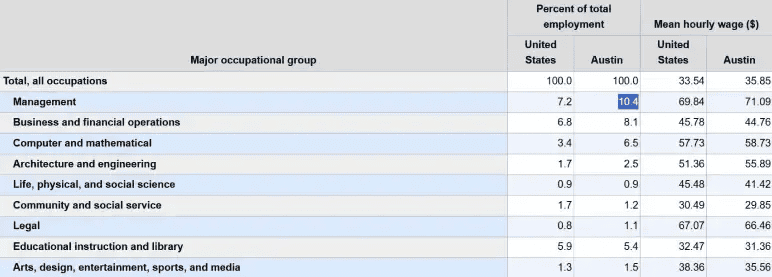
The base is also sizable. Travis County had 42,837 private-sector establishments employing 736,608 people, with an annual private payroll of $63.6 billion. That works out to an average wage near $86,300, well above the national median and a direct reflection of the region’s technology concentration.
Within that base, Austin skews heavily toward technology, professional services, and healthcare, the knowledge-based employers whose hiring, compensation, and compliance needs grow with headcount but rarely justify a full internal HR team.
Target Customer
Cardinal HR Advisor’s primary customer is a privately owned company with approximately 10–100 employees.
The initial focus will be:
- Professional services firms
- Technology and SaaS companies
- Healthcare and wellness businesses
These businesses are attractive because people management is important to their operations, hiring and onboarding occur regularly, and HR mistakes can become increasingly disruptive as headcount grows.
The likely buyer is the founder, CEO, COO, office manager, finance leader, or another executive currently handling HR responsibilities alongside their primary job.
Demand Drivers
Three forces keep this work arriving.
1. Compliance complexity
FLSA overtime and exemption classification (US Department of Labor) and the IRS employee-versus-contractor tests (IRS) are the two areas where small employers are most often wrong and most expensive to be wrong about. Texas is an at-will, no-state-income-tax jurisdiction, which small employers frequently misread as meaning employment rules are loose, when federal exposure is identical.
2. Hiring load
Austin’s employer base is still adding headcount. Companies in the 10 to 100 band hire unevenly and rarely have a repeatable process.
3. Normalization of fractional roles
Fractional CFOs made the model familiar. Buyers who already rent a finance leader by the month understand renting an HR leader the same way.
Competitive Analysis
Cardinal HR’s competitive set extends beyond other consulting firms. For many prospects, the first decision is whether to buy outside HR support at all.
Key competitors include:
| Alternative | Main advantage | Main limitation | Typical annual cost |
| Owner or office manager handles HR | No added provider cost | Consumes management time, often without HR expertise | None, absorbed internally |
| Templates and software | Low cost, convenient | Provides tools, not judgment or implementation | Low, often under $500 |
| Independent HR consultant | Flexible expert support | Capacity often depends on one person | Hourly or by project, varies |
| PEO (co-employment) | Broad outsourced employment administration | More infrastructure than a small firm needs, thin on advisory | A share of payroll, billed monthly |
| Full-time HR employee | Dedicated internal resource | Permanent payroll and overhead | $180,000+ loaded |
| Employment attorney | Deep legal expertise | Reactive, no HR systems or day-to-day support | Hourly, engaged only in a crisis |
Competitive Positioning
Cardinal HR sits in the middle of that table. It is cheaper and more flexible than a full-time hire, more accountable and specific than a template, and more advisory than a PEO.
The firm’s two-partner structure also provides broader capability. Rachel will lead compliance, employee relations, policies, and HR strategy, while Marcus will lead hiring systems, onboarding, HR technology, and manager training.
Cardinal HR will not attempt to compete with PEOs on payroll or benefits administration or with staffing agencies on candidate placement. Its focus is advisory work and building better internal HR systems.
Services and Pricing
Cardinal HR sells six defined services with published starting prices, not open-ended “HR help.” This is where most HR consulting plans go vague, and it is where the revenue model in this plan becomes checkable.
Services Offered
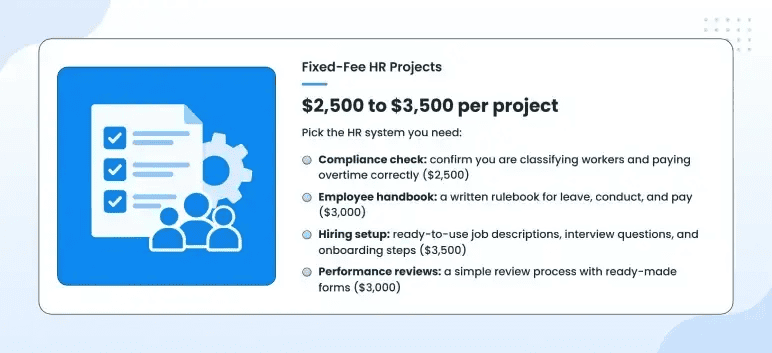
- Fixed-Fee HR Projects
Fixed-fee projects are for companies that need a specific HR system built right, a compliance audit, a handbook, a hiring process, or a performance cycle, without taking on an ongoing cost.
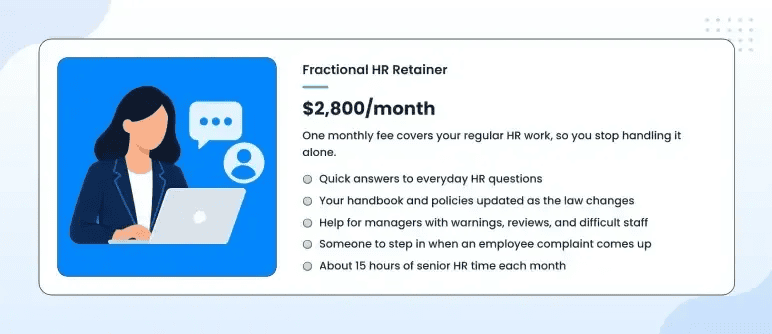
- Fractional HR Retainer
The retainer is for companies that need steady HR guidance through the year but are not ready to hire a full-time HR leader.
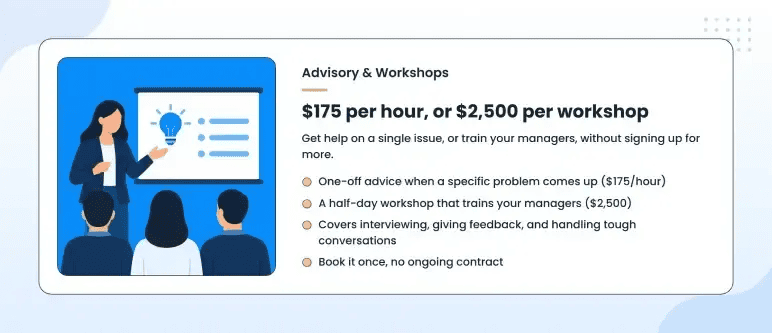
- Advisory & Workshops
Advisory and workshops are for companies that need occasional help, a one-off question answered, or managers trained, without committing to a project or retainer.
Pricing Strategy
Cardinal HR prices for clarity and for the way small employers actually buy. Every service has a set price agreed before work starts, so clients never face a surprise invoice.
- Fixed-fee projects let a client solve one problem at a known cost
- The monthly retainer turns that into predictable ongoing support
- Hourly advisory keeps one-off requests from complicating a retainer
The pricing is deliberately positioned in the middle of the market: well below the cost of a full-time HR hire, and well above a generic template, which is exactly the gap Cardinal HR Advisors is built to fill.
Most clients enter with a single project, see the value, and move onto the retainer, which is where the relationship becomes recurring for the client and the firm.
Capacity Per Service
| Service | Partner hours per unit | Realistic monthly capacity (both partners) |
| Compliance Assessment | 14–16 | 1–2 |
| Employee Handbook | 18–20 | 1 |
| Hiring & Onboarding Setup | 20–22 | 1 |
| Performance Management | 16–18 | 1 |
| Retainer (per client) | ~15/month | 7–9 active clients |
| Manager Workshop | 12–14 incl. prep | 1 |
What Cardinal HR Does Not Offer at Launch
The firm is narrow on purpose. It does not provide:
- Staffing or recruiting-agency placement, or executive search
- Payroll processing
- Benefits brokerage or insurance sales
- PEO or co-employment services
- HR software as a product
Each of these carries licensing, liability, or capital requirements that a two-partner advisory firm should not absorb in year one. Where a client needs them, Cardinal HR refers out.
Marketing and Sales Strategy
A clear service menu is only useful if the right buyers see it. Cardinal HR’s first clients will come from the two partners’ combined networks and a deliberate referral network, not a paid advertising campaign.
The firm budgets $10,000 for ongoing marketing in Year 1, rising to $15,000 by Year 3, plus a one-time $7,000 website and branding build at launch. That is roughly 3% of revenue, which is appropriate for a referral-led professional services firm and deliberately modest compared with a consumer business.
Acquisition Channels
Cardinal HR Advisors is referral-led, not ad-led. Most clients come through relationships, in this order:
- Partner networks (40%): Direct outreach to people who have seen Rachel and Marcus work, the warmest leads
- Referral partnerships (30%): Accountants, attorneys, payroll providers, and benefits brokers who meet HR problems they don’t solve
- LinkedIn and HR content (15%): Short, specific posts that build credibility with buyers checking the firm out
- Chambers and local communities (10%): Active membership and visible participation
- Workshops and webinars (5%): Free sessions that double as lead generators
Referral partners are the highest-leverage channel. An accountant who spots a misclassified contractor, a payroll provider watching a client run overtime wrong, and an employment attorney who would rather prevent a claim than defend one all share one problem: a client who needs HR help they cannot sell.
Cardinal HR’s target is 8 to 12 active referral relationships by the end of Year 1.
Marketing Budget
The Year-1 budget reflects a referral-led model: the highest-volume channels cost almost nothing. So the money goes toward building visibility and credibility.
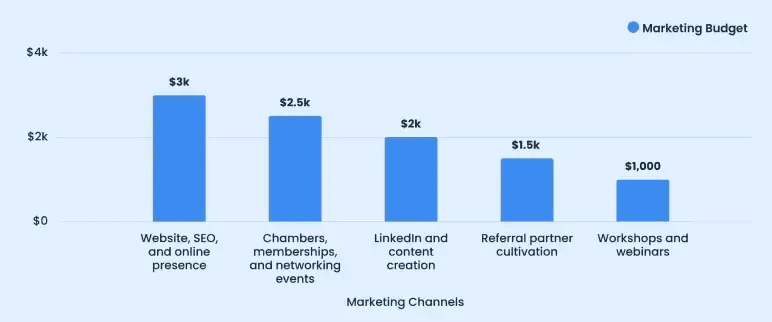
The one-time $7,000 website and branding build is a separate launch cost.
Sales Path
Every engagement follows the same five steps:
- Get introduced. A referral or a direct approach to a business/a target employer that needs HR help.
- Have a short discovery call. A 30-minute chat to understand the company and what prompted the conversation.
- Send a fixed quote: a clear proposal within two days, with a set price, defined deliverables, and explicit exclusions.
- Do the first paid project, usually the Compliance Assessment or a handbook.
- Offer the retainer. That is proposed at project close, on the strength of findings the client has just seen.
No work begins before a signed agreement and a deposit. The project is the trial; the retainer is the relationship.
Client Retention
Retainer clients are reviewed quarterly in a scheduled 60-minute session covering what changed, what is coming, and what the firm handled. Response-time commitments are written into the service agreement. Every deliverable is documented so the client can see accumulated value rather than an invoice for conversations they half-remember.
Metrics Tracked
| Metric | Year-1 target | Why it matters |
| Qualified leads per month | 8–10 | Top of funnel health |
| Discovery calls per month | 5–6 | Conversion from lead to conversation |
| Proposal acceptance rate | 40%+ | Tests whether pricing and scoping are right |
| Project-to-retainer conversion | 30%+ | The single most important number in the business |
| Average project value | $3,000 | Guards against scope discounting |
| Client retention (retainer) | 85%+ annual | Recurring revenue durability |
| Revenue concentration | No client above 25% | Lender-facing risk control |
Project-to-retainer conversion is the metric the partners review weekly. It is what turns one-off project income into a business a lender can underwrite.
Operations and Staffing
Cardinal HR runs on a fixed weekly rhythm with billable capacity capped on purpose.
Hours of Operation
The firm operates Monday to Friday, 8:30 AM to 5:30 PM Central. Each partner blocks mornings for client delivery and afternoons for calls, proposals, and admin, with Friday afternoons for pipeline review and the weekly metrics check.
Each partner is capped at 25 billable hours per week, against a Year-1 plan of roughly 17. The cap is a design choice: a two-partner firm that bills 35 hours a week stops selling.
Delivery Workflow
Every engagement runs the same five stages.
- The coordinator handles intake once the agreement is signed and the deposit received, with kickoff within five business days.
- The lead partner runs discovery, builds the deliverable with coordinator support on formatting, and holds one client review round; scope changes are quoted separately.
- At close, the partner presents the final deliverable, implementation guidance, and a retainer proposal, and the coordinator makes a 30-day check-in call.
Retainer clients draw down about 15 hours a month, and unused hours do not roll over. It keeps capacity planning honest and stops a client from banking six months of hours and calling them in during one crisis.
The firm uses a CRM, project management, e-signature, cloud storage with per-engagement access controls, accounting software for Net 20 invoicing, and video conferencing. Technology subscriptions run $7,200 in Year 1, rising to $9,600 by Year 3.
Staffing Model
The firm scales through leverage rather than partner hours:
| Role | Type | Start | Year 1 cost | Year 3 cost |
| Managing Principal | Owner, W-2 | Month 1 | $80,000 | $120,000 |
| Principal Consultant | Owner, W-2 | Month 1 | $80,000 | $120,000 |
| HR Coordinator | Part-time W-2 | Month 5 | $20,000 | $48,000 |
| Specialist contractors | 1099, on demand | As needed | $25,760 | $50,190 |
Contractors cover compensation benchmarking, HRIS implementation, and workplace investigations. Both the coordinator and the contractor bench sit in cost of goods sold rather than overhead, because both scale with delivery volume. That is what holds gross margin in the 77 to 82% band while revenue grows 56% over three years.
Compliance, Insurance and Data Security
Cardinal HR Advisors handles personnel files, accommodation records, investigation notes and compensation data. Controls are proportionate:
- Professional liability (errors and omissions) plus general liability, budgeted at $4,200 in Year 1.
- Written service agreements with defined scope, exclusions and a limitation-of-liability clause, plus confidentiality terms in client and contractor agreements.
- Per-engagement access controls, no client data on local drives, and two employment attorneys on standing referral for matters that cross from HR into legal advice.
Milestones and First-Year Roadmap
The first year runs in three phases: set up, build referrals, then stack retainers. Revenue is uneven in the first quarter by design.
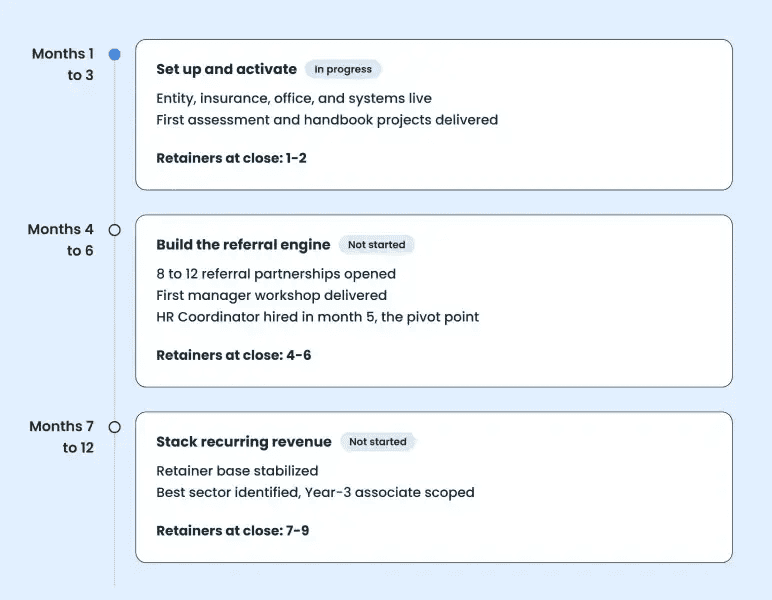
The coordinator hire in month 5 is the pivot point. Before it, both partners absorb their own documentation and admin, capping how many engagements they can run.
After it, partner hours shift toward billable delivery and sales, making the Year-2 step up to 2,270 billable hours achievable within the 25-hour cap. By month 12, the firm should carry 7 to 9 retainer clients, roughly $235,000 of annualized recurring revenue.
Management Team
Cardinal HR splits the work two ways at the top: Rachel owns compliance and strategy, Marcus owns hiring systems and HR operations.
Rachel Donnelly, Managing Principal
Fifteen years in in-house HR, most recently leading the people function at a mid-sized Austin professional services firm. SHRM-SCP certified. Her work has centred on what small employers get wrong most expensively: exemption classification, terminations, accommodation requests and investigations.
Responsibilities
At Cardinal HR, she leads compliance assessments, handbook builds, performance systems and employee relations escalations, and holds sign-off on pricing, banking, insurance and the lender relationship.
Marcus Reyes, Principal Consultant
Twelve years in talent acquisition and HR operations, building hiring processes inside fast-growing technology companies. PHR certified. His background is the systems side: HRIS selection and configuration, structured interviewing, onboarding design, and training first-time managers.
Responsibilities
At Cardinal HR, he leads hiring and onboarding engagements, HRIS work, manager training, and delivery operations, including capacity planning and the contractor bench.
Supporting Team and Hiring Path
A part-time HR Coordinator joins around month 5 to handle documentation, drafting, onboarding builds, and scheduling, moving close to full-time by Year 3. Two to three vetted 1099 specialists cover compensation benchmarking, HRIS implementation, and workplace investigations. An employment attorney and a CPA serve as outside advisors.
The operating agreement records who decides what. Rachel holds compliance positions, pricing exceptions, and the lender relationship; Marcus holds delivery scheduling, capacity, and tooling; hiring and the annual plan are joint.
The coordinator is the only planned Year-1 hire. By Year 3, the plan anticipates an associate consultant who can own routine retainer clients under partner supervision, moving the firm from two billing partners to a leveraged practice.
Financial Plan
Cardinal HR’s financial model is based on the amount of consulting work the firm can realistically sell and deliver rather than a percentage of the broader HR consulting market.
Startup Costs
| Expense | Amount |
| Office equipment (3 laptops, monitors, printer, phones), capitalized | $9,000 |
| Furniture and fixtures (office setup), capitalized | $6,300 |
| Leasehold improvements (office buildout), capitalized | $4,000 |
| Website and branding (launch) | $7,000 |
| Licenses, permits, and LLC filing | $1,200 |
| Professional setup (legal, accounting, partnership agreement) | $3,500 |
| Prepaid insurance and refundable office deposit | $4,000 |
| Working capital reserve, held in cash | $65,000 |
| Total startup costs | $100,000 |
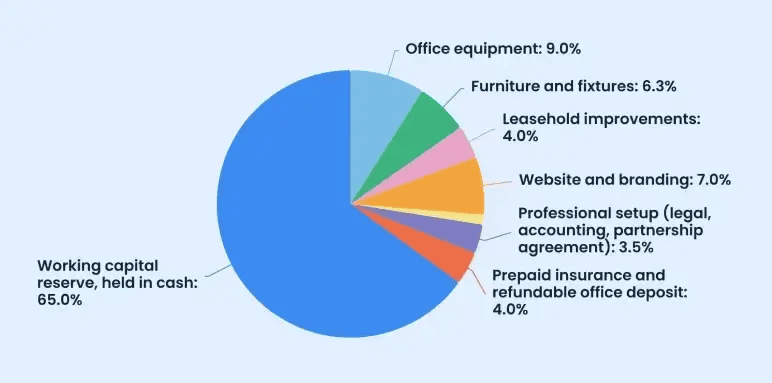
Only $19,300 is capitalized equipment and $11,700 one-time launch expense. The remaining $69,000 is cash and prepaid items, because the risk in a consulting launch is not equipment but the months between signing the lease and signing the fifth retainer.
Important Assumptions
| Item | Assumption |
| Retainer price and volume | $2,800 per client-month; 60 / 84 / 108 months |
| Project price and volume | $3,500 blended; 34 / 40 / 46 projects |
| Hourly advisory | $175 per hour; 200 / 210 / 220 hours |
| Total billable hours | 1,780 / 2,270 / 2,760, at ~$181 blended |
| HR Coordinator (W-2) | $20,000 / $36,000 / $48,000, plus 7.65% payroll tax |
| Contractors and pass-through | Contractors 8 / 9 / 10% of revenue; materials 3% |
| Owner salaries, combined | $160,000 / $200,000 / $240,000, plus 7.65% payroll tax |
| Receivables and payables | Net 20 (DSO 20); Net 15 (DPO 15); no inventory |
Depreciation Schedule
| Asset | Cost | Life | Annual dep. | Net PP&E Y1 | Net PP&E Y2 | Net PP&E Y3 |
| Office equipment | $9,000 | 5 yrs | $1,800 | $7,200 | $5,400 | $3,600 |
| Furniture and fixtures | $6,300 | 7 yrs | $900 | $5,400 | $4,500 | $3,600 |
| Leasehold improvements | $4,000 | 10 yrs | $400 | $3,600 | $3,200 | $2,800 |
| Total | $19,300 | — | $3,100 | $16,200 | $13,100 | $10,000 |
Projected Profit and Loss Statement (3 Years)
| Income Statement | Year 1 | Year 2 | Year 3 |
| Billable hours | 1,780 | 2,270 | 2,760 |
| Total revenue | $322,000 | $411,950 | $501,900 |
| COGS | |||
| HR Coordinator, including payroll tax | $21,530 | $38,754 | $51,672 |
| 1099 contractors | $25,760 | $37,076 | $50,190 |
| Direct materials and pass-through | $9,660 | $12,358 | $15,057 |
| Total COGS | $56,950 | $88,188 | $116,919 |
| Gross profit | $265,050 | $323,762 | $384,981 |
| Gross margin | 82.3% | 78.6% | 76.7% |
| Operating Expenses | |||
| Owner salaries and payroll taxes | $172,240 | $215,300 | $258,360 |
| Rent, shared office | $9,600 | $12,000 | $14,400 |
| Insurance (E&O and general liability) | $4,200 | $4,800 | $5,400 |
| Professional fees and development | $7,500 | $8,500 | $9,500 |
| Technology and communications | $10,200 | $11,600 | $13,000 |
| Travel, supplies and maintenance | $7,000 | $7,700 | $8,400 |
| Marketing | $10,000 | $13,000 | $15,000 |
| One-time launch costs | $11,700 | – | – |
| Total operating expenses | $232,440 | $272,900 | $324,060 |
| EBITDA | $32,610 | $50,862 | $60,921 |
| Depreciation | $3,100 | $3,100 | $3,100 |
| EBIT | $29,510 | $47,762 | $57,821 |
| Interest expense | $4,712 | $4,041 | $3,300 |
| Net income, pre-tax | $24,798 | $43,721 | $54,521 |
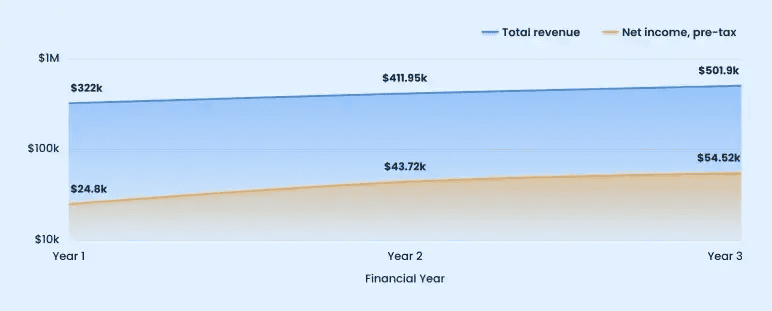
The firm is profitable in Year 1 after paying both partners a combined $160,000 and absorbing $11,700 in one-time launch costs.
Gross margin declines from 82.3% to 76.7% by design: the contractor bench rises from 8% to 10% of revenue, and the coordinator moves toward full-time. That is how the firm grows without the partners billing more hours.
Projected Cash Flow Statement (3 Years)
| Cash flow | Year 1 | Year 2 | Year 3 |
| Beginning cash | $76,700 | $84,091 | $120,193 |
| Operating Activities | |||
| Net income, pre-tax | $24,798 | $43,721 | $54,521 |
| Depreciation, non-cash | $3,100 | $3,100 | $3,100 |
| Change in accounts receivable | ($17,643) | ($4,929) | ($4,930) |
| Change in accounts payable | $2,340 | $1,284 | $1,181 |
| Change in prepaid expenses | $1,200 | $0 | $0 |
| Net cash from operations | $13,795 | $43,176 | $53,872 |
| Investing Activities | |||
| Capital expenditures | $0 | $0 | $0 |
| Net Cash from Investing | $0 | $0 | $0 |
| Financing Activities | |||
| Loan principal repayment | ($6,404) | ($7,074) | ($7,815) |
| Net Cash from Financing | ($6,404) | ($7,074) | ($7,815) |
| Net change in cash | $7,391 | $36,102 | $46,057 |
| Ending cash | $84,091 | $120,193 | $166,250 |
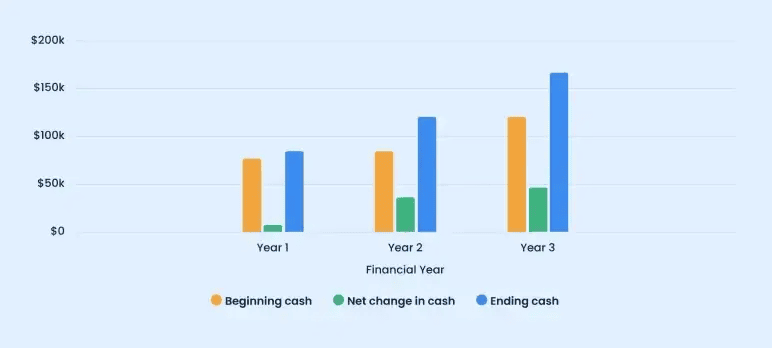
Cash rises every year and never falls below the opening balance. Year-1 operating cash is compressed by a $17,643 receivable build, which is what the working capital reserve exists to absorb.
Projected Balance Sheet (3 Years)
At launch, total assets are $100,000: $76,700 cash, $4,000 prepaid, and $19,300 gross PP&E, funded by the microloan and owners’ capital.
| Item | Year 1 | Year 2 | Year 3 |
| Assets | |||
| Cash | $84,091 | $120,193 | $166,250 |
| Accounts receivable | $17,644 | $22,573 | $27,501 |
| Prepaid expenses | $2,800 | $2,800 | $2,800 |
| Net PP&E | $16,200 | $13,100 | $10,000 |
| Total assets | $120,735 | $158,665 | $206,551 |
| Liabilities | |||
| Accounts payable | $2,340 | $3,624 | $4,805 |
| SBA microloan | $43,596 | $36,522 | $28,707 |
| Total liabilities | $45,937 | $40,146 | $33,512 |
| Equity | |||
| Paid-in capital | $50,000 | $50,000 | $50,000 |
| Retained earnings | $24,798 | $68,519 | $123,040 |
| Owners’ equity | $74,798 | $118,519 | $173,040 |
Break-Even Analysis
| Item | Value |
| Revenue per billable hour | $181.48 |
| Variable cost per billable hour (12%) | $21.78 |
| Contribution margin per hour | $159.70 (88.0%) |
| Annual fixed costs | $311,654 |
| Break-even billable hours per year | 1,952 |
| Break-even billable hours per month | ~163 hours (~19/week per partner) |
| Break-even revenue | $354,152 |
19 billable hours a week per partner sits below the 25-hour cap. That gap is the firm’s margin for a slow quarter, a lost client, or a partner taking three weeks off.
Funding Requirement and Repayment Plan
Cardinal HR Advisors is requesting a $50,000 SBA microloan from PeopleFund, an SBA-designated microlender in Austin. The program lends up to $50,000 for working capital, supplies, furniture, and equipment, matching the uses in this plan.
| Source | Amount | Share |
| SBA microloan (PeopleFund) | $50,000 | 50% |
| Owner equity, two partners at $25,000 each | $50,000 | 50% |
| Total startup capital | $100,000 | 100% |
The loan runs for 6 years at 10.0% fixed: $926.29 a month, $11,116 a year.
Loan Repayment Plan
| Item | Year 1 | Year 2 | Year 3 |
| Interest expense | $4,712 | $4,041 | $3,300 |
| Principal repayment | $6,404 | $7,074 | $7,815 |
| Total debt service | $11,116 | $11,115 | $11,115 |
| EBITDA | $32,610 | $50,862 | $60,921 |
| Debt service coverage ratio | 2.93x | 4.58x | 5.48x |
| Ending loan balance | $43,596 | $36,522 | $28,707 |
Coverage is 2.93x in the first year and improves after, against the 1.25x most lenders look for.
The loan is funding runway, not equipment. $65,000 of the $100,000 raised covers payroll and operating costs in the months when work has been delivered, but Net 20 invoices have not been collected. The business never draws that reserve to zero, and no second financing round is contemplated.
The Quickest Way to turn a Business Idea into a Business Plan
Fill-in-the-blanks and automatic financials make it easy.


Upmetrics
Upmetrics is the #1 business planning software that helps entrepreneurs and business owners create investment-ready business plans using AI. We regularly share business planning insights on our blog. Check out the Upmetrics blog for such interesting reads. Read more